


By using our website, you agree to the use of cookies as described in our Cookie Policy
Blog
What to Know About Refacing Your Cabinets

Deep Dive · Kitchen Remodeling
Cabinet Refacing: What It Is, What It Costs, and What to Watch Out For
By Tim & Pam Toupin · Toupin Construction, Walnut Creek, CA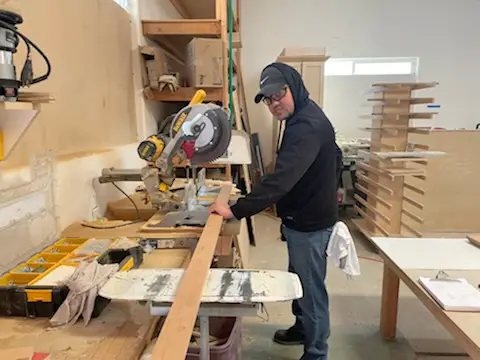
A craftsman cuts wood panels in a workshop, preparing materials for a cabinet refacing project. Precision cutting ensures custom-fit panels that contribute to a high-quality finished product.
We walked into a Rossmoor kitchen a few years back — solid oak boxes from 1984, not a scratch on them structurally, but dated in every way. Dark doors, brass hardware, that laminate strip around the edges that had started to bubble at the corners. The homeowner had gotten quotes for a full cabinet replacement. She was looking at $28,000.
We told her the boxes were fine. We refaced them instead — new shaker doors in white, brushed nickel hardware, solid wood overlays on the frames. The job was done in six days. The kitchen looked brand new. The bill was just over $11,000.
That gap — $17,000, in this case — is why it's worth understanding what refacing actually is, how it works, and what separates a job done right from one that's going to look tired in five years.
What Refacing Actually Means
Refacing is one of those words that gets used loosely — sometimes to mean "we painted the doors," sometimes to mean a complete surface transformation. When we do it, here's what it means:
Your existing cabinet boxes stay put. The boxes — the rectangular frames that are actually mounted to your wall and hold everything up — are almost always the most expensive and most disruptive thing to replace. If those boxes are structurally sound, there's no reason to touch them. Refacing works around them.
Everything you see and touch, though? That gets replaced. New doors. New drawer fronts. New hardware. And the exposed faces of the cabinet frames — the strips of wood visible between and around the doors — get covered with a fresh veneer or a coat of professional-grade paint.
Trade Term Explained
Cabinet box (also called the "carcass"): The structural frame of the cabinet — the sides, top, bottom, and back panel — that is fastened to the wall. This is the skeleton. Cabinet faces (also called "face frames"): The front-facing trim pieces of the box, typically made of solid wood, that form the border around the door opening. These are visible when the door is closed. In a reface, the face frames get covered with new solid wood overlays. Door overlay: How much the door overlaps the face frame. Full overlay doors cover most of the frame. Inset doors sit flush inside the opening. The choice affects the look significantly.
Done right, refacing produces a result that's genuinely indistinguishable from new cabinetry — from the inside of the room, at least. The bones are yours; the whole face of the kitchen is new.
The Process, Step by Step
Here's what actually happens on a professional reface job, from the first day on-site to the final walkthrough.
1
Assessment & Box Inspection
Before anything gets ordered, we open every door and drawer and look hard at the boxes. We're checking for water damage at the base (common under sinks and around dishwashers), warped or delaminated panels, sagging shelves, and whether the boxes are plumb and level. A box that looks fine from the outside can have real problems inside. This step isn't optional.
2
Material Selection
New doors are ordered in your chosen style, wood species, and finish. Lead time is typically 2–4 weeks for custom orders, which is why this step happens long before demo day. At the same time, you'll choose your veneer or paint finish for the face frames, your hardware, and any add-ons — crown molding, under-cabinet lighting strips, soft-close hinges, toe-kick drawers.
3
Door & Drawer Removal
All existing doors, drawer fronts, and hardware come off. The boxes get cleaned thoroughly — decades of cooking grease can build up on surfaces that nobody ever touches, and new veneer won't adhere over it. This is also when any minor box repairs happen: loose joints get glued, soft spots get addressed, shelf pins get replaced if needed.
4
Face Frame Overlay or Paint
This is the step most people don't know about. The visible face frames of the cabinet boxes get covered with ⅜" solid wood veneer strips, cut to fit, glued, and fastened. This gives the frames the same look and feel as the new doors. If you've chosen a painted finish, the frames get primed, sanded, and painted instead — same principle, different execution. Either way, when the doors go back on, every surface you see is new.
5
New Door & Drawer Installation
New doors are hung, shimmed, and adjusted until every gap is even and every door swings true. Drawer fronts get mounted. New hinges and soft-close mechanisms go in. This part takes patience — a good door hang is the difference between a kitchen that looks handcrafted and one that looks like a budget flip.
6
Hardware, Trim & Finishing
Handles and pulls get installed, consistently spaced. Crown molding goes up if you've added it — this alone changes the perceived quality of the whole kitchen. Under-cabinet lighting gets wired. Toe-kick panels get replaced or covered. The end result is a kitchen that looks like somebody spent a lot more money than you did.
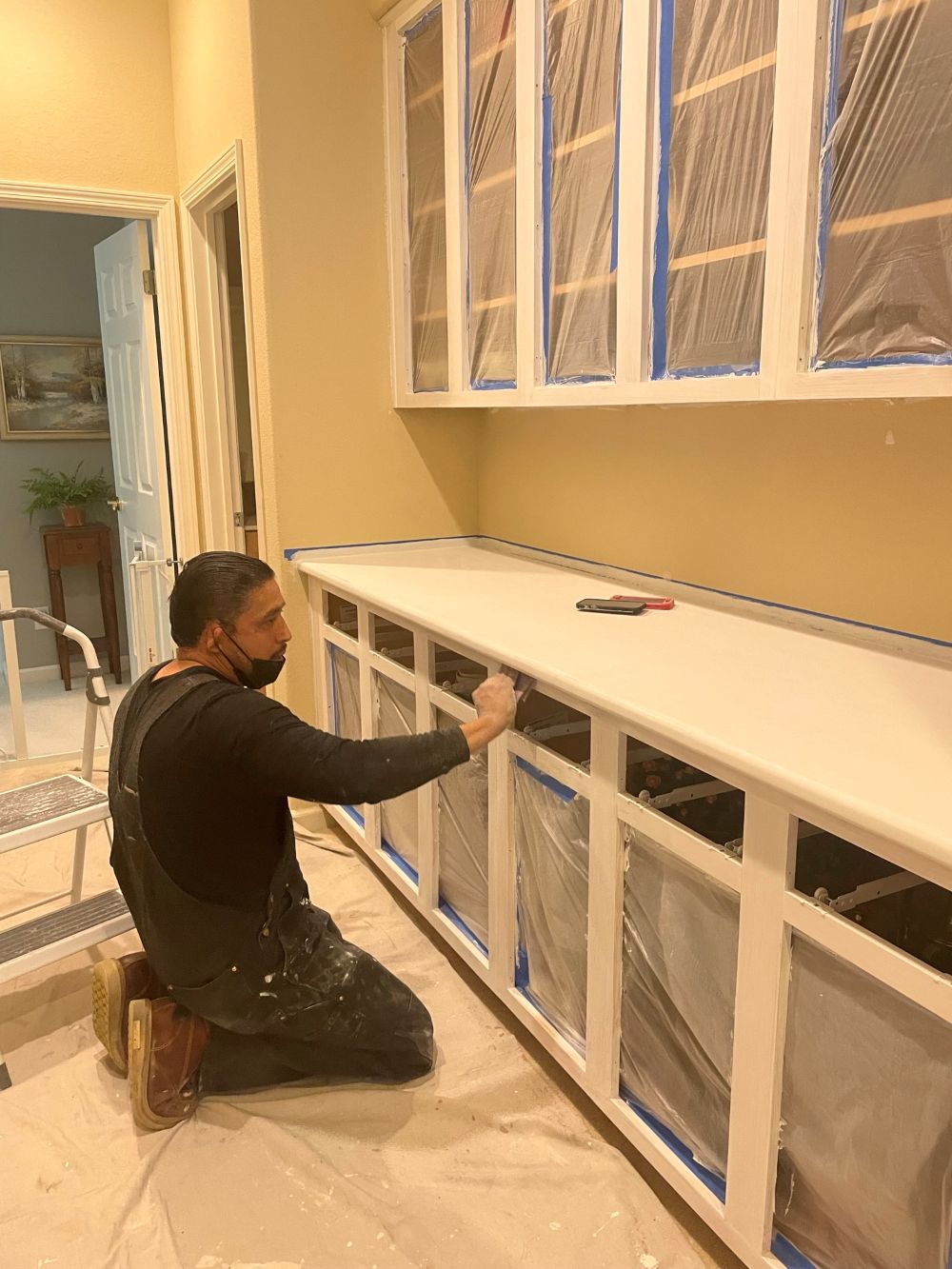
A contractor carefully prepares and sands cabinetry during a cabinet refacing project. Protective coverings and taped edges ensure a clean workspace, highlighting the importance of proper prep work for a smooth, professional finish.
Refacing vs. Refinishing vs. Replacing
These three words get used interchangeably by homeowners, which causes real confusion. They're actually very different things, with very different outcomes.
| Refacing | Full Replacement | Refinishing | |
|---|---|---|---|
| What changes | Doors, drawer fronts, hardware, face frame surfaces | Everything — boxes, doors, frames, all of it | Surface finish only — paint or stain on existing doors |
| Layout change possible? | ✗ Boxes stay where they are | ✓ Full flexibility | ✗ Nothing moves |
| Relative cost | ● Mid — 30–50% less than replacement | ✗ Highest | ✓ Lowest upfront |
| Typical timeline | 5–10 days | 4–8 weeks | 3–7 days |
| Longevity (done right) | ✓ 15–20 years | ✓ 20–30+ years | ● 5–10 years, then repaints |
| Kitchen usable during work? | ✓ Partially — no demo | ✗ Full demo disruption | ✓ Yes, mostly |
| Changes door style? | ✓ Yes — completely new profile | ✓ Yes | ✗ Same doors, new color |
| Best for | Solid boxes, dated look, layout works | Damaged boxes, layout change needed | Good bones, just want a color refresh |
Trade Term Explained
Refinishing: Sanding down and repainting or restaining your existing cabinet doors without replacing them. It's cheaper upfront, but the results depend heavily on prep work and paint quality — and the doors are still the same profile and style they always were. You're changing the color, not the look. Refacing: Replacing the doors entirely while keeping the boxes. This is a structural and aesthetic upgrade. Replacing: Pulling out the whole thing — boxes, doors, everything — and starting over. The right move when the bones are bad or you need a completely different layout.
What Good Refacing Looks Like — and How to Spot Bad Work
Not all refacing is equal. We've been called in to fix refacing jobs done by other contractors, and the problems are almost always the same three things.
Problem One: Cheap Door Material
Budget refacing companies use MDF doors — that's medium-density fiberboard, an engineered wood product — because they're inexpensive and paint easily. There's nothing wrong with MDF in the right application. But in a kitchen, where doors get bumped, steamed, and wiped down regularly, MDF can swell at the edges over time, especially near the sink and dishwasher. We use solid wood or wood veneer doors on our refacing jobs. The price difference is real, but so is the lifespan difference.
Trade Term Explained
MDF (Medium-Density Fiberboard): An engineered wood product made from wood fibers and resin, pressed into dense, smooth panels. Great for paint adhesion and dimensional stability in dry environments. The weakness is moisture — MDF can swell and warp in high-humidity areas. Solid wood: Exactly what it sounds like — cut from actual lumber. More durable, takes stain beautifully, and handles humidity better than MDF. It costs more, but in kitchens and bathrooms, it earns that premium.
Problem Two: Skipping the Face Frame Overlay
Some contractors put brand-new doors on your cabinets and call it a reface — without covering the face frames at all. What you're left with is new doors next to old wood, and the mismatch is immediately obvious up close. The face frame overlay is what makes a reface look cohesive. If your contractor doesn't mention it, ask specifically about it.
Problem Three: Sloppy Door Alignment
Door hanging is a finishing trade. The gaps between doors, between doors and drawer fronts, and at the tops and bottoms of the door openings should be consistent — typically ⅛" all the way around. When they're not, the whole kitchen looks off even if you can't immediately identify why. This is the kind of detail that takes experience to get right and about two seconds to mess up.
"The face of a kitchen is only as good as the prep work behind it. Clean boxes, proper veneer adhesion, even door gaps — that's what separates a job that holds up for twenty years from one that starts looking tired in five."
What Refacing Costs in Walnut Creek and Rossmoor
We don't post flat rates because every kitchen is different — number of doors, door style, material choices, add-ons, and the condition of the existing boxes all move the number. What we can tell you is the general range and what drives costs up or down.
What Affects the Price of a Reface
- Kitchen size: More doors and drawer fronts mean more materials and more labor. A small galley kitchen in a Rossmoor condo has about 15–20 doors. A large open kitchen might have 35–45.
- Door style: A flat-panel Shaker door is simpler to make and costs less. A raised-panel or arched cathedral door costs more. The difference between the cheapest and most expensive door profile can be $40–80 per door — significant across a whole kitchen.
- Material: Solid wood costs more than MDF. Wood species matters too — maple runs cheaper than cherry or walnut.
- Face frame finish: Wood veneer overlay costs more than paint, but in stained-wood kitchens it's the only way to get a seamless look.
- Add-ons: Crown molding, under-cabinet lighting, soft-close hinges, pull-out inserts, new toe-kick panels — each one adds cost but also adds finished quality. Crown molding alone can transform how a kitchen reads in a room.
- Box repairs: If we find water damage or structural issues during the assessment, those need to be addressed before refacing. It's an upcharge, but it's also not optional — refacing over a damaged box just hides the problem.
As a rough orientation: professional refacing typically runs 30–50% less than full replacement on an equivalent kitchen. On a project where replacement might cost $25,000–35,000, a reface with quality materials often comes in at $12,000–18,000. The specifics depend entirely on your kitchen. The honest answer to "what will mine cost?" is: let us look at it.
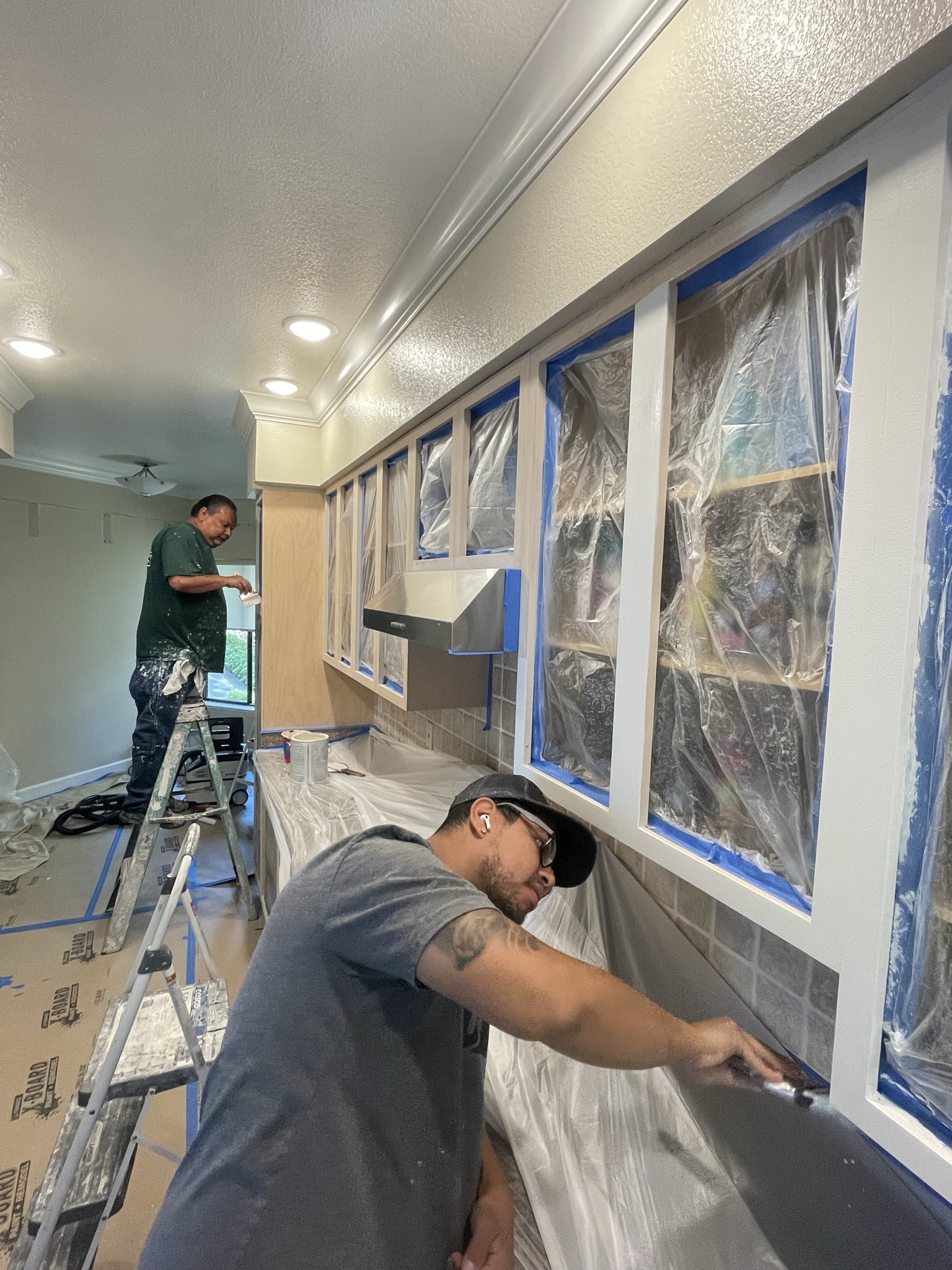
Two professionals work on refinishing kitchen cabinets, using masking tape and plastic coverings to protect surrounding areas. This stage showcases the detailed process involved in transforming outdated cabinetry into a fresh, modern look.
A Few Things Worth Knowing Before You Decide
Refacing is the right call for a lot of kitchens — but not every kitchen. Here's what we tell homeowners before they commit.
Refacing doesn't fix a layout you hate. If your kitchen flow has always felt wrong — not enough counter space, the refrigerator is in a weird spot, you want an island and there isn't one — refacing won't touch any of that. The boxes stay where they are. If your frustration is with the layout, replacement is the conversation to have. We cover that decision in detail in our post on when to reface vs. replace.
The countertops need consideration. When new doors go on, they'll sit right next to your existing countertops. If the countertops are dated, yellowed, or damaged, the contrast can make the cabinets look better and the counters look worse. A lot of our clients reface cabinets and replace countertops at the same time — both projects together still usually cost less than a full cabinet replacement alone.
No permit required in most cases. Because you're not moving plumbing, electrical, or walls, a standard reface doesn't require a building permit. That saves time and money. If you're doing a Rossmoor condo, you may still need Mutual approval for the scope of work — check with your association first.
The kitchen stays mostly functional. Unlike a full remodel where your kitchen is essentially out of commission, a reface job allows partial use throughout. You'll have some disruption — doors off, dust, the crew in your space — but the sink and appliances stay connected and accessible.
Thinking About Refacing Your Cabinets?
We'll take an honest look at your boxes, tell you what we find, and give you a real number — no pressure, no pitch.
Get a Free Quote Call Us: 925-937-4200
Toupin Construction
Ready to start your remodel?
Whether you're dreaming of a new kitchen, a spa-worthy bathroom, or a whole-home transformation — we’d love to hear about your project. Reach out and let's talk.
‹ Back
Comments