

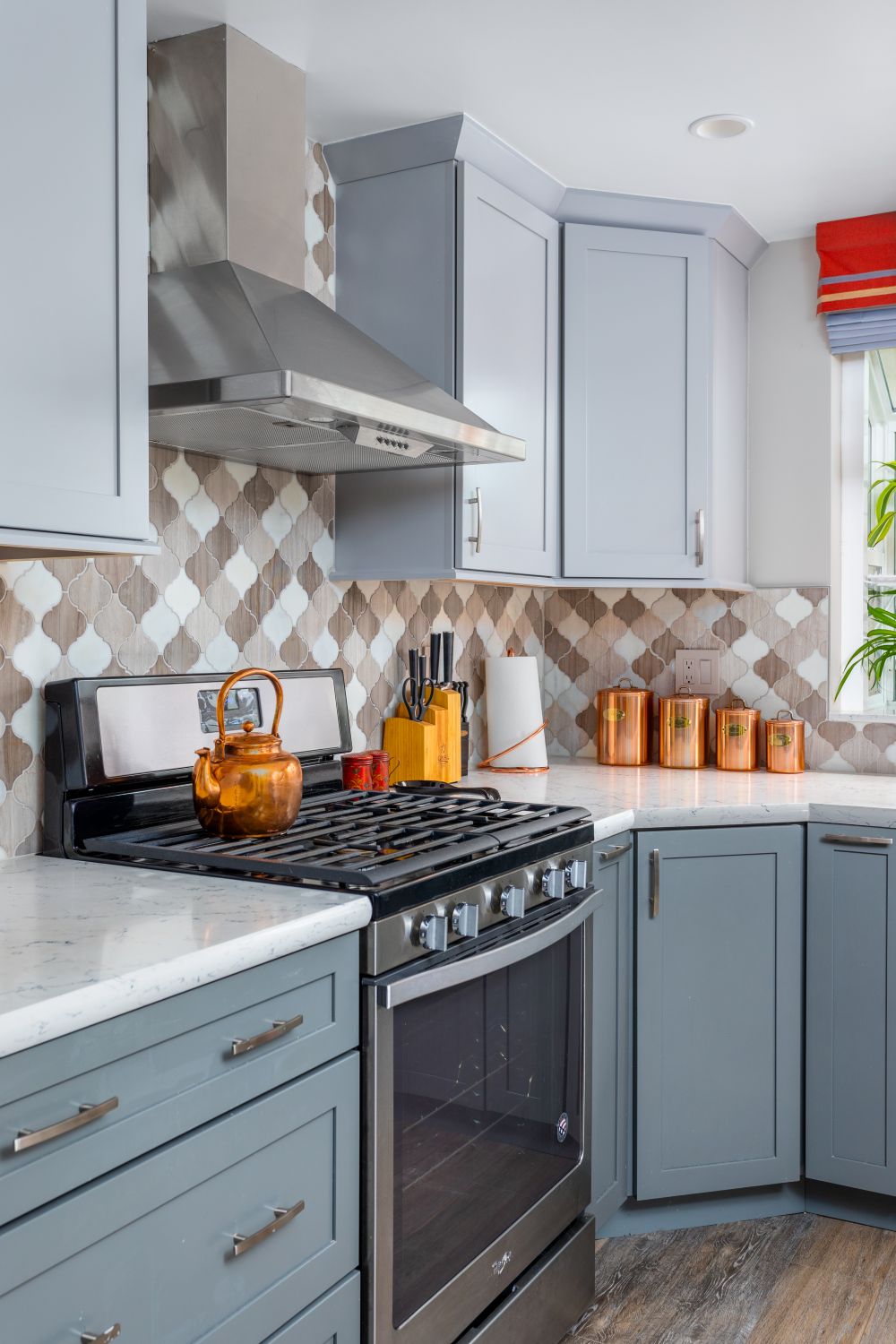
Kitchen with blue-gray shaker cabinets, quartz countertops, stainless steel range hood, and decorative patterned tile backsplash with warm metallic accents.
A client called us last spring, embarrassed. She'd just had a contractor over who told her she needed a full kitchen remodel — $60,000 minimum — just to feel better about her house. She wasn't sure. She wanted a second opinion.
We walked through and told her the truth: she needed paint, a new faucet, and lighting that didn't make her kitchen look like a hospital. Total cost? Under $800. She did it herself over a long weekend. I've thought about that conversation a lot since then, because it's a good reminder that impact and investment don't always move together.
These are the 10 updates we see make the biggest difference — in real homes, in Walnut Creek and Rossmoor and Lafayette — when the budget is tight but the itch to do something is real.
This is the single highest-ROI move in a kitchen or bathroom — full stop. New cabinets can run $10,000–$25,000+ in the East Bay. A careful repaint with the right prep work and a quality enamel paint can get you 80% of the way there for a fraction of the cost.
Key word: prep. The paint is maybe $80. The time spent degreasing, sanding, and priming is where people rush and regret it. Do it right and it lasts. Shortcut it and you're peeling in two years.
Neutrals like Accessible Beige or Repose Gray are safe. Navy and forest green are having a serious moment right now. If you've always wanted a color, this is your low-stakes chance to try it.
→ Read: What to Know About Refacing Your CabinetsLighting is the most underrated thing in a home. It controls how you feel in a room, how the colors read, how big or small the space seems. And outdated fixtures are one of the quickest ways to make a beautiful renovation look tired.
Brass boob lights from 1987? Gone. Recessed cans with no character? At minimum, change the trim rings and bulb color temperature. (Warm white — 2700K–3000K — almost always wins over the harsh daylight bulbs that make your kitchen look like a CVS.)
Color temperature is measured in Kelvin (K) and describes how warm or cool a lightbulb looks. Lower numbers (2700K) are warm and golden — think candlelight. Higher numbers (5000K+) are cool and bright — think fluorescent office. For kitchens and bathrooms, 2700K–3000K almost always looks best.
Facebook Marketplace and local salvage shops like Ohmega Salvage in Berkeley are great for interesting fixtures at a fraction of retail. Just make sure any vintage fixture gets inspected before you hang it.
A kitchen backsplash is genuinely one of those things that punches way above its weight. It frames the whole cooking zone and gives a room a focal point. Dated tile — we're looking at you, beige 4x4 — can drag everything else down even if the rest of the kitchen is fine.
If you're a renter or not ready to commit, peel-and-stick tile sheets have gotten surprisingly good. They won't fool a contractor, but they'll photograph beautifully and hold up reasonably well with careful installation. For homeowners doing a proper upgrade, subway tile with a well-grouted joint is classic for a reason — it reads clean, works with almost any cabinet color, and you can get it at Bedrosians in Concord for very reasonable prices.
→ Read: Exploring the Beauty of Backsplash Heights"Impact and investment don't always move together. Sometimes a $200 weekend does what a $20,000 renovation couldn't."
Your front door is your home's handshake. Scratched brass hardware from 2002 says something — and not something good. A new handle set with a deadbolt takes less than an hour to swap, costs about $150–$250 for a solid option, and immediately makes the whole entry feel intentional.
In Rossmoor, where the exterior of condos is often governed by the Mutual's design guidelines, this is one of the few things you can change without board approval. Take advantage. A matte black or satin nickel handle set looks like a completely different house.
→ Read: Front Doors: Fiberglass or Wood?Floating shelves — shelves that appear to hover on the wall with no visible brackets — are one of those things that work in almost any room. Kitchen, bathroom, bedroom, entryway. They add storage, they create display space, and they make walls feel intentional rather than empty.
In kitchens, replacing upper cabinets on one wall with open floating shelves is a popular move right now — it opens the room up visually and forces you to be a little more curated about what's on display. (Fair warning: it also means your cabinet contents are always on show. If your mugs are a chaotic mishmash of stadium freebies, consider that before you demo those doors.)
This is one of those updates where the old fixture was probably just fine — it worked, it delivered water — but it made the whole room look tired. A new faucet in a cohesive finish (matte black, brushed gold, or polished chrome are all strong right now) reads as a design decision, not just a replacement.
For showerheads: a rainfall showerhead is a wider, flat showerhead mounted overhead that delivers water more like rain falling from above than a standard pressurized stream. They feel more relaxing, look more intentional, and start at around $60 at any big-box store. Pair it with a handheld option on a slide bar and you've got a genuinely upgraded shower experience for under $200.
→ Read: How to Choose the Right Shower Head for YouThis is the quietest update on this list and arguably one of the most satisfying. Fresh, crisp white on your baseboards, door casings, and window trim makes a room feel clean in a way that's hard to explain until you've done it. It's the difference between "nice room" and "well-maintained home."
Use a semi-gloss paint for trim — it's more washable and reflects light better than flat. Take your time with the tape and prep work. The brush strokes and sloppy edges are exactly what you're trying to avoid here. Slow is fast.
Walk through your house right now and look at your door knobs. Old brass? Wobbly? A different finish from the hinges? Yeah. This one drives contractors crazy because it's so easy to fix and so many people live with mismatched hardware for years.
Pick a finish and commit to it throughout the house. Matte black has been a strong choice for a few years and doesn't show fingerprints. Satin nickel is a reliable neutral. Brushed gold adds warmth without going over the top. Whatever you choose, keep it consistent — that coherence is what makes a house feel designed rather than assembled.
An accent wall — one wall in a room painted a different (usually bolder) color from the rest — is the oldest trick in the interior design book, and it works because it gives a room a clear focal point. You're not committing to painting the whole house. You're making one decisive statement.
The most common mistake: choosing the wrong wall. You want the wall you naturally look at when you enter the room — behind the bed, behind the sofa, the one visible from the doorway. That's your accent wall. Not the one with the most windows (you'll lose the effect) and not a wall that's already busy with built-ins or a fireplace.
→ Read: How to Overcome Paint ParalysisWindow treatments — curtains, shades, blinds, shutters — are one of those things that seem minor until you actually change them, and then suddenly everything else looks better. Cheap mini-blinds flattened from years of being yanked up and down read as neglect, even when everything else in a room is nice.
Clean white roller shades are a safe, inexpensive place to start. Linen drapery panels add texture and warmth. In Rossmoor specifically, plantation shutters have been popular for decades because they work with the era of the homes, look polished, and hold up in our East Bay climate without warping the way wood blinds sometimes do.
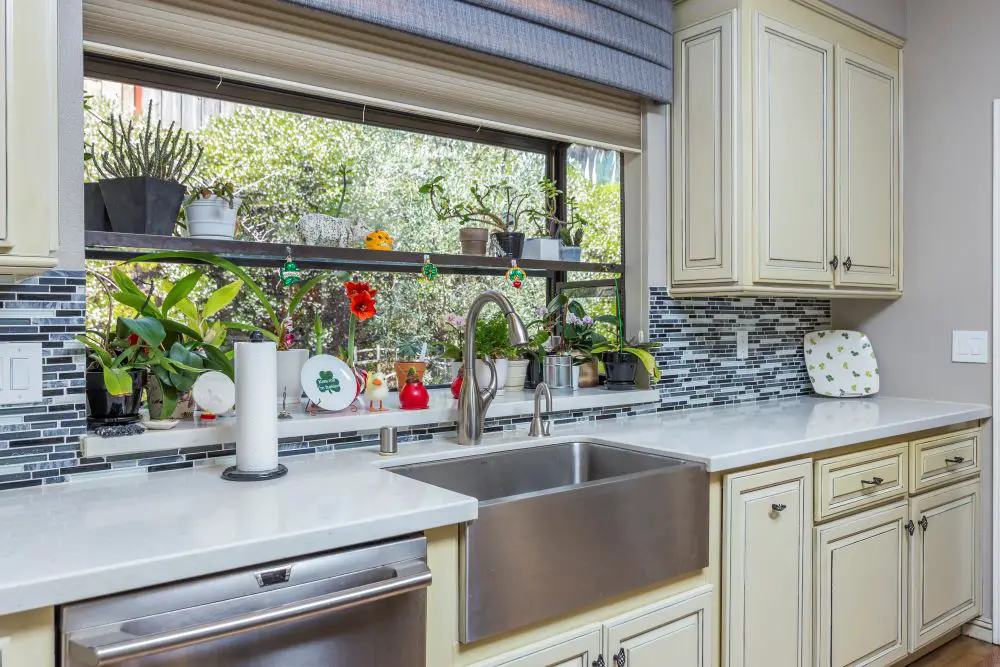 kitchen featuring a farmhouse apron-front sink, quartz countertops, mosaic tile backsplash, and a large window with greenery and potted plants.
If You're Tackling Multiple Projects — Do It In This Order
- Lighting — sets the mood for everything else
- Cabinet paint — highest visible impact in the kitchen
- Backsplash — adds a design focal point
- Door and cabinet hardware — cohesion throughout
- Trim and baseboards — makes everything feel finished
- Window treatments — light control and polish
- Accent wall — personality and depth
- Floating shelves — function and display
- Faucets and showerheads — bathroom refresh
- Front door hardware — curb appeal punctuation mark
One More Thing
These updates are genuinely good on their own. But I also want to be honest about what they are: they're the prelude, not the symphony. If your kitchen layout doesn't work, painting the cabinets won't fix the flow. If your bathroom shower is cramped and the tile is cracking, a new showerhead won't change the experience of being in there.
Small updates buy you time, add value, and scratch the itch to do something. They're smart. But when you're ready to actually transform a space — when you want a kitchen that feels like yours, or a bathroom that doesn't feel like an afterthought — that's when you call us. We've been doing this for over 40 years in the East Bay, and we love figuring out what a home can become.
FAQs
Lighting, almost without exception. Change the bulb color temperature to warm white (2700K–3000K) throughout the house and upgrade one fixture — like the one over your kitchen sink or the entry pendant. You'll be surprised how much the room changes.
Peel-and-stick tile and wallpaper have improved significantly. For renters or homeowners who want to try something before committing, they're a reasonable option — just follow the installation instructions carefully, especially the wall prep. They're not forever, but they're not a mistake either.
Interior updates like paint, fixtures, hardware, shelving, and window treatments are generally yours to do as you please. The Mutual's oversight typically applies to exterior changes, structural work, plumbing inside walls, and anything that affects shared systems. When in doubt, check with your Mutual before starting — it's always faster to ask than to undo.
Any time you're opening walls, moving plumbing, rewiring circuits, or making structural changes. Also: when the scope of what you want is larger than what any of these updates can deliver. We're happy to talk through your situation — no obligation, no pitch. Just an honest conversation.
Ready for the Next Level?
Small updates are smart. But when you're ready to actually transform a space, we'd love to talk through what your home could become. We've been doing this in Walnut Creek and the East Bay for over 40 years.
Call 925-937-4200Toupin Construction · CA Lic #626819 · Walnut Creek, CA


Comments