

By using our website, you agree to the use of cookies as described in our Cookie Policy
Blog
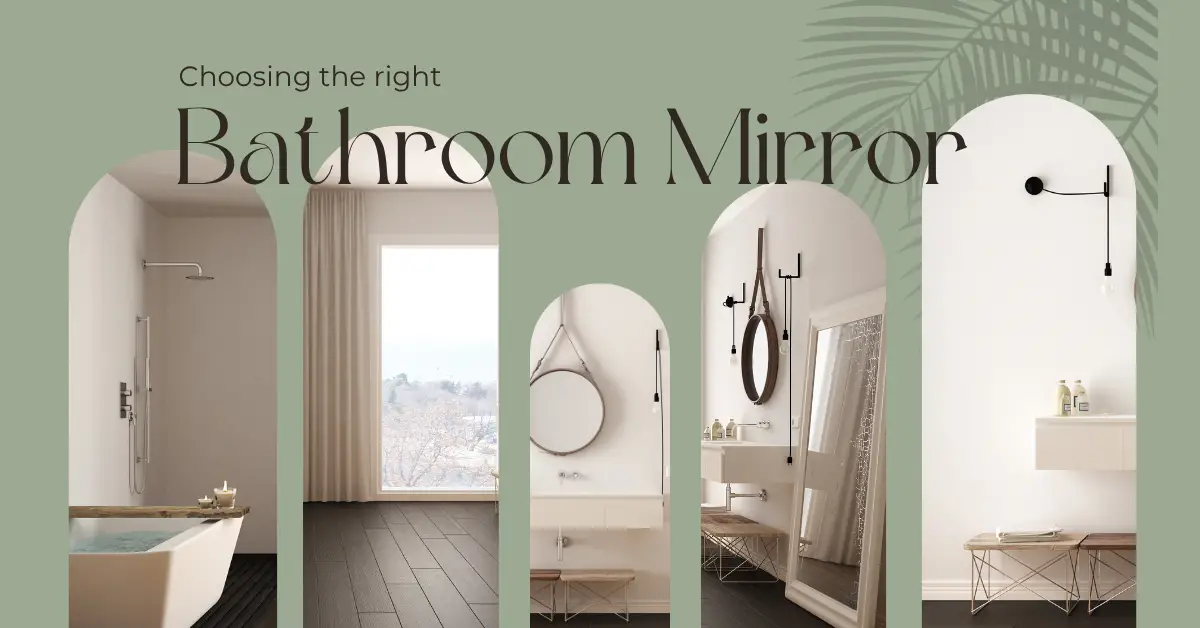
How to Choose the Right Bathroom Vanity Mirror
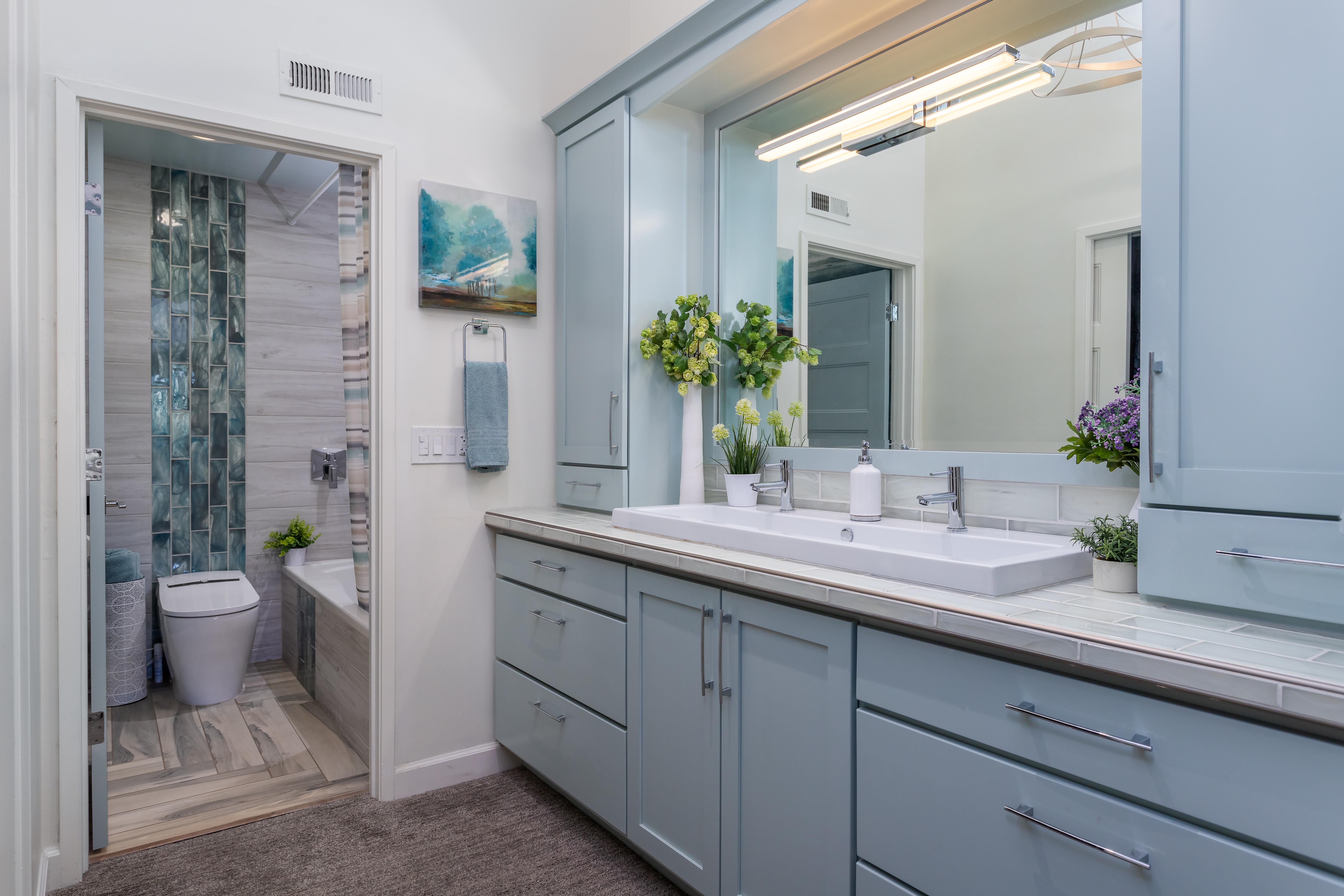
A bright, modern bathroom featuring a large wall mirror above a soft blue vanity with sleek hardware. The expansive mirror enhances light and creates a clean, airy feel, while coordinating finishes and subtle décor complete the contemporary look.
The mirror is almost always the last decision in a bathroom remodel. By the time we're talking about it, the tile is set, the vanity is ordered, and the client is running on three months of living without a functional bathroom. So when I ask "what are you thinking for the mirror?" I usually get a look that says: I have thought about nothing else for weeks and I'm still not sure.
It's a surprisingly hard call. The mirror anchors the whole vanity wall. Get it right and the room feels finished. Get it wrong — size, shape, frame style — and it's one of those things you notice every single morning and quietly resent.
After years of helping homeowners land on the right choice, here's what I actually walk people through.
Start With Function, Then Layer In Style
The most beautiful mirror in the world doesn't work if it's hung at the wrong height, doesn't give you even light to work in, or competes with your vanity instead of completing it.
Before you fall in love with a shape or finish on Pinterest, answer these first: Who uses this bathroom, and how tall are they? Where is your light source — above the mirror, beside it, or built into it? And how much wall space do you actually have between the top of the vanity and whatever is above it (medicine cabinet, soffit, window)?
Those three questions will eliminate half your options immediately, which is actually a relief.
Getting the Size Right
This is where most people go wrong, and it's usually in one direction: too small. A mirror that's noticeably narrower than the vanity looks like an afterthought. One that's wider than the vanity — especially in a small bathroom — starts to feel like a fun house wall.
The general rule we use: the mirror should be 2–4 inches narrower than the vanity on each side, or match the vanity width exactly if you want a more graphic, intentional look. Both work. What doesn't work is a 24-inch mirror over a 60-inch double vanity.
| Vanity Width | Single Mirror Range | Double Mirror Option |
|---|---|---|
| 24–30 inches | 20–28 inches wide | N/A — single mirror is the right call |
| 36–48 inches | 30–44 inches wide | Two 18–22" mirrors work here |
| 60–72 inches | 54–68 inches wide | Two 24–30" mirrors centered over each sink |
For height: mount the bottom of the mirror roughly 5–10 inches above the backsplash. The top should clear the ceiling or soffit by at least 4 inches. If you have tall family members and shorter ones using the same mirror, a taller mirror — rather than a higher-mounted one — is usually the answer.
"A mirror that's noticeably narrower than the vanity looks like an afterthought. We see it go wrong in that direction more often than the other."
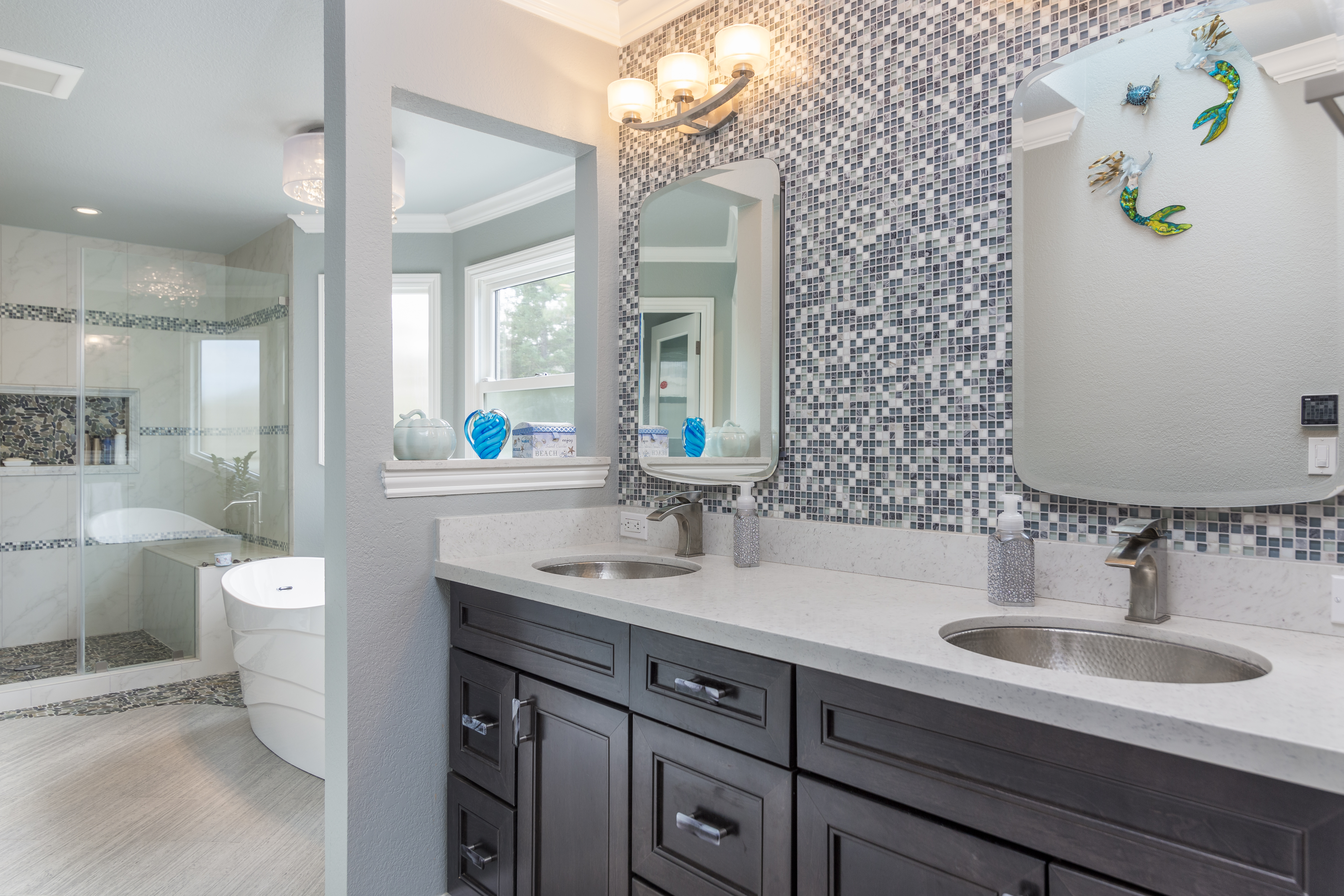
A stylish bathroom showcasing dual mirrors paired with a mosaic tile backsplash and dark cabinetry. The combination of textures and reflective surfaces adds depth and visual interest, perfect for a modern shared vanity space.
Framed vs. Frameless: The Style Decision That Matters Most
This isn't about one being better than the other. It's about what your bathroom is already saying — and whether you want the mirror to speak the same language or provide contrast.
Frameless
- Reads clean and contemporary
- Easy to wipe down — no frame edge collecting grime
- Works well when the vanity or tile is already making a statement
- Usually the right call in modern or minimalist bathrooms
- Can feel flat if the rest of the room is also understated
Framed
- Adds warmth, weight, and visual definition to the vanity wall
- Wood frames: spa-like, natural, calm
- Brass or bronze frames: warm and a little glamorous
- Matte black: graphic, timeless, hides smudges well
- Ties the mirror to hardware and fixtures when finishes coordinate
On mixing metals: yes, you can mix — but do it with a plan. Pick one dominant finish (let's say brushed nickel) and one accent (matte black). Don't introduce a third. We see three-metal bathrooms fairly often in older East Bay homes where fixtures have been swapped out over the years, and it's a harder look to pull together than it sounds.
Shape: The Easiest Way to Change the Whole Feeling of the Room
Shape is underused as a design tool in bathrooms because people play it safe. Rectangle is the default — and there's nothing wrong with it — but if your vanity is already rectangular, a rectangular mirror above it doubles down on an angular room. Sometimes that's exactly right. Sometimes a round or arched mirror is the breath of air the space needs.
Rectangular
Classic, versatile, and works with almost every vanity style. The safe choice — which also means it's reliably good.
Round
Softens a boxy room. Particularly effective over a single-sink vanity where the round shape doesn't feel undersized.
Oval
More elongated than round, with a slightly traditional feel. Works beautifully in transitional or coastal-influenced bathrooms.
Arched
Has stayed strong through several trend cycles. Adds architectural detail without requiring any actual architectural change.
The contrast principle is worth remembering: if your vanity is boxy and angular, a round or arched mirror creates visual interest. If your vanity has curved legs or decorative detail, a clean rectangle balances it. Design gets more interesting when not everything matches.
Backlit Mirrors, Medicine Cabinets, and Combo Units
This is where the functional side of mirror selection gets more interesting — and where the decisions you make early in a remodel (specifically, where you roughed in your electrical) either open up your options or close them down.
Trade term, explained
Rough-in — the stage of construction where electrical wiring, plumbing pipes, and blocking are installed inside the walls before drywall goes up. If you want a backlit mirror or a medicine cabinet with a built-in outlet, the rough-in is when we plan for it. Trying to add it after the walls are closed is possible but significantly more work and cost.
Backlit Mirrors
A backlit mirror has LED lighting built into the back or edge of the mirror itself, casting an even glow around your face instead of throwing a shadow from above. If you've ever applied makeup in a bathroom with a single overhead light and wondered why you looked fine at home and different everywhere else — this is the fix.
They require an outlet or hardwired connection behind the mirror. If your remodel is already opening the walls, adding that circuit is straightforward. If you're just swapping mirrors, it depends on what's already there.
Medicine Cabinets
A recessed medicine cabinet sits flush with the wall — meaning the cabinet box lives inside the wall cavity rather than projecting out from it. The result is a mirror that looks like a mirror, with hidden storage behind it. In smaller bathrooms, especially in Rossmoor units where every inch counts, a recessed medicine cabinet is often the smartest use of that wall.
Trade term, explained
Recessed — installed so that the unit sits inside the wall rather than mounting on the surface. A recessed medicine cabinet, for example, keeps the face of the cabinet flush (or nearly flush) with the drywall, so it doesn't protrude into the room. Surface-mounted cabinets project out from the wall, which can work fine but does reduce clearance in tight spaces.
Combo Units
Yes, these exist — mirrors with built-in LED lighting, defoggers, dimmer controls, and integrated storage, all in one unit. We've installed them with touch-activated dimmers and built-in night lights. Are they necessary? No. Do clients who get them stop talking about how much they love them? Also no.
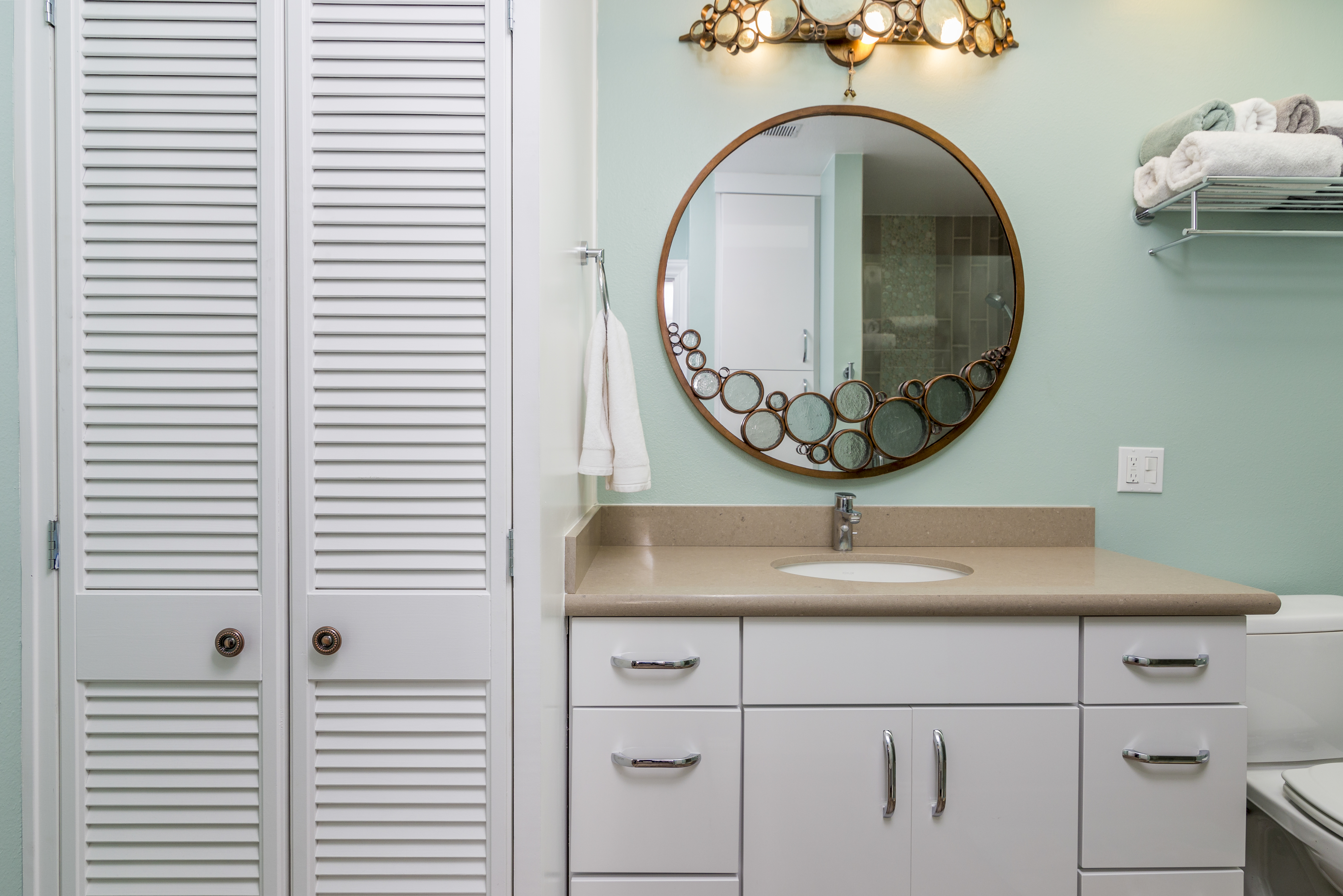
A minimalist bathroom design featuring a round mirror mounted on a soft green wall above a clean white vanity. The simple shape and calming color palette create a serene, contemporary aesthetic.
The Mistakes We See Most Often
None of these are design crimes. They're all fixable. But they're also avoidable if you know to watch for them.
Common missteps
- Mirror hung too high. The center of the mirror should land around 60–65 inches from the floor — eye level for most adults. We see mirrors hung at 72" and above more often than you'd think, especially in older homes where someone guessed.
- Mirror too small for the vanity. Already covered in sizing, but worth repeating: a mirror that's clearly narrower than the vanity will bother you every morning. When in doubt, go wider.
- Lighting planned without the mirror in mind. If you're adding sconces, their placement should be coordinated with the mirror's width and height before the electrician marks the wall. Moving them after is an extra call we'd rather you not have to make.
- Frame finish that fights with the hardware. Your mirror frame doesn't have to match your faucet exactly — but they should at minimum be having the same conversation. A warm antique brass mirror against a cold polished chrome faucet is a conversation going nowhere.
- Skipping the template step. Before you order, cut a piece of kraft paper or cardboard to your planned mirror size and tape it to the wall. Live with it for a day. This costs nothing and saves the cost of returning a mirror you only disliked once it was actually up.
Questions We Hear Most
One large mirror or two over a double vanity?
Both are valid and it comes down to preference. One large mirror feels seamless and often reads more contemporary. Two individual mirrors — each centered over a sink — feel more custom and allow each person to have "their" mirror. If you go with two, make sure they're the same size and mounted at exactly the same height. Even a half-inch difference is noticeable.
Do I need to match my mirror frame to my faucet finish?
Not exactly, but you should coordinate them intentionally. Mixing metals is fine — many designers encourage it — but there should be a logic to it. Pick a dominant finish and a supporting accent. If you can't articulate why you're mixing two finishes, that's a signal to simplify.
What if I don't have room for a recessed medicine cabinet?
It depends on what's inside that wall. In most stud-framed walls, there's enough cavity depth for a standard recessed cabinet. In some Rossmoor co-op units, the walls are thinner or have more going on inside them — we check before we commit to anything recessed. Surface-mounted cabinets are a real option and don't have to look clunky if the proportions are right.
Are backlit mirrors hard to install?
Not if the electrical is already roughed in correctly. If you're mid-remodel and the walls are open, adding a circuit is a relatively minor addition. If you're just swapping mirrors in a finished bathroom, it depends on what's behind the wall and where the nearest outlet or switch is. We can assess that during a walk-through.
What's the best mirror for a small bathroom?
In tight bathrooms — which we see often in Rossmoor and in older East Bay homes — a recessed medicine cabinet is usually the most practical choice because it gives you storage without taking up any floor or counter space. If storage isn't the priority, a frameless mirror with minimal visual weight keeps the room feeling open. Avoid heavy ornate frames in small spaces; they tend to close the room down.
Not Sure What's Right for Your Bathroom?
We've been helping East Bay homeowners navigate these decisions — mirrors, vanities, lighting, tile, all of it — for over 40 years. Give us a call and we'll talk it through. No pressure, just honest advice.
925-937-4200Toupin Construction · CA Lic #626819
Toupin Construction
Ready to start your remodel?
Whether you're dreaming of a new kitchen, a spa-worthy bathroom, or a whole-home transformation — we’d love to hear about your project. Reach out and let's talk.
‹ Back
Comments