

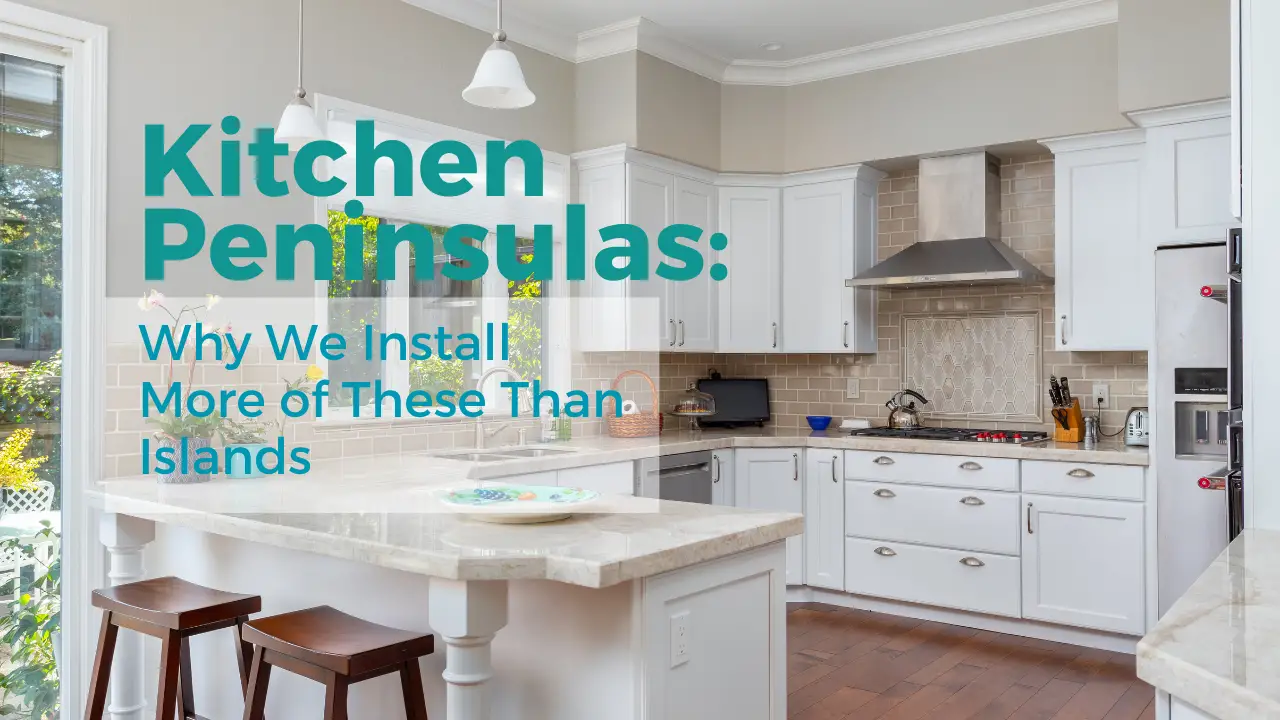
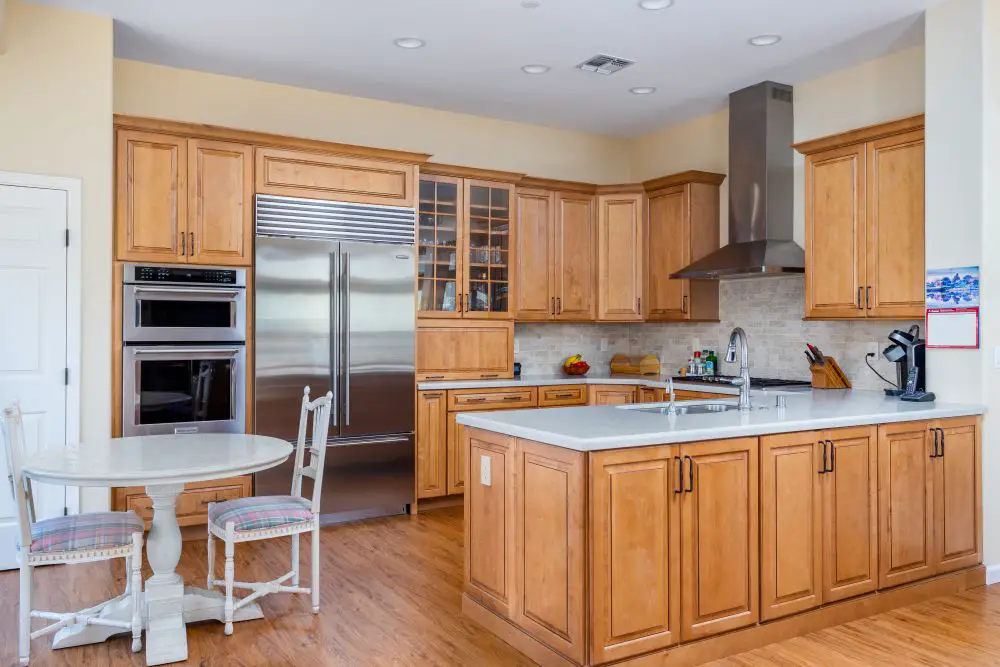
Bright Walnut Creek kitchen featuring light maple-style cabinets, white quartz countertops, stainless steel appliances, and a functional island layout with built-in storage and seating.
We were demoing a kitchen in a Rossmoor Golden Gate model a few years back — Pam was on-site coordinating materials, Tim was knee-deep in the layout — and the homeowner said something I've never forgotten: "I wanted an island, but everyone kept telling me this unit is too small for one. Is that true?"Tim looked at the space for about ten seconds and said, "You don't need an island. You need a peninsula. And honestly? It'll work better." She got her peninsula, her three bar stools, her waterfall countertop, and she sends us a Christmas card every year.Islands get all the press. They show up in every magazine spread and every renovation show. But in real East Bay kitchens — the ones people actually cook in, eat breakfast in, do homework in — peninsulas quietly outperform them more often than not. Here's why we install so many of them, and how to know if one is right for your kitchen.
What Is a Kitchen Peninsula, Exactly?
A peninsula is a countertop and cabinet structure that connects to your existing cabinetry on one end. It extends out into the room, creating an "L" or "U" shape — like an island, but anchored. One side is your kitchen workspace; the other faces your living or dining area and becomes seating, serving, or a visual divider.
An island is freestanding — four finished sides, plumbing and electrical running through the floor, clear walkway space all the way around. A peninsula connects on one end to existing cabinetry or a wall, so it only needs three finished sides, shares the cabinet run, and doesn't need independent utility connections. That's where the cost savings come from.
Think of it as a bridge between the kitchen and the rest of your home. The cooking happens on one side; the conversation happens on the other. And unlike a wall or a half-wall, a peninsula keeps the space open and connected.
Peninsula vs. Island: An Honest Comparison
Islands are great — when the space can actually support one. The problem is, a lot of kitchens that say they want an island really just want more workspace and seating. A peninsula delivers both, without the footprint requirements.
| Peninsula | Island | |
|---|---|---|
| Minimum kitchen size | Works in smaller spaces | Needs more room to breathe |
| Cost | 15–25% less on average | Higher — more finished sides, separate utilities |
| Storage | Integrates with existing cabinet run | Must build storage into island structure separately |
| Electrical/plumbing | Can tap existing cabinetry run | Requires dedicated floor penetration |
| Seating | One side (very functional) | Multiple sides (great for large families) |
| Rossmoor/condo suitability | Excellent | Often too large; permit complications |
| Visual impact | Strong with right finishes | Strong — more presence in the room |
The honest answer: if your kitchen can support an island — enough clearance on all sides, enough square footage, budget for the utility work — an island is wonderful. But in most East Bay homes we work in, a peninsula does the job better and costs less to get there.
"The homeowners who ask for an island and end up with a peninsula almost always love it more than they expected. Once it's in and the pendants are hung, they can't imagine the kitchen without it."— Tim Toupin, Toupin Construction
Design Upgrades That Make a Peninsula Shine
The basic structure is the starting point. What makes a peninsula truly memorable is how you finish it. Here are the upgrades we recommend most often.
Waterfall Countertop
A waterfall edge extends the countertop material down both sides of the peninsula to the floor — a continuous slab wrapping the structure. It's sculptural, modern, and it protects cabinet corners from the usual wear. I have this in my own kitchen and it hasn't gotten old yet. The key is working with a fabricator who does tight mitered joints — if the seam isn't clean, it looks cheap fast.
A waterfall edge is when the countertop material continues vertically down the side(s) of the cabinet. The two pieces of stone meet at a miter joint — a 45-degree cut on each piece that creates a seamless corner. The quality of that joint is what separates a waterfall that looks like a showroom and one that looks like an afterthought.
Two-Tone Cabinetry
Your upper cabinets don't have to match your peninsula. In fact, contrast is often the better design move. White or light-toned uppers with a navy, charcoal, sage, or warm black peninsula gives the kitchen visual depth and makes the peninsula feel intentional — like a piece of furniture rather than an extension of the wall.
Pendant Lighting
Two or three pendants hung over the peninsula define the zone and frame the seating area. Mount them 30–36 inches above the counter surface. You want light that hits the work surface without hitting anyone in the head on their way to the sink. Wire for this before drywall — adding it after is always more expensive than doing it during.
Built-In Storage on the Open End
The end panel of a peninsula is prime real estate. Use it. Deep drawers, a pull-out trash, open shelving for cookbooks — anything that puts that panel to work instead of just capping the run. We often build in a microwave drawer at the end, which frees up counter space and gets the microwave off the appliance shelf.
Open Shelving on the Seating Side
Rather than boxing in the lower face of the peninsula with solid cabinet doors, consider floating shelves on the seating side. It reads as lighter and more open — good for small kitchens — and gives you a natural display spot for things you actually want to look at. Just be honest with yourself about whether you'll keep it looking good. Open shelving forgives nothing.
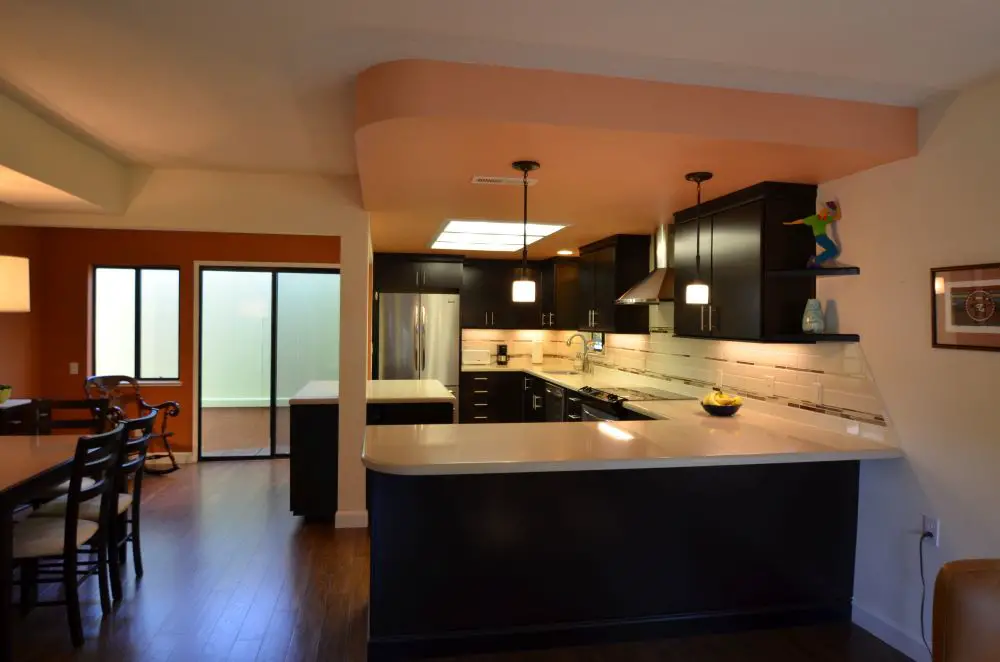
Modern East Bay kitchen remodel with black flat-panel cabinets, warm ambient lighting, open-concept layout, and peninsula seating connecting to the dining area.
The Measurements That Actually Matter
Peninsula design fails when the measurements aren't thought through. Here's what we plan around on every install:
The working clearance — that 36–42 inches on the kitchen-facing side — is the one people skip at their peril. If two people need to pass each other while one is cooking, 36 inches is the minimum. If you cook with a partner and both of you open doors and pull drawers at the same time, you want 42. We've been in kitchens where this wasn't thought through. It shows.
Two Peninsula Installs You Can See in Our Portfolio
Golden Gate Model
The clients wanted an island but the layout couldn't support one. We removed a non-structural partial wall and installed a peninsula that added five linear feet of counter, seating for two, and deep drawer storage. Quartz waterfall edge, pendant lighting, two-tone cabinetry. This is the one that gets Christmas cards.
Sonoma Model
A galley kitchen that felt tight and disconnected from the living area. The peninsula opened it up visually and created a breakfast bar. Because it's Rossmoor, we coordinated with the Mutual board and the City of Walnut Creek for the dual permit process — which we handle on behalf of our clients every time.
What Does a Peninsula Actually Cost in the East Bay?
Material and finish choices drive the number more than anything else. Here's an honest range for our market:
| Category | Typical Range (East Bay) | Notes |
|---|---|---|
| Cabinetry + framing | $1,500 – $4,000 | Often shares existing run; new base units added as needed |
| Countertop fabrication | $2,000 – $5,000 | Quartz runs lower; marble or quartzite runs higher |
| Electrical + pendant wiring | $500 – $1,200 | Plan this during framing — retrofit costs more |
| Flooring adjustments | $300 – $800 | Patching or refinishing where the old wall/cabinet was |
| Labor + finish work | $1,000 – $2,500 | Depends on complexity of end panel, lighting, and edges |
| Total Project Range | $5,300 – $13,500 | Most land $7K–$10K depending on countertop choice |
Is a Peninsula Right for Your Kitchen?
Good Fit
- Your kitchen is too small for an island but needs more workspace
- You want seating without a formal dining area
- You have an open layout that needs a soft visual divide
- You want built-in storage along an existing cabinet run
- You're working with a tight budget and want the most for your money
- You're in a Rossmoor condo or a smaller East Bay kitchen
Think Twice
- Your kitchen has multiple doorways on each wall — a peninsula may block traffic
- You genuinely need 360° access and seating on all sides
- Your kitchen is very wide and open — an island may look more proportional
- You're planning a cooktop in the center — that's island territory
How We Plan a Peninsula Install: 5 Steps
- Measure Your SpaceConfirm clearances on the working side and the seating side before anything else. If you don't have 36" minimum clearance on the kitchen-facing side, a peninsula will hurt more than it helps.
- Decide the Primary FunctionSeating? Prep space? Storage? The function should drive the depth, overhang, and end panel design. Don't try to do everything — decide what matters most.
- Plan Power and Lighting FirstOutlets for small appliances and pendant wiring need to happen in the framing phase. Adding them after drywall is always more expensive than doing it right the first time.
- Select Your FinishesCountertop material, cabinetry color, hardware, edge profile. Coordinate these choices before the cabinets are ordered — changes in the middle of a job cost time and money.
- Permits and TimelineIf the peninsula involves removing or altering a wall, that's a permitted structural change. In Rossmoor, add Mutual board review on top of the City permit. We handle both — but plan for 4–6 weeks of lead time in the permitting phase.
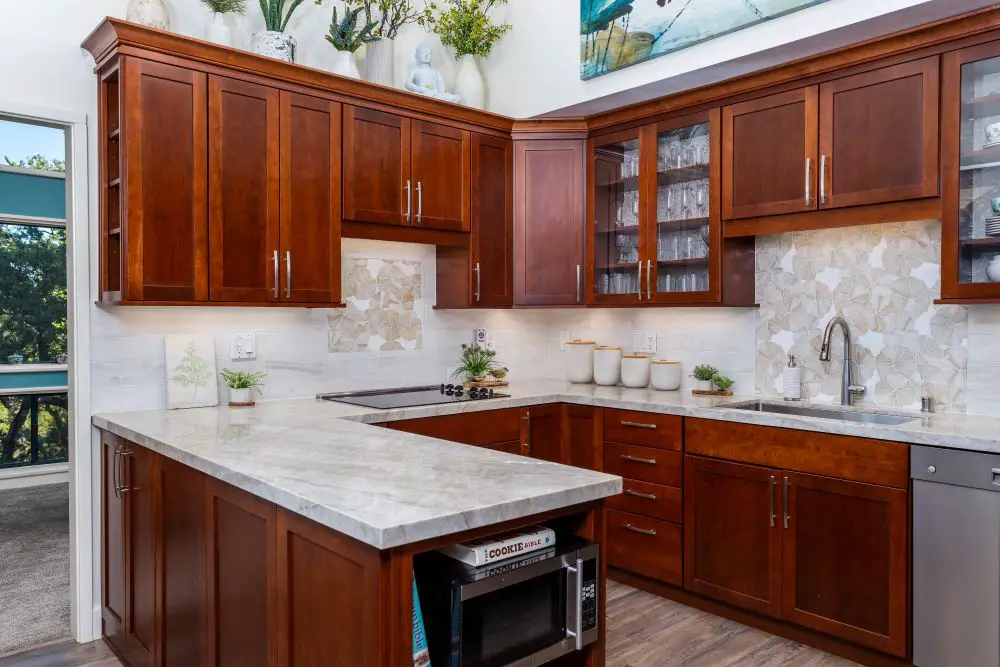
Rossmoor kitchen remodel featuring rich cherry wood cabinets, quartz countertops, full-height cabinetry, and a bright backsplash with decorative tile accents.
Questions We Hear All the Time
Generally, yes — typically 15–25% less. The savings come from fewer finished sides, shared cabinetry, and not needing independent utility runs. The gap closes when you add a high-end waterfall countertop or custom end panel work, but the peninsula usually still lands lower.
Depends on the run length, but most installs add 4–8 linear feet of counter. That's a significant upgrade for a kitchen that was fighting for prep space.
A sink — yes, depending on proximity to existing plumbing. A cooktop requires ventilation, and running a duct through a connected wall is more involved than through a floor, but it's been done. A cooktop in the center of the room is easier on a freestanding island. We'd look at your specific layout before saying yes or no.
Yes, and they're often the best option in Rossmoor precisely because the units were built in the '60s and '70s with smaller kitchens. The layout often supports a peninsula when it can't support a full island. We've done them in Golden Gate, Sonoma, and several other models — we know these floor plans.
If you're moving or removing a wall, yes — that's a structural change and requires a permit from the City of Walnut Creek. If you're in Rossmoor, add Mutual board approval. If the peninsula is simply extending existing cabinetry without structural changes, the permit threshold may not apply, but we review this case by case and never skip the step.


Comments