
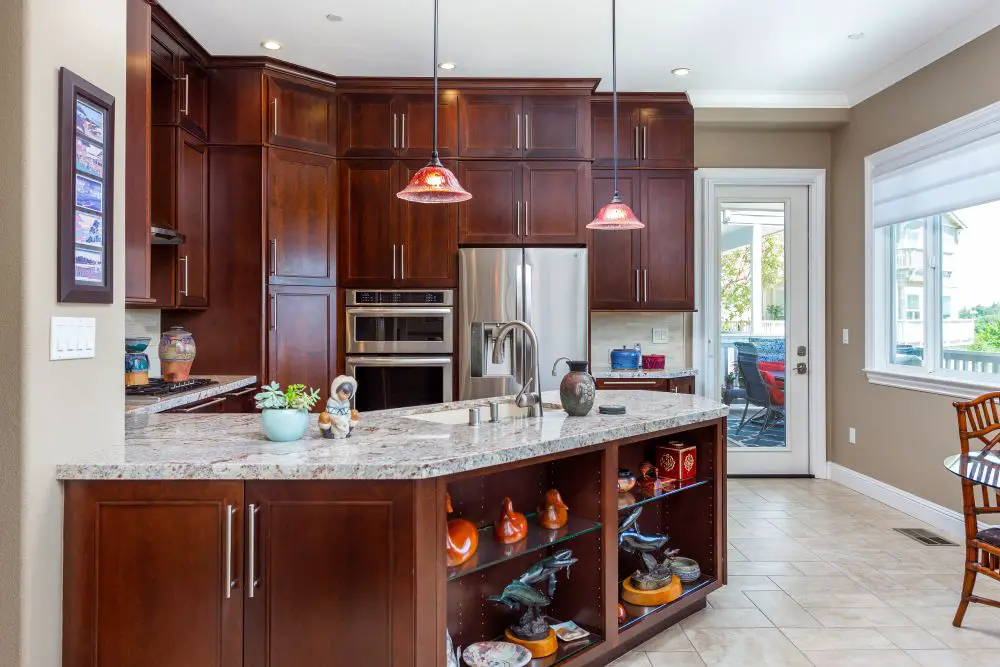
Walnut Creek kitchen featuring rich dark wood cabinetry, a large island with open shelving, granite countertops, and warm pendant lighting.
I've seen the planning spiral in real time. Someone comes to us with a stack of Pinterest boards, a rough number in their head, and a kitchen that hasn't been touched since 1987. By the time we've talked for thirty minutes, they realize the number in their head is about a third of what they're actually looking at — and they're not sure where to even begin.
That's not a failure of imagination. It's just that nobody tells you the full picture up front. So we're doing that here. After more than 40 years remodeling kitchens across Walnut Creek, Rossmoor, Orinda, Danville, and the rest of the East Bay, we know what the real questions are — and we're going to answer them honestly.
What Does a Kitchen Remodel Actually Cost in the East Bay?
Budget is the conversation everyone wants to have and nobody wants to start. So let's just say it plainly: East Bay kitchen remodels run differently than national averages. Our labor costs are higher, our permit requirements are stricter, and the trade professionals who do this work correctly are not the cheapest option. That's not a complaint — it's just reality.
Here's a rough range based on scope:
Those ranges feel wide because kitchen remodels genuinely vary — a lot. The biggest drivers are cabinets (they're usually 30-40% of the budget), countertops, and whether you're moving any plumbing or electrical. For a deeper look at why costs add up so fast, read our post on why kitchen remodeling is so expensive. Or if you're working with a tighter budget, we wrote a guide to remodeling ideas that don't require a second mortgage.
Layout First — Everything Else Follows
The biggest mistake I see homeowners make is falling in love with finishes before they've figured out their layout. You can have the most beautiful countertops in the East Bay — and if your workflow is broken, you'll be annoyed every single morning you make coffee.
Layout determines how you move through the space. Where you prep. Where you land groceries. Whether two people can cook together without one of them getting hip-checked every thirty seconds. Get this right first, and the finish decisions become much easier.
The Work Triangle (And When It Matters)
The "work triangle" is the imaginary path between your three main work zones: the stove, the sink, and the refrigerator. The idea is that if those three points are too far apart, you're walking too much. Too close, and everyone's in each other's way. Classic design rule says the total triangle distance should land between 13 and 26 feet. In modern kitchens with islands and open layouts, we've mostly shifted to thinking in "zones" instead — but the triangle is still a useful starting point for evaluating whether a layout makes sense.
Most East Bay homes fall into a few common layout categories. Here's how to think about which one fits your kitchen:
| Layout | Choose This If... |
|---|---|
| Kitchen Island | You have the square footage, want a gathering spot, and need extra prep and storage space. Minimum 42" clearance on all sides. |
| Peninsula | Your kitchen is smaller or opens to a living area. Gets you island functionality without the floor space requirement. Common in Rossmoor condos. |
| Galley | You have a long, narrow kitchen and want maximum efficiency. Two parallel counters keep everything within arm's reach. |
| L-Shape | You want an open-concept flow into a dining or living room. Works well in most East Bay floor plans. |
| U-Shape | You have three walls to work with and want tons of counter and cabinet space. Great for serious cooks. |
We go deep on island design in our complete kitchen island guide, and we've written specifically about whether a peninsula is right for your kitchen. If you want to think in zones instead of just furniture, this guide to kitchen zones and workflowis worth a read.
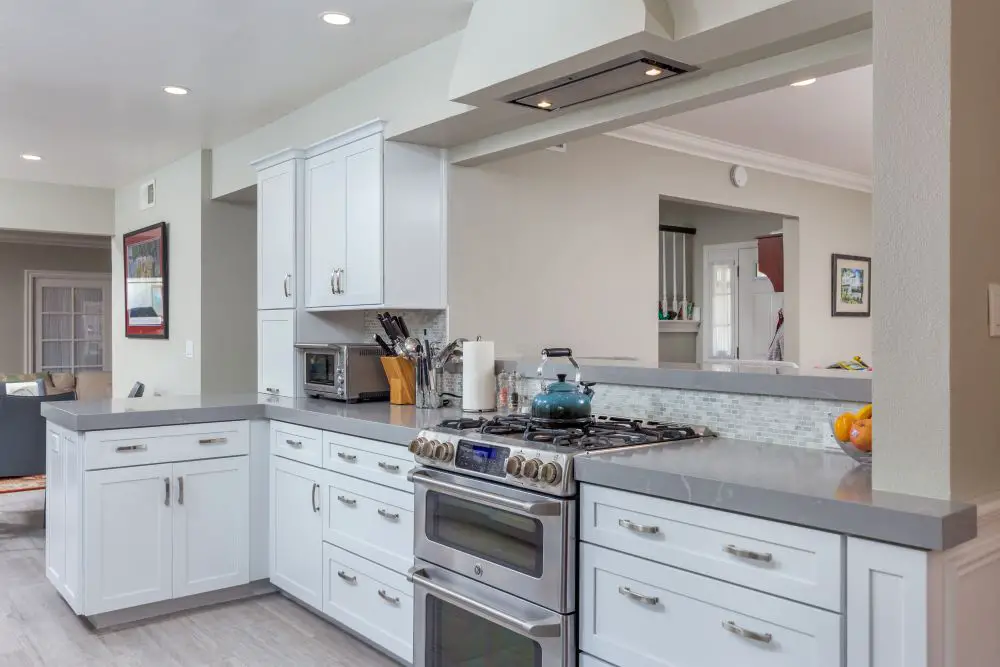
Rossmoor kitchen remodel with white cabinets, quartz countertops, recessed lighting, and a pass-through opening connecting to the living space.
Cabinets: The Decision That Drives Everything Else
Cabinets are typically the biggest line item in a kitchen remodel — and the decision of whether to reface or replace them is one of the first calls we make on a project. Get this wrong and you've either spent money you didn't need to, or you've put a fresh face on a broken structure.
"If the bones are good and the layout works, refacing is one of the smartest moves in a remodel. If neither of those is true, you're just lipstick on a pig."
Refacing vs. Replacing
Refacing means keeping your existing cabinet boxes — the part attached to the wall — and replacing the doors, drawer fronts, and visible surfaces. It costs significantly less than a full replacement and can be done in a fraction of the time. The catch: your layout stays exactly where it is, and the boxes need to be structurally solid.
Replacing is the right call when your boxes are compromised (water damage, particle board that's seen too many decades, weird sizes that don't fit standard hardware), or when you need a different layout entirely. We spec KraftMaid cabinets on most of our full replacements — we've used them for decades and stand behind them. You can read more about why in our KraftMaid cabinet story.
Not sure which one you need? This post walks you through the decision, and we've also written a detailed guide on what to expect from a cabinet reface.
Countertops, Backsplash, and the Details That Make a Kitchen Feel Finished
Here's what nobody tells you: the countertop edge style and grout color you choose will bother you more than almost anything else — once you know to notice them. These are the details that make a kitchen look intentional or look like an afterthought.
Countertops
Quartz dominates East Bay kitchens right now, and for good reason — it's non-porous, doesn't need sealing, and holds up beautifully under daily use. But granite, quartzite, butcher block, and even concrete all have a place depending on your style and how you cook. We wrote the full breakdown in our countertop materials guide.
One detail that surprises a lot of clients: the edge profile matters. That's the shape along the front edge of the countertop — whether it's square and modern, slightly rounded (eased), layered (ogee), or dramatic (waterfall). We made a quiz about it because we've had too many clients say "wait, I didn't know I had to choose that" when it was the last decision before install: what your edge profile says about you.
Backsplash
Subway tile is still a workhorse — classic, clean, easy to source, easy to clean. But the backsplash is one of the few places in a kitchen where you can really take a swing without blowing your budget. Full-height backsplashes (running all the way to your upper cabinets, or all the way to the ceiling) are having a major moment in the East Bay right now. They make the space feel bigger and give you a real design statement. We explored that in depth here: backsplash height options.
Grout — Don't Skip This Part
Regular grout is cement-based — it works fine but it's porous, which means it stains, absorbs moisture, and needs sealing. Epoxy grout is a two-part formula (resin + hardener) that sets hard, doesn't need sealing, resists stains, and holds up in high-moisture areas like kitchen backsplashes. It's also harder to install — it sets faster and is less forgiving — which is why you want an experienced tile setter applying it. For kitchens, we almost always recommend it. The upfront cost difference is minor compared to what you'll save in maintenance over ten years. More here: why epoxy grout is the gold standard.
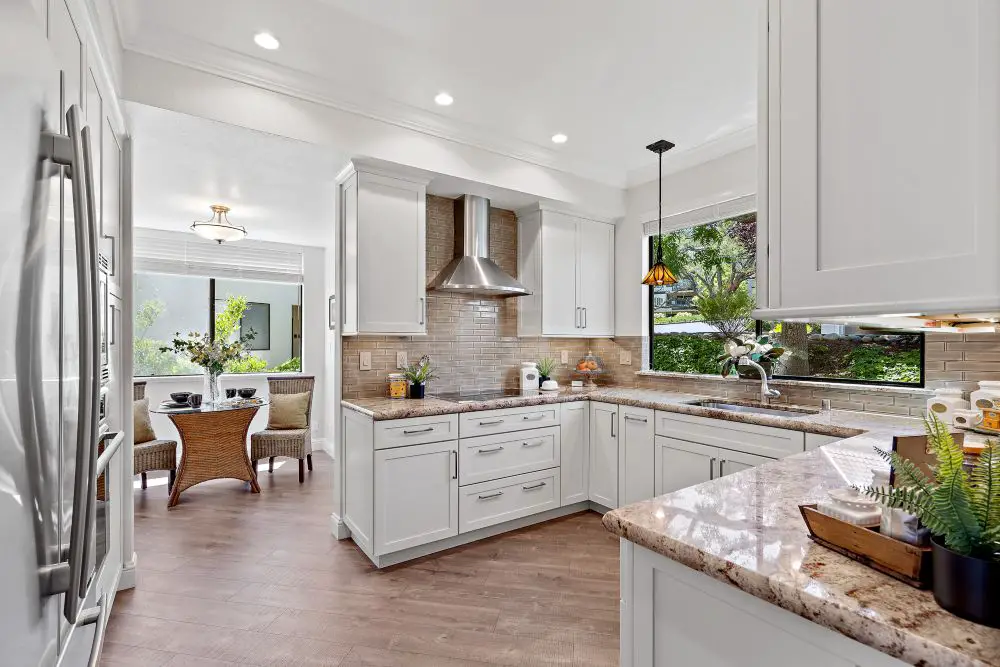
Light-filled Rossmoor kitchen with white cabinetry, tile backsplash, warm wood flooring, and an adjacent breakfast nook with large windows and natural light.
California Code: The Part Nobody Wants to Talk About Until They Fail an Inspection
California has stricter building codes than most states, and East Bay cities each have their own layers on top of that. I'm not going to sugarcoat it: if you're doing a real kitchen remodel — moving plumbing, upgrading electrical, touching any structural element — you're getting permits. That's not optional, and trying to skip it creates expensive problems when you sell the house.
The most common code issues we see in older East Bay kitchens:
- GFCI outlets — Ground Fault Circuit Interrupter outlets are required within 6 feet of any sink. Older kitchens often don't have them. (A GFCI outlet is the kind with the little "test" and "reset" buttons — it shuts off power instantly if it detects a fault, which matters when you're dealing with water nearby.)
- Dedicated circuits — Microwaves, dishwashers, and refrigerators each need their own circuit. Older wiring usually has several appliances sharing one circuit, which is a fire risk.
- Ventilation — If you're replacing or adding a range hood, it needs to vent to the exterior. Recirculating hoods (the kind that just filter and blow back into the room) often don't meet code for new installations.
- Clearances — Island and peninsula installations require minimum 42" clearances for one-cook kitchens, 48" for households with multiple cooks. This is a code requirement, not just a preference.
We've written several posts that get specific about code requirements: the top 5 kitchen code violations, kitchen electrical codes, and California-specific electrical codes.
A quick note on Rossmoor: if you own a condo or co-op there, your remodel is subject to Mutual board approval before work begins. The scope of what you're allowed to change — and what requires HOA sign-off — varies by Mutual. We've navigated this process many times and know what to expect. Don't start work before you have that approval in hand.
DIY vs. Hiring the Pros — Where to Draw the Line
We're not going to tell you that DIY is always a bad idea. It's not. There are real projects you can do yourself that will save you money without creating liability or safety hazards. The trick is knowing exactly where that line is — because the things that go wrong on the other side of it are expensive to fix.
Safe to DIY
- Painting cabinets or walls (with proper prep — which is 80% of the work)
- Swapping hardware: pulls, knobs, hinges
- Replacing a faucet or sink, if you're comfortable with basic plumbing
- Installing peel-and-stick backsplash or floating shelves
- Painting over existing tile (yes, it's a thing — and yes, it can look great if done right)
Call the Pros
- Any electrical work — this is not negotiable in California
- Moving or capping plumbing lines
- Cabinet installation (getting them level, plumb, and square is harder than it looks)
- Tile installation, especially if you're doing a pattern or large-format tile
- Any work that requires a permit
Read more on this in when not to DIY and why hiring an insured contractor matters. If you're interviewing contractors, this post on what separates a craftsman from a handyman is worth a read first.
What's Trending in East Bay Kitchens Right Now
Design trends move fast, but the kitchens we're most proud of are the ones that still feel right a decade from now. That said, here's what we're seeing across the East Bay heading into 2025 and beyond:
- Warm wood tones are back — not the golden oak of the '90s, but richer, more natural finishes: walnut, white oak, and rift-sawn materials with visible grain.
- Two-tone cabinetry — upper cabinets in a lighter color, lower cabinets in a deeper one. It adds depth without making a small kitchen feel closed in.
- Statement range hoods — custom plaster or wood hoods are becoming a focal point rather than an afterthought.
- Larger islands with waterfall edges — the countertop wraps down the sides of the island, creating a seamless sculptural look.
- Integrated appliances — refrigerators and dishwashers with panel fronts that match the cabinetry, so the kitchen reads as one continuous surface.
See the full trend breakdown in our 2025 remodeling trends report.
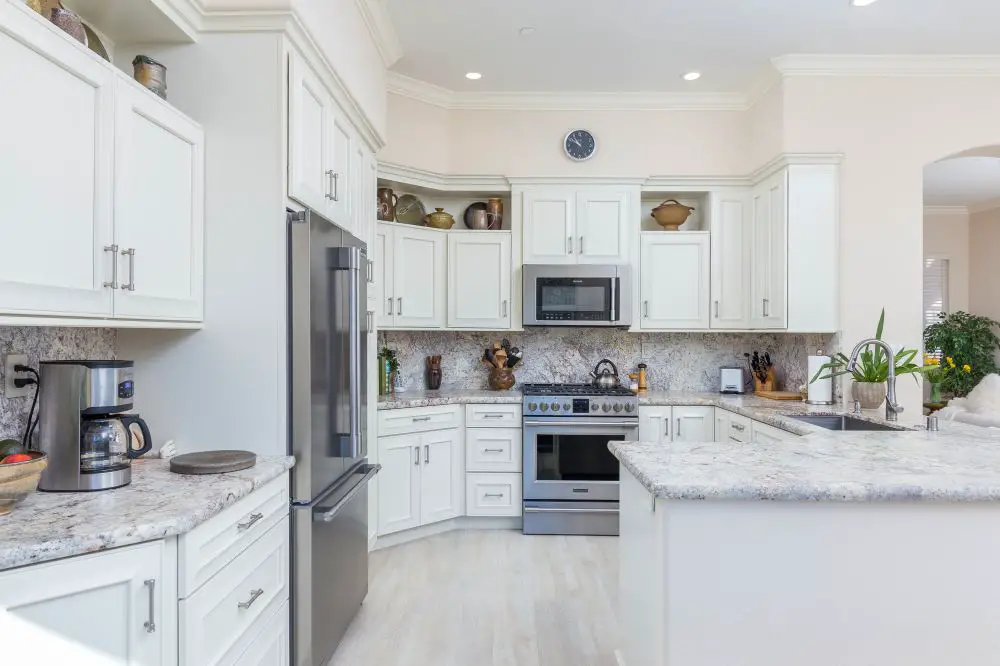
Bright white kitchen remodel in Walnut Creek Rossmoor featuring shaker cabinets, granite countertops, stainless steel appliances, and a classic U-shaped layout.
FAQ
Read More
Ready to Start Your Kitchen Remodel?
We've been remodeling East Bay kitchens for over 40 years. We know the permits, the materials, the layouts, and the thousand small decisions that make a kitchen actually work for the people who live in it. Give us a call — no pressure, just an honest conversation about what you're thinking.
Get a Free Consultation925-937-4200 · CA Lic #626819 · Walnut Creek, CA


Comments