

Tank vs. Tankless Water Heaters: The Honest Homeowner’s Guide
Costs, pros and cons, maintenance, Rossmoor considerations—and five models worth knowing
|
The short answer: Tank water heaters usually win on upfront cost and simplicity. Tankless systems win on space, longevity and continuous hot water—but only when the unit is sized correctly and the home can support the installation. |
You are in the middle of planning a kitchen or bathroom remodel, the water heater comes up, and suddenly everyone has an opinion. A neighbor swears by tankless. An online calculator promises huge savings. Your plumber says, “It depends.” And you are left holding two very different estimates.
We have seen this conversation play out in homes across Walnut Creek, Rossmoor, Danville, Orinda, Lafayette and Alamo. The honest answer is that neither system is automatically better. The right choice depends on your household’s hot-water demand, the condition of your gas or electrical service, your installation location, your budget and how long you plan to stay in the home.
Water-heater planning is especially important during a whole-house remodel, when plumbing, electrical and ventilation work may already be part of the project.
How Tank and Tankless Water Heaters Actually Work
Traditional tank water heaters
A tank water heater stores a reservoir of heated water—commonly 40 to 80 gallons—and keeps it warm until a fixture calls for it. Hot water is available immediately, but the supply is limited. Once the tank is depleted, the household must wait for it to refill and recover.
Tankless water heaters
A tankless, or on-demand, unit heats water as it moves through the heat exchanger. When the hot-water tap opens, the burner or electric element activates. When the tap closes, the unit stops heating. There is no stored reservoir and no standby heat loss from maintaining a full tank.
|
Know the term—GPM: Gallons per minute measures how much hot water a tankless unit can produce under stated conditions. A shower may use roughly 2 to 2.5 GPM, while a kitchen faucet may use about 1.5 GPM. The unit must handle the combined demand of fixtures that may run at the same time. |
Tank vs. Tankless: The Quick Comparison
The biggest differences are upfront cost, available hot water, installation requirements, space and maintenance. This visual gives you the fast version before we dig into the East Bay-specific details.
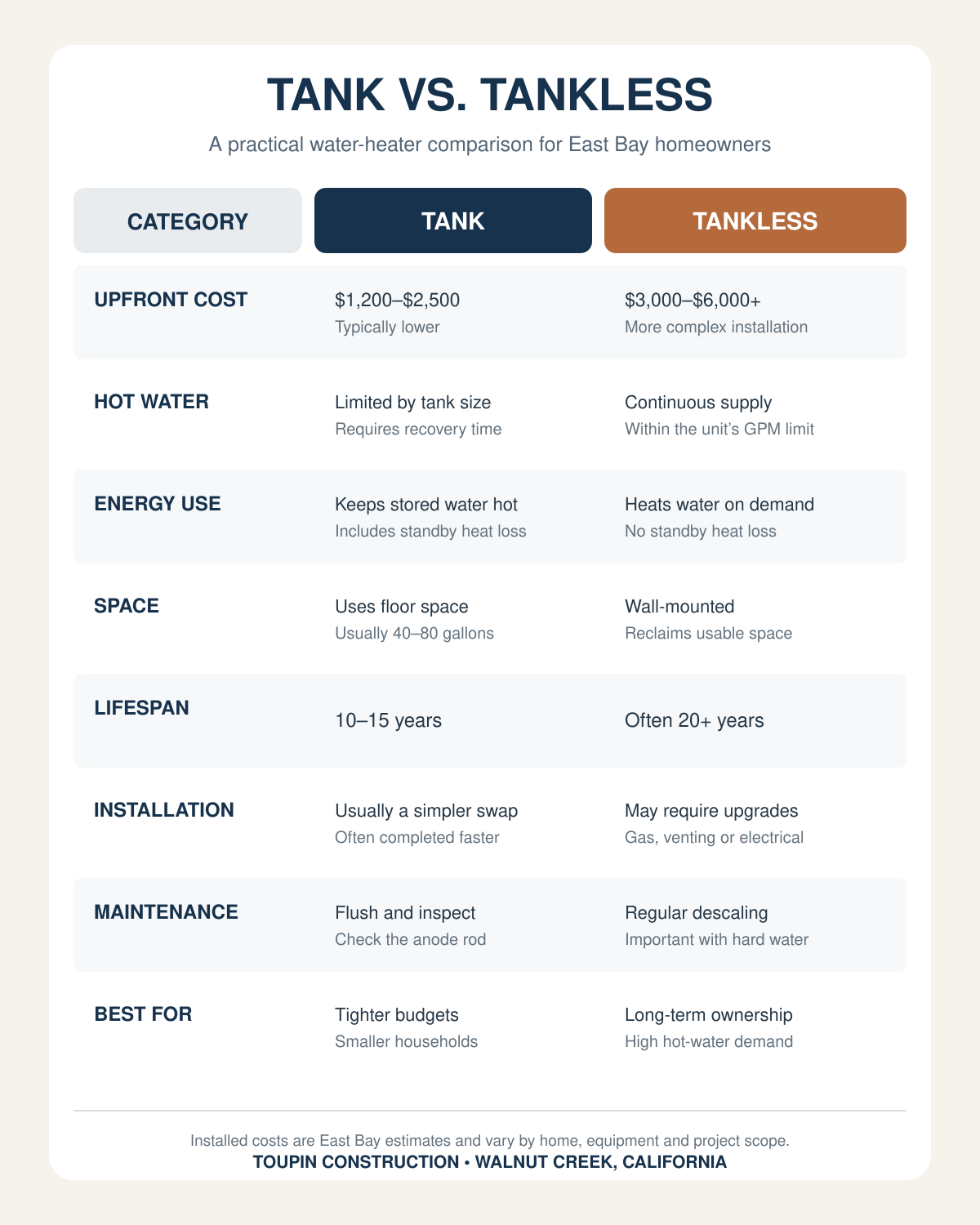
Visual comparison of tank and tankless water heaters, including upfront cost, hot-water supply, energy use, space, lifespan, installation and maintenance.
Tank Water Heaters: Where They Still Make Sense
Traditional tanks are not outdated by default. They remain a practical choice when the existing unit has failed, the budget is tight, the current location already supports a straightforward replacement or the household has predictable hot-water needs.
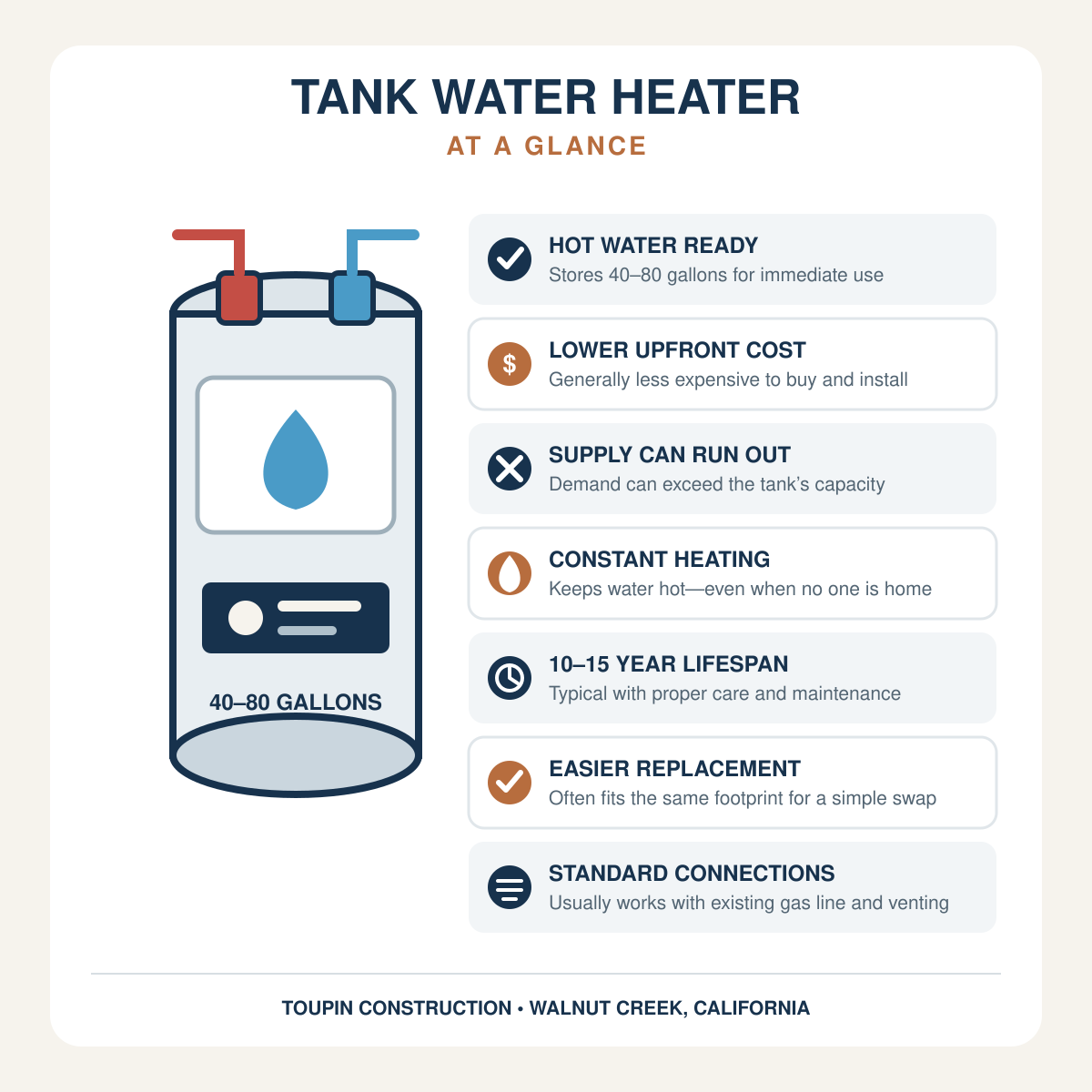
Illustrated overview of a traditional 40- to 80-gallon tank water heater, highlighting its lower upfront cost, stored hot water, 10- to 15-year lifespan and easier replacement.
A tank replacement is often the most economical route when you need hot water restored quickly. It can also be the better choice in an attached condominium where exterior venting modifications or service upgrades would make a tankless conversion unnecessarily complicated.
Tankless Water Heaters: What You Gain—and What Changes
Tankless systems are attractive for households that regularly exhaust a storage tank, want to reclaim floor space or expect to remain in the home long enough to benefit from the unit’s longer service life. They are especially logical when a broader remodel already includes plumbing, gas or electrical work.
“Continuous hot water” does not mean unlimited capacity. A properly sized unit can supply hot water continuously, but it can still struggle if several showers, faucets and appliances exceed its GPM rating at the same time. Incoming water temperature and the required temperature rise also affect real-world output.
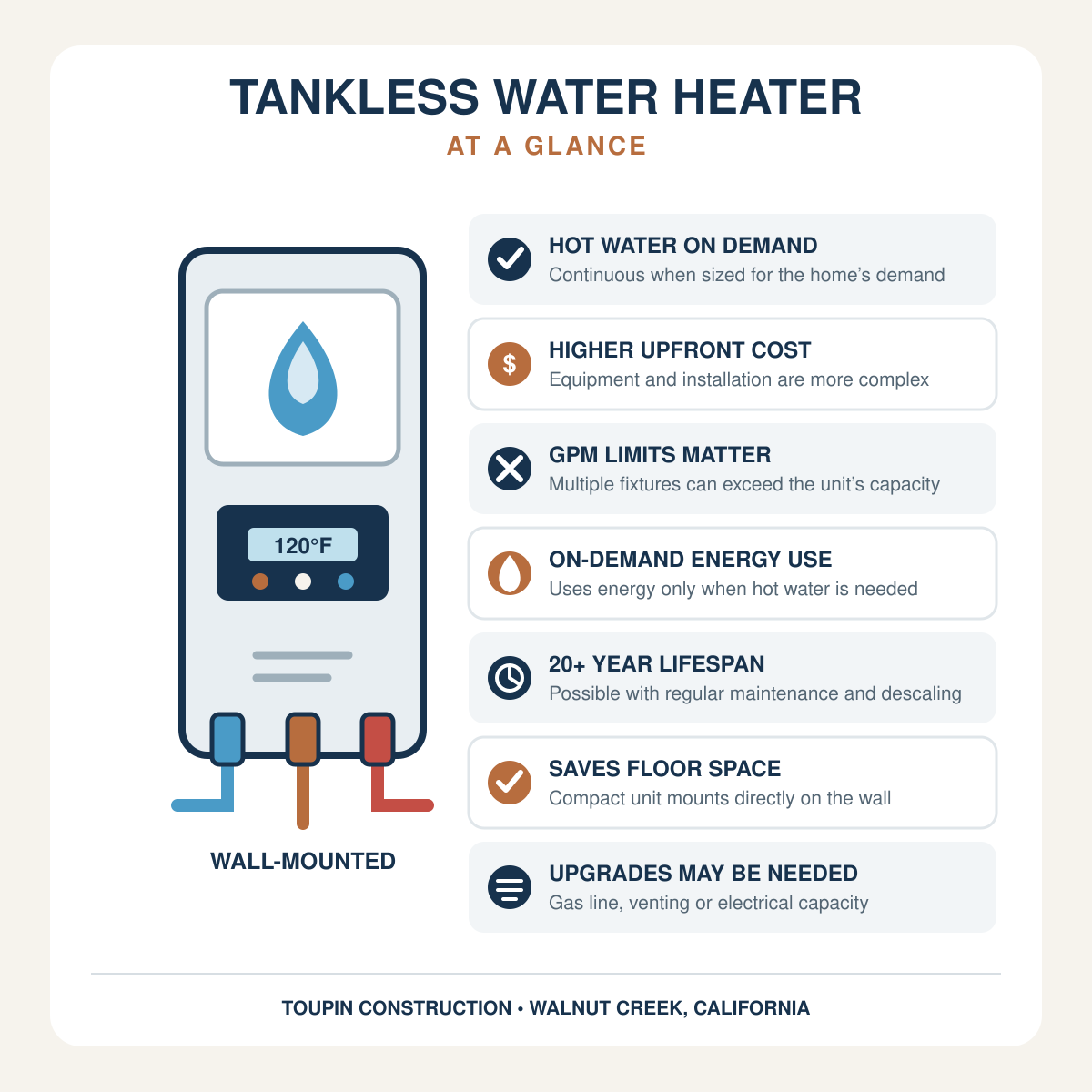
Illustrated overview of a wall-mounted tankless water heater, highlighting on-demand heating, GPM limits, a potential 20-plus-year lifespan and possible utility upgrades.
ENERGY STAR explains why certified gas tankless water heaters can be a strong fit for new construction, major remodeling and some storage-tank replacements. Read the ENERGY STAR tankless water-heater overview.
What Water Heater Installation Costs in the East Bay
Installed prices vary with the equipment, access, permit requirements, fuel source and condition of the existing utilities. Gas-line upgrades, new venting, condensate drainage, electrical circuits and panel work are the items most likely to move a project beyond the basic-replacement price.
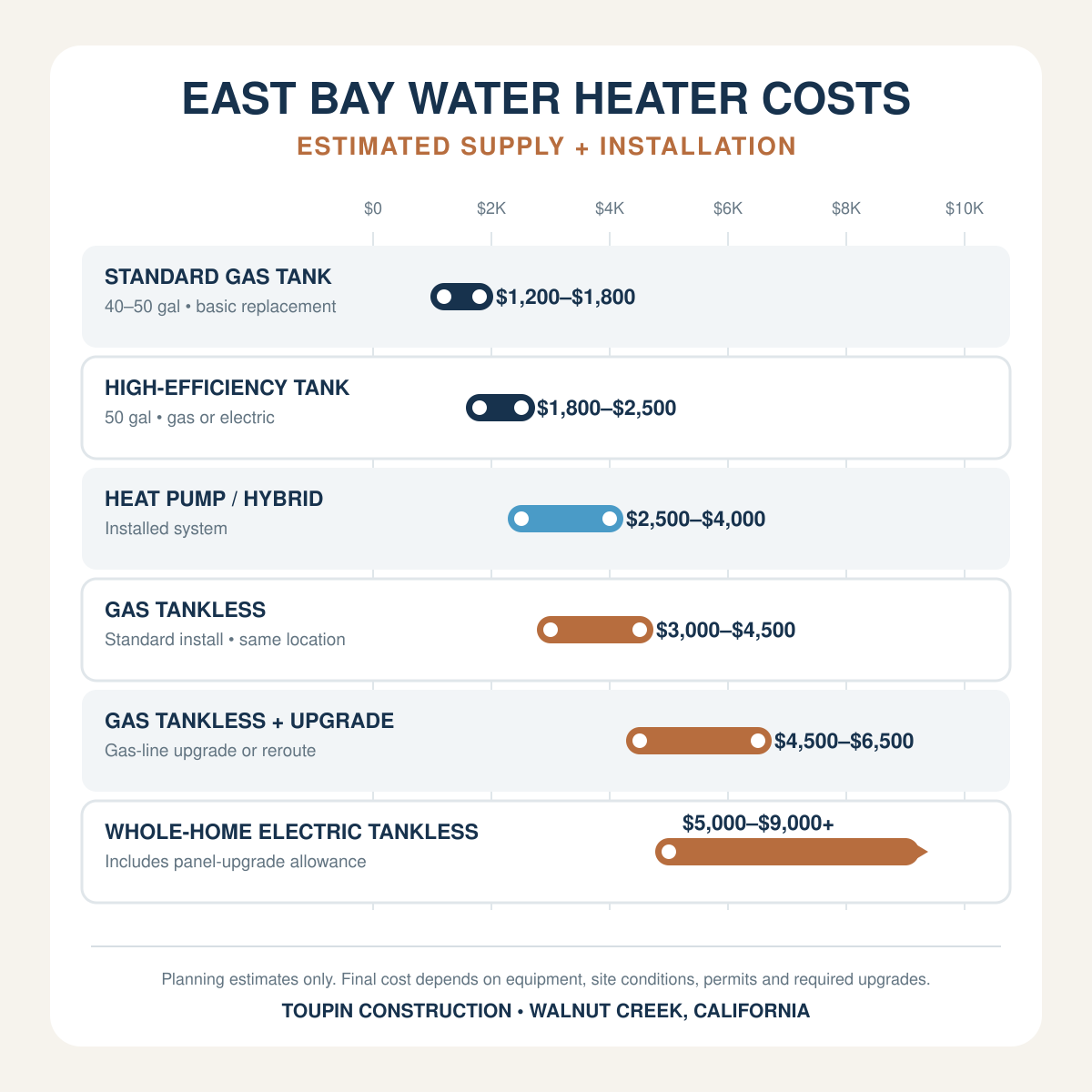
These figures are planning estimates, not quotes. Permit fees and unusual site conditions may be separate. Always ask whether the proposal includes removal of the old unit, isolation valves, venting, gas or electrical work, condensate routing, startup and required permits.
Does a Tankless Water Heater Really Pay for Itself?
Tankless energy savings are real, but the payback period is often longer than homeowners expect. If a tankless installation costs several thousand dollars more than a like-for-like tank replacement, energy savings alone may take many years to recover that difference.
The financial case becomes stronger when the longer service life is considered, the household uses a great deal of hot water, the project already includes utility work, or the installation solves a meaningful space problem. Tankless should be selected because the total package fits the home—not because someone promised an automatic five-year payback.
Rebates and Tax Credits: Verify Before You Buy
Incentives change frequently, and eligibility often depends on the exact model number, efficiency rating, installation date, fuel type, customer income and program funding. Do not count a rebate as part of your budget until the equipment and installation have been confirmed as eligible.
The federal Energy Efficient Home Improvement Credit applied to qualifying equipment placed in service through December 31, 2025. Check the current IRS home-energy credit guidance before relying on a federal credit for a 2026 project.
For current utility and regional programs, review PG&E rebates and incentives and the BayREN incentive finder.
The East Bay Hard-Water Factor
Minerals in hard water can shorten the life of any water heater. In a storage tank, sediment settles at the bottom. In a tankless unit, mineral scale builds inside the heat exchanger, restricting flow and reducing efficiency.
Descaling is not optional
Descaling circulates an approved solution through the tankless heat exchanger to dissolve mineral deposits. The correct maintenance interval depends on local water quality, household usage and manufacturer requirements, but East Bay homeowners should plan for regular service rather than treating it as an optional extra.
|
Toupin tip: Ask for isolation valves during installation. They make future flushing and descaling much easier. Also review the manufacturer’s water-quality limits before deciding whether pretreatment or a softening system is appropriate. |
Rossmoor and Condominium Installation Considerations
Many Rossmoor homes were built with water heaters located in compact closets and with older gas, electrical or ventilation infrastructure. A tankless conversion may require new wall penetrations, vent routing, condensate drainage or service upgrades—all of which can become more complicated in an attached building.
Before selecting equipment, confirm whether exterior modifications require Mutual approval. Toupin Construction regularly works within these constraints; explore our Rossmoor remodeling portfolio and our condominium remodeling services for more context on these homes.
For some Rossmoor units, a high-efficiency tank replacement may be the smarter choice—not because tankless technology is inferior, but because the building conditions make the conversion cost difficult to justify. The best recommendation should follow an on-site evaluation.
Do Not Overlook Heat-Pump Water Heaters
A heat-pump, or hybrid, water heater stores hot water but uses electricity to move heat from the surrounding air into the tank. In the right location, it can be considerably more efficient than a standard electric-resistance tank.
The tradeoff is space and installation planning. Many models need substantial surrounding air volume or appropriate ducting, produce cool exhaust air, create condensate and require an electrical circuit. A garage or roomy utility area may work well; a tight interior closet may not. Always follow the chosen manufacturer’s installation requirements.
Five Tankless Water Heaters Worth Considering
There is no universal “best” model. These five established options represent different strengths, but the final selection must be based on a professional demand calculation, the home’s utilities and the installation environment.
1. Rinnai SENSEI RX199iN — Best Overall
Best for: Larger households and multiple bathrooms.
This high-capacity condensing model offers up to 11.1 GPM, a 0.98 UEF rating, natural-gas or propane capability, and indoor or outdoor configuration options. Review the Rinnai RX199iN specifications.
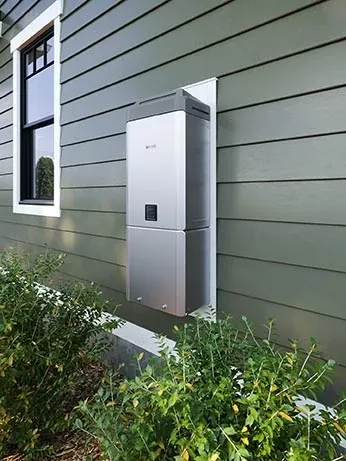 The Rinnai SENSEI RX199iN is a compact, white, suitcase-sized tankless water heater designed for wall-mounted installation. It operates with natural gas or propane, delivers up to 11.1 GPM and can be configured for indoor or outdoor use. View the Rinnai RX199iN
2. Navien NPE-240A2 — Best for Built-In Recirculation
Best for: Larger floor plans and bathrooms located far from the heater.
The NPE-240A2 pairs condensing technology with a built-in recirculation pump. It also features dual stainless-steel heat exchangers and low-NOx operation. Review the Navien NPE-240A2 specifications.
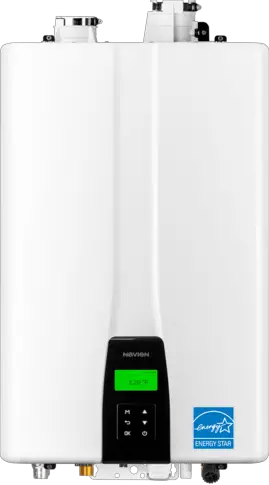 The Navien NPE-240A2 has a streamlined white cabinet with a dark central control panel and digital display. This condensing tankless unit includes a built-in recirculation system, dual stainless-steel heat exchangers and low-NOx operation. View the Navien NPE-240A2
3. Rheem IKONIC — Best Smart Option
Best for: Homeowners interested in connected controls and installation flexibility.
The IKONIC line offers Wi-Fi connectivity, high-efficiency operation and flexible installation features. Capabilities vary by exact model, so compare the proposed model number rather than relying only on the series name. Explore the Rheem IKONIC line.
4. Noritz EZ111 — Best for Tank-to-Tankless Conversions
Best for: Projects replacing an existing storage-tank water heater.
The EZ111 is designed with retrofit flexibility in mind and offers up to 11.1 GPM with a 0.98 UEF rating. Installation and venting options depend on the selected configuration. Review the Noritz EZ Series.
5. Stiebel Eltron Tempra 36 Plus — Best Whole-Home Electric Option
Best for: Appropriately sized all-electric homes with sufficient electrical capacity.
Advanced Flow Control helps maintain the selected temperature when demand rises, and the unit requires no combustion venting. Whole-home electric tankless systems can impose a very large electrical load, so the service and panel must be evaluated first. Review the Stiebel Eltron Tempra Plus line.
Which Water Heater Should You Choose?
Choose a traditional tank when:
- You need the fastest, most affordable replacement.
- Your household has predictable and moderate hot-water demand.
- The existing location already supports a straightforward swap.
- Condo or Mutual rules make new venting difficult.
- You expect to sell the home before a premium system delivers much long-term value.
Consider tankless when:
- Your household regularly runs out of stored hot water.
- You want to reclaim floor or closet space.
- You are already completing a larger remodel that includes utility work.
- You plan to remain in the home long enough to value the longer service life.
- You are prepared to maintain and descale the equipment regularly.
- A professional confirms that the unit can meet your peak GPM demand.
Plan the Water Heater Before It Becomes an Emergency
Water heaters rarely fail on a convenient schedule. If your storage tank is approaching the end of its expected life, planning early gives you time to compare systems, confirm the home’s utilities, check approval requirements, choose the right model and complete permitting without emergency pressure.
Water-heater decisions often surface during a kitchen remodel or bathroom remodel, when plumbing and electrical systems are already being evaluated. Coordinating the work at that stage can prevent expensive rework later.
|
The bottom line: Choose the system that fits your home, household and long-term plans—not the one with the loudest marketing claim. |
Ready to Talk Through Your Remodel?
Toupin Construction has served Walnut Creek, Rossmoor and surrounding East Bay communities for more than four decades. We coordinate with qualified plumbing professionals and help homeowners understand how water-heater decisions affect the larger remodeling plan.
Request a free estimate from Toupin Construction or call 925-937-4200. CA Lic #626819.


Comments