


By using our website, you agree to the use of cookies as described in our Cookie Policy
Blog
The Quartz Countertop Ban: What California Homeowners Need to Know
The Quartz Countertop Ban: What California Homeowners Need to Know
Updated October 8, 2026
Quartz countertops have been a popular choice for kitchens and bathrooms for years. They offer a clean look, come in many colors, and usually require less maintenance than some natural stones.
If you have been planning a remodel, quartz may already be on your wish list. But headlines about countertop bans and worker safety can make that choice feel confusing.
Is quartz dangerous to have in your kitchen? Is California banning it? Will you need to replace the countertops you already own? And what should you choose instead?
Understanding the issue starts with one distinction: using a finished countertop and breathing dust while making that countertop are very different situations.
At Toupin Construction, we want homeowners to have clear information before making decisions about their homes. Here is a straightforward look at the quartz countertop debate, what California is considering, and how to approach your next kitchen or bathroom project.
What Are Quartz Countertops Made Of?
Despite the name, most quartz countertops are not solid pieces of natural quartz cut from the earth.
They are manufactured by combining crushed minerals, including quartz, with resins and pigments. The resin acts like glue, holding the material together. Pigments give the countertop its color.
You may hear this product called engineered quartz, engineered stone, or artificial stone.
Manufacturing allows companies to create consistent colors and patterns, including designs that resemble marble. That consistency appeals to homeowners who want a predictable look across their counters and backsplash.
Natural stones, such as granite, marble, and quartzite, are quarried from the earth and cut into slabs. Their patterns come from nature, so each slab is different.
Neither description tells you everything about a countertop’s performance or safety. The specific product, its composition, and how it is handled all matter.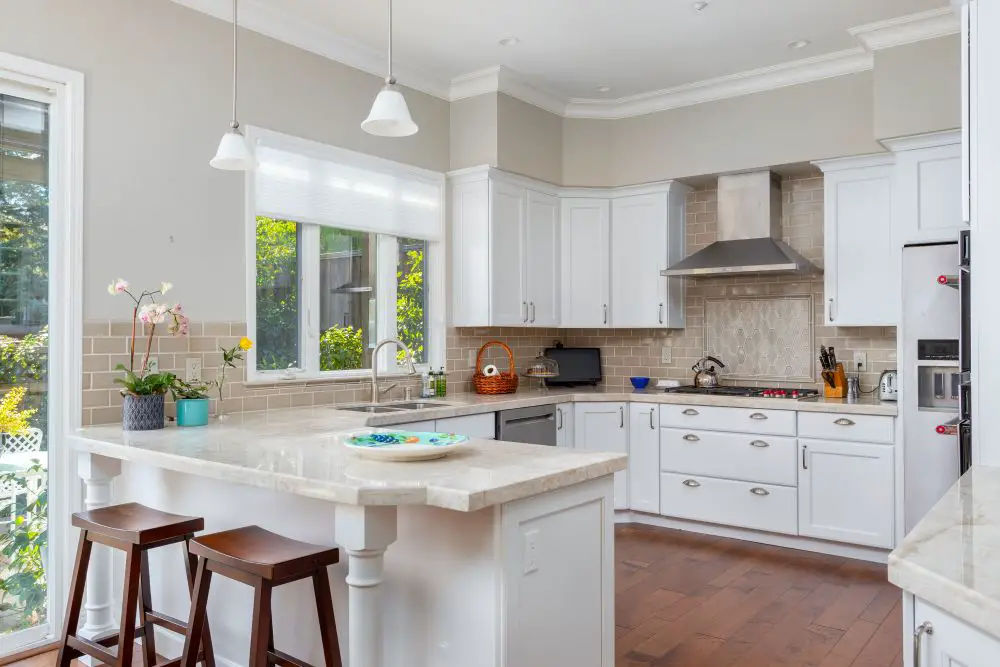 Cream quartz countertops extend across this bright kitchen and its seating peninsula. White cabinetry, warm wood flooring, pendant lights, and a beige tile backsplash create a welcoming space, with a decorative tile inset above the cooktop.
Why Are People Calling for a Quartz Countertop Ban?
The main concern is the dust produced when workers cut, grind, or polish engineered stone.
Quartz contains crystalline silica, a mineral found in many rocks. Cutting materials that contain silica can release tiny dust particles into the air. Workers can breathe those particles deep into their lungs.
Repeated exposure can cause silicosis, a serious disease that permanently scars the lungs and makes breathing difficult. There is no cure.
California has identified severe illness and deaths among workers who make engineered stone countertops. State officials have concluded that existing protections have not adequately addressed the risks associated with these products.
For homeowners, that means the conversation extends beyond how a countertop looks or how easily it wipes clean. It also includes the people who turn a large slab into the finished surface installed in your home.
Is the Quartz Already in My Home Dangerous?
This is often the first question homeowners ask, and the answer should provide some reassurance.
Available evidence suggests that installed engineered stone does not pose a safety risk during normal use, as long as it is not being cut, ground, or polished.
Making lunch, wiping up a spill, or setting groceries on the counter is different from using a power tool to cut an opening for a sink.
The concern is airborne dust created when the material is disturbed. Repairs, modifications, and removal can create that dust if the work is not handled properly.
You generally do not need to replace an intact countertop simply because you have heard about a ban. If it needs work, contact a qualified professional rather than drilling, sanding, or cutting it yourself.
Is Quartz Banned in California?
California has taken steps toward prohibiting certain work involving high-silica artificial stone.
In May 2026, the Occupational Safety and Health Standards Board voted to begin the process of prohibiting fabrication and installation of artificial stone containing more than 1% crystalline silica.
In September 2026, Cal/OSHA published a discussion draft of proposed restrictions. That draft is part of the rulemaking process; it should not be described as a completed statewide ban.
For someone planning a remodel, the practical takeaway is to check current requirements before ordering materials. A headline may describe a proposal, a board vote, or an effective regulation, and those are different stages.
You can follow the official updates on Cal/OSHA’s engineered stone rulemaking page.
Ask your contractor and supplier to confirm what applies to your particular product and project.
What Has Australia Already Done?
Australia introduced a ban on the manufacture, supply, processing, and installation of certain engineered stone countertops, panels, and slabs beginning July 1, 2024.
An import ban followed on January 1, 2025.
Those restrictions were introduced to protect workers from silica dust exposure. They do not mean homeowners must tear out every existing engineered stone countertop.
Australia allows certain work on previously installed surfaces, including removal and repairs, subject to applicable safety requirements. Its official engineered stone guidance explains both the restrictions and the distinction between installed surfaces and dust-producing work.
Australia’s experience helps explain why California is considering stronger measures, although California’s final rules and exceptions must be evaluated separately.
Why Don’t Workers Just Use Water and Masks?
Water-fed cutting tools, dust collection, and appropriate respirators are important protections. However, a safe workplace requires more than one piece of equipment.
Dust can be produced during cutting, edge finishing, drilling, and cleanup. Workers also need training, properly maintained equipment, and respiratory protection suited to the work.
California’s evaluation found that existing measures had not been enough to resolve the engineered stone silicosis crisis. This is part of the reason regulators are considering restrictions on the material itself.
As a homeowner, you do not need to become an expert in workplace air testing. You can ask who will make your countertops, where the cutting will happen, and how dust-producing work will be managed.
Could Buying Quartz From Another State Solve the Problem?
Buying a slab somewhere else would not automatically answer whether it could legally be worked on or installed in California.
The answer would depend on the final regulation: which products it covers, which activities it prohibits, and whether any exceptions apply.
For that reason, an out-of-state purchase should not be treated as a guaranteed workaround while California’s rules are still developing.
Before paying a deposit, ask who is responsible for confirming compliance. Also clarify who will measure, transport, install, and handle any problems with the countertop.
Even apart from regulations, ordering a finished countertop from a distant supplier can make adjustments and replacement more complicated. Those responsibilities should be clear before you commit.
What Happens When Existing Quartz Countertops Are Removed?
A countertop may need to come out because you are replacing cabinets, changing the layout, or updating the entire room.
That work should be planned with dust control in mind. The removal method depends on the countertop, its attachments, its size, and the conditions in the home.
Homeowners should avoid breaking up or modifying engineered stone themselves. A qualified professional can assess how to remove it while minimizing dust and following applicable requirements.
Discuss removal during the planning stage. Ask whether your household needs to stay away from the work area and how the space will be cleaned afterward.
Our kitchen remodeling services include planning how countertop changes fit into the larger project, alongside cabinetry, plumbing fixtures, flooring, and layout decisions.
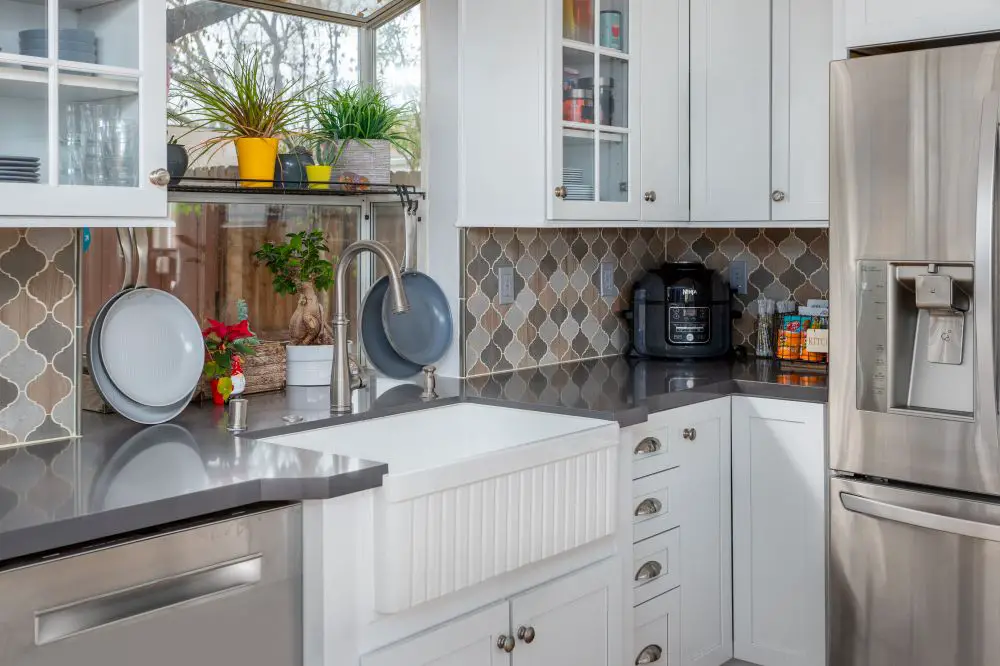 This kitchen pairs polished gray quartz countertops with white cabinetry, a farmhouse sink, and a curved stainless steel faucet. A patterned tile backsplash adds character, while the garden window brings natural light and greenery into the space.
What Countertop Alternatives Should Homeowners Consider?
There are several options beyond traditional engineered quartz. The best choice depends on your priorities, including appearance, maintenance, budget, and the demands of your household.
Keep in mind that choosing another surface does not automatically eliminate dust hazards during fabrication. Natural stone and ceramic products also require appropriate worker protections when processed.
Granite
Granite is a natural stone available in a wide range of colors and patterns. Some slabs have a subtle appearance, while others feature bold movement.
It is a durable option for kitchens, with good resistance to everyday scratching and heat. However, heat resistance does not mean you should routinely place hot cookware directly on it. Sudden, concentrated heat can contribute to cracking.
Ask about the care needs of the particular slab you select. Some granite benefits from sealing, while other varieties may not require it. There is no single sealing schedule that applies to every granite countertop.
Quartzite
Quartzite and quartz sound similar, but they are different materials.
Quartzite is natural stone. Engineered quartz is manufactured.
If you are drawn to natural veining and variation, quartzite is worth exploring. Before buying, confirm the stone’s identity and ask about its care requirements, including whether sealing is recommended.
You can see more design considerations in our guide to quartzite countertops for Bay Area kitchens.
Also remember that quartzite contains silica. Its natural origin does not remove the need for dust controls during cutting and fabrication.
Porcelain and Sintered Surfaces
Porcelain and sintered surfaces offer another way to achieve a stone-inspired appearance. Products vary, so ask for information about the exact brand and surface you are considering.
For example, Cosentino describes its Dekton sintered surface as resistant to stains, scratches, and high temperatures. Its care guidance also addresses chipped edges and recommends precautions around certain heat sources.
That is a useful reminder: a durable countertop can still have vulnerable areas and specific care instructions. Ask about thickness, edge design, repairs, and warranty coverage before choosing.
Soapstone
Soapstone can appeal to homeowners who like a softer, more traditional appearance.
It is highly heat resistant and has a history of use in laboratory work surfaces. However, it is softer than some other countertop stones and is more prone to scratching.
For some homeowners, surface wear becomes part of its appeal. Others prefer a material that keeps a more uniform appearance.
See the Natural Stone Institute’s information about soapstone for more about its characteristics.
Lower-Silica Manufactured Surfaces
You may also encounter manufactured products marketed as lower-silica alternatives.
Ask for documentation showing the composition of the specific product. A familiar brand name or a general marketing claim does not tell you everything about an individual slab.
Also request care instructions, warranty information, and confirmation that the product meets the requirements applicable to your project.
How Do You Choose the Right Countertop for Your Household?
Start with how you actually use the room.
Do you cook every day? Does the island double as a homework table? Are you comfortable following stone-care instructions, or do you want the simplest cleaning routine possible?
Think about appearance, too. Some homeowners love natural variation. Others want an even pattern that is easier to coordinate with cabinets and backsplash tile.
Bring cabinet, flooring, and backsplash samples when comparing surfaces. A countertop that looks perfect under showroom lighting may look different beside the finishes in your home.
For bathroom projects, consider makeup, hair products, cleaning products, and the amount of counter space you need. Our bathroom remodeling services can help you evaluate the vanity and countertop together.
What Should a Countertop Quote Include?
Ask for the total installed price rather than comparing slab prices alone.
Depending on the project, the quote may need to address:
-
Measuring and templates.
-
Material and fabrication.
-
Sink and faucet openings.
-
Edge details and seam placement.
-
Delivery and installation.
-
Required supports.
-
Removal of existing countertops.
-
Plumbing disconnection and reconnection.
-
Backsplash work.
Ask what could change the price and who handles an unexpected problem. Two quotes may look very different because one includes work the other leaves out.
Questions to Ask Before Ordering
Before signing off on a countertop, ask:
-
What is the exact product name and material?
-
Does it meet current California requirements?
-
Who will fabricate and install it?
-
Will any cutting or grinding happen at my home?
-
How will dust-producing work be controlled?
-
Where will the seams go?
-
What cleaning and maintenance does it require?
-
What does the warranty cover?
Request answers before the deposit is paid, while there is still time to compare options.
Planning Your Next Kitchen or Bathroom Remodel
Countertops are one part of a larger design. The sink location, cabinet layout, backsplash, lighting, and available space all affect how the finished room will work.
Choosing these pieces together can help prevent expensive changes later.
If you are planning a bathroom project, our complete bathroom remodel guide for Bay Area homes provides a broader look at the planning process.
At Toupin Construction, we help homeowners in Walnut Creek, Rossmoor, and the East Bay understand their options and make thoughtful choices for their homes.
Whether you already have quartz or are exploring alternatives, we can help you plan a kitchen or bathroom that fits your style, your budget, and your everyday life.
Visit Toupin Construction or call 925-937-4200 to discuss your project.

Toupin Construction
Ready to start your remodel?
Whether you're dreaming of a new kitchen, a spa-worthy bathroom, or a whole-home transformation — we’d love to hear about your project. Reach out and let's talk.
‹ Back
Comments