


By using our website, you agree to the use of cookies as described in our Cookie Policy
Blog
Wood Species 101: A Homeowner’s Guide to Choosing the Right Wood for Cabinets, Floors & Built-Ins
A client came into our showroom last spring holding her phone out to me. She'd saved 47 kitchen photos. Every single one was beautiful. And every single one was a completely different wood.
"I don't understand," she said. "How do I choose?"
I told her what I tell everyone: the wood you pick isn't just about the photo. It's about how you live, what you're willing to maintain, and what that kitchen needs to do for the next twenty years. Once she understood that, the decision got a whole lot easier.
That's what this guide is for. Think of it as your no-pressure starting point before you dive into each species — because once you understand the basics, everything else clicks into place.
Wood Species Series — You Are Here
- ★ Wood Species 101: Start Here (this post)
- Oak Cabinets: Classic, Durable, and More Modern Than You Think
- Maple Cabinets: The Go-To Choice for Painted Kitchens
- Walnut Cabinets: Rich, Sophisticated, and Timelessly Bold
- Cherry Cabinets: Warm, Elegant, and Designed to Age Beautifully
- Alder Cabinets: Soft, Warm, and Perfect for a Relaxed Home
- Hickory Cabinets: Bold Grain and Built for Real Life
- Birch Cabinets: Clean, Affordable, and Surprisingly Versatile
- Ash Cabinets: The Modern Alternative to Oak
- Pine Cabinets: Soft, Character-Rich, and Not for Everyone
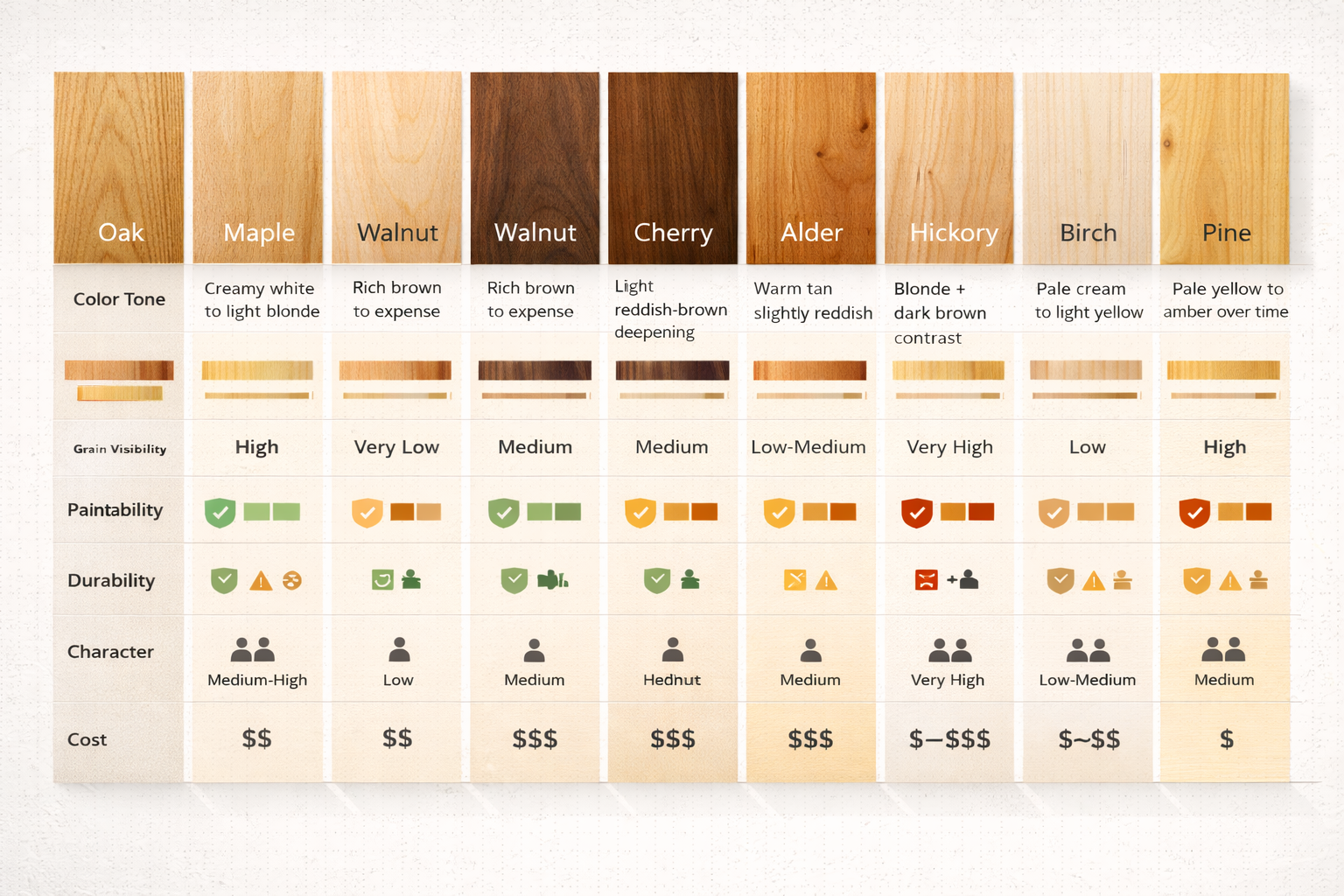 A detailed cabinet wood comparison chart featuring popular species including oak, maple, walnut, cherry, alder, hickory, birch, and pine. The chart compares color tone, grain visibility, paintability, durability, character, and cost to help homeowners choose the best wood for kitchen cabinets and built-ins.
Why Wood Species Matter More Than You Think
Two kitchens can look nearly identical on Pinterest and have wildly different price tags, performance records, and long-term satisfaction — all because of what the cabinets are actually made of.
Wood species determines how well your cabinets resist dents and scratches, whether the grain will telegraph through paint five years from now, how the finish absorbs stain, and how the whole kitchen reacts to humidity shifts. In the Bay Area — where we're working in older homes, condos, and shared-wall properties — materials have to perform, not just photograph well on day one.
Jargon Card
Grain Telegraphing
When wood grain shows through a painted finish — sometimes immediately, sometimes years later as the paint moves with humidity cycles. This is the number-one complaint we hear about painted oak cabinets. It's completely avoidable if you choose the right species for what you're trying to do.The First Big Divide: Hardwood vs. Softwood
Before we talk species, let's clear up the most common misconception in the wood world. Hardwood and softwood don't describe how hard the wood actually feels. They describe the type of tree it comes from.
Hardwoods — Deciduous Trees
- Lose their leaves seasonally
- Generally denser and more durable
- Standard choice for cabinetry
- Oak, maple, walnut, cherry, alder, hickory, birch, ash
Softwoods — Evergreen Trees
- Keep their needles year-round
- Grow faster, typically less dense
- Dent more easily under daily use
- Pine, fir, cedar
For kitchen and bathroom cabinetry in East Bay homes, hardwoods dominate — and for good reason. They hold up to daily use in a way softwoods simply can't sustain over the long haul.
Grain: The Personality of the Wood
Grain is what most homeowners react to emotionally, even when they can't name why. Walk past a kitchen and feel like it's "busy" or "calm"? That's grain doing its job invisibly.
Tight, subtle grain — like maple or birch — looks smoother and more uniform. It's ideal for painted cabinets where you want the finish to be the feature. Pronounced, visible grain — like oak, hickory, or ash — adds character and movement, but it's best appreciated stained or natural rather than under paint.
"If you hate seeing grain, choosing the wrong species will drive you crazy — no matter how pretty the color is."
We've watched it happen. A homeowner falls in love with a white kitchen photo, specs it in oak to save money, and six years later the grain is telegraphing through the paint. That conversation could have been had on day one and it wasn't. This series fixes that.
How Finish Changes Everything
One of the biggest mistakes I see homeowners make is choosing wood based on color alone. Here's the reality: wood species plus finish equals final look. The same wood can feel warm or cool, traditional or modern, light or dramatic — entirely depending on how it's finished.
Oak with a light matte finish reads as modern and Scandinavian. Oak with a heavy amber stain reads as traditional. Maple painted white is crisp and furniture-quality. Maple stained dark can look muddy and blotchy. Understanding the base material before falling in love with a sample board will save you from a very expensive regret.
Durability at a Glance
For households with kids, pets, or a kitchen that actually gets used — which I hope is most of you — durability needs to weigh as heavily as aesthetics in this decision.
| Wood | Durability | Hides Wear? | Best For |
|---|---|---|---|
| Hickory | Very High | Yes — grain absorbs it | Busy family kitchens |
| Oak | High | Yes — ages gracefully | Most kitchens |
| Ash | High | Yes | Modern kitchens |
| Maple | High | Somewhat | Painted cabinets |
| Birch | Moderate | Somewhat | Budget-conscious builds |
| Cherry | Moderate | Yes — patina forms | Elegant, lower-traffic spaces |
| Walnut | Moderate | Yes — grain absorbs it | Statement kitchens |
| Alder | Moderate | Yes — reads as character | Casual, warm spaces |
| Pine | Low–Moderate | Somewhat | Rustic, secondary spaces only |
Cost: What Species Does to Your Budget
Wood species has a bigger impact on cabinet pricing than most homeowners expect before they get into it. Choosing a more affordable species can free up real budget for better hardware, smarter storage, or the countertop you actually want.
| Price Tier | Species | Notes |
|---|---|---|
| Lower–Mid | Birch, Alder, Pine | Real wood, good value — trade-offs in durability or finish flexibility |
| Mid | Maple, Oak, Ash | The sweet spot for most East Bay and Rossmoor remodels |
| Upper | Cherry, Walnut | Premium materials worth the investment when used intentionally |
A Note for Rossmoor Homeowners
For Rossmoor remodels, we almost always lean toward mid-tier hardwoods — oak, maple, and ash — because they photograph well, hold up in the compact kitchen layouts common in co-op units, and tend to resonate with future buyers. The Mutual board approval process is already an investment of time and energy. The wood you choose should be something you're confident will serve you well for the long run.
The Full Series: Nine Species, Honestly Reviewed
Each post below goes deep on one wood — the real pros and cons, how it behaves over time, what it pairs with, and who it's actually right for. No fluff. Just forty years of honest answers from people who've installed all of it.
Oak
Durable, classic, and far more modern than its reputation. The grain is the feature, not the flaw.
Read the Oak Deep Dive →Walnut
Rich, dramatic, design-forward. Not for everyone — but unforgettable when it fits.
Read the Walnut Deep Dive →Cherry
Elegant and known for deepening in color over time. A wood that actually ages.
Read the Cherry Deep Dive →Alder
Soft-looking with a relaxed, organic feel. The one that quietly wins people over in person.
Read the Alder Deep Dive →Hickory
Bold, high-contrast, and extremely durable. Not subtle — but honest.
Read the Hickory Deep Dive →Birch
Affordable and understated. Often the smartest move when budget needs to go elsewhere.
Read the Birch Deep Dive →Ash
Light, linear, and modern. A great alternative to oak with a sleeker, more disciplined personality.
Read the Ash Deep Dive →Pine
Character-rich, casual, and a full personality wood. Asks you to opt in completely.
Read the Pine Deep Dive →Start With the Wood, Not the Finish
Paint colors can change. Hardware can be swapped. Countertops evolve. But the wood underneath your cabinets? That choice sticks with you for decades. Think of species selection as the foundation — and this series as the conversation we'd have in person before you ever walked into a showroom.
From Candi
When homeowners understand what they're choosing before we finalize a single door style, everything else moves faster and feels less overwhelming. I've had this conversation on jobsites across Rossmoor, Lafayette, Danville, and Alamo for over 40 years. These posts are that conversation in writing — so you can come to us already knowing what you want. That's the best kind of meeting there is. Check out our kitchen remodeling page or our remodeling process when you're ready.
Ready to Talk Through Your Cabinets?
We've been doing this for over 40 years. Kitchens, bathrooms, custom built-ins — we'll help you find the wood that fits how you actually live. No pressure, just an honest conversation.
Get a Free Consultation →
Toupin Construction
Ready to start your remodel?
Whether you're dreaming of a new kitchen, a spa-worthy bathroom, or a whole-home transformation — we’d love to hear about your project. Reach out and let's talk.
‹ Back
Comments