


By using our website, you agree to the use of cookies as described in our Cookie Policy
Blog
French Laundry: Tiny, Smart, and Surprisingly Practical

Here's the thing nobody tells you about French apartments: the washing machine is in the kitchen, and it's not because they ran out of ideas. It's because the kitchen has the water. The kitchen has the drain. The kitchen has a counter at exactly the right height. In an apartment building where the plumbing runs through one wall and the rest is solid Haussmann-era stone, that's just where it goes.
And honestly? It works. It works really well.
I think about French laundry habits all the time when we're working on Rossmoor units. The parallel is uncanny — older buildings built without private laundry in mind, limited plumbing options, tight spaces, homeowners who want something functional without tearing the place apart. The French have been solving exactly this problem for a century. We'd be silly not to pay attention.
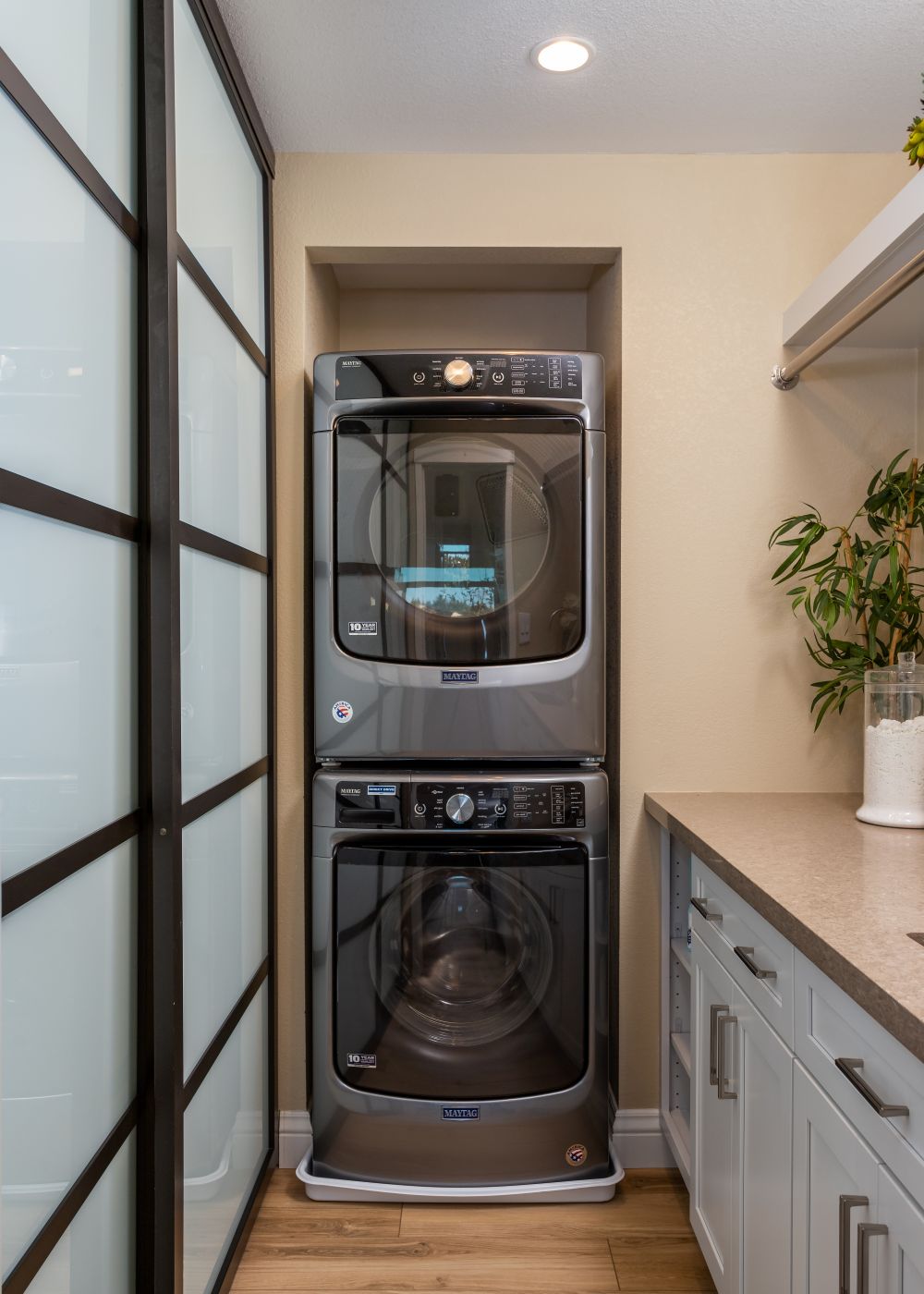 An upgraded stacked laundry closet in a Moraga home featuring improved lighting, nearby cabinetry, and a more intentional layout. This design makes better use of vertical space while creating a cleaner, more functional laundry experience.
Why French Laundry Spaces Are So Small (And Why That's Not a Problem)
Most French apartments — particularly in Paris and older provincial cities — were built long before washing machines existed. Plumbing was added later, retrofitted in wherever made structural sense. There are no utility rooms, no attached garages, no laundry closets. Real estate is expensive, walls are thick, and every square meter matters.
So laundry became something you integrate into existing life rather than something that gets its own dedicated space. The washer fits where there's plumbing. Drying happens wherever there's air movement. The system is built around the home's reality rather than around an idealized floor plan that doesn't exist.
The Rossmoor Parallel
Many Rossmoor units were built under essentially the same constraints — laundry was never part of the original design, plumbing runs through specific walls, and the structural possibilities for adding new hookups are limited. The difference is that in France this was accepted as normal and elegant solutions were developed. In the U.S., we tend to fight the constraint instead of designing with it. The French approach argues that designing with it is both more practical and more livable.
The Washer in the Kitchen: Why It Makes Sense
The kitchen washer is the most distinctive French laundry feature — and the most misunderstood by Americans who see it for the first time.
Think about what the kitchen already has: a cold water supply line, a hot water supply line, a drain, a 240-volt electrical connection (for the stove), and a counter at precisely the height needed to sit above a standard appliance. That's everything a washer needs. The machine slides under the counter exactly the same way a dishwasher does — because it's using the same connections, or connections very close to them.
French Design Principle #1
Put the machine where the plumbing is. Don't fight the building's structure — work with it. A washer under the kitchen counter is more honest than an elaborate workaround.
In Rossmoor and older East Bay homes, we apply this principle regularly. When we're doing a kitchen remodel and the client wants in-unit laundry, the most efficient solution is almost always to add the washer to the kitchen cabinetry rather than run new plumbing to a different part of the unit. It's cleaner, faster, and less disruptive to the rest of the home.
For the full breakdown of how kitchen laundry integration works in Rossmoor, see Closet and Laundry Reconfigurations in Rossmoor.
Air Drying: Practical, Not Precious
Dryers are far less common in France than in the U.S. This is partly cultural, partly economic (energy costs), and partly structural — venting a dryer through a Haussmann-era exterior wall is genuinely difficult. So the French dry clothes on racks, over radiators, on collapsible wall-mounted systems, and on balcony lines.
The benefits aren't just aesthetic. Clothes air-dried at room temperature last significantly longer than those subjected to heat-dryer cycles. Natural line drying leaves fabrics softer (particularly cotton) and extends garment life in a way that heat drying doesn't. And small loads — the French norm — dry quickly enough that air drying rarely creates the "pile-up" problem that comes with the American big-load-once-a-week approach.
French Design Principle #2
The dryer is optional. Good airflow and daily rhythms accomplish what weekly machine-drying does in America — without the energy cost or the fabric damage.
The Combo Unit: France's Compact Workhorse
When French households do want a dryer function, they almost always choose a combination washer-dryer unit — one machine that does both. These machines are ubiquitous in compact European apartments for obvious reasons: one footprint, one set of hookups, one space requirement.
Combo Washer-Dryer — How It Works and What to Expect
A combo unit is a single front-load machine that runs a wash cycle and then transitions directly to a drying cycle using ventless technology — typically condensation or heat pump drying. You load once, press start, and come back to dry clothes. The tradeoffs: drum capacity is smaller than separate machines (typically 2–2.5 cubic feet), and the combined cycle takes longer (often 3–4 hours total). For a 1–2 person household doing regular-size loads, this is entirely manageable. For a larger household doing full loads of towels, it may feel limiting. In Rossmoor units where even compact stackables are a tight fit, combo units are often the only realistic ventless solution.
The best places for combo units in East Bay and Rossmoor homes: bathroom corners, under-counter kitchen slots, entry closets where even a 24-inch stacked set is too deep, and bedroom closets adjacent to bathroom plumbing walls.
Smaller Machines, Better Habits
French washers are smaller than American ones by design — typically 5 to 7 kg capacity versus the American 8 to 11 kg norm. This isn't a limitation. It's a feature.
Smaller machine capacity encourages smaller, more frequent loads. Instead of one giant weekly laundry event — which requires time blocking, multiple loads, an afternoon of folding — laundry becomes a daily background task. A small load before bed. Another in the morning. Clean clothes available continuously, no pile on the chair, no "I have nothing to wear" Monday morning crisis.
"Laundry isn't a chore in France. It's a rhythm. And a well-designed space makes rhythm possible."
What to Take Home
You don't need to move to Paris to implement any of this. These ideas translate directly to Rossmoor condos and older East Bay homes.
If your kitchen has plumbing and you're doing a remodel, consider building laundry in. If you have a bathroom with a linen closet that's underused, a compact stacked unit or combo unit belongs there. If you have a balcony or patio, a retractable drying line is genuinely useful for nine months of the year in the East Bay climate. If you've been fighting your home's structure trying to create a "real" laundry room where one can never really exist, the French model suggests that the fight isn't worth having.
Good design doesn't mean more space. It means smarter space. And in that respect, the French have been ahead of us for a long time.
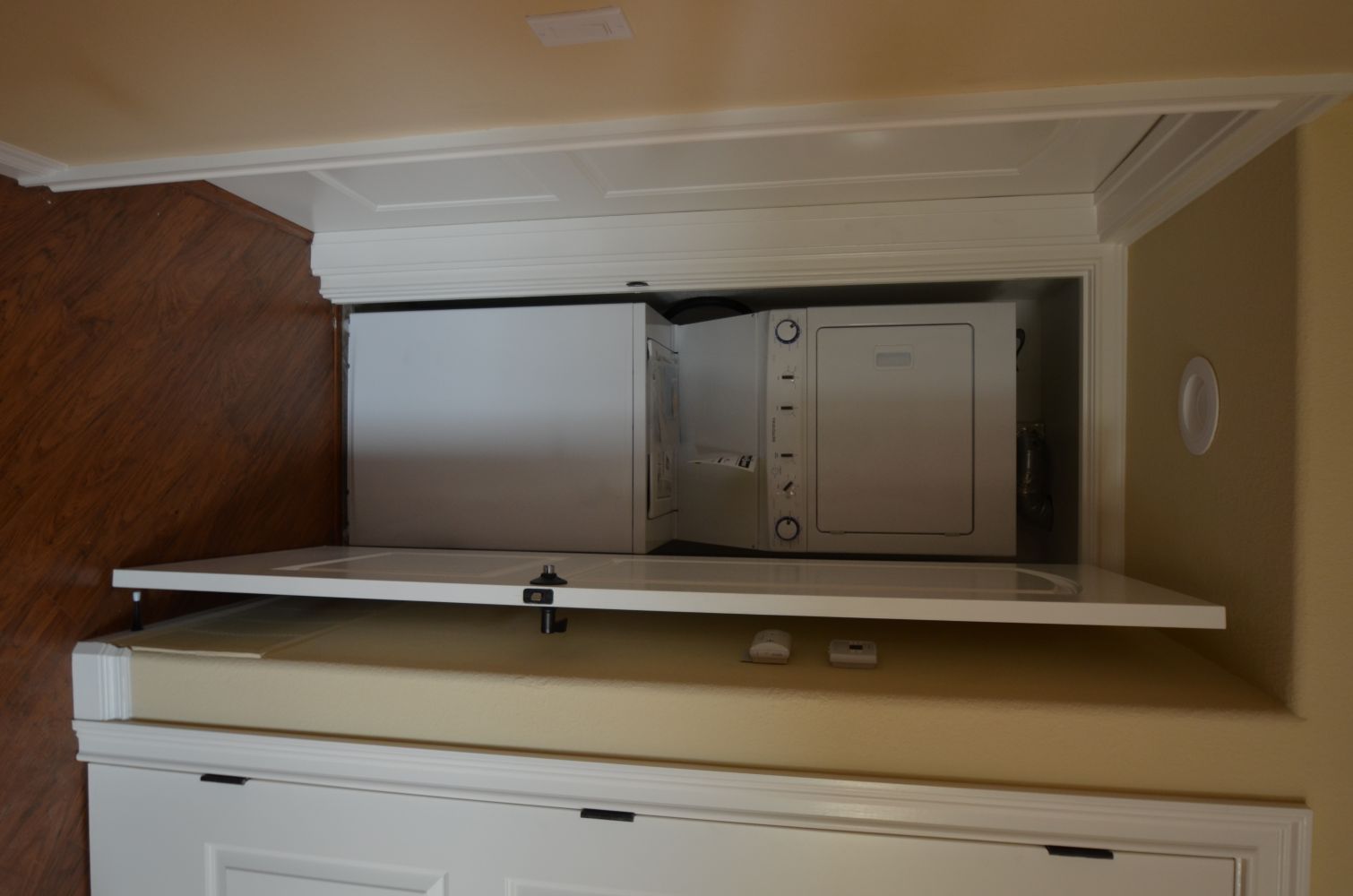 A basic stacked washer and dryer setup in a tight closet in a Rossmoor condo. Limited clearance, minimal lighting, and lack of storage highlight common frustrations in older laundry layouts.
I've shown homeowners the French laundry concept and watched them go from "that's weird" to "actually that's exactly what my kitchen needs" in about 90 seconds. Once you let go of the idea that laundry requires a dedicated room, the whole floor plan opens up. That mental shift is often the most valuable thing we bring to a conversation.
Want Laundry That Works With Your Home — Not Against It?
We design compact, integrated laundry spaces throughout the East Bay and Rossmoor. The French would approve.
Get a Free Consultation
Toupin Construction
Ready to start your remodel?
Whether you're dreaming of a new kitchen, a spa-worthy bathroom, or a whole-home transformation — we’d love to hear about your project. Reach out and let's talk.
‹ Back
Comments