


By using our website, you agree to the use of cookies as described in our Cookie Policy
Blog
Laundry Rituals: The Emotional Labor of Keeping a Family Dressed
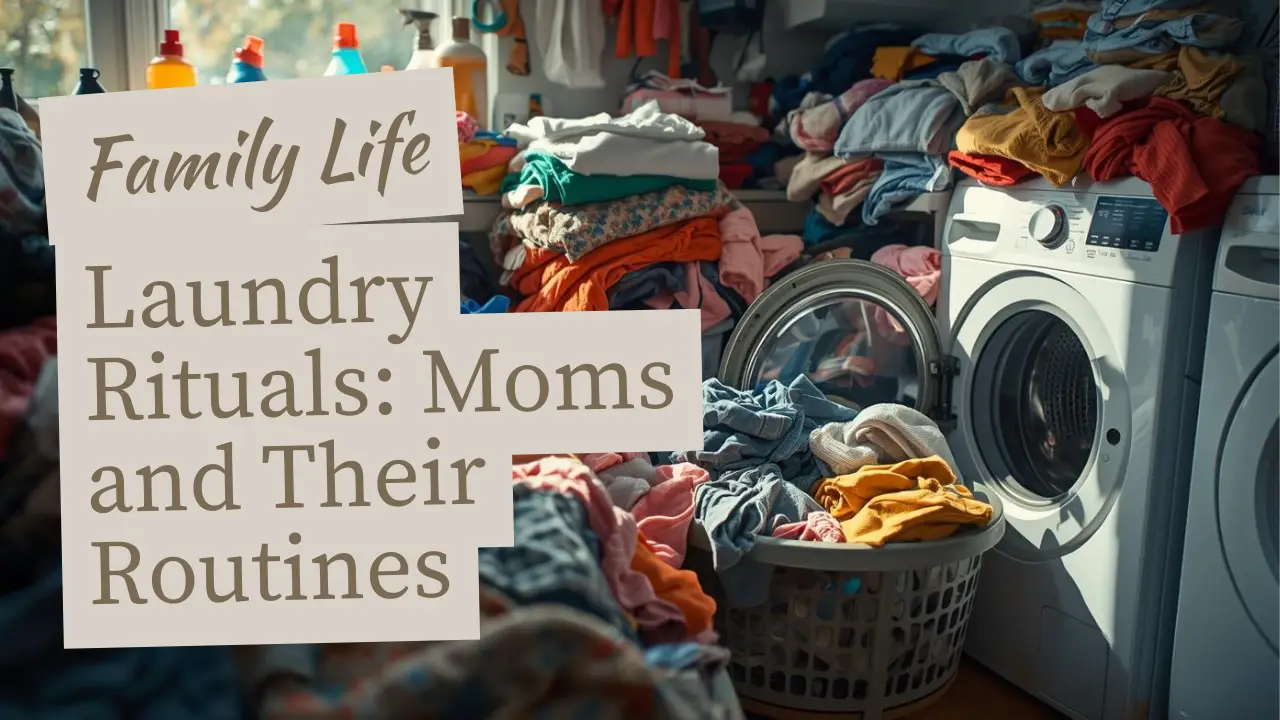
My mom did laundry every single day. Not as a lifestyle choice — as a necessity. Four kids, a husband who came home covered in sawdust and stucco every afternoon, and a washer and dryer in a narrow closet off the kitchen that she navigated like a game of Tetris for about twenty years.
I never thought about it as anything except "Mom doing laundry." It was background noise. Permanent background noise.
It wasn't until I started doing my own laundry — really doing it, in real homes with real families — that I understood what that closet was costing her every day. Not just time. Energy. Cognitive load. The low-level friction of a poorly designed space that multiplies every time you have to use it.
This one's for her, and for everyone like her.
What We Mean When We Say "Emotional Labor"
Laundry is one of the most repetitive tasks in household life. It never finishes. The pile comes back. In a family with kids, the cycle is relentless — and in a home with a poorly designed laundry space, every single cycle adds friction on top of the task itself.
Emotional labor is the invisible mental work that goes into managing tasks — the remembering, the planning ahead, the tracking of what's clean and what isn't, the mental load of keeping multiple people dressed and ready every single day. Laundry carries more of this load than almost any other household task, because it touches every person in the family, every day, and the consequences of dropping it are immediate and visible.
"When the space fights you, the task feels like failure. When the space works with you, the task becomes just a task."
A poorly designed laundry space amplifies this emotional load. Every awkward reach, every wrestle with a bifold door, every time you have to step over a basket because there's nowhere else to put it — that's friction. And friction compounds. It's not just annoying in the moment; it creates avoidance. And avoidance creates piles. And piles create the particular stress of a task that's perpetually behind.
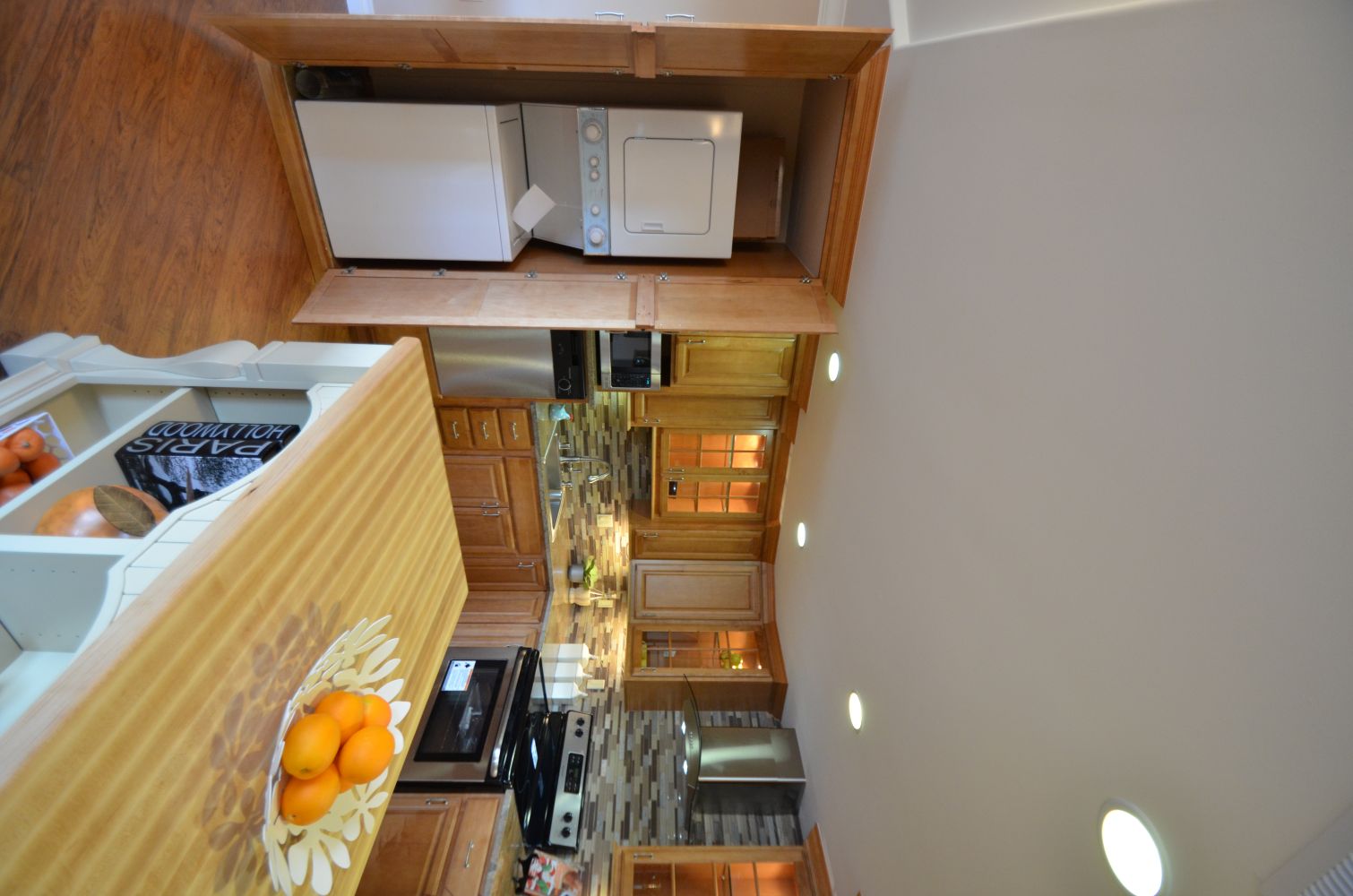 A stacked washer and dryer concealed inside a kitchen cabinet in a Rossmoor condo. This space-saving solution keeps laundry tucked away, but also highlights the challenges of noise, accessibility, and workflow when laundry shares space with the kitchen.
What "Good Design" Looks Like in a Laundry Space
Good design in a laundry space isn't about aesthetics — though a space that's pleasant to be in is genuinely better. It's about removing friction from a task you have to do regardless. Every friction point eliminated is mental energy returned to the person who uses the space.
A Place to Fold
This sounds obvious, but it's absent in most East Bay laundry setups. A counter at the right height — even a wall-mounted drop-down shelf — transforms folding from a kitchen-table task into a laundry-adjacent task. When folding happens where laundry is, clothes go to bedrooms instead of living on the couch for three days.
Design Fix
A wall-mounted drop-down shelf above a stacked unit costs very little and adds a full folding surface without taking up permanent floor space. In a compact Rossmoor entry closet, this is often one of the highest-value additions we make.
Sorted Hampers, Off the Floor
Floor-level laundry baskets require bending, sorting, and visual clutter. Pull-out hampers built into a cabinet base — one for lights, one for darks — keep laundry sorted automatically without adding any daily decision-making. When you're ready to run a load, it's already separated.
Lighting That Doesn't Make You Feel Like You're in a Closet
Because you are in a closet — but you don't have to feel like it. Motion-activated LED strip lighting makes an enormous difference in a small laundry space. You open the door, the light comes on, you can actually see what you're doing. Cheap to install, genuinely transformative in daily use.
Hanging Space for the Items You Never Know What to Do With
A short rod — 18 inches, even 12 inches — in the laundry closet handles the things that come out of the dryer needing to go straight on a hanger: button-downs, dress clothes, the shirts that wrinkle if they sit in the basket. Without this rod, those items end up on doorknobs, on chairs, on the bed. With it, they go where they belong while you're standing right there.
Machines That Match Your Life, Not an Imagined Life
A family with active kids and a husband in construction — hi, Mom — has different laundry needs than a couple of empty-nesters in a Rossmoor two-bedroom. Machine selection should reflect actual load frequency and size, actual clothing types, and the actual physical space available. Oversized machines in undersized spaces don't do more laundry faster. They just make the space harder to use.
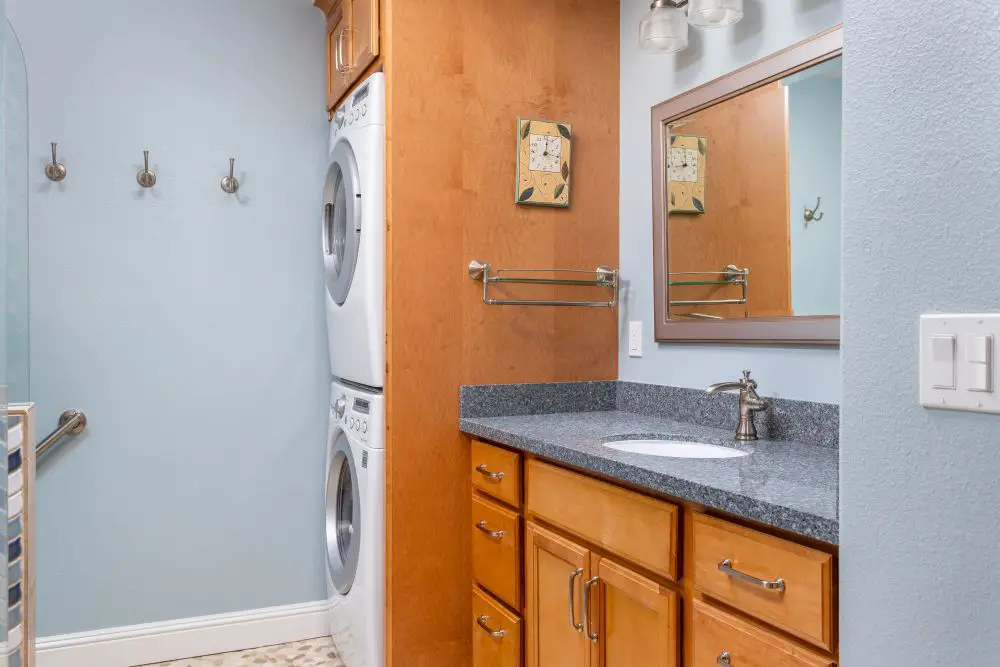 A compact bathroom layout in a Rossmoor home featuring a stacked washer and dryer integrated next to the vanity. While efficient, this setup demonstrates the importance of planning for clearance, storage, and daily usability.
The Rhythm Problem
Here's something I've observed working in homes for a long time: the people who dread laundry the most are almost always doing it in one big weekly batch. The people who barely think about laundry are almost always doing a small load most days.
This isn't a personality difference. It's a design difference. Small frequent loads only work if the laundry space is accessible and easy to use. If getting to the machines requires effort — navigating past obstacles, dealing with a door that never opens right, clearing space to fold — you're going to avoid doing small loads and save everything for the weekend. And then the weekend feels like a punishment.
We talk about this rhythm in our French laundry post — the French approach to daily small loads is directly connected to having a small, easy, integrated laundry setup rather than a big dedicated room you have to "go to."
Rossmoor Specifically: Laundry and Aging in Place
Many of the homeowners I talk to in Rossmoor are in their 60s and 70s. They're healthy, active, and planning ahead. They're also thinking carefully about how their homes will work for them as time goes on — and laundry is almost always part of that conversation.
For Rossmoor Residents
Laundry access is a quality-of-life issue that compounds significantly over time. Front-load machines on raised platforms eliminate the bending to the drum floor. Wider door openings allow wheeled hampers to pass through without maneuvering. Good lighting reduces the chance of missteps in a dark closet. These are small changes that add up to genuine long-term independence — and they're entirely achievable in Rossmoor's floor plans.
Private in-unit laundry in Rossmoor isn't just a convenience. For homeowners managing mobility concerns, recovery from surgery, or simply the physical reality of carrying a heavy basket down a hallway, having laundry close and accessible is the difference between managing independently and needing help. We design for that reality on every Rossmoor laundry project.
Design Choices That Actually Reduce Emotional Labor
Here's the short version of what we've learned works across hundreds of laundry spaces in East Bay homes and Rossmoor units.
Storage that follows behavior, not an organizational ideal. Detergent goes next to the machine — not above the dryer, not in the cabinet across the room. Stain remover at eye level. Dryer sheets where you reach for them naturally. Design storage around how you actually move through the space, not around how an organizing guru says you should.
Fewer decisions per load. Pre-sorted hampers. A folding surface right there. A hanging rod for items going straight to hangers. Each of these eliminates a micro-decision that adds up over hundreds of laundry cycles into real mental energy saved.
Machines that run quietly. In shared-wall Rossmoor buildings especially, a machine that vibrates through the floor and hums through the night trains you to delay running loads until "a better time." A quieter machine — modern smart washers have significantly better vibration dampening — removes that mental calculus entirely.
A space you don't dread. This part matters more than it sounds. Fresh paint. A clean shelf. Good light. Matching baskets. You're going to be in this space multiple times a week for the rest of your life in this home. It's worth making it a space you don't mentally sigh about before you open the door.
I renovated a laundry space in a Skycrest Drive unit last year for a woman who told me she'd been putting off her laundry for "as long as possible" for about five years. That's five years of low-grade stress sitting in the back of her mind every time she walked past that closet door. After the project, she texted me: "I did laundry twice this week and it wasn't terrible." That's the goal. Not amazing. Not transformative. Just not terrible. Laundry that doesn't steal anything from your day beyond the time it actually takes.
The Connection Between Space and Stress
There's real research behind this, but you already know it intuitively: clutter and disorder increase stress hormones. Environments that feel chaotic or difficult to navigate elevate the background anxiety level even when you're not actively thinking about the disorganized space.
Laundry, because it touches every person in a household and never fully resolves, sits in that background-anxiety category for many people — especially people managing busy households. A designed laundry space doesn't eliminate laundry. But it removes the design-caused friction, and that friction reduction is real.
If your laundry setup is currently part of your daily low-grade stress, that's a design problem with a design solution. For practical specifics on what those solutions look like, Why Laundry Sucks is the best starting point. For Rossmoor specifically, Closet and Laundry Reconfigurations in Rossmoor gets into the specific logistics. And for the appliance piece, the future of laundry covers what modern machines can actually do that older ones couldn't.
Ready to Make Laundry Less of a Thing?
We design laundry spaces that work with how you actually live — not against it. Give us a call or request a consultation. No pressure, just an honest conversation about what's possible.
925-937-4200 · Get a Free Consult
Toupin Construction
Ready to start your remodel?
Whether you're dreaming of a new kitchen, a spa-worthy bathroom, or a whole-home transformation — we’d love to hear about your project. Reach out and let's talk.
‹ Back
Comments