

By using our website, you agree to the use of cookies as described in our Cookie Policy
Blog
Hickory Cabinets: Bold Grain, High Contrast, and Built for Real Life
Hickory is not subtle. It doesn't blend in. And it definitely doesn't try to please everyone.
I've seen homeowners fall in love with hickory the moment they touch a sample. I've also seen homeowners look at the same sample and say, "Absolutely not." And honestly? That's exactly how hickory is supposed to work. This is a wood with strong opinions about itself, and it rewards people who share them.
Wood Species Series
- Wood Species 101: Start Here
- Oak Cabinets
- Maple Cabinets
- Walnut Cabinets
- Cherry Cabinets
- Alder Cabinets
- Hickory Cabinets (this post)
- Birch Cabinets
- Ash Cabinets
- Pine Cabinets
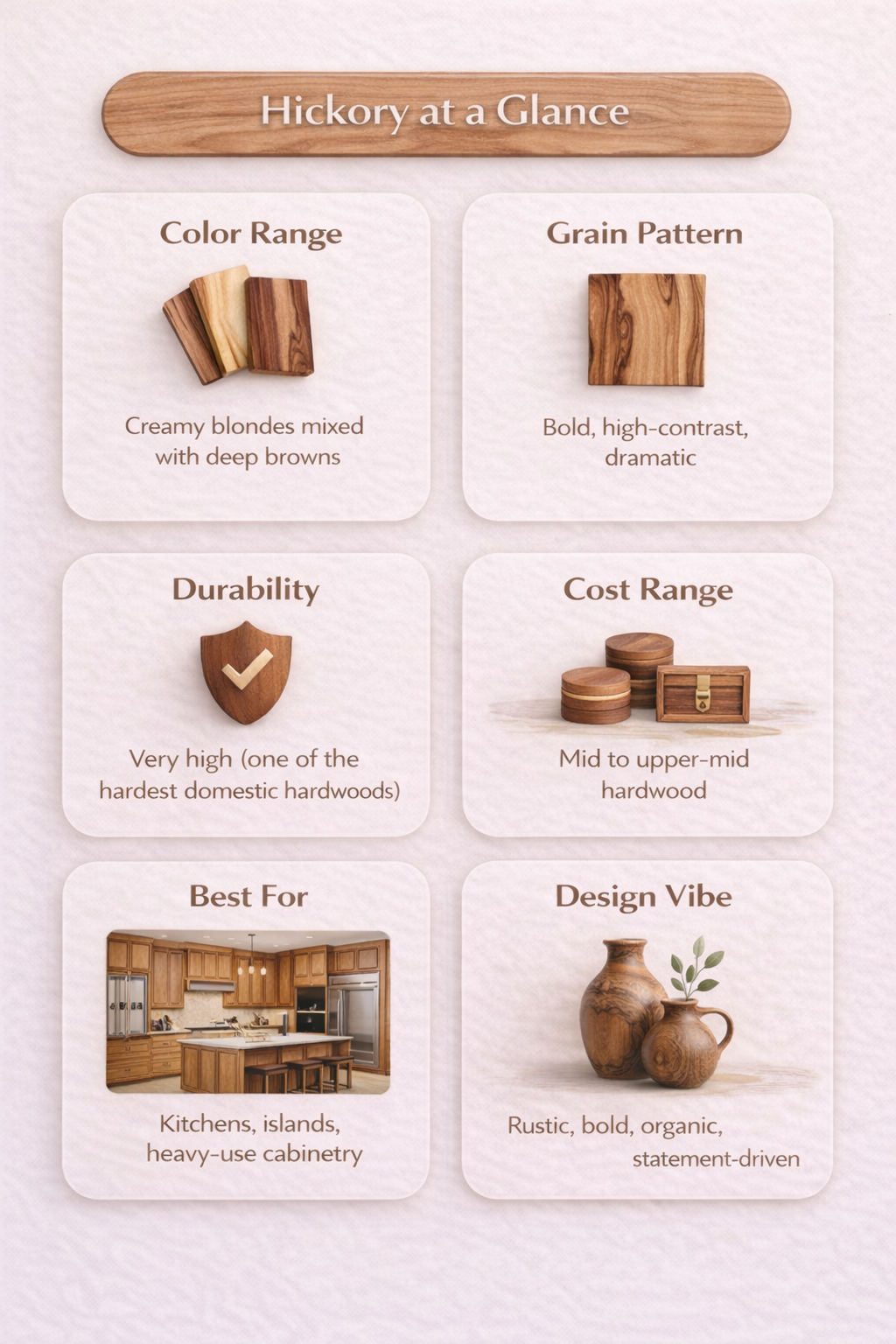 A visual guide to hickory wood showcasing its high-contrast color range, bold grain pattern, exceptional durability, and mid to upper-mid price point. Hickory is one of the hardest domestic hardwoods and ideal for statement cabinetry.
What Makes Hickory Different from Everything Else
Hickory's defining visual feature is contrast — light sapwood and dark heartwood appearing side by side, sometimes within a single cabinet door. That contrast can feel warm and earthy or visually overwhelming, depending entirely on who's looking at it. Neither reaction is wrong. Hickory is a personality wood — it either speaks to you or it doesn't.
Jargon Card
Sapwood vs. Heartwood
The sapwood is the lighter, outer portion of the tree — typically creamy or blond in hickory. The heartwood is the darker, inner core — deep brown. Because hickory grows with dramatic color variation between these zones, a single cabinet door can contain both, creating the high-contrast look the wood is known for. This isn't a defect. It's the signature.
What matters is understanding this going in: when you choose hickory, you're choosing the contrast. There's no taming it with stain. Painting it removes the entire point of the wood. If the variation is what you love, hickory is extraordinary. If you want uniformity, look at maple or ash first.
Durability: Hickory's Superpower
Here's where hickory genuinely earns its place: it is one of the hardest domestic hardwoods available for cabinetry. Harder than oak. Harder than maple. Harder than any other species in this series. In practical terms, it resists dents better than almost anything else, holds up to heavy daily use without complaint, and is the wood I'd recommend to anyone who has ever said, "I don't want to worry about my cabinets."
Wear on hickory also tends to blend into the grain rather than standing out. A scratch on a uniform maple cabinet is obvious against that smooth, consistent surface. A scratch on hickory's already-varied face largely disappears into the existing color variation. For active households — kids, pets, people who actually cook — that invisibility is genuinely valuable.
"Hickory is the wood I'd recommend to anyone who's ever said, 'I don't want to worry about my cabinets.'"
Hickory vs. the Other Bold Woods
Hickory often gets compared to walnut and oak as the "character" options in the hardwood family. Here's how they actually differ:
| Quality | Hickory | Oak | Walnut |
|---|---|---|---|
| Grain character | Bold, high-contrast, dramatic | Pronounced, linear | Rich, moderate movement |
| Color range | Blonde to deep brown — in the same board | Tan to honey | Chocolate to espresso |
| Durability | Highest of the three | Very high | Moderate-high |
| Design fit | Rustic, farmhouse, bold organic | Classic to modern-organic | Sophisticated, design-forward |
| Painted finish | Never — defeats the purpose | Not ideal | Never — defeats the purpose |
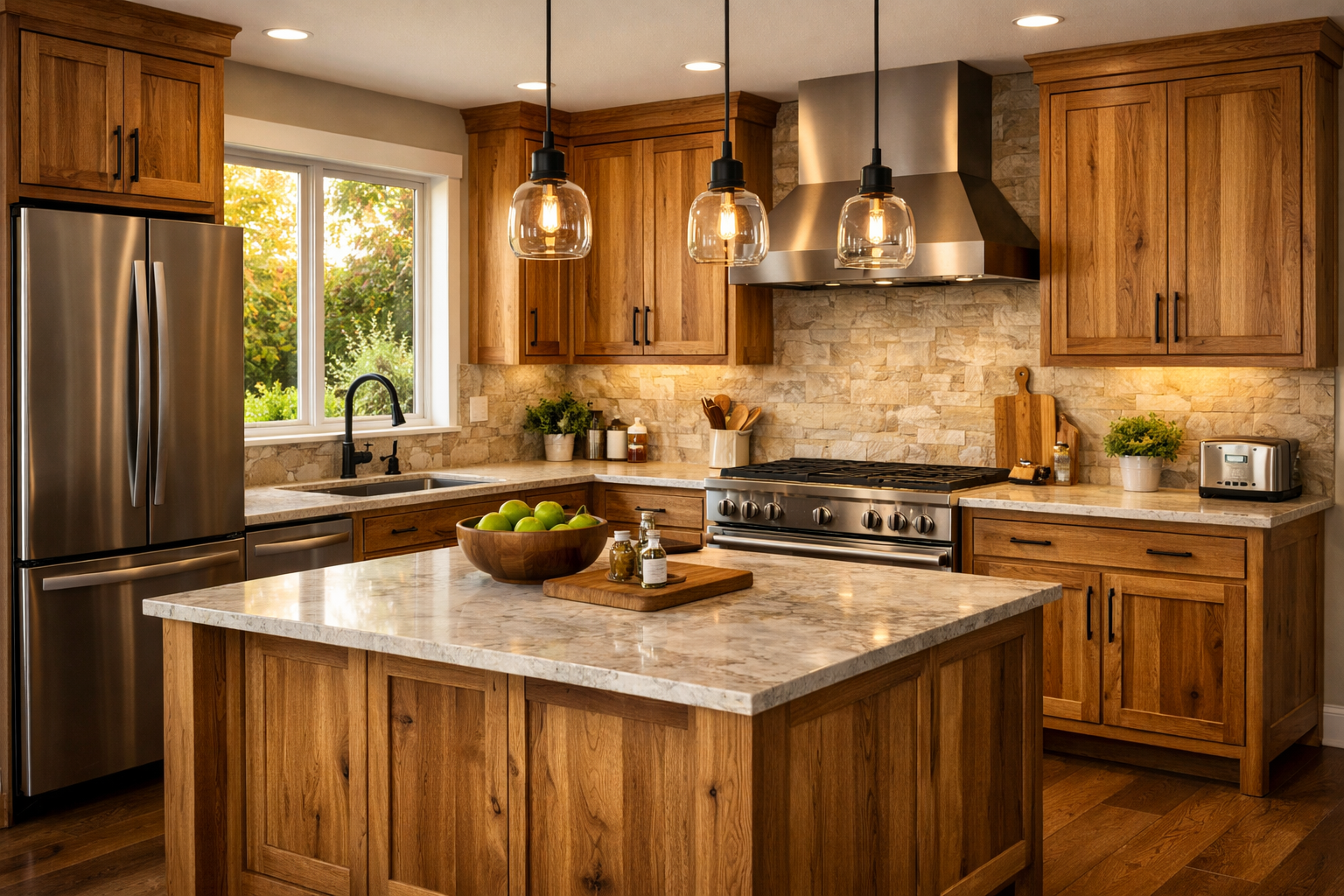 A warm, inviting kitchen featuring hickory cabinetry with rich color variation and bold grain. Hickory cabinets create a rustic, high-character look and are ideal for heavy-use kitchens.
Door Styles That Suit Hickory
Hickory's grain does so much visual work that the door profile needs to stay quiet. Flat-panel and slab doors are the strongest choice — they let the contrast between sapwood and heartwood read across the entire face without interruption. Simple shaker profiles work too, particularly with wider rails that frame the grain without overwhelming it.
What to avoid: ornate raised panels, cathedral arches, or heavily routed profiles. These styles compete with hickory's natural drama and the result is visual noise rather than character. Hickory is already making a statement. The door should amplify it, not argue with it.
One practical note: because hickory's color variation is so pronounced, door layout and grain matching during installation matters more than with most species. A good cabinet maker will be thoughtful about how doors are arranged so the contrast flows naturally rather than looking random or patchy.
What Hickory Actually Costs
Hickory sits in the mid to upper-mid range of hardwood pricing — more than birch or alder, roughly comparable to oak, and less than walnut or cherry. For the durability you're getting, it's genuinely good value.
The cost is reasonable for what hickory delivers: exceptional hardness, dramatic visual character, and a wood that will outlast almost anything else in a hard-use kitchen. If you're choosing between hickory and a more expensive species purely for looks, it's worth asking whether hickory's character actually suits your home better — because in the right context, it does.
How Hickory Ages
Hickory ages honestly — which means it becomes more itself over time, not less. The contrast between light and dark tones mellows slightly as the wood settles, but the drama never fully disappears. Wear blends into the grain rather than creating obvious damage points. Minor dents and scratches disappear into the variation in a way that simply doesn't happen with smoother, more uniform species.
Ten-year-old hickory cabinets that have been maintained well look like they've earned their place in the kitchen. There's a settled, substantial quality to aged hickory that's hard to fake with any other material. It's one of the few woods where time genuinely improves the overall impression.
Pros and Cons
What Works
- Extreme durability — one of the toughest cabinet woods available
- Bold visual character — every cabinet is genuinely unique
- Hides wear beautifully — marks blend into existing grain variation
- Ideal for active households with kids, pets, and heavy cooking
- Ages honestly — develops more character, not less, over time
What to Watch For
- Very busy visually — genuinely not for minimalists or modern spaces
- Hard to pair with bold countertops or competing finishes
- Painted hickory removes the entire point of the wood — never recommended
- Visual weight can overwhelm smaller kitchens and condos
- Grain matching during installation requires a skilled cabinet maker
Rossmoor Homeowners
Hickory is rare in Rossmoor kitchens — and because of the compact layouts, that generally makes sense. The visual weight of full hickory cabinetry in a smaller co-op kitchen can feel like too much. But hickory as an accent? A hickory island against painted perimeter cabinets in a unit with good natural light? That can be really striking. If you have the square footage and the light exposure to support it, it's worth a conversation. For most Rossmoor primary kitchens, white oak gives you natural character and durability in a package that works better at that scale.
Design Pairings for Hickory
The rule with hickory is simple: restraint in everything around it. The wood is carrying the visual load. Everything else needs to step back.
Countertops: Soapstone, simple quartz with minimal or no veining, or plain honed porcelain. Busy veining or dramatic stone patterns compete directly with the grain and neither wins. Keep the countertop as calm as possible — it should be a resting place for the eye, not another texture fighting for attention.
Hardware: Matte black, oil-rubbed bronze, or simple wrought iron profiles. Warm, rustic, unfussy. Polished or contemporary hardware — brushed nickel, chrome — looks wrong against hickory's organic character. Stay in the earthy register.
Wall colors: Warm whites, soft creams, and earth tones. Tan, warm greige, or a muted sage can work beautifully. Cool-toned walls make hickory look muddy. The wood wants warmth around it to feel grounded rather than jarring.
Backsplash: Simple handmade ceramic in a warm white, plain subway tile, or no tile at all with a painted wall. A busy or patterned backsplash against hickory cabinets is genuinely too much. This is one situation where less is always more.
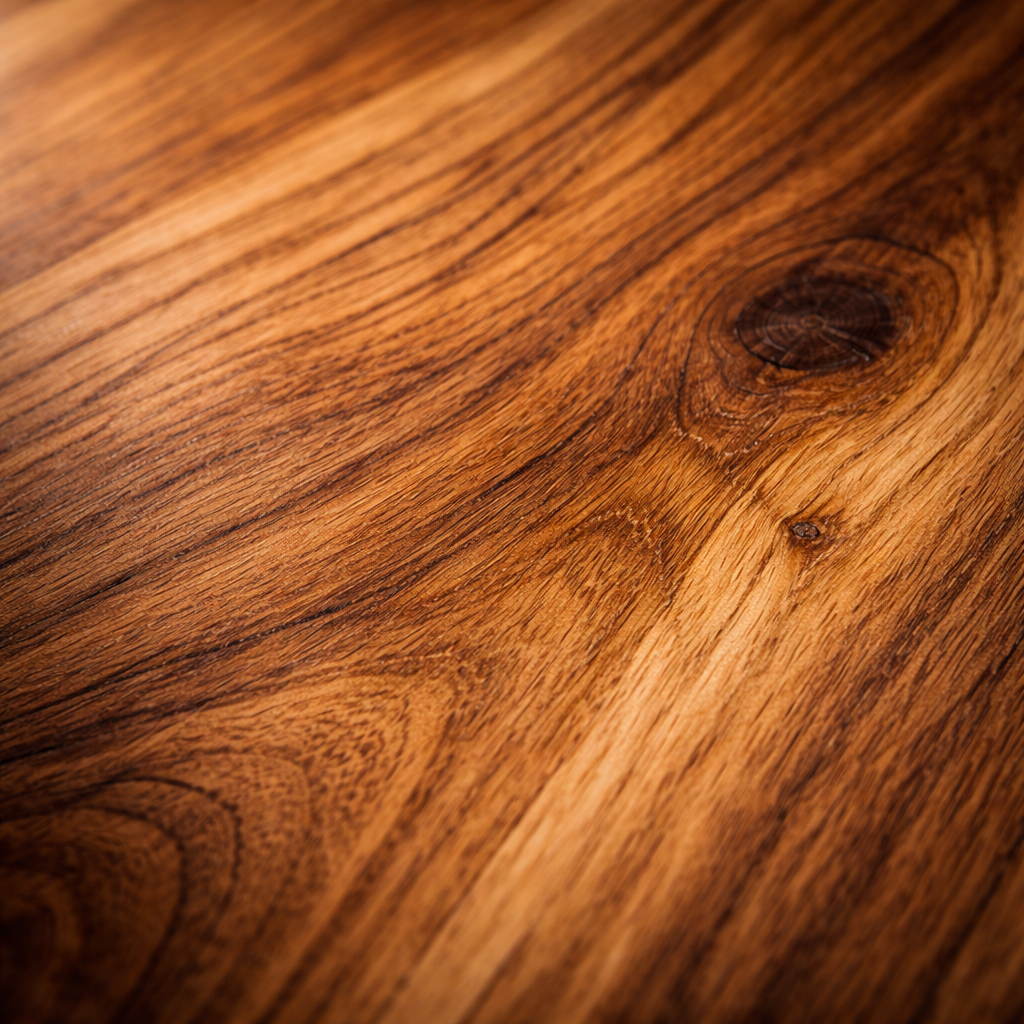 A detailed close-up of hickory wood highlighting its dramatic grain pattern, natural knots, and strong color variation. Hickory is known for its bold, rustic character and high durability.
Is Hickory Right for You?
Hickory is the right wood if you love bold grain and high contrast, want maximum durability without babying your cabinets, cook and live hard in your kitchen, and are drawn to organic, natural materials in a real and unpolished way. The clients who are happiest with hickory are the ones who said yes to the sample immediately — who didn't need convincing, just confirmation.
Pass on hickory if you prefer clean, uniform surfaces, are going for a modern or minimal aesthetic, plan to paint your cabinets, or have a smaller kitchen where the visual weight would dominate rather than anchor. For durability without the drama, oak gives you most of the hardness with a more versatile look. For bold character in a darker palette, walnut is the more refined version of the same instinct. For the warmth of natural wood without hickory's intensity, alder is worth a look.
But if hickory spoke to you the moment you saw a sample — trust that. It's a wood that knows its audience.
From Candi
Hickory is one of those species where the best clients I've ever worked with absolutely knew what they wanted. They didn't second-guess the grain, didn't want us to tone it down, just wanted to know we could build it right. That kind of confidence in a material is a joy to work with. If you're thinking about a kitchen remodel and hickory is calling to you, let's start the conversation. See our kitchen remodeling page or portfolio for context.
Thinking About Hickory?
Let's talk through whether hickory fits your space, your lifestyle, and what you're going for. No pitch — just honest experience.
Start a Conversation →A warm, inviting kitchen featuring hickory cabinetry with rich color variation and bold grain. Hickory cabinets create a rustic, high-character look and are ideal for heavy-use kitchens.

Toupin Construction
Ready to start your remodel?
Whether you're dreaming of a new kitchen, a spa-worthy bathroom, or a whole-home transformation — we’d love to hear about your project. Reach out and let's talk.
‹ Back
Comments