


By using our website, you agree to the use of cookies as described in our Cookie Policy
Blog
Open Floor Plans: Still Worth It?
Design Inspiration · Whole Home
Open Floor Plans: Still Worth It?
40 years of knocking down walls — and putting some back up — gives you a pretty honest perspective on this
If you've spent any time on HGTV, you know the ritual: contractor walks into a 1970s home, homeowners gaze longingly at the wall between their kitchen and living room, and someone says "what if we just opened this up?" The wall comes down, everyone gasps at the light, and the episode ends happily.
What you don't see on television is the homeowner who called us two years later because the cooking smells had taken over the whole house, or the couple who realized open concept felt great for parties and miserable for two people trying to work from home simultaneously. Open floor plans are genuinely wonderful in the right circumstances. In the wrong ones, they're expensive regret.
Here's what 40 years of East Bay remodeling has actually taught us about this question.
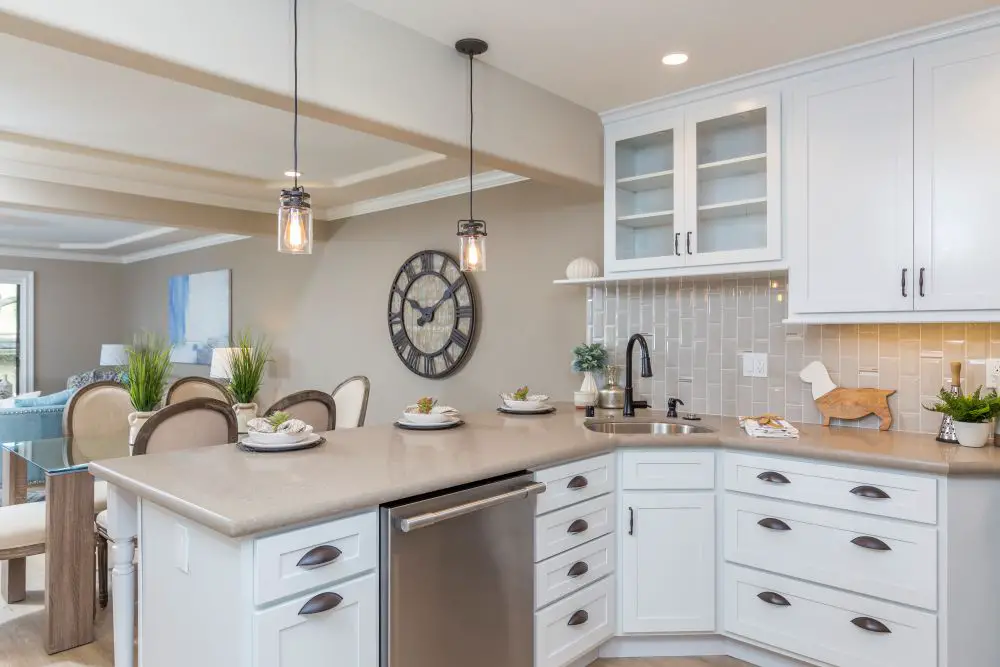 Bright open-concept kitchen with island seating flowing seamlessly into a dining and living area, showcasing modern interior design.
The Case For and Against
What Both Sides Get Right
✓ Open Floor Plan — What Works
- Natural light travels through the whole space instead of dying at a wall
- Easier supervision of young children or aging parents while cooking
- Entertaining flows without the cook being isolated in the kitchen
- Smaller homes feel significantly larger and less segmented
- Consistent flooring across spaces reads as more contemporary
✗ Open Floor Plan — What Doesn't
- Sound travels completely freely — TV, cooking, phone calls, all of it
- Cooking smells — good and bad — fill every room instantly
- Fewer walls means less storage, fewer art display options, less furniture flexibility
- HVAC costs increase when heating/cooling one large undivided space
- Privacy disappears for anyone trying to work, rest, or be on a call
"The homes we remodel back toward more definition — partial walls, pocket doors, glass partitions — are almost always homes that went fully open five to ten years ago. The people in them liked it for parties. They want their rooms back for daily life."
The Critical Question First
Load-Bearing Wall or Not? This Changes Everything.
Trade Term: Load-Bearing Wall
A load-bearing wall carries structural weight from the roof or floors above, down through the foundation. Removing one requires transferring that load to a beam — typically a steel I-beam or LVL (laminated veneer lumber) beam — supported by posts or columns that carry the weight to the foundation. This is permitted, engineered structural work. A non-load-bearing wall (also called a partition wall) carries no structural load and is comparatively simple to remove.Do not assume which type you have without a professional assessment.Exterior walls and walls running perpendicular to floor joists are frequently load-bearing. The wall you most want to remove is often the one that's actually holding the house up.
In East Bay homes built in the 1960s and '70s — which is the bulk of what we work on in Walnut Creek and Rossmoor — the wall between the kitchen and the dining room or living room is quite often load-bearing. The consequence of removing it incorrectly isn't aesthetic; it's structural. We've seen the aftermath of unpermitted wall removals where the ceiling slowly deflected over years, doors began sticking, and cracks appeared in drywall in adjacent rooms. The fix at that point is significantly more expensive than the original project would have been with proper engineering.
When we assess a wall removal request, we open the wall in one location, trace the framing, and often consult a structural engineer. The permit process requires this for load-bearing walls. It's not optional.
The East Bay Pattern
What We Actually See in Walnut Creek and Rossmoor
| Home Type / Location | Common Request | What Usually Works |
|---|---|---|
| Walnut Creek single-family, 1960s–1980s | Open up kitchen to dining and living | Full or partial wall removal with beam; very achievable and popular |
| Rossmoor co-op / condo | Open kitchen to dining area | Semi-open — removing a partial wall or widening a pass-through; full open requires Mutual approval |
| Larger East Bay homes, multigenerational | Better flow without losing rooms | Pocket doors, wide cased openings, glass panel inserts — visibility without full openness |
| Any home, post-2020 | Reclaiming a defined workspace | Adding back a partial wall, glass partition, or barn door to create a separated zone |
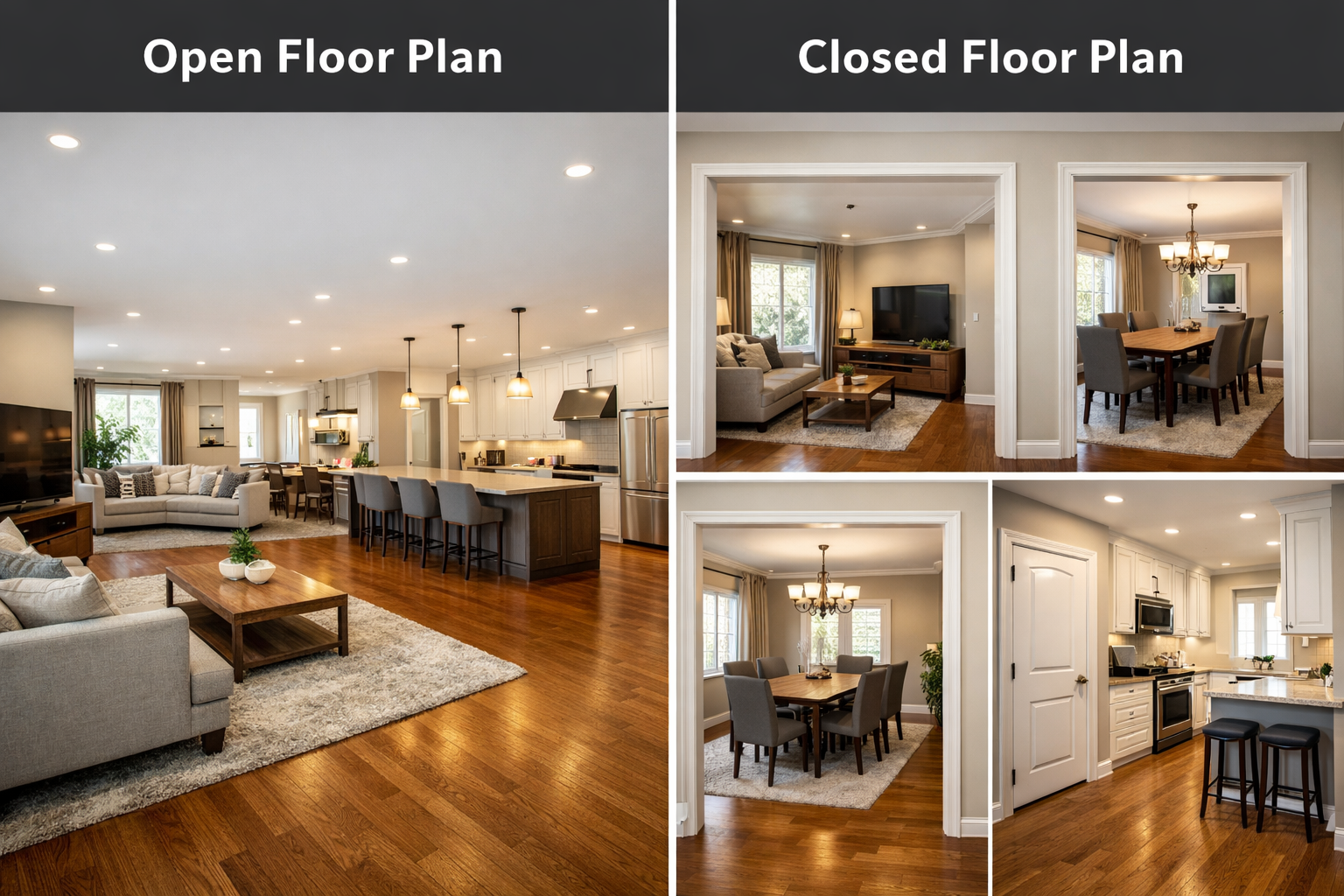 Side-by-side comparison of an open floor plan and a closed floor plan in a modern home, highlighting differences in layout, space flow, and room separation.
The Hybrid Reality
Most People Want Something In Between
After all these years, my honest observation is that most homeowners don't actually want fully open or fully closed — they want connection without chaos. They want to see into the kitchen from the living room, but they don't necessarily want the kitchen to smell the living room. They want a sense of flow, not a single undivided room.
The solutions that satisfy this in the most homes are not dramatic ones:
- Wide cased openings (48–60 inches): Remove the wall but frame a wide passage with visible trim — creates connection and visual flow without eliminating the sense of a threshold between spaces
- Half-walls or knee walls: Lower the wall to counter height (36 inches) rather than removing it entirely — natural bar seating opportunity, maintains some sound and visual separation
- Pocket doors: Open during the day, closed for movie night or when someone's on a call — the most flexible option because it's truly adjustable
- Glass panel inserts: Keep the wall structurally but add glass panels — light passes through, sound is muffled, privacy is maintained
How do I know if the wall I want to remove is load-bearing?
The honest answer: you often can't tell without opening it up and assessing the framing. General indicators that a wall may be load-bearing: it runs perpendicular to the floor joists, it's located near the center of the house, or it's directly below a ridge beam or above a foundation wall. But these are indicators, not rules. We assess this as part of every wall-removal consultation.
Does opening up a floor plan actually increase resale value?
In most East Bay markets, a more open main living area has appealed to buyers for the past twenty years. But the pendulum is moving. We're seeing more buyers ask specifically about home office space and defined rooms — a shift from the fully-open preference of the 2010s. Our current recommendation: if you're opening up for resale, include a pocket door or some mechanism to optionally separate spaces. That flexibility appeals to both camps.
What does wall removal typically cost?
A non-load-bearing wall removal with patching and painting: roughly $2,000–$4,000 depending on finish work. A load-bearing wall removal requiring a beam, posts, and structural work: $8,000–$20,000 depending on span, beam type, and what's in the wall (plumbing, electrical, HVAC). These are ranges — every job is different and we'll give you a specific number after a walkthrough.
Thinking about changing your floor plan?
We're happy to walk through your home, assess what's possible, and give you an honest picture — including what we'd actually recommend for your specific situation.
Get a Free Consultation Call 925-937-4200
Toupin Construction
Ready to start your remodel?
Whether you're dreaming of a new kitchen, a spa-worthy bathroom, or a whole-home transformation — we’d love to hear about your project. Reach out and let's talk.
‹ Back
Comments