

By using our website, you agree to the use of cookies as described in our Cookie Policy
Blog
Pine Cabinets: Soft, Character-Rich, and Not for Everyone
Pine is one of the most emotionally loaded woods in home design.
For some homeowners, it feels warm, nostalgic, full of charm — the kind of wood that reminds them of old farmhouses, cabins, and kitchens that feel genuinely lived in. For others, it feels frustrating, dented, uneven, and impossible to keep looking clean.
Both reactions are completely valid.
Pine is not a neutral wood. It's not a safe wood. It doesn't meet you halfway and it doesn't try to. Pine is a personality wood — one that rewards the right homeowner and punishes the wrong expectations going in. This post exists to make sure you know which one you are before you commit to it.
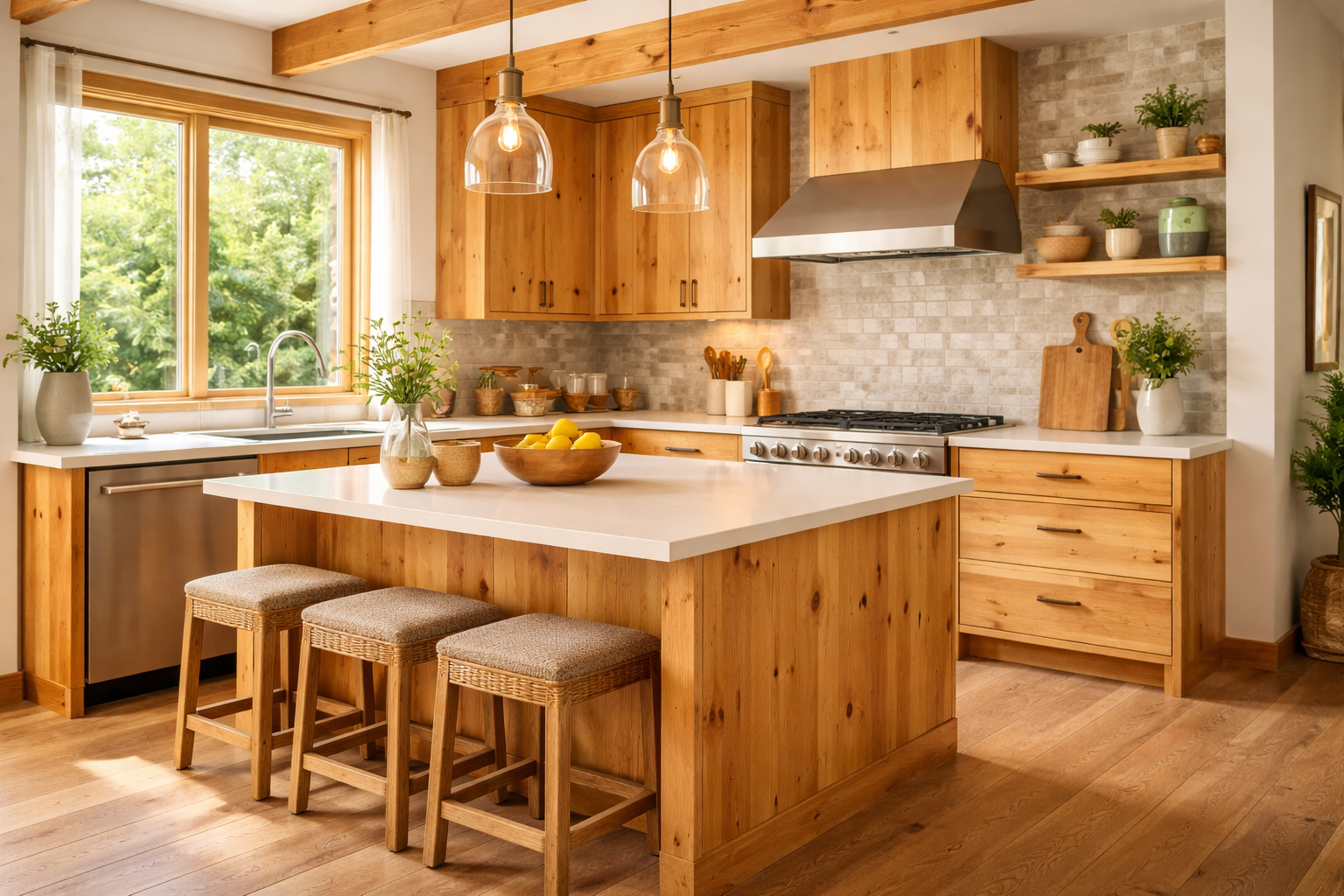 This kitchen showcases natural pine cabinetry with visible knots and warm tones, paired with white countertops and wood beams. A great example of pine creating a bright, rustic kitchen design in Walnut Creek.
Wood Species Series
The Most Important Thing to Understand: It's a Softwood
Pine is a softwood — not a hardwood. That single fact changes everything about how you should think about it as a cabinet material.
Jargon Card
Softwood
Softwood comes from evergreen trees (pine, fir, cedar) that grow faster and are generally less dense than hardwoods. "Soft" doesn't mean cheap — it means the wood will dent and scratch more easily under daily use. Pine grown in different climates varies in density, but all pine is meaningfully softer than oak, maple, hickory, or any of the hardwood species in this series.
What that means in practice: pine dents from normal kitchen use. Pots set down firmly, chair backs, kids being kids — all of this shows up on pine in a way that wouldn't register on oak or hickory. This is not a failure of the material. It's the nature of the wood. The question is whether you can live with it — and ideally, whether you can love it.
Knots: Feature, Not Flaw
Pine's knots are its identity. They're what the wood is. You don't choose pine hoping the knots will somehow be minimized — you choose pine because you want exactly that. Large visible knots, swirls, resin pockets, natural imperfections. These elements add charm for the right homeowner and cause frustration for perfectionists.
"If you don't love knots, pine is not the wood for you. No finish will change that."
The other thing to know: knots don't disappear under paint. They bleed through. The resins in the knots will keep pushing through paint indefinitely unless they're sealed with shellac-based primer before anything else touches them. This is a step that can be done — but it has to be done correctly, and it has to be accounted for in the finishing process from the very beginning.
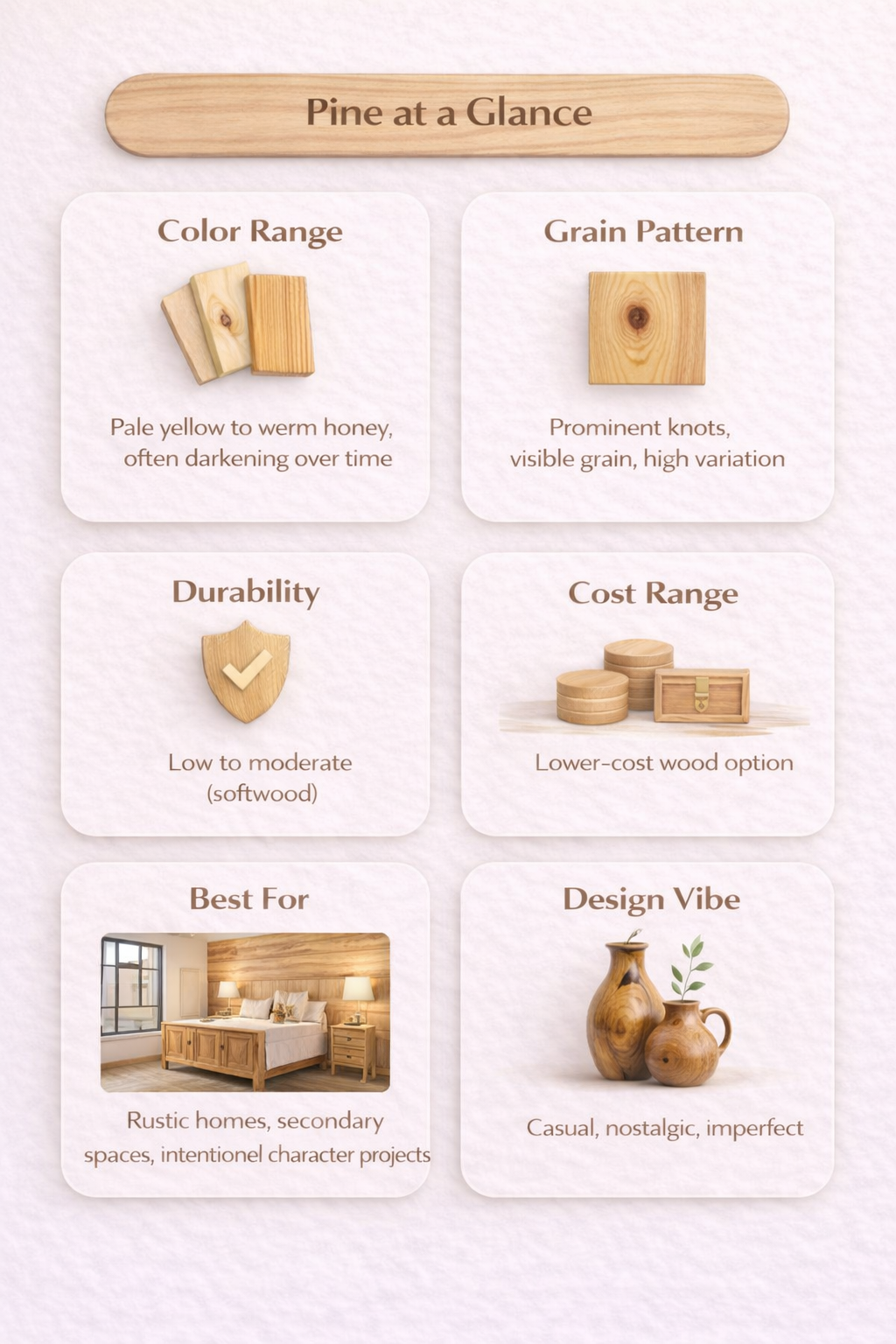 A visual guide to pine wood characteristics including its warm color range, knotty grain pattern, softwood durability, and budget-friendly cost, commonly used in rustic and casual home design.
Painted Pine: What Actually Happens
Painted pine is common — and consistently misunderstood. Homeowners see it and think it'll look like painted maple. It won't. Ever.
Grain telegraphs through paint over time. Dents break paint film. Touch-ups are frequent. Knots require shellac primer or they'll bleed through regardless of how many coats of paint go over them. Painted pine can work if knots are properly sealed, expectations are realistic, and wear is accepted as part of the aesthetic. But painted pine will never look like painted maple, and it shouldn't try to.
If a smooth, clean painted finish is your goal, maple is the wood built for that job. Pine's natural state — stained or clear-finished, knots visible, grain honest — is where it actually shines.
What Pine Looks Like Over Time
Fresh pine is pale and almost creamy — much lighter than people expect when they first see it at the lumber yard. Then it starts to move.
Within the first few years, pine deepens into amber and honey tones. The knots darken. Color variation between boards becomes more pronounced, not less. By the time pine cabinets are ten years old, they look nothing like they did on install day — and for the right homeowner, that transformation is the whole point. Pine doesn't stay still. It ages visibly, quickly, and with a lot of personality.
That patina — the accumulated character of a wood that shows everything — is either pine's greatest gift or its most frustrating quality. It depends entirely on whether you opted in to the philosophy before day one.
Where Pine Actually Works
Pine is not the right answer for every kitchen — but it's genuinely the right answer in specific contexts. Here's where we've seen it work beautifully:
- Cabins and rural properties. Pine's natural home. The wear, the patina, the knots — it all makes sense here in a way it doesn't always translate to a suburban kitchen.
- ADUs and secondary kitchens. Lower traffic, lower stakes. Pine's softness is far less of an issue in a guest cottage or in-law unit than it is in a primary kitchen that gets used three times a day.
- Built-ins, mudrooms, and storage. Bookshelves, storage benches, mudroom cubbies — lower-impact applications where pine's warmth and character shine and its softness matters much less.
- Accent pieces and islands. A pine island paired with painted or hardwood perimeter cabinets gives you the character moment without the full commitment. This is one of our most common pine recommendations.
- Homes going all-in on farmhouse or rustic design. If the whole home is leaning that direction, pine can be the anchor. Commit fully and it's stunning. Use it halfway and it looks like an accident.
Pros and Cons
What Works
- Affordable material cost — one of the least expensive real-wood options
- Every cabinet is genuinely unique — high natural variation
- Ages dramatically and beautifully in the right setting
- Feels authentic and handmade in rustic or farmhouse homes
- Great character in secondary spaces, built-ins, and accent pieces
What to Watch For
- Dents and scratches from normal daily use — unavoidable
- Knots bleed through paint unless properly sealed with shellac primer
- Grain telegraphs through painted finishes over time
- Limited style versatility — won't adapt to modern or formal kitchens
- Lower material cost doesn't always mean lower total project cost
Design Pairings That Work With Pine
Pine is visually busy on its own — knots, grain variation, color movement. Everything around it should settle down and let the wood be the feature.
Countertops: Soapstone, solid surfaces, or simple quartz with minimal veining. Busy countertop patterns compete directly with the knots and grain, and neither wins that fight. Keep it calm.
Hardware: Iron, oil-rubbed bronze, or unlacquered brass. Simple and warm. Modern bar pulls or sleek contemporary hardware fights pine's personality and makes both look wrong.
Wall colors: Warm whites, creams, and earth tones. Cool grays and bright whites make pine look sallow. The wood wants warmth around it to feel intentional rather than dated.
Flooring: Wide-plank hardwood, concrete, or terracotta. Match the casual, organic energy. Polished porcelain or high-gloss flooring clashes with everything pine is trying to be.
Rossmoor Remodels
Pine is rarely the right fit for Rossmoor co-ops and condos. The compact footprints in most Rossmoor units mean every surface gets real daily use — and softwood cabinetry in a primary kitchen takes a beating. There are also resale considerations: Rossmoor buyers tend to respond better to durable hardwood kitchens. If you're remodeling in Rossmoor and love what pine brings visually, alder gives you similar warmth with better durability, and white oak gives you the natural wood feel with long-term performance. Either will serve you better in this specific context.
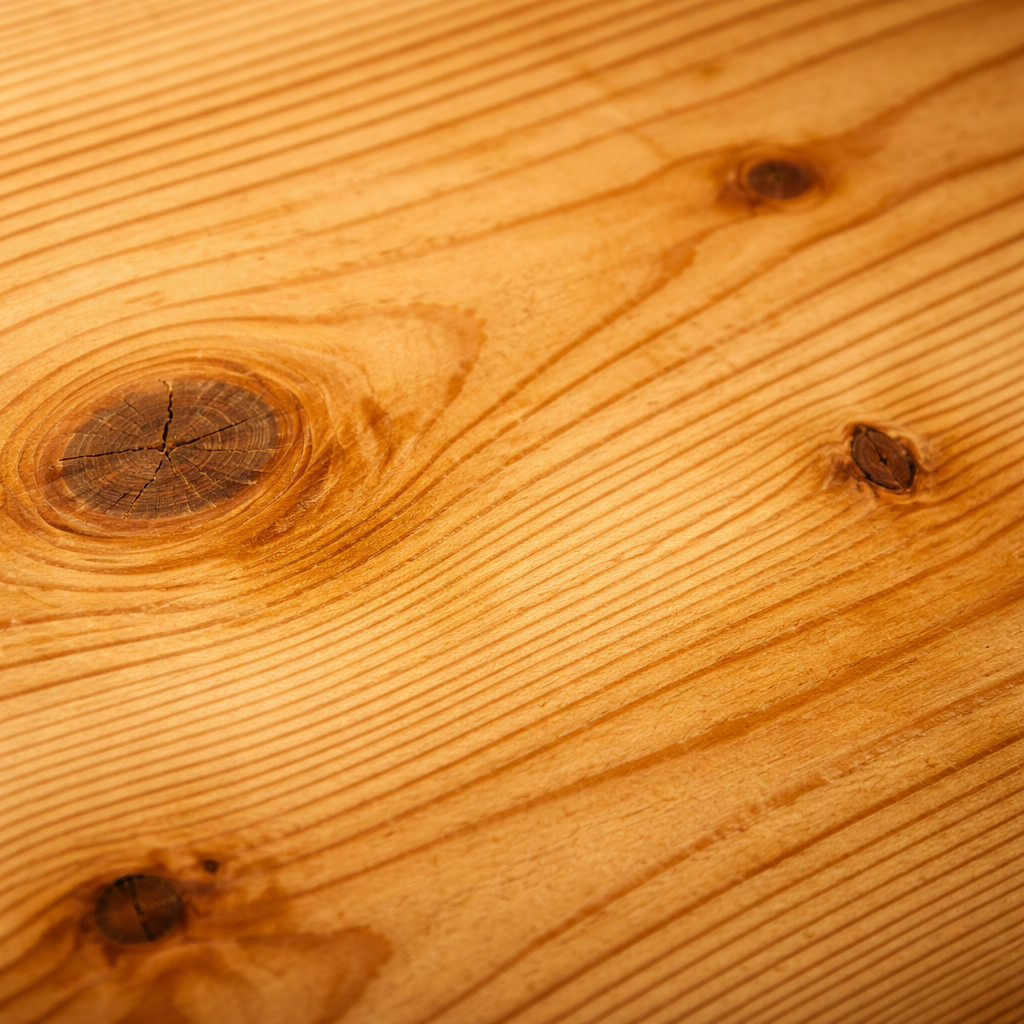 Detailed view of pine wood highlighting its signature knots, visible grain variation, and warm golden coloring, often used for rustic cabinetry and character-driven spaces.
Is Pine Right for You?
Pine is the right wood if you love knots and visible variation, want a rustic or farmhouse kitchen, are genuinely okay with wear becoming part of the story, and care more about character than uniformity. The homeowners who are happiest with pine are the ones who didn't just tolerate its quirks — they actively wanted them.
Skip pine if you want durability as a priority, have your heart set on painted cabinets that stay smooth, prefer a modern or polished aesthetic, or are planning a primary kitchen with resale value front of mind. None of that makes pine a bad wood — it just makes it the wrong wood for those specific goals.
And if you're drawn to the warmth of pine but nervous about the commitment, look at alder. It's where a lot of homeowners land when they love the idea of pine but want something more forgiving in practice — softer than the hardwoods, but calmer and more versatile than pine.
From Candi
Pine wraps up our wood species series, and I saved it for last because it's the wood that requires the most honest self-assessment. The homeowners who thrive with pine are the ones who fully opted in — who wanted exactly what pine does, including the dents and the aging and the imperfection. If that's you, I think it's a beautiful choice. If you're on the fence, it probably isn't. For most East Bay kitchens, we'll end up pointing you toward something else from this series. Start with our Wood Species 101 hub if you haven't already, or reach out through our contact page and we'll figure it out together.
Not Sure Pine Is Right for You?
Let's talk through it. We'll help you figure out which wood actually fits how you live — pine, oak, alder, or something else entirely. Honest experience, no upsell.
Let's Have That Conversation →
Toupin Construction
Ready to start your remodel?
Whether you're dreaming of a new kitchen, a spa-worthy bathroom, or a whole-home transformation — we’d love to hear about your project. Reach out and let's talk.
‹ Back
Comments