


By using our website, you agree to the use of cookies as described in our Cookie Policy
Blog
Quartzite Countertops: The Marble Look Without the Marble Anxiety
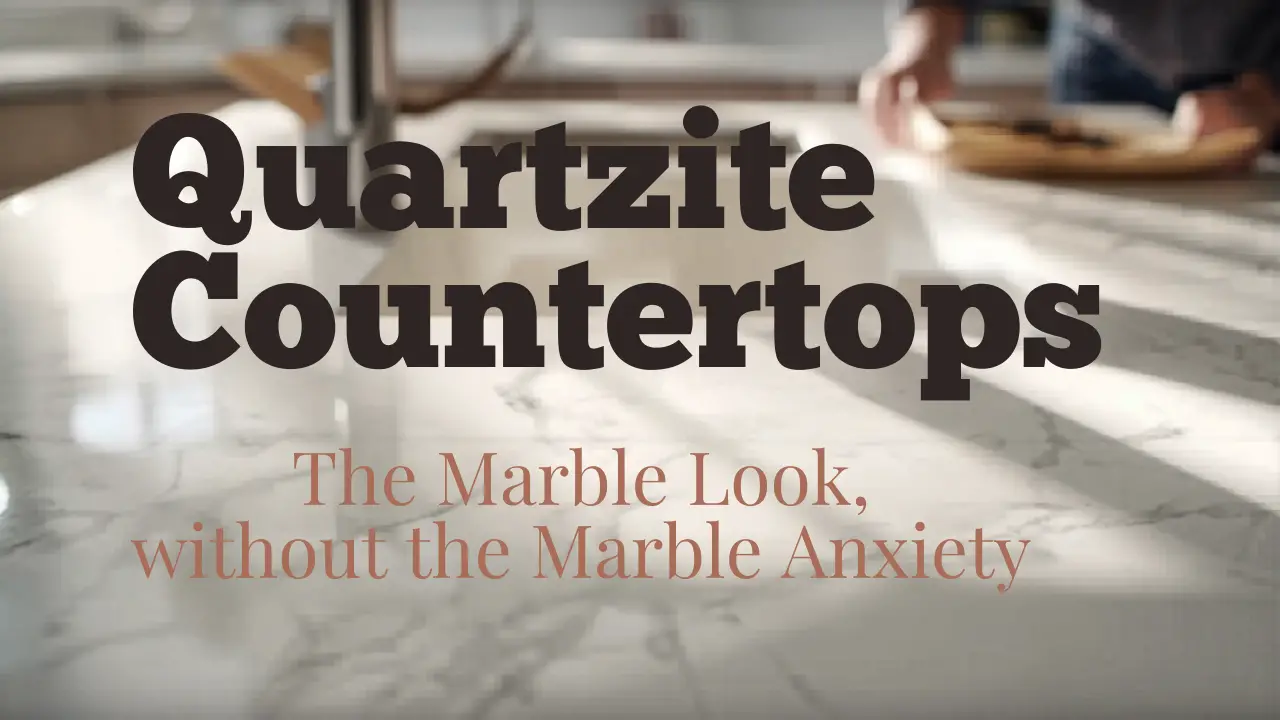
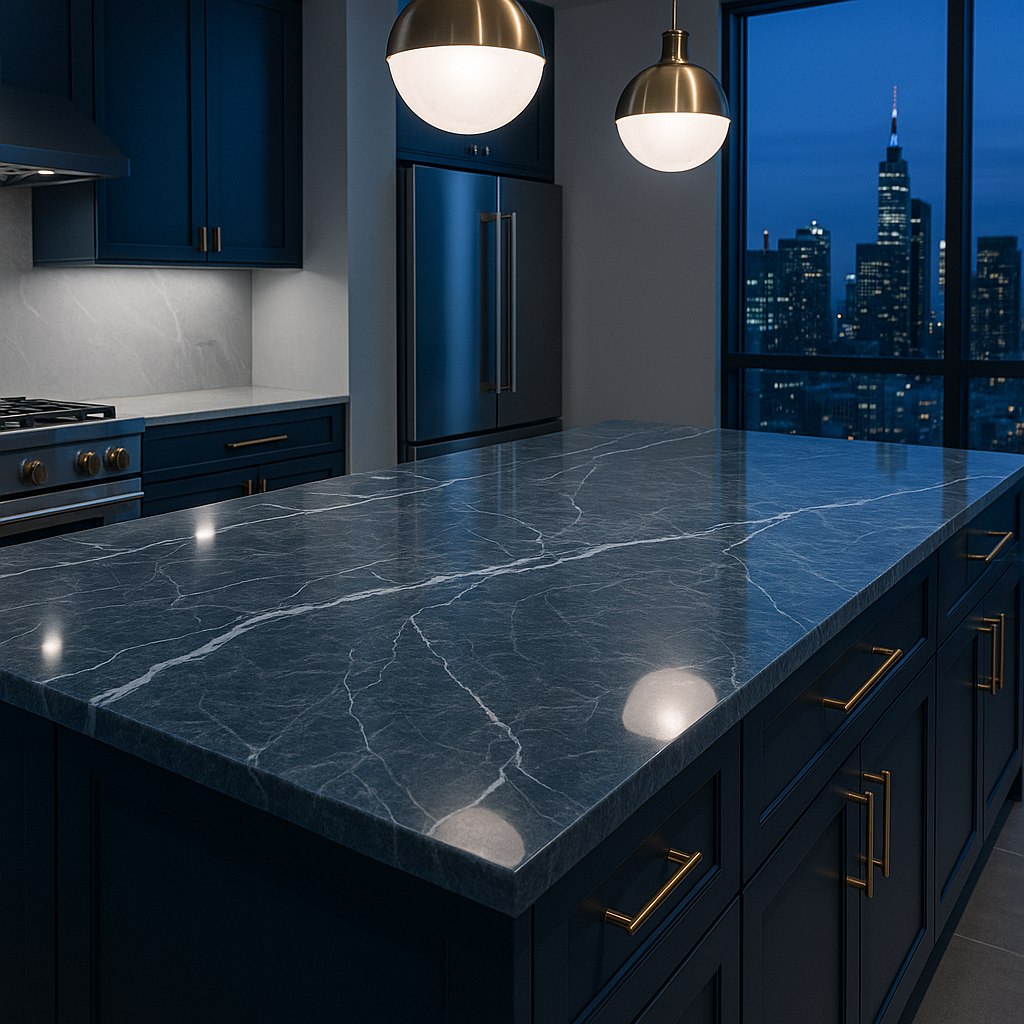 Modern kitchen with deep blue cabinetry and dramatic quartzite countertops, highlighted by pendant lighting and city views. The stone’s veining stands out against the darker palette.
Every few weeks someone walks into a slab yard, falls head over heels for a piece of marble, hears the maintenance speech, and leaves heartbroken. I've watched it happen. And nine times out of ten, what they actually fell in love with was the veining — the movement, the drama, that sense that nature painted something just for them.
Here's what I always tell them: quartzite gives you almost everything you loved about that marble slab, with a fraction of the worry. It's one of the most misunderstood materials in our industry, and honestly, that's a shame — because for the right homeowner, it's the closest thing to a unicorn countertop that actually exists.
This post is part of our Countertop Materials Series, where we walk through every major surface we install — granite, quartz, marble, porcelain, soapstone, butcher block, and quartzite — with complete honesty about what works, what doesn't, and who each material is really for.
Wait — Quartzite and Quartz Are Not the Same Thing
I have to start here, because the confusion is real. Even some contractors mix them up. I've overheard it in showrooms.
Trade Term Explained: Quartzite vs. Quartz Quartzite is a 100% natural metamorphic rock. It starts as sandstone, gets buried deep in the earth, and over millions of years, extreme heat and pressure fuse the grains into something entirely new — harder, denser, crystalline. It's quarried from the earth exactly like marble or granite. Nothing is added.
Quartz(engineered stone) is a manufactured product: roughly 90–95% ground quartz particles combined with polymer resins and pigments. It's made in a factory. Totally different origin, totally different material, totally different strengths.
Quartz(engineered stone) is a manufactured product: roughly 90–95% ground quartz particles combined with polymer resins and pigments. It's made in a factory. Totally different origin, totally different material, totally different strengths.
The reason this matters: if you go shopping for "quartzite" and end up with quartz, you'll have different expectations around heat resistance, UV stability, and natural variation. And if you're told a soft stone is quartzite when it's actually marble or dolomite, you may find out the hard way that it etches. More on that in a minute.
How Quartzite Actually Forms
Quartzite begins as pure quartz sandstone — think beaches and riverbeds, millions of years compressed into rock. Then tectonic forces drive it deep into the earth's crust, where heat and pressure do something remarkable. The individual sand grains re-crystallize, fusing together so completely that when the stone is finally broken, it fractures through the grains, not around them. That's how dense it becomes.
The result is a stone that's harder than granite, more resistant to chemical attack than marble, and — because of the way light interacts with those crystalline structures — genuinely stunning. The shimmer in a good quartzite slab isn't polish. It's the stone itself catching light.
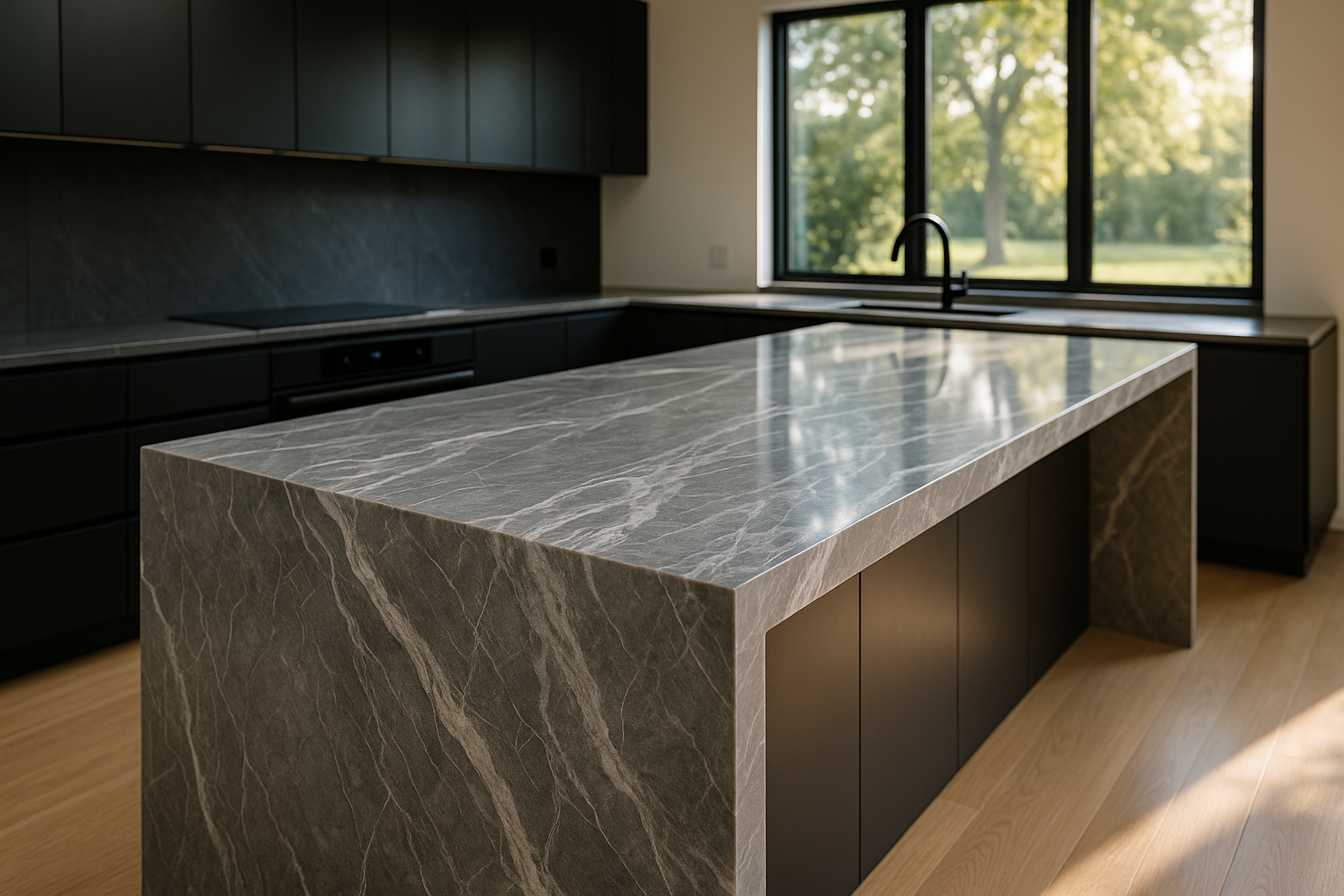 Sleek modern kitchen with matte black cabinetry and a waterfall quartzite island. The natural veining of the stone creates a striking focal point against the minimalist design.
Why People Fall in Love With Quartzite
The short version: it looks like marble, handles like granite, and doesn't etch. For a lot of homeowners, that's the complete wishlist on one slab.
The slightly longer version: quartzite offers dramatic veining and movement in colors you won't find in engineered stone. Some varieties — Taj Mahal, Cristallo, Blue Roma — are genuinely breathtaking in a way that's hard to photograph. When you see them in person under natural light, people stop talking. That's not an exaggeration. I've watched it happen on Rossmoor kitchen installs where the homeowner came into the jobsite expecting to just check on progress and ended up standing at the island for ten minutes just looking at it.
Rossmoor Homeowner Note
Quartzite works beautifully in Rossmoor condos and co-ops because it comes in lighter, airy tones (Taj Mahal, Sea Pearl, White Macaubas) that brighten compact kitchens without sacrificing the elegance many homeowners want. It's also UV-stable, which matters in units with good southern exposure — quartz can yellow over time near bright windows, quartzite won't. If you're remodeling a Rossmoor unit, bring your layout to us before you fall in love with a slab — some Mutual boards have aesthetic guidelines worth knowing before you commit.
Beyond looks, quartzite earns its keep on performance. It ranks higher on the Mohs hardness scale than most granite varieties — meaning it resists scratching from everyday kitchen activity better than you might expect. It handles heat without scorching or discoloring. And because it's a naturally formed stone (not held together with resins), there's no resin content to warp or yellow under a hot pan.
True Quartzite Does Not Etch — But Here's the Catch
This is the most important thing I can tell you about quartzite, and it's also the most frequently botched piece of information in the countertop world. True quartzite — the metamorphic stone made from sandstone — is not chemically reactive to acids. Lemon juice, vinegar, wine, coffee: none of them will dull or etch the surface. That's a fundamental difference from marble, which etches almost on contact with anything acidic.
Here's the catch: not everything sold as "quartzite" is actually quartzite. Some softer stones — dolomite, certain marbles, hybrid minerals sometimes called "soft quartzite" — do etch. If someone quotes you a price for quartzite and it seems low, or if the stone feels noticeably soft compared to something like Taj Mahal, ask questions. Do a simple test: put a drop of vinegar on an inconspicuous edge. If it dulls within a minute, that stone contains calcite and will behave like marble, not quartzite.
Working with a contractor who knows the difference matters more than it sounds. We've pulled stones that were mislabeled before installation and saved clients from an expensive lesson.
The Real Trade-Offs of Quartzite
I won't pitch this material without being honest about where it falls short, because that's the only way you make a decision you'll actually be happy with in five years.
It usually needs sealing. Unlike quartz (which is non-porous by design) or soapstone (which is naturally non-porous), most quartzite has some porosity and benefits from sealing. For most varieties, that means once a year, maybe twice if your kitchen gets heavy use. It's not the burden it sounds like — it takes about twenty minutes and you're done.
It's not cheap. Quartzite runs higher than quartz or granite in the East Bay — typically $130–$220+ per square foot installed, and rare varieties like Blue Roma or Cristallo can go well beyond that. If budget is the primary concern, quartzite is probably not the place to start looking.
Natural variation cuts both ways. You are not getting a consistent, predictable pattern. Each slab is unique, which most quartzite buyers consider a feature — but if uniformity matters to you, engineered quartz will make you happier.
Large islands require planning. Quartzite slabs have size limits, and an oversized kitchen island might require careful seam placement or mitered edges to look seamless. That's not a dealbreaker, but it's a fabrication conversation worth having early. See our kitchen remodeling page for how we approach the planning process.
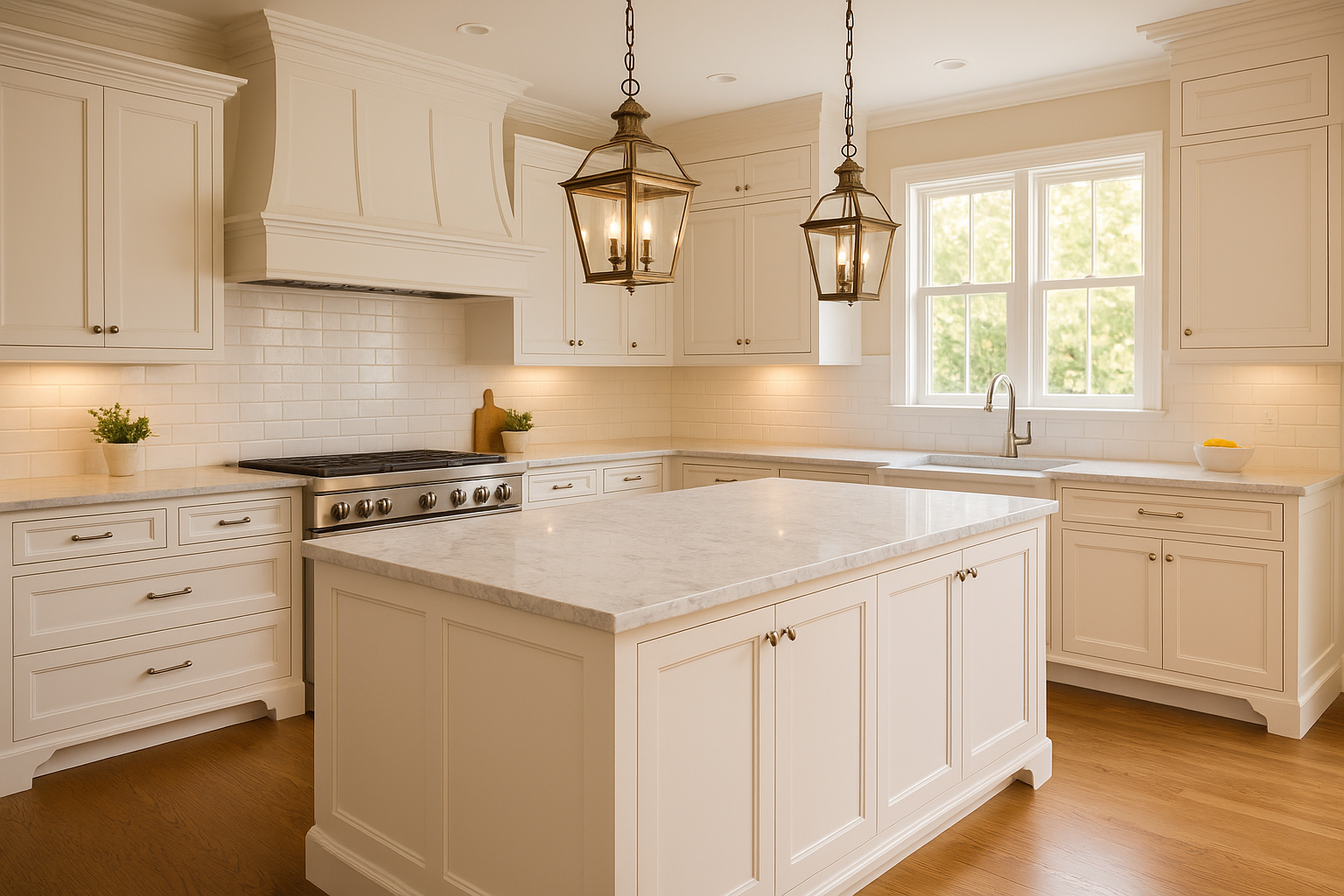 Bright, traditional kitchen in Walnut Creek featuring a large quartzite island, cream cabinetry, subway tile backsplash, and warm wood flooring. The natural stone countertop adds durability and subtle movement to the space.
 Popular Quartzite Varieties We See in East Bay Homes
Quartzite comes in a remarkable range of colors, from near-white to deep blue. Here are the ones we install most often:
Taj Mahal — Warm cream with soft gold veining. Probably the most popular quartzite in Walnut Creek and Danville right now. Pairs beautifully with white and warm oak cabinetry. Softer movement, very livable.
Sea Pearl — Soft gray with subtle movement. Works well in modern and transitional kitchens. Less dramatic than Taj Mahal, but very sophisticated.
White Macaubas — Bright white with linear veining that reads very modern. Designers love it for waterfall applications.
Cristallo — Nearly translucent white with a crystalline shimmer. One of the most striking stones you'll ever see lit from below on an island with integrated LED strips. It's genuinely show-stopping.
Blue Roma — For the homeowner who is not afraid of a statement. Bold blue tones, gold veining, and no two slabs remotely alike. Not everyone's material — but the people who choose it are never disappointed.
Perla Venata — Warm champagne and cream tones with soft movement. Elegant without being ostentatious.
Quartzite Finishes: What to Know Before You Choose
Polished is the classic option — high shine, durable, shows off the color depth and veining most dramatically. It does show water marks more than a honed or leathered surface, which matters in kitchens with hard water (hello, East Bay).
Honed has a soft matte finish that feels sophisticated and current. It hides everyday marks better than polished, but requires slightly more frequent sealing because the surface is more open.
Leathered has a subtle texture that catches light differently across the surface. It hides fingerprints better than either polished or honed. In darker quartzites, it adds genuine depth. Harder to clean around the texture if anything sticky gets in there, so factor that into your lifestyle.
Quartzite vs. the Competition
| Feature | Quartzite | Quartz | Granite | Marble |
|---|---|---|---|---|
| Heat Resistance | Excellent | Fair (can scorch) | Excellent | Good |
| Etch Resistance | Excellent (true quartzite) | Excellent | Good | Poor |
| Scratch Resistance | Very High | Good | Good | Low |
| UV Resistance | Excellent | Poor (fades) | Good | Good |
| Needs Sealing | Yes (annually) | Never | Yes (every 10–15 yrs) | Yes (annually) |
| Natural Variation | Yes — dramatic | Controlled/consistent | Yes — natural | Yes — dramatic |
| Typical Installed Cost | $130–$220+/sq ft | $95–$165+/sq ft | $75–$140+/sq ft | $110–$200+/sq ft |
Caring for Quartzite: Easier Than You'd Think
Daily cleaning is soap and warm water — that's truly it for routine maintenance. Skip the vinegar-based cleaners and anything acidic; use a pH-neutral stone cleaner for anything tougher. Seal it once a year (we can walk you through the process), and you're done. Quartzite is genuinely one of the easiest natural stones to live with on a day-to-day basis. The annual sealing is the main commitment, and it takes less time than cleaning your oven.
Candi's Take
Quartzite is the material I find myself recommending most often to homeowners who want drama and durability in the same breath. It's for people who love natural stone for what it actually is — not a perfect, uniform surface, but something that formed over millions of years and carries that depth in every square inch. If you're standing in a slab yard and something stops you cold, it might be quartzite. Come find out.
Where Quartzite Shines in Your Home
Quartzite works beautifully as a kitchen countertop or island — obviously. But it's also excellent for waterfall islands (where the slab wraps over the edge and down to the floor), full-height backsplashes matched to the countertop, bathroom vanities, fireplace surrounds, and home bars. The UV stability makes it viable for certain outdoor bar applications as well, though we'd evaluate that case by case.
For kitchen planning and layout questions, explore our kitchen remodeling services or browse our portfolio to see finished East Bay kitchens.
Ready to See Quartzite in Person?
Photographs don't do this material justice. If you're remodeling a kitchen or bathroom in Walnut Creek, Rossmoor, Danville, or anywhere in the East Bay, we'd love to walk you through slab selection, edge profiles, and what works best for your space.
Get a Free Consultation — 925-937-4200
Toupin Construction
Ready to start your remodel?
Whether you're dreaming of a new kitchen, a spa-worthy bathroom, or a whole-home transformation — we’d love to hear about your project. Reach out and let's talk.
‹ Back
Comments