
Every few years, open shelving has a moment. Design blogs go all in, Instagram fills up with perfectly styled kitchens where someone's collection of ceramic bowls looks genuinely art-directed. And then we get called in on the remodel, and the homeowner says: "We tried the open shelves. We lasted eight months."
To be fair, we've also done plenty of open shelving projects that clients love years later — the right shelves in the right kitchen for the right person are genuinely beautiful and functional. So this isn't a takedown. It's a real conversation about when each option works, with enough specifics that you can actually make a decision — not just absorb more competing opinions.
The Case for Upper Cabinets
Upper cabinets have been the default in American kitchens for good reason: they solve the actual problem. Most people have more stuff than they want to look at. Cabinets handle that without any daily effort on your part. Close the door, done.
Beyond storage, uppers are genuinely adaptable across styles. A Shaker door reads traditional, a slab front reads modern, a glass insert reads transitional — same box, different personality. That flexibility is part of why they tend to hold up well at resale. Buyers can see themselves in the space regardless of taste.
The visual weight issue is worth addressing directly, because it comes up a lot in East Bay homes — particularly in Rossmoor, where kitchens tend to be compact and ceilings aren't especially high. The fix isn't to remove the cabinets. It's to use lighter colors, add undercabinet lighting — which brings the eye down and makes the countertop pop — or break up a long run with glass-front doors near the window. We do this constantly, and it works.
This is exactly what it sounds like: strip lights or puck lights mounted to the underside of your upper cabinets, aimed at the countertop. Beyond task lighting (which matters more than people realize when you're prepping food), undercabinet lighting makes a kitchen feel bigger and more finished. It's one of the better dollar-for-dollar upgrades in a kitchen remodel — and it completely changes how a run of upper cabinets reads in a room.
The Case for Open Shelving
When open shelving works, it really works. A well-executed shelf run — good brackets, the right depth, well-curated contents — brings warmth and lightness to a kitchen in a way that closed cabinets just can't match. You're bringing the room into the walls instead of walling the room off.
The practical benefits are real too: grab-and-go access means you're not opening and closing cabinet doors a hundred times a day. And from a cost standpoint, shelving typically runs less than comparable semi-custom upper cabinets — which matters if you're trying to put money toward better countertops, appliances, or a tile backsplash.
The grease issue is the one we push back on the most. We've seen shelving placed directly flanking a range hood that looked great in photos and was a maintenance nightmare within three months. Cooking releases airborne grease particles that settle on every horizontal surface — and open shelves give those particles nowhere to hide. The fix is placement: shelves work well away from the range, flanking a window, or on a wall that doesn't see direct cooking action. Directly adjacent to the hood? We steer clients toward glass-front cabinets instead.
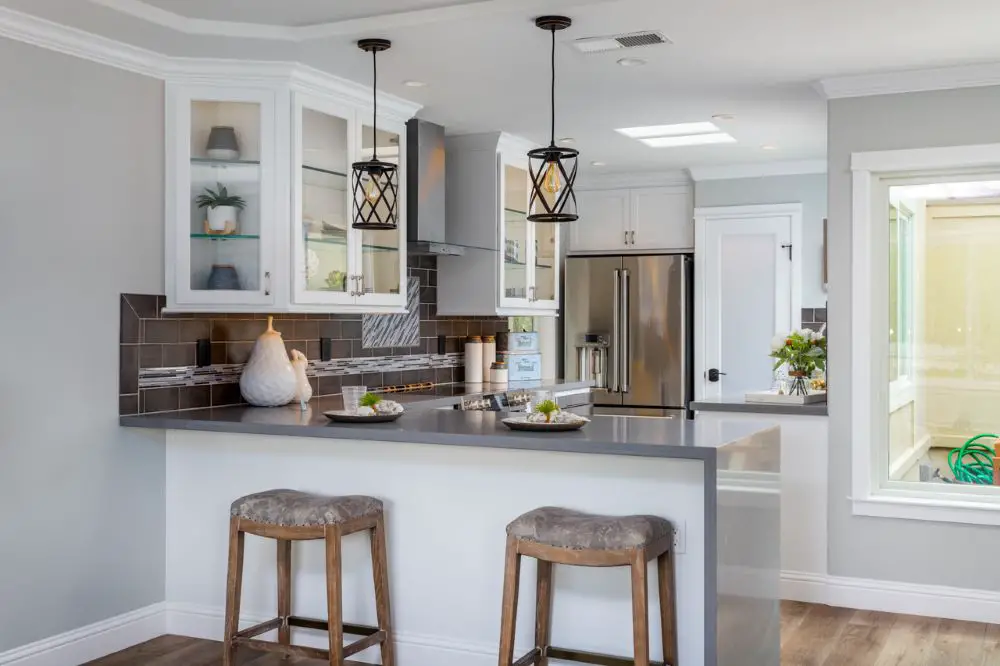
A bright remodeled kitchen with white cabinetry, gray countertops, pendant lighting, glass-front cabinets, and a peninsula with seating.
The Shelf Specs That Actually Matter
If you're going the open shelving route — or incorporating it into a hybrid kitchen — the execution details are what separate a shelf that looks intentional from one that looks like an afterthought. Here's what we specify on jobs:
Why Most East Bay Kitchens End Up with a Mix
Here's the honest answer: after doing this for decades in Walnut Creek, Lafayette, Orinda, Danville, and Rossmoor, the hybrid approach is what we land on most often — not because we can't make a decision, but because it genuinely solves more problems than either option alone.
The pattern that keeps working: upper cabinets on the main walls where storage density matters, with shelves used as a deliberate design moment — flanking a hood, above the sink, or on the wall opposite the range. You get the storage you actually need and the airiness you want, without committing the whole kitchen to either aesthetic.
In Rossmoor specifically, where the footprints are compact, we almost always recommend keeping the upper cabinet runs intact and using glass-front doors or a single display shelf near natural light to break things up. Losing storage in a 900-square-foot condo kitchen is a real sacrifice. Adding a visual moment near the window costs almost nothing and changes the feel of the room significantly.
For a broader look at how storage decisions fit into a full kitchen project, our East Bay kitchen remodeling guide covers the whole process — from layout decisions to budget to what to expect from the build itself.
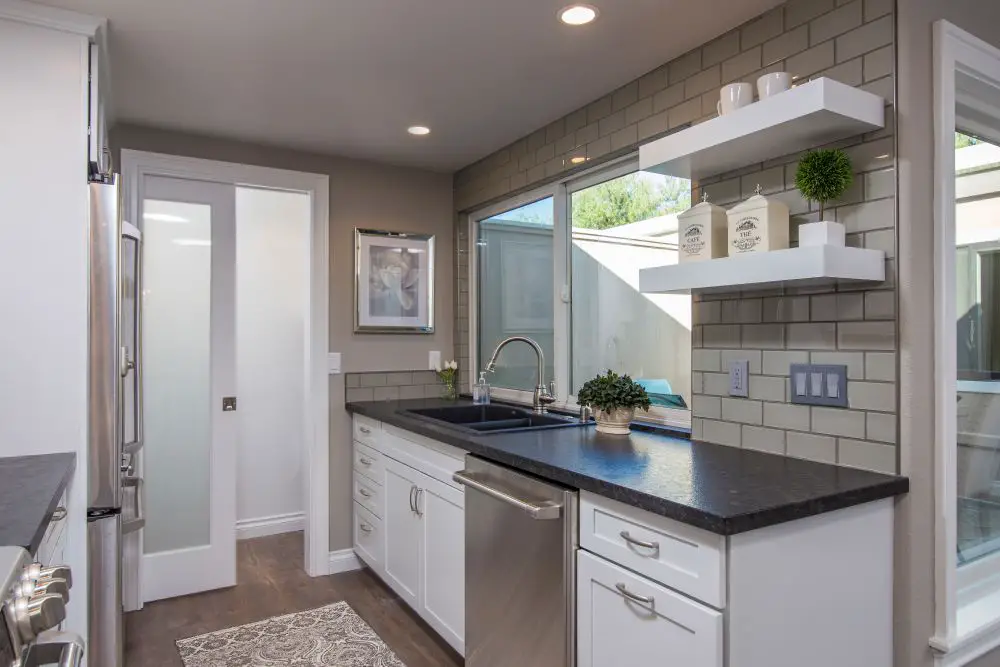
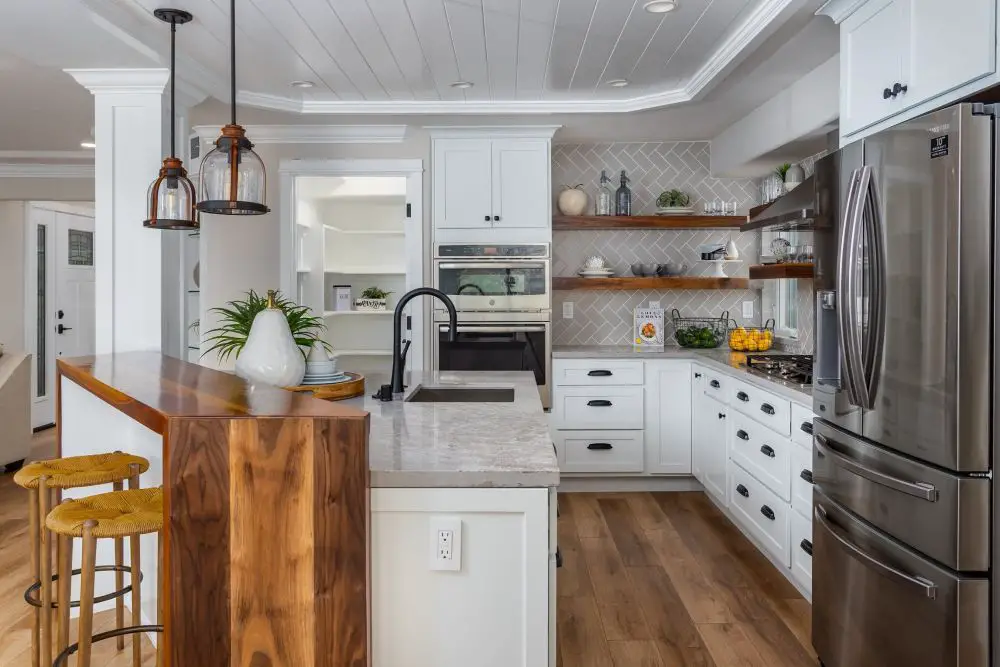
A remodeled kitchen featuring floating white open shelves above the sink, gray subway tile backsplash, stainless appliances, and white cabinetry.
Which Option Is Right for You
The cabinet and cabinetry decisions you make are some of the longest-lasting choices in a remodel — these don't get changed on a whim five years later. If you're looking at the full picture of what kitchen cabinetry involves, including refacing existing boxes versus a full replacement, our cabinet refacing guide is a good place to dig in. And for how upper storage fits into your overall kitchen layout and workflow, our piece on kitchen zones is worth a read before you finalize anything.
"The best kitchen storage isn't the most storage. It's the storage that fits how you actually cook, what you actually own, and how much daily maintenance you're actually willing to do."


Comments