


By using our website, you agree to the use of cookies as described in our Cookie Policy
Blog
What Actually Drives Labor Costs in Remodeling
Remodeling Tips
What Actually Drives Labor Costs in Remodeling
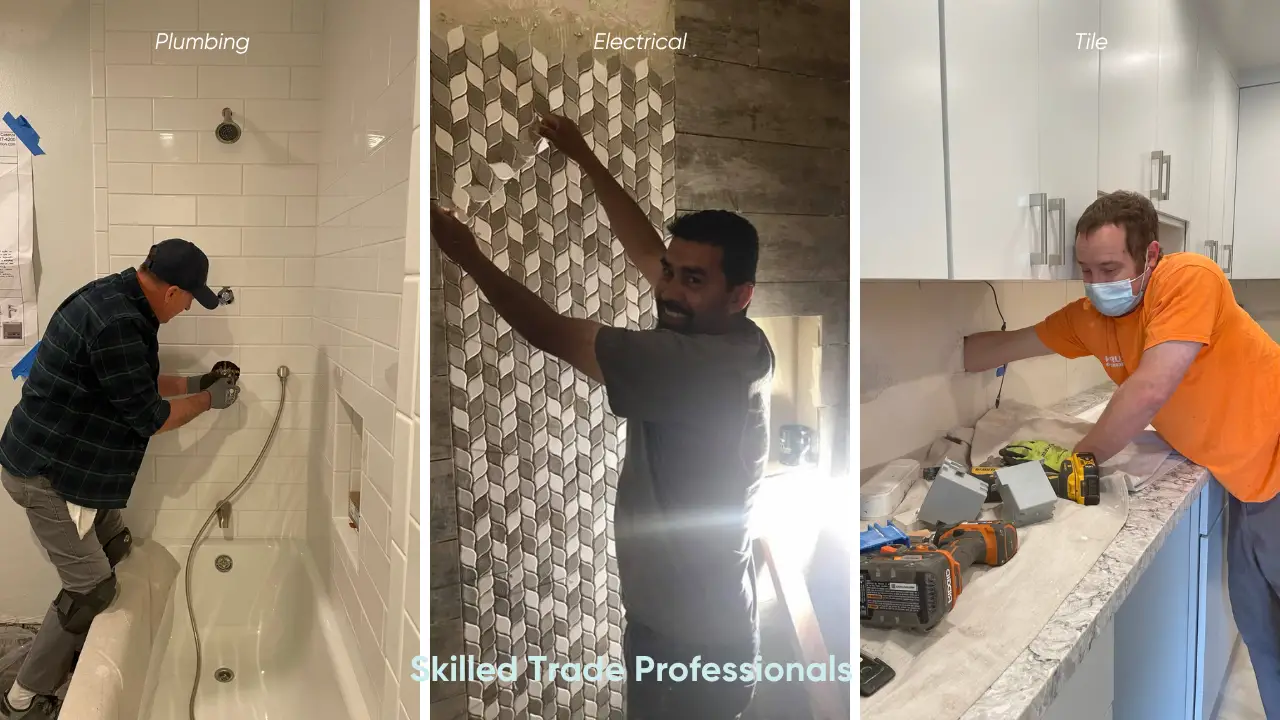
A collage showcasing Toupin Construction's in-house skilled trades team at work. The image features a plumber installing shower fixtures, a tile setter installing decorative wall tile, and an electrician completing kitchen electrical work. The photo highlights the craftsmanship and coordination required to successfully complete remodeling projects throughout Walnut Creek and the East Bay.
The question comes up on almost every project, usually after we hand over the quote. Someone points to the labor line — which is almost always the largest number on the page — and asks: why does it cost that much? What am I actually paying for?
It's a fair question. And I'd rather answer it here, honestly, than dance around it. Understanding what drives labor costs doesn't just help you read a quote — it helps you make smarter decisions about your project, ask better questions, and avoid the kind of "savings" that end up costing more to fix.
Skilled Trades Are Not Interchangeable
Here's something that surprises a lot of homeowners: a remodel isn't one job. It's a sequence of completely different trades, each with their own expertise, their own licensing requirements, and their own market rate. Your kitchen remodel involves a demo crew, a plumber, an electrician, a cabinet installer, a tile setter, a countertop fabricator, and probably a painter. That's six or seven skilled professionals, each billing at their own rate, each showing up on a specific schedule.
When people say "labor is expensive," they usually mean the total of all of those trades combined. And when you understand that each one is a licensed professional with years of experience in their specific discipline, the number starts to make a lot more sense.
Trade Term, Explained
Trade Sequencing
This is the order in which different trades work on a project — and getting it wrong is expensive. Plumbing rough-in has to happen before the walls close. Electrical before drywall. Tile before fixtures. A good general contractor manages this sequence so no one is waiting on someone else and no work has to be undone. That coordination is a skill in itself, and it's part of what you're paying for.
We've been doing this for over 40 years in Walnut Creek and the East Bay. Managing trade sequencing — keeping the plumber, the electrician, and the tile setter from tripping over each other while keeping the project moving — is one of the less visible parts of what we do. But it's one of the most valuable.
Unlike a lot of general contractors, we have everything in house. Our plumbers, electricians and tile setters etc... are all Toupin employees who have been working seamlessly together for decades. They know each other so well and have special bonds with each other that make the projects flow so easy.
The Seven Things That Drive Labor Costs
Not every remodel costs the same, and not every labor quote should. Here's what actually moves the number up or down.
Access and Site Conditions: A wide-open first-floor kitchen is easy to work in. A third-floor condo with no elevator and a narrow stairwell is not. Every extra constraint — tight spaces, load-bearing walls, difficult access — adds time, and time is what you're paying for. In Rossmoor, where units are compact and the Mutual boards have rules about construction hours and common area protection, projects routinely take longer than they would in a suburban tract home.
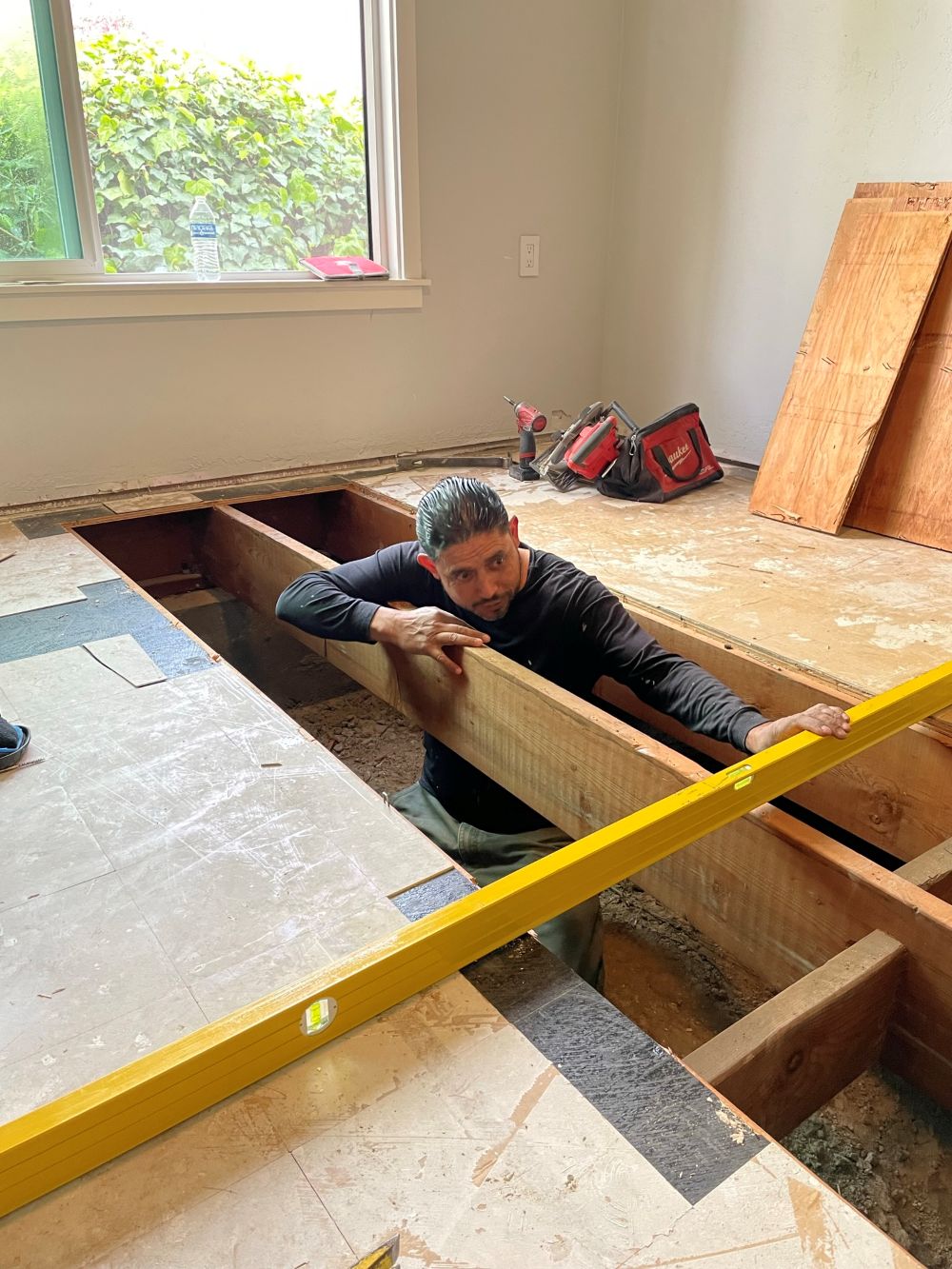
What's Behind the Walls: Older homes are full of surprises. We've opened up walls in Lafayette and Orinda and found knob-and-tube wiring that had to be brought up to code before anything else could happen. We've pulled up floors and found subfloor damage that wasn't visible from the surface. None of that is in the original quote because nobody could see it. When it shows up, the scope changes and so does the cost.
Complexity of the Work: A straight cabinet swap is fast. Moving a load-bearing wall to open up a kitchen layout is an engineering project. A simple subway tile backsplash takes a fraction of the time that a hand-set mosaic in a herringbone pattern does. Design choices that look similar on a mood board can have wildly different labor implications in the field.
Permits and Inspections: Any structural work, plumbing relocation, or electrical upgrade in the East Bay requires a permit and inspections. Permits cost money. More importantly, permitted work requires licensed contractors — which means you're working with professionals who are accountable, insured, and doing the work to code. Projects get paused for inspections. That pause time is real time on a project.
Materials Handling: Heavy, fragile, or oversized materials cost more to handle safely. Large-format porcelain tile requires two people. Natural stone countertops require special equipment to move without cracking. Custom cabinetry has to be carefully staged, protected, and installed in sequence. The more demanding the materials, the more demanding the labor.
Finish Quality and Tolerance: There's a real difference between a tile floor that's roughly flat and one that meets industry standards for lippage — meaning no edge of any tile is measurably higher than the tile next to it. The second one takes longer. The same is true for cabinet alignment, grout line consistency, paint finish quality. You're often not paying for a different outcome on paper; you're paying for the precision and care it takes to actually get there.
Experience and Accountability: A licensed, insured contractor with a track record costs more than an unlicensed one with a truck and a phone number. That gap in price is the gap in liability protection, warranty coverage, and the likelihood that the work holds up. If something goes wrong with a licensed contractor's work, there's a clear path to resolution. If something goes wrong with someone's cousin who did it cheap, there often isn't.
What the Labor Rate Actually Covers
When a skilled tradesperson charges $85–$150 an hour in the East Bay market, that rate isn't all going into their pocket. Here's a rough breakdown of what a legitimate contractor is actually carrying:
What's Baked Into a Contractor's Labor Rate
|
Worker's compensation insurance |
Required by California law. Protects workers if they're injured on your property. If a contractor can't show you a current certificate, that's a red flag. |
|
General liability insurance |
Covers damage to your home if something goes wrong. Without it, you could be holding the bag. |
|
Licensing fees and continuing education |
CA contractor licenses require ongoing renewal, testing, and compliance. That's not free. |
|
Tools, equipment, and vehicle costs |
Professional tools are expensive to buy and maintain. Wet saws, scaffolding, laser levels — none of this is cheap. |
|
Overhead: office, estimating, project management |
Someone has to answer the phone, write the quote, pull the permit, coordinate the schedule, and follow up with the inspector. |
|
Warranty and callbacks |
Reputable contractors stand behind their work. If something fails, they come back. That guarantee has a cost built into the rate. |
This is why the lowest bid is rarely the best deal. A dramatically lower number usually means something in this list isn't being accounted for — and you'll find out which one eventually.
"The labor rate isn't what a person earns per hour. It's what it costs to run a professional operation that shows up, does the work right, and stands behind it."
Where Homeowners Lose Money Trying to Save It
I've seen this pattern enough times that I think it's worth naming directly. These are the "savings" that tend to backfire.
Going Unlicensed
No license means no permit, no inspection, and no protection. In California, unpermitted work can complicate your home sale and leave you liable for code violations. The savings rarely survive contact with reality.
Skipping the General Contractor
Managing your own subcontractors feels like a way to cut the general contractor markup. It becomes a part-time job fast — and when sequencing goes wrong, the delays cost more than the markup would have.
Choosing the Low Bid
A quote that's 30% below everyone else's isn't a deal — it's a question. What did they leave out? Where are they cutting corners? Get three bids and understand why they differ before you choose.
Underestimating Contingency
Most remodeling pros recommend 10–15% contingency on your total budget. In older East Bay homes where surprises are common, we say 15–20%. Running out of budget mid-project is one of the most stressful positions a homeowner can be in.
How to Have a Better Conversation About Labor
When you get a quote and you want to understand the labor line, here's how to ask about it without starting a fight:
Ask for a breakdown by trade. A good contractor can tell you roughly how much of the labor is plumbing, electrical, tile work, and so on. If they can't, that's worth noting.
Ask what's included in project management. Coordination, permitting, inspections, and scheduling are real work. Understand whether that's built into the rate or billed separately.
Ask about the contingency process. How does the contractor handle it when something unexpected shows up? Do they bring you options, or do they just proceed and hand you a change order after the fact? The answer tells you a lot about how the relationship will go.
Ask what's not included. The scope exclusions on a quote matter as much as the inclusions. Knowing what's outside the contract keeps you from being surprised mid-project.
We've had these conversations with homeowners across the East Bay for decades — in Danville, Alamo, Orinda, and everywhere in between. The clients who go into a project with a realistic picture of what labor costs and why are almost always happier with the outcome. Not because the project costs less, but because nothing catches them off guard.
Have questions about a quote you've received?
We're happy to walk through it with you — no obligation, just an honest conversation. That's how we've operated for over 40 years in Walnut Creek and the East Bay, and we're not changing now.
925-937-4200Toupin Construction · CA Lic #626819

Toupin Construction
Ready to start your remodel?
Whether you're dreaming of a new kitchen, a spa-worthy bathroom, or a whole-home transformation — we’d love to hear about your project. Reach out and let's talk.
‹ Back
Comments