


By using our website, you agree to the use of cookies as described in our Cookie Policy
Blog
Why Permits Cost What They Cost in the Bay Area
Remodeling Tips· Permits & Process· East Bay·
Why Permits Cost What They Cost in the Bay Area
We tell a client the permit for their kitchen remodel is going to run $2,400, and there's a pause. Then: "For a permit? Just to get permission to do work on my own house?" And we get it. We really do. On paper, a permit fee sounds like the government charging you to spend your own money improving your own property. It's an easy thing to resent.
** We are not fans of the rising permit costs. We understand the reason for permits and agree they are necessary but the high costs we disagree with and unfortunately just have to accept as a business. We just want that to be clear. **
But after 40-plus years of pulling permits across Walnut Creek, Danville, Lafayette, Orinda, Alamo, and every jurisdiction in Contra Costa County, we've seen what happens when permits get skipped — and we've seen what they actually buy you when they don't. The story is more interesting than the fee schedule suggests.
So let's actually explain it. Where does the money go, what does it get you, and why does the Bay Area cost so much more than the national average? Here's the honest version.
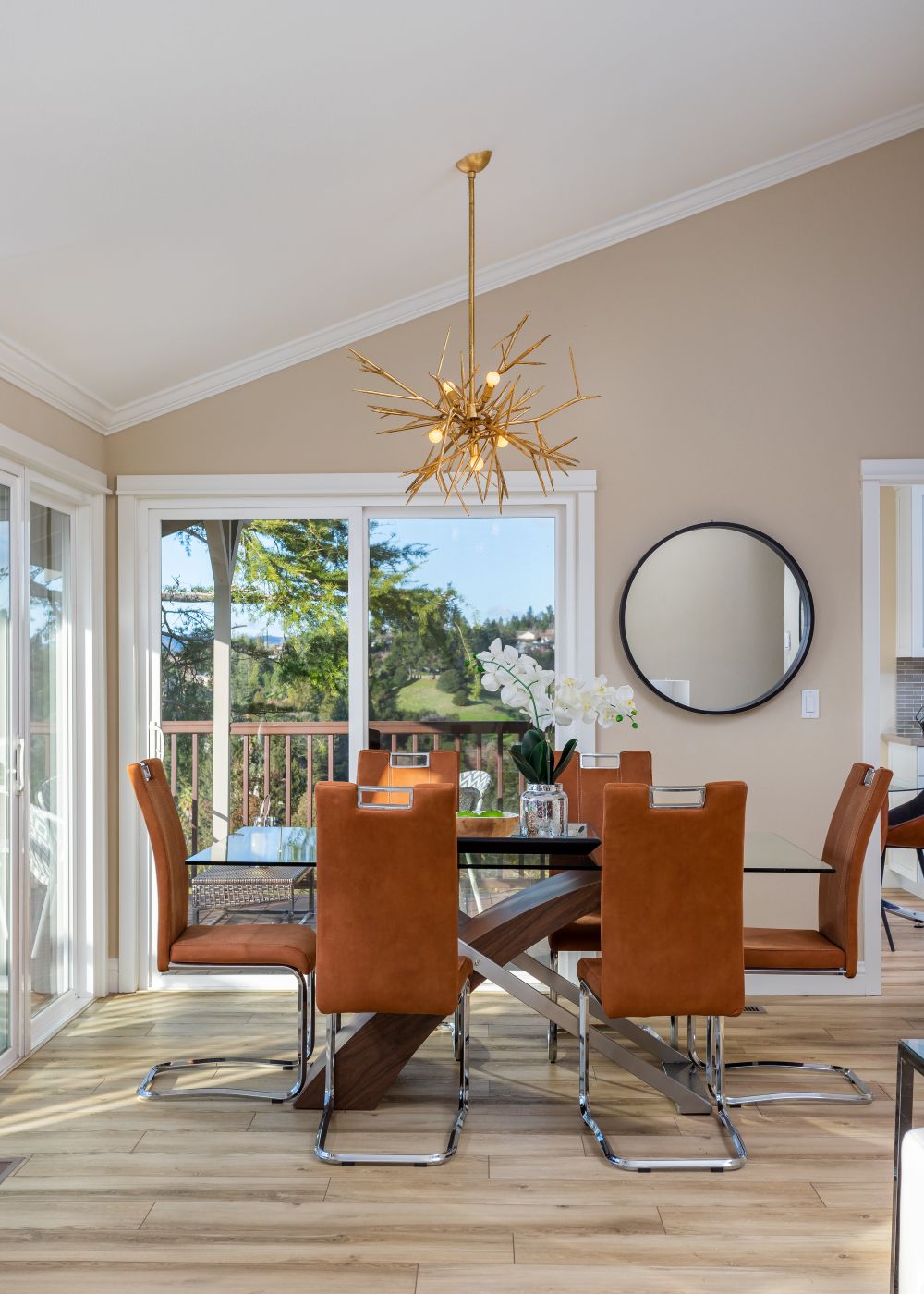
Bright, contemporary dining room featuring a glass-top dining table with warm caramel-colored cantilever chairs, a sculptural gold chandelier, and expansive windows overlooking a scenic outdoor view. Neutral beige walls, light wood-look flooring, and natural light create an inviting, upscale atmosphere.
What You're Actually Paying For
A permit fee isn't a flat charge. It's a bundle of services that the building department provides over the life of your project. Most homeowners think of it as one transaction — you pay, you get a piece of paper. The reality is that fee funds a sequence of work that happens before, during, and after construction.
Before Construction
Plan Check
A building department plan checker reviews your project drawings against California Building Code, local ordinances, Title 24 energy requirements, and sometimes fire, structural, and mechanical codes depending on scope. For a kitchen remodel with electrical and plumbing work, this review might involve three or four separate departments. Their job is to find problems on paper before they exist in your walls.
During Construction
Inspections
A licensed building inspector visits the jobsite at defined stages — typically rough framing, rough electrical, rough plumbing, insulation, and final. They physically verify that what's been built matches what was approved. This is the part that has real teeth: work that doesn't pass inspection has to be corrected before it gets covered up. It's also the part that's genuinely valuable — an independent set of eyes that isn't being paid by the contractor.
After Construction
Final Approval & Record
Once all inspections pass, the permit closes and the work is recorded in the county's property records. That record matters more than most homeowners realize — we'll come back to this.
Trade Term Explained
Title 24
Title 24 refers to Part 6 of the California Code of Regulations — the state's building energy efficiency standards. Every permitted construction project in California has to comply with Title 24 requirements, which govern things like insulation values, window U-factors, HVAC efficiency, and lighting controls. When your contractor says "we need to meet Title 24 on this," they mean the project has to satisfy these state energy standards as a condition of permit approval. California's Title 24 is among the strictest in the country, and complying with it adds real design and material requirements that other states don't have — which is part of why Bay Area projects cost more to permit and build than comparable work elsewhere.
Why the Bay Area Is More Expensive Than Everywhere Else
This is the question that generates the most frustration, and it deserves a real answer.
Permit fees in Contra Costa County — and across most Bay Area jurisdictions — are structured as a percentage of project valuation, not a flat fee. A kitchen remodel that the building department values at $80,000 pays a higher fee than one valued at $40,000, even if the paperwork is similar. This is called a valuation-based fee structure, and it's the norm in California.
The valuation the building department uses is not your contractor's bid. They use standardized construction cost tables — typically based on ICC (International Code Council) figures adjusted for California labor costs — which tend to run high relative to actual project costs in the current market. You don't get to argue them down. The fee is what it is.
On top of valuation-based fees, Bay Area jurisdictions often layer additional charges:
What's Inside a Typical Permit Fee — Walnut Creek Kitchen Remodel Example
Base Building Permit Fee Calculated as % of project valuation — covers plan check and inspection labor
$900–$1,400
Electrical Permit Separate permit for any electrical work — new circuits, panel work, outlets
$200–$500
Plumbing Permit Separate permit for any plumbing work — pipe moves, new fixtures, gas line work
$150–$400
Mechanical Permit If HVAC is modified or a range hood requires makeup air
$100–$300
School District Fee Yes, this is real — California AB 181 allows school districts to levy fees on new construction and some remodels. Varies by district and scope.
$0–$400
State Strong Motion Instrumentation (SMIP) FeeA tiny state surcharge that funds California's seismic monitoring network
$5–$25
Realistic Total Range
$1,500–$3,000+
Add to this the cost of the architect or designer who prepares the drawings required for plan check submission — typically $1,500–$5,000 depending on project complexity — and you start to see how "getting a permit" can add $3,000–$8,000 to a kitchen remodel budget before a single hammer swings.
That's real money. It's also, in our opinion, almost always worth it. Here's why.
"The permit fee funds a sequence of services: plan review before work starts, inspections while walls are open, and a permanent record when it's done. That's what you're buying."
What Needs a Permit and What Doesn't
The question we get almost as often as "why does it cost so much" is "do I even need one for this?" The answer is more nuanced than most people expect — and it varies by jurisdiction. Here's a general guide for Contra Costa County and the East Bay cities we work in most:
|
Work Type |
Permit Required? |
Notes |
|
Kitchen remodel — moving walls |
Yes |
Structural + building permit required |
|
Kitchen remodel — same layout, no structural |
Usually yes |
If electrical or plumbing is touched, permit required in most jurisdictions |
|
Cabinet replacement only |
Usually no |
Cosmetic work without trade work typically exempt |
|
Countertop replacement only |
No |
Cosmetic — no permit required |
|
Bathroom remodel — full gut |
Yes |
Plumbing + electrical + building permit required |
|
Toilet/faucet replacement (same location) |
No |
Like-for-like fixture swap typically exempt |
|
Adding a bathroom |
Yes |
Building + plumbing + electrical, often structural |
|
Water heater replacement |
Yes |
Plumbing permit required; inspection required in most jurisdictions |
|
Electrical panel upgrade |
Yes |
Electrical permit required; utility coordination often needed |
|
Adding circuits or outlets |
Yes |
Electrical permit required |
|
Window replacement — same opening |
Varies |
Some jurisdictions require permit; others exempt like-for-like |
|
Flooring replacement |
No |
No permit required for surface flooring in most cases |
|
Interior painting |
No |
Cosmetic — never requires a permit |
|
Door replacement — same opening |
Usually no |
Like-for-like typically exempt; new opening requires permit |
|
Deck addition or replacement |
Yes |
Building permit + structural review required |
|
ADU / garage conversion |
Yes |
Full building permit + all sub-trades; jurisdiction-specific rules apply |
When in doubt, call the building department. Most jurisdictions in the East Bay have a permit technician you can reach by phone who will tell you whether a specific scope requires a permit before you commit to anything. This costs nothing and takes ten minutes. We do it regularly even after all these years, because the rules genuinely vary between Walnut Creek, Danville, Lafayette, and unincorporated Contra Costa County — and they do change.
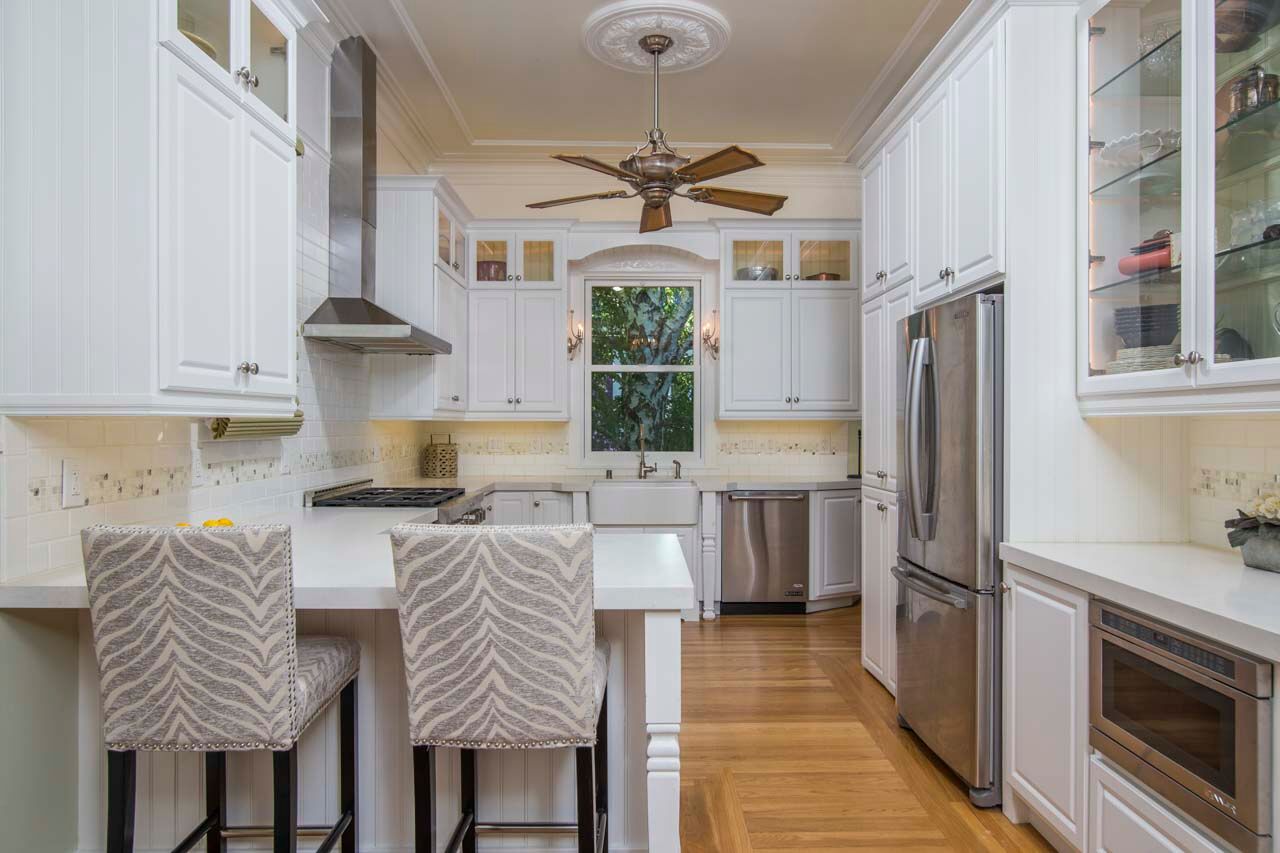
Elegant white kitchen with shaker-style cabinetry, stainless steel appliances, a farmhouse sink, quartz countertops, and decorative glass-front cabinets. The space features hardwood flooring, pendant-free task lighting, and a cozy breakfast bar with patterned upholstered seating.
What Happens When You Skip the Permit
We want to be direct here, because this is the part of the conversation that matters most. Skipping a permit isn't just bending a rule. It has real consequences that show up in specific, often expensive ways.
The Real Consequences of Unpermitted Work
It becomes your problem at resale. Real estate transactions in California require disclosure of known unpermitted work. Buyers' agents know how to spot it. An unpermitted addition or remodeled kitchen can kill a deal, require the work to be legalized (which often means opening walls to prove compliance), or result in a price reduction that exceeds what the permit would have cost.
Your homeowner's insurance may not cover it. If unpermitted work is involved in a claim — a fire that started in an unpermitted electrical panel upgrade, water damage from an unpermitted bathroom addition — your insurer has grounds to deny the claim or reduce the payout. Read your policy carefully. Most contain language about code compliance.
The city can make you tear it out. Unpermitted work that's discovered — by a neighbor complaint, by a subsequent inspection for different work, or during a real estate transaction — can result in a Stop Work Order or a Notice of Violation requiring the work to be removed or legalized. Legalizing unpermitted work is almost always more expensive than permitting it correctly from the start.
It creates liability for the contractor too. A licensed contractor in California who performs work that legally requires a permit, without one, is in violation of their license. We don't do unpermitted work. Not because we're rule-followers for its own sake — because we care what happens to you after we leave.
It doesn't actually save that much. The permit fee on a $100,000 kitchen remodel might be $3,000. The permit fee is real and it's significant. But the potential downside — a deal that falls through, an insurance claim denied, a legalizing process that costs $15,000 — is in a different order of magnitude.
Rossmoor: The Permit Process Has a Second Layer
If you're remodeling in Rossmoor, the building permit from the City of Walnut Creek is only part of the approval process. Rossmoor's Mutual boards have their own review and approval requirement that runs parallel to — and sometimes intersects with — the city permit process. These are two separate things, and confusing them creates problems.
How Permit Timing Works in Rossmoor
Mutual approval first, then city permit. In most cases, you'll want Mutual approval in hand — or at least confirmed — before submitting for a city building permit, because the Mutual may have requirements that affect the project design. Starting the permit process before Mutual approval can result in rework if the Mutual requires changes.
Mutual approval doesn't substitute for a building permit. We've seen homeowners in Rossmoor get Mutual sign-off and assume they're good to go. The city building permit is still required for any work that meets the permit threshold — regardless of what the Mutual has approved.
Contractor familiarity matters. A contractor who knows the Rossmoor process can navigate both tracks simultaneously and keep the project moving. One who doesn't may inadvertently start work in the wrong order and cause delays that are difficult to unwind. We've been doing Rossmoor work for years. It's a process we know well.
How We Handle Permits on Every Project
We pull permits. On everything that requires one. We don't offer a "cash discount to skip the permit" and we don't let clients talk us into unpermitted work by promising they'll handle any consequences themselves. We've seen those conversations end badly too many times.
What we do offer: we manage the permit process as part of the job. We prepare or coordinate the drawings, submit the application, schedule inspections, and make sure the project closes out properly with a final inspection on record. For most clients, the permit process happens in the background — they're aware it's happening, but it doesn't disrupt their lives or require them to become experts in municipal bureaucracy.
We also build permit costs and timelines into the project estimate from day one. A permit that takes four weeks to get approved is four weeks that need to be accounted for in the project schedule. Surprises in the permit process — a plan check comment that requires a design revision, a jurisdiction that's running six weeks on review — are much easier to manage when everyone planned for them from the start.
"We don't offer cash discounts to skip permits. We've seen too many of those conversations end badly — for the homeowner, not the contractor."
The Part That Actually Makes the Fee Worth It
Here's the thing about permits that nobody talks about because it's not dramatic: they create a permanent record that your work was done right.
When a final inspection passes and the permit closes, the county records that your kitchen was remodeled, that the electrical and plumbing work was inspected, and that it met code at the time of construction. That record lives in the property file. When you sell the house — next year, or in twenty years — the buyer's agent can pull that file and see a clean history of permitted work done by licensed contractors.
That record is worth something. It's worth something to buyers who don't want to inherit surprises. It's worth something to lenders who need to know the property is compliant. And it's worth something to you, right now, as a homeowner who wants to know that the electrical work behind your kitchen walls was looked at by someone whose job is to find problems — not to hide them.
The permit isn't just bureaucratic friction. It's a paper trail that says: this was done correctly, by people who stood behind their work, in the presence of someone whose job was to verify it. For work that's going to live behind your walls for the next thirty years, that paper trail has real value.
Questions About What Your Project Needs?
We'll walk you through what permits are required for your specific scope, what the process looks like from application to final inspection, and how we handle it so you don't have to become a permit expert yourself.

Toupin Construction
Ready to start your remodel?
Whether you're dreaming of a new kitchen, a spa-worthy bathroom, or a whole-home transformation — we’d love to hear about your project. Reach out and let's talk.
‹ Back
Comments