

By using our website, you agree to the use of cookies as described in our Cookie Policy
Blog
Why Your Remodel Costs More Than the Quote

Industry Insider · Remodeling Tips
Why Your Remodel Costs More Than the Quote
The real reasons budgets run over — and what you can do about it before demo day.
By Candi Toupin · Toupin Construction · CA Lic #626819
A homeowner called us last spring — frustrated, a little embarrassed, and a lot over budget. She'd gotten a quote from another contractor for her Lafayette kitchen, signed the contract, and was now looking at a final number that was substantially higher than what she'd been told. "How does this happen?" she asked. "Is this just how it works?"
Honestly? Sometimes, yes. But not because remodeling is a scam. It's because a quote and a final cost are two genuinely different things — and most homeowners don't know that going in. After 40+ years of doing this, we've seen every variation of this conversation, and we think you deserve a straight answer about why it happens and how to protect yourself.
East Bay Cost Reality Check
How far over budget do remodels actually run?
|
Project type |
Typical quote range |
Typical final range |
Common overrun |
|
Kitchen (mid-range) |
$60,000–$90,000 |
$70,000–$110,000 |
10–25% |
|
Bathroom (primary) |
$25,000–$45,000 |
$30,000–$55,000 |
10–20% |
|
Full home remodel |
$150,000–$300,000 |
$180,000–$360,000 |
15–25% |
|
Rossmoor unit refresh |
$35,000–$65,000 |
$40,000–$78,000 |
10–20% |
The Quote Was Only a Snapshot
Most homeowners treat the initial quote like a price tag. It's not. It's an educated estimate based on what a contractor can see in an hour-long walkthrough — visible surfaces, accessible plumbing, the layout as it currently exists.
That estimate assumes standard conditions. It often assumes you'll pick mid-range materials. It doesn't account for what's behind your walls or under your floors, because nobody's looked yet. The quote reflects a version of your project that doesn't fully exist yet.
This is especially true for free or phone-based quotes, which are closer to ballpark figures than actual cost breakdowns. A "$60,000 kitchen" might assume stock cabinets from a catalog, basic field tile, all plumbing staying put, and no structural changes. Change any one of those assumptions — and you will — and the number changes with it.
Know the Lingo
Allowance
A placeholder dollar amount built into a quote for something you haven't picked yet — cabinets, countertops, tile, fixtures. The quote might say "$8,000 cabinet allowance." If the cabinets you love cost $14,000, that $6,000 difference is a budget overrun — even though nothing went "wrong." This is one of the biggest sources of sticker shock at the end of a project.
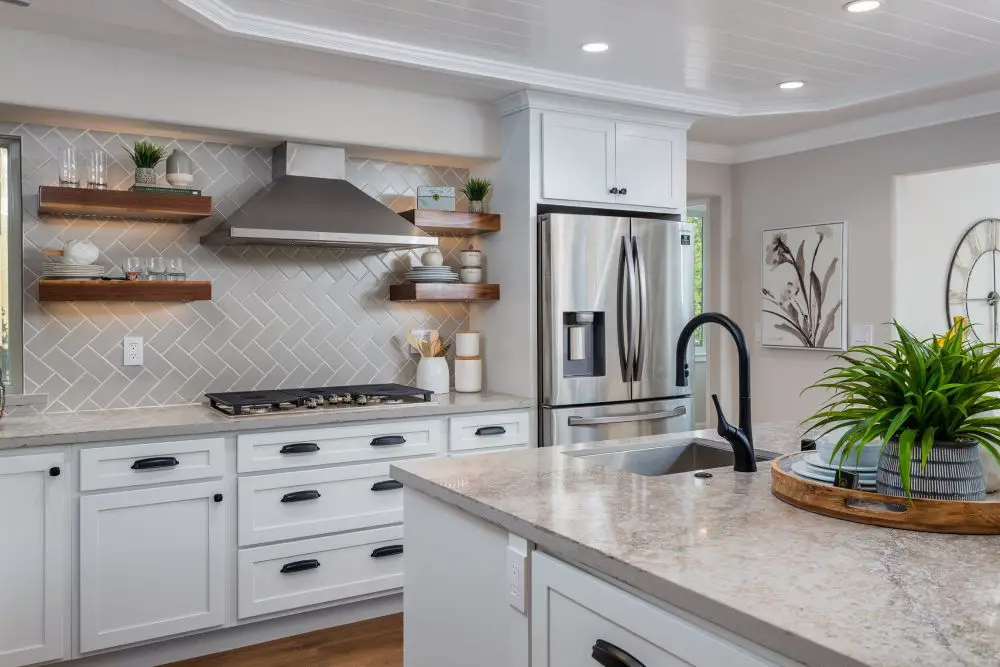
Bright transitional kitchen remodel featuring white shaker cabinets, quartz countertops, a large island with undermount sink, stainless steel appliances, floating wood shelves, a custom range hood, and a white herringbone tile backsplash.
Hidden Conditions Only Show Up Once You Start
This is the one homeowners dread most, and honestly, it's the most legitimate source of cost overruns. Behind walls that look perfectly fine, we've found: knob-and-tube wiring, subfloor rot, plumbing that's three code cycles out of date, mold that nobody knew was there, and framing that someone 40 years ago improvised in ways that made absolutely no sense.
We can't quote what we can't see. And once we open a wall and find a problem, we're legally and professionally obligated to address it before we can close it back up. That's not a gotcha — that's how safe, permitted construction works.
East Bay homes — especially anything built before 1980 in Walnut Creek, Orinda, Danville, and Lafayette — are particularly prone to this. These houses have had multiple owners, multiple DIY moments, and sometimes multiple layers of flooring and tile stacked on top of decisions made in the 1960s. We've pulled up kitchen floors and found three generations of vinyl underneath.
Toupin Tip
If your home is pre-1980, budget a contingency before you start — not if something comes up, but when. We typically recommend 10–15% of your total budget set aside specifically for unknown conditions. If you don't need it, great. But it's a lot less stressful to build a remodel knowing you have a buffer than to be caught flat-footed in week two.
Scope Creep: You Changed Your Mind (No Shame)
There's a phenomenon every contractor knows about and almost every homeowner experiences: the "while we're at it" conversation. Once your walls are open and your kitchen is gutted, the adjacent mudroom suddenly looks rough by comparison. The powder bath you weren't going to touch is right there. The original plan starts to expand.
This is normal. It's actually a reasonable way to approach a home — why not improve the mudroom now, while the contractor is already on site and the disruption is already happening? But every addition has a cost, and those costs add up faster than people expect.
|
Common Scope Additions |
Typical Add-On Cost (East Bay) |
Why It Gets Added Mid-Project |
|
Expanding to adjacent bathroom |
$15,000–$35,000+ |
"As long as the plumber is here..." |
|
Adding a kitchen island |
$3,000–$12,000 |
"The layout looks bigger than I thought" |
|
Upgrading to hardwood flooring |
$4,000–$9,000 |
Seeing the subfloor makes the difference obvious |
|
Built-in pantry or storage |
$2,500–$7,000 |
"We've always needed this" |
|
Electrical panel upgrade |
$3,500–$6,500 |
Required once new circuits are added |
We're not trying to upsell you on these. We've talked clients out of scope additions when the timing wasn't right. But when you add them, they become change orders — and those need to be documented, signed, and added to your contract total.
Material Choices Drive Real Costs
This is where a lot of well-intentioned budgets quietly slip. The quote might include an allowance for tile — say, $4 per square foot. Then you walk into a showroom, see a gorgeous handmade zellige tile from Morocco at $28 per square foot, and fall in love. Which, honestly? We get it. But that's not a price increase from us — that's a choice you made, and it's a real one.
The same thing happens with cabinets. We've worked with KraftMaid cabinets for over 40 years — they're our go-to because the quality is consistent and the customization is genuinely excellent. But there's a meaningful cost difference between a stock KraftMaid configuration and a fully custom layout with specialty storage, pull-outs, and cabinet lighting. Both are real options. Neither is "wrong." But they land at different price points.
"The quote may not have been wrong — your selections simply landed above the baseline that was built into it."
|
Material Category |
Budget Option |
Mid-Range |
Premium |
|
Cabinet line |
Stock/RTA — $5,000–$12,000 |
Semi-custom — $12,000–$25,000 |
Full custom — $30,000+ |
|
Countertops |
Laminate — $1,500–$3,000 |
Quartz — $4,000–$8,000 |
Quartzite/marble — $8,000–$18,000+ |
|
Floor tile (per sq ft) |
Porcelain — $3–$7 |
Glazed ceramic — $6–$14 |
Natural stone/zellige — $18–$35+ |
|
Plumbing fixtures |
Builder-grade — $800–$1,500 |
Mid-range — $2,000–$4,500 |
Designer/Signature — $5,000–$12,000+ |
⚠ Verify cost ranges before publishing.
Toupin Tip
Before you finalize a contract, ask your contractor to walk you through every allowance line by line. What brand or tier did they use to build that number? If it's a stock cabinet assumption and you know you want semi-custom, adjust the allowance upward before you sign — not after demo day.
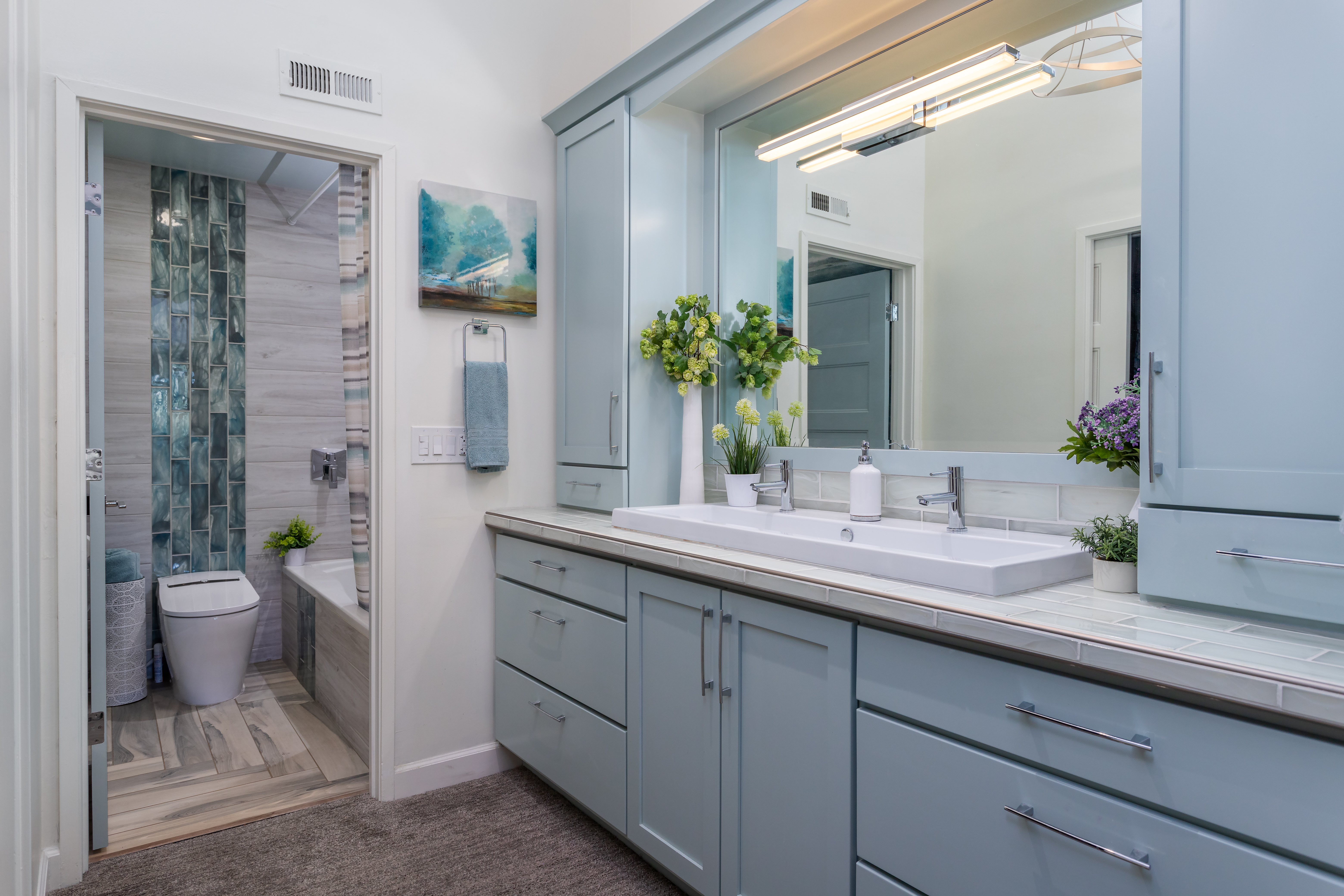
Modern bathroom remodel with a light blue double vanity, large framed mirror, integrated storage cabinets, contemporary lighting, and a walk-in tub and shower area featuring decorative blue accent tile.
Labor, Permits, and the Reality of East Bay Construction
Labor rates in Contra Costa and Alameda counties run higher than national averages — sometimes significantly higher. Electricians, plumbers, tile setters, finish carpenters — their hourly rates reflect the cost of doing business in one of the most expensive metro areas in the country. When you see a national average on a home improvement site, those numbers weren't built for East Bay jobsites.
Permits add another layer. Any structural change, new circuit, moved plumbing, or addition of square footage typically requires a permit from your city's building department — and those permits trigger inspections at multiple stages of the project. If an inspection requires a revision (which happens), that's additional labor and sometimes additional materials.
Know the Lingo
Change Order
A formal written document that modifies the original contract — changing the scope of work, the cost, or both. Every time something unexpected comes up or you add to the project, it should be documented as a change order. This protects you (you can see exactly what you're agreeing to pay) and protects the contractor (the work is authorized in writing). Never let a contractor do extra work without a signed change order.
The Risk of the Suspiciously Low Bid
Sometimes the problem isn't your project — it's the quote you said yes to. In a competitive market, some contractors win jobs by coming in lower than everyone else, then making it back on change orders once you're already committed and mid-demo.
We've seen homeowners come to us after exactly this scenario. They accepted a bid that was 20–30% below what other contractors quoted. Seemed like a win. Then the change orders started — for things that any experienced contractor would have anticipated. By the end, they paid more than they would have with a higher initial bid from someone who built the full scope into the original number.
When you're comparing bids, don't just compare the bottom line. Compare what's included.
How to Protect Your Budget (Without Sacrificing the Project)
You can't remove every surprise from a remodel. But you can structure the whole thing so surprises cost you less stress and less money.
|
What to Do |
Why It Matters |
When to Do It |
|
Ask for a line-item estimate, not a lump sum |
You can see what's included (and what isn't) before work starts |
Before signing any contract |
|
Clarify every allowance in writing |
Know what tier of product the quote assumed for cabinets, tile, fixtures |
Contract review stage |
|
Set aside a contingency fund |
Older homes especially — plan for the unknown |
Before you start |
|
Make material selections before demo |
Reduces mid-project changes and pricing uncertainty |
Design phase |
|
Require signed change orders for every addition |
Paper trail for every dollar above your original contract |
Throughout the project |
|
Get multiple comparable bids |
Reveals outliers (too high or suspiciously low) |
Estimating phase |
A Note for Rossmoor Homeowners
If you live in Rossmoor, budget conversations come with a few extra layers that don't apply elsewhere. Every project needs Mutual board approval before work begins — and that approval process takes time that affects your project timeline, not just your schedule. Some Mutuals are faster than others; some have specific requirements around noise hours, elevator access, and contractor credentialing.
Additionally, most Rossmoor units were built on concrete slab construction with aluminum wiring throughout — two conditions that require specialized knowledge and can affect both the scope and cost of any electrical or flooring work. We've been working in Rossmoor long enough to know which Mutuals have which quirks, what the approval process looks like, and how to factor all of this into an accurate estimate from day one.
Toupin Tip
In Rossmoor, factor the Mutual approval timeline into your project start date — not just your calendar. We build this into our scheduling from the beginning. If a contractor quotes you without asking about your Mutual, that's a red flag they haven't worked there before.
Before You Sign, Make Sure...
You have a line-item estimate, not a one-number ballpark
Every allowance is spelled out — what brand or tier does the number assume?
You've set aside a contingency of 10–15% (more for pre-1980 homes)
You understand what triggers a change order and how those will be handled
You've compared at least three bids on equal scope — not just price
Your contractor has pulled permits in your city before and knows local code
Serving Walnut Creek, Danville, Lafayette, Orinda & Rossmoor
Want an Estimate You Can Actually Trust?
We build line-item estimates with every allowance explained — so you know exactly what you're agreeing to before anyone touches a wall.
Toupin Construction · CA Lic #626819 · 40+ years in the East Bay

Toupin Construction
Ready to start your remodel?
Whether you're dreaming of a new kitchen, a spa-worthy bathroom, or a whole-home transformation — we’d love to hear about your project. Reach out and let's talk.
‹ Back
Comments