

By using our website, you agree to the use of cookies as described in our Cookie Policy
Blog
Bathroom Remodel Cost in the East Bay and Rossmoor: What to Actually Expect
Bathroom Remodeling · Community & Rossmoor Focused · Remodeling Process
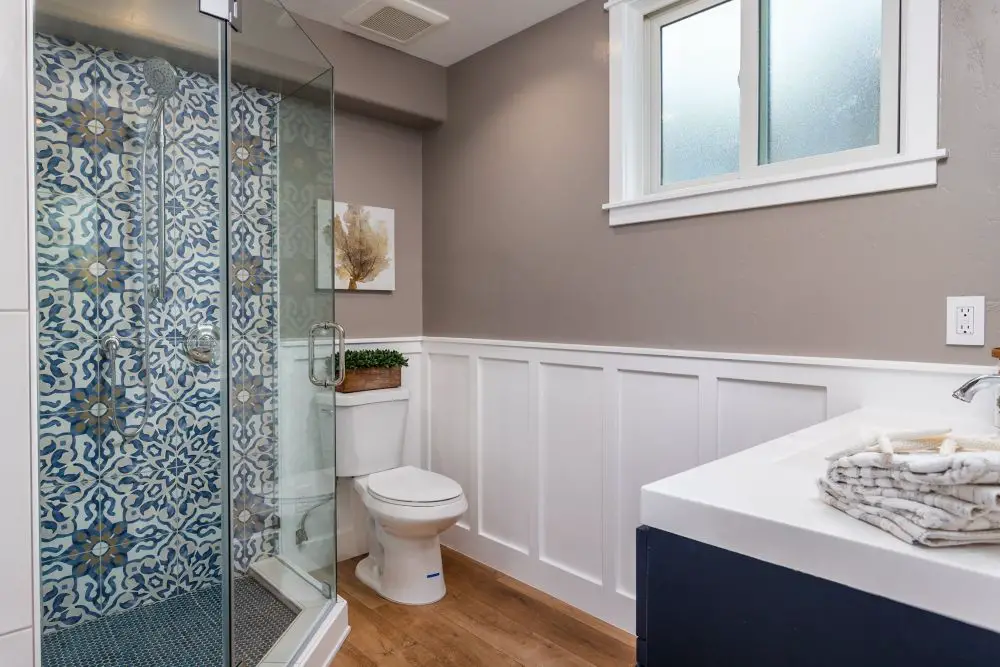 A stylish bathroom remodel showcasing a bold blue patterned tile shower wall paired with white wainscoting and warm wood-look flooring. The glass shower enclosure and clean-lined vanity create a balanced mix of classic and modern design elements.
Every contractor's website says the same thing when you ask about bathroom remodel cost: "It depends." That's technically true and practically useless. It depends on what, exactly? And how much does it depend?
We've remodeled hundreds of bathrooms across Walnut Creek, Rossmoor, Lafayette, Orinda, and the broader East Bay. We know what things cost here — not what they cost nationally, not what they cost according to Remodeling Magazine's annual survey, but what they actually cost when our crew shows up on a Monday morning in a specific ZIP code with a specific building department and specific material suppliers.
These are those numbers.
The Real Ranges: East Bay Bathroom Remodel Costs
Before the tier breakdown: East Bay costs run meaningfully higher than national averages. Bay Area labor rates, local permit fees, the complexity of older construction, and HOA coordination all push costs up. If a national article says a bathroom remodel averages $15,000–$20,000, that's a reasonable number for markets with lower labor costs. It's not our number.
A Note on Range Width
These ranges are deliberately wide because two bathrooms at the "standard full bath" scope can cost $28,000 or $55,000 depending entirely on material selections, whether plumbing moves, and what we find behind the walls. The ranges represent real projects we've completed, not estimates padded for safety. Where you land within a range is determined by the four cost drivers in the next section.
Where the Money Actually Goes
This is the breakdown that matters — not just percentages, but actual dollar figures anchored to a real project scope. We're using a standard East Bay full bathroom remodel at $40,000 as the reference point.
| Category | % of Budget | At $40K Total | What Drives It Higher |
|---|---|---|---|
| Labor & Installation | 35–40% | $14,000–$16,000 | Moving plumbing, unusual tile patterns, curbless shower framing |
| Tile & Flooring | 20–25% | $8,000–$10,000 | Natural stone, large-format, handcrafted tile, heated floor system |
| Vanity & Cabinetry | 12–18% | $4,800–$7,200 | Custom or semi-custom vs. stock; double vs. single; integrated countertop |
| Plumbing Fixtures | 8–12% | $3,200–$4,800 | Designer brands, multiple body sprays, freestanding tub filler, heated towel bar |
| Countertop | 5–8% | $2,000–$3,200 | Natural stone, quartz vs. cultured marble, integrated sink |
| Lighting & Electrical | 5–8% | $2,000–$3,200 | Recessed lighting addition, heated floor circuit, specialty sconces |
| Permits & Fees | 3–5% | $1,200–$2,000 | Structural modifications, Rossmoor Mutual application fees |
Labor is consistently the largest single category — and that won't change because skilled tile installation, waterproofing, and plumbing connection are genuinely skilled trades that require years of experience and carry real consequences when done wrong. A bathroom where the waterproofing fails costs far more to fix than the labor savings from hiring cheaper. We've replaced tile work installed by lower-cost contractors who skipped the membrane step. It is not inexpensive.
The most expensive bathroom remodel we've ever done wasn't one of our projects. It was fixing someone else's.
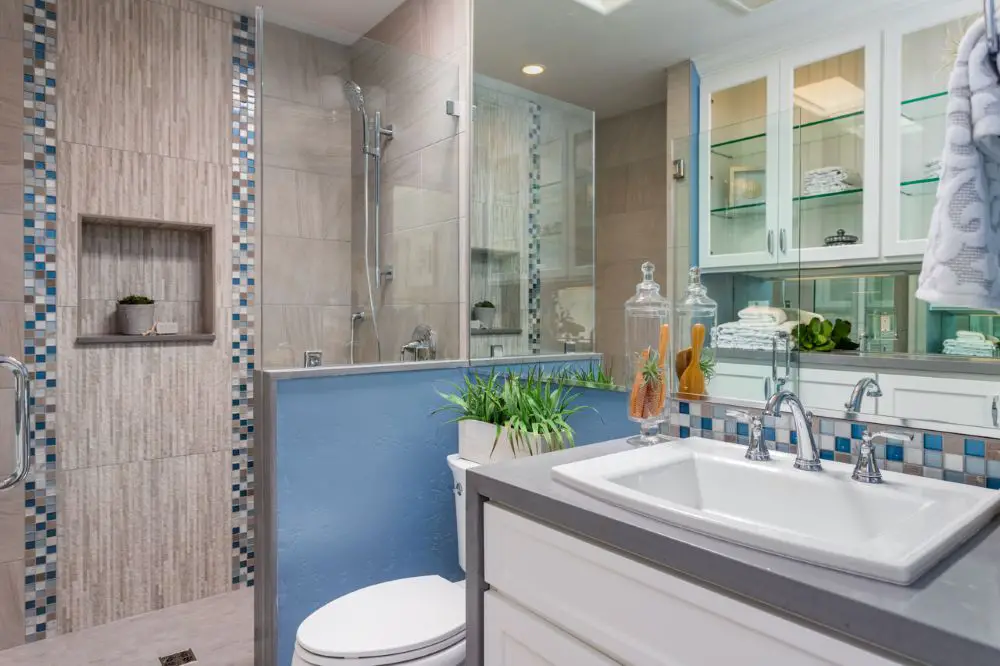 A detailed bathroom design featuring a walk-in shower with neutral tile, vertical mosaic accent strips, and a built-in shower niche. The space includes a white vanity, glass-front storage cabinets, and coordinated tile detailing that adds texture and visual interest.
The Four Things That Move Your Number
1. Whether Plumbing Moves
Keeping the toilet, shower, and sink in their current locations is the single biggest budget lever in a bathroom remodel. Moving any of these requires rerouting drain lines and supply lines — work that involves opening floors and walls, coordinating plumbing inspection, and in condos, navigating specific restrictions on what can and cannot be relocated.
Moving a toilet typically adds $2,000–$5,000. Moving a shower drain can add $3,000–$8,000 depending on the subfloor type and how far it moves. In Rossmoor specifically, drain relocation may be restricted by the Mutual due to the shared plumbing stack — something we verify before any layout conversation goes further.
2. Material Selections
The delta between entry-level and premium material choices in a single bathroom can easily be $15,000–$25,000. A stock vanity from a home improvement store costs $400–$800. A semi-custom vanity from KraftMaid runs $2,000–$5,000. A custom-built vanity from a local millwork shop runs $5,000–$12,000+.
The same spread applies to tile: basic 12x12 porcelain at $2/sq. ft. versus large-format Italian porcelain at $12/sq. ft. versus Moroccan hand-glazed zellige tile at $30+/sq. ft. We're usually specifying 80–120 square feet of tile in a bathroom. That math compounds quickly.
3. What's Behind the Walls
Why East Bay Older Homes Have This Problem More Than Others
A significant percentage of Walnut Creek and Rossmoor bathroom remodels are in homes and condos built between 1960 and 1985. That era predates modern plumbing standards, waterproofing methods, and in some cases, wiring codes. When we open walls in these bathrooms, we routinely find galvanized steel supply lines that are corroding from the inside (swap them while access is easy), subfloor damage from slow leaks near the toilet or shower base that went undetected for years, original tile installed over drywall with no waterproofing membrane (not code-compliant for wet areas by modern standards), and wiring that doesn't meet current requirements for GFCI protection in wet locations.
None of these are project-killers. All of them add cost. A 15–20% contingency budget in a bathroom remodel is not padding — it's planning for what our experience tells us is likely to be there.
4. Scope: Cosmetic vs. Full Gut
A cosmetic bathroom remodel — new fixtures, new vanity, new paint, new light, same tile — can be done for $8,000–$15,000 and looks substantially better. It doesn't require a permit in most cases, doesn't involve opening walls, and can be completed in 3–5 days.
A full gut remodel — everything out to the studs, new waterproofing, new tile, new plumbing, new electrical — is what the ranges above reflect. Both are valid approaches depending on the condition of the existing bathroom and the homeowner's goals. We'll tell you honestly which scope serves your situation rather than defaulting to whichever one we make more money on.
Rossmoor: The Specific Cost Factors
Rossmoor Bathroom Remodel — What's Different
Mutual board application: Rossmoor remodeling requires Mutual board approval before city permitting. Application preparation, review, and approval typically adds $300–$800 in direct fees (varies by Mutual) and 3–6 weeks of calendar time. We prepare and manage all Mutual documentation on your behalf — this is part of our standard process for Rossmoor projects, not an add-on charge.
Drain relocation restrictions: Many Rossmoor Mutuals restrict or require specific engineering documentation for any work that penetrates or modifies the floor system — which directly affects shower drain relocation. Before we discuss moving anything in a Rossmoor bathroom, we verify what your specific Mutual permits. This is a common surprise for clients who have done remodeling elsewhere and assume it's straightforward.
Older plumbing reality: Rossmoor's 1960s and 1970s construction means galvanized supply lines are common. When we're already opening a bathroom for a remodel, we typically recommend replacing supply lines while access is available. This adds $1,500–$3,500 depending on how many fixtures are involved, but replaces lines that may fail in the next 5–10 years if left in place.
Concrete slab subfloor: Unlike wood-framed construction, Rossmoor's concrete slab subfloor means waterproofing and tile installation proceed slightly differently. It also means subfloor leveling (if needed) is a concrete grinding or self-leveling compound process rather than a simple plywood replacement. Costs are comparable but the process differs.
Typical Rossmoor bathroom remodel budget: Add 5–10% to standard East Bay ranges above for the Mutual approval coordination, application fees, and the slightly higher complexity of the building type. A standard full bath that would run $35,000 in a Walnut Creek single-family home typically runs $37,000–$42,000 in Rossmoor after accounting for these factors.
What the Timeline Actually Looks Like
The timeline question is one where most clients are surprised — not because the construction itself takes long, but because there's a significant amount of necessary work before a hammer swings.
1
Initial consultation and designScope development, material selections, 3D layout if applicable. 2–3 weeks depending on decision pace.
2
Mutual application (Rossmoor only)Application preparation and board review. 3–6 weeks. This runs before city permit submission.
3
City permitSubmitted after Mutual approval for Rossmoor; concurrent with material ordering for standard homes. 2–4 weeks.
4
Materials ordered and receivedTile, vanity, fixtures — ordered during permitting. Vanity lead time: 3–6 weeks. Tile usually faster. We track everything.
5
ConstructionDemo, rough plumbing and electrical, waterproofing, tile, fixtures, finish work. 4–8 weeks depending on scope and inspection scheduling.
6
Final inspection and punch listCity final inspection, any Mutual post-completion walkthrough, punch list closed. 1–2 weeks.
Total from first conversation to completion: Standard East Bay home — 10–14 weeks. Rossmoor — 14–20 weeks, with the Mutual approval being the primary driver of the additional time. The construction itself doesn't take longer; the approval front-end does.
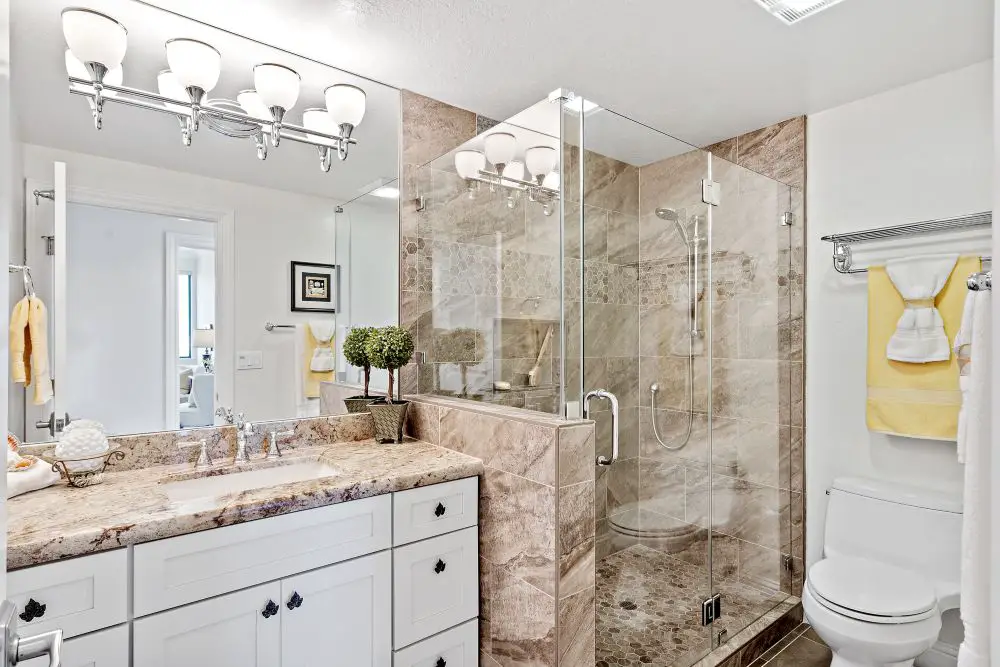 A bright, modern bathroom featuring a walk-in shower with beige stone-look tile, a glass enclosure, and a pebble shower floor. The space includes a double vanity with a granite countertop, chrome fixtures, and overhead lighting, creating a clean and timeless design ideal for a full bathroom remodel.
How to Budget Smarter Without Cutting Quality
Stretching a bathroom budget intelligently is about knowing where material quality shows up in daily use and where it doesn't.
- Spend on tile and fixtures. These are what you see and touch every day. The vanity faucet you reach for every morning — get the one that feels right. The shower tile — get something you genuinely love. These are not places to budget-optimize.
- Stock or semi-custom vanity over fully custom. A well-specified KraftMaid or similar semi-custom vanity looks excellent and performs well. Saving $4,000–$8,000 versus a custom-built piece is meaningful in the context of the total project.
- Keep the layout. If the toilet, sink, and shower can stay where they are, keep them there. The visual transformation of new tile, new fixtures, and a new vanity is dramatic without the cost of plumbing relocation.
- Mix tile tiers intentionally. A statement shower wall in a more expensive handcrafted tile, balanced with a neutral large-format tile on the floor and other walls, delivers the visual impact without applying the expensive tile everywhere.
- Build in the 15% contingency. Budget $40,000 and expect to spend $40,000 — but if we find subfloor damage or outdated wiring, you're not in crisis. You're prepared.
The Honest Answer to "How Much Should I Budget?"
The question I get most often isn't really about the number. It's about whether the number is worth it. The honest answer is that a well-done bathroom remodel in an East Bay home typically recovers 60–70% of its cost in resale value — and that doesn't account for the daily quality-of-life benefit for however many years you live in the home before you sell.
A bathroom you love to walk into every morning isn't a luxury. It's the room where you start every single day. After we've done enough of these to count in the hundreds, the clients who say they wished they'd done it sooner outnumber the clients who question whether they should have done it at all by a lot. That's not a sales pitch. It's just what we hear.
Frequently Asked Questions
Why do East Bay bathroom remodels cost more than national averages?
Three main reasons. Labor costs in the Bay Area are significantly higher than the national average — licensed trades (tile setters, plumbers, electricians) earn substantially more here than in most of the country. Our local permit fees are also above national averages. And a high percentage of East Bay housing stock is 40–60 years old, which means pre-existing conditions — outdated plumbing, inadequate waterproofing, subfloor issues — are common and add remediation cost that wouldn't exist in newer construction. These aren't contractor markup — they're the real cost of skilled labor and proper construction in this market.
Do I need to move out during a bathroom remodel?
If you have a second full bathroom in the home, most clients stay put. For a single-bathroom home or a bathroom remodel where it's the only full bath, we recommend a hotel or family arrangement for the 2–3 weeks of heaviest construction — primarily during demo and tile work when the room is completely non-functional. We'll give you a specific recommendation based on your project scope and whether there's an alternative bathroom.
What's the most expensive mistake people make in bathroom remodels?
Choosing finishes before confirming the budget can support them, then having to value-engineer down after falling in love with the $30/sq. ft. tile. The second most common is skipping waterproofing — either hiring someone who doesn't do it properly, or trying to DIY tile over a non-waterproofed substrate. We've replaced tile work where the original installation failed within two years because the waterproofing was skipped. The tile looked fine until the water got behind it. At that point, everything comes out and it's a full redo.
Is a primary bathroom remodel worth it for resale?
In the East Bay market — yes, consistently. Mid-range bathroom remodels typically recover 60–70% of cost in East Bay resale, and primary bathrooms specifically attract buyer attention in a way that other improvements don't. A dated primary bathroom lowers perceived value more than its square footage warrants. A spa-quality primary bathroom elevates the whole home in buyers' minds. The caveat: the improvement should be calibrated to the neighborhood's price range. A $90,000 primary bath in a home that would sell for $900,000 makes more sense than the same investment in a $650,000 market.
How do I compare contractor bids for a bathroom remodel?
Make sure you're comparing the same scope. A bid that's significantly lower than others is usually missing something — subfloor preparation, waterproofing membrane, permit fees, or demo and disposal. Ask every contractor what's explicitly not included. Check that all bids specify the same materials — "tile" on a bid means nothing without the specific product, quantity, and installation method specified. Verify license and insurance for each bidder at cslb.ca.gov before taking any bid seriously. And get at least three bids from contractors who have completed comparable projects in your city or Mutual.
Ready to Plan Your Bathroom Remodel?
We'll walk through your bathroom, talk through scope and budget, and give you a detailed proposal — not a ballpark, a real number you can plan around. No obligation, just an honest conversation from people who've done this hundreds of times in your neighborhood.
Get a Free Quote → 925-937-4200
Toupin Construction
Ready to start your remodel?
Whether you're dreaming of a new kitchen, a spa-worthy bathroom, or a whole-home transformation — we’d love to hear about your project. Reach out and let's talk.
‹ Back
Comments