

By using our website, you agree to the use of cookies as described in our Cookie Policy
Blog
Butcher Block Countertops: Warm, Honest, and Better Than Its Reputation
Butcher Block Countertops: Warm, Honest, and Better Than Its Reputation
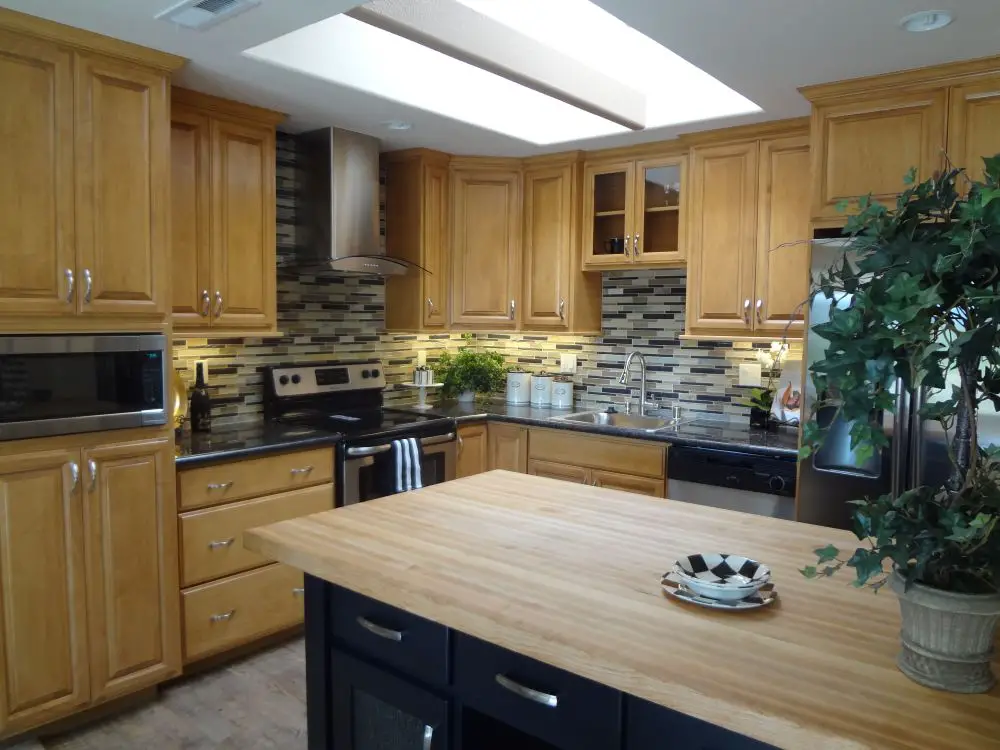
Warm, traditional kitchen featuring light wood cabinetry and a butcher block island under a large skylight. The space combines natural materials with modern appliances, creating a bright and functional cooking area.
I want to defend butcher block for a minute, because it gets treated like the scrappy little sibling of the countertop world — fine for the baking station, maybe the coffee nook, but not serious enough for a whole kitchen. That's wrong, and I'll tell you why.
We've installed butcher block islands that became the literal center of family life in homes across the East Bay. Not because wood is trendier than stone or cheaper than quartz — sometimes it's neither — but because it does something no other countertop material does: it makes people want to use the kitchen. There's something about the warmth and texture of wood that pulls people in. Kids do homework at it. Couples talk at it while one person chops and the other opens wine. It's not decorative. It's functional in the truest sense.
That said — I'll be just as honest about where butcher block falls short, because the last thing we want is for someone to install it in the wrong place and spend the next five years angry at us.
This is part of our Countertop Materials Series, covering all the major surfaces we install in East Bay homes: quartz, granite, marble, quartzite, soapstone, and porcelain.
What "Butcher Block" Actually Means
Trade Term Explained: Edge Grain, End Grain, Face GrainButcher block isn't just "a wood counter" — it's a specific construction method where narrow strips of wood are glued together under pressure. The orientation of those strips determines the look, durability, and price:
Edge grain— The long edges of the boards are glued together and face up. This is the most common type: smooth, durable, and relatively budget-friendly. Great for most kitchen applications.
End grain— The boards are cut crosswise and the end grain faces up, creating that classic checkerboard pattern. It's the most knife-friendly surface (the wood fibers part around the blade rather than getting cut), the most durable, and the most expensive.
Face grain— The wide face of the board faces up, like a wide plank. Beautiful and rustic-looking, but the most prone to warping and cracking. We don't typically recommend it near sinks.
Edge grain— The long edges of the boards are glued together and face up. This is the most common type: smooth, durable, and relatively budget-friendly. Great for most kitchen applications.
End grain— The boards are cut crosswise and the end grain faces up, creating that classic checkerboard pattern. It's the most knife-friendly surface (the wood fibers part around the blade rather than getting cut), the most durable, and the most expensive.
Face grain— The wide face of the board faces up, like a wide plank. Beautiful and rustic-looking, but the most prone to warping and cracking. We don't typically recommend it near sinks.
For most kitchen applications — an island, a peninsula, a run of perimeter counter — edge grain is the call. It performs well, looks great, and doesn't cost a fortune. End grain is worth the upgrade if you have a dedicated prep station or baking area where you'll actually be doing heavy knife work directly on the surface.
Why Butcher Block Does Something Stone Can't
Every material in this series has something it does uniquely well. Granite's heat resistance. Soapstone's acid immunity. Quartzite's hardness. Porcelain's UV stability.
Butcher block's superpower is less technical but just as real: it's self-healing in a way no stone surface can be. Scratches in wood — even significant ones — can be sanded away entirely and the surface restored to like-new condition with an afternoon of work and a few dollars of mineral oil. That's not a patch or a repair. It's actually gone. Try that with a chip in your quartz countertop.
Wood is the only countertop material where damage doesn't accumulate. You can genuinely start fresh with sandpaper and oil, and nobody will ever know the difference.
This matters particularly for families with young kids, homeowners who do real heavy-duty cooking, and people who just don't want to live in a museum. Butcher block is the material for people who actually use their kitchen.
The Design Equation: Where Butcher Block Fits
Butcher block pairs beautifully with just about every design direction, which surprises people. It shows up in farmhouse kitchens, obviously — but it also looks sharp against dark navy or forest green modern cabinetry. Walnut butcher block under white upper cabinets and open shelving reads as warm and contemporary. Light maple on an island surrounded by quartz perimeter counters creates a two-surface kitchen that's functional and visually dynamic.
The multi-surface approach is actually one of the most popular ways we use butcher block — not as the entire kitchen, but as an island or peninsula counter that introduces warmth and texture against cooler stone or engineered surfaces. It gives the kitchen layers that a single-material approach can't achieve. See our portfolio for examples of mixed-surface kitchens we've completed in the East Bay.
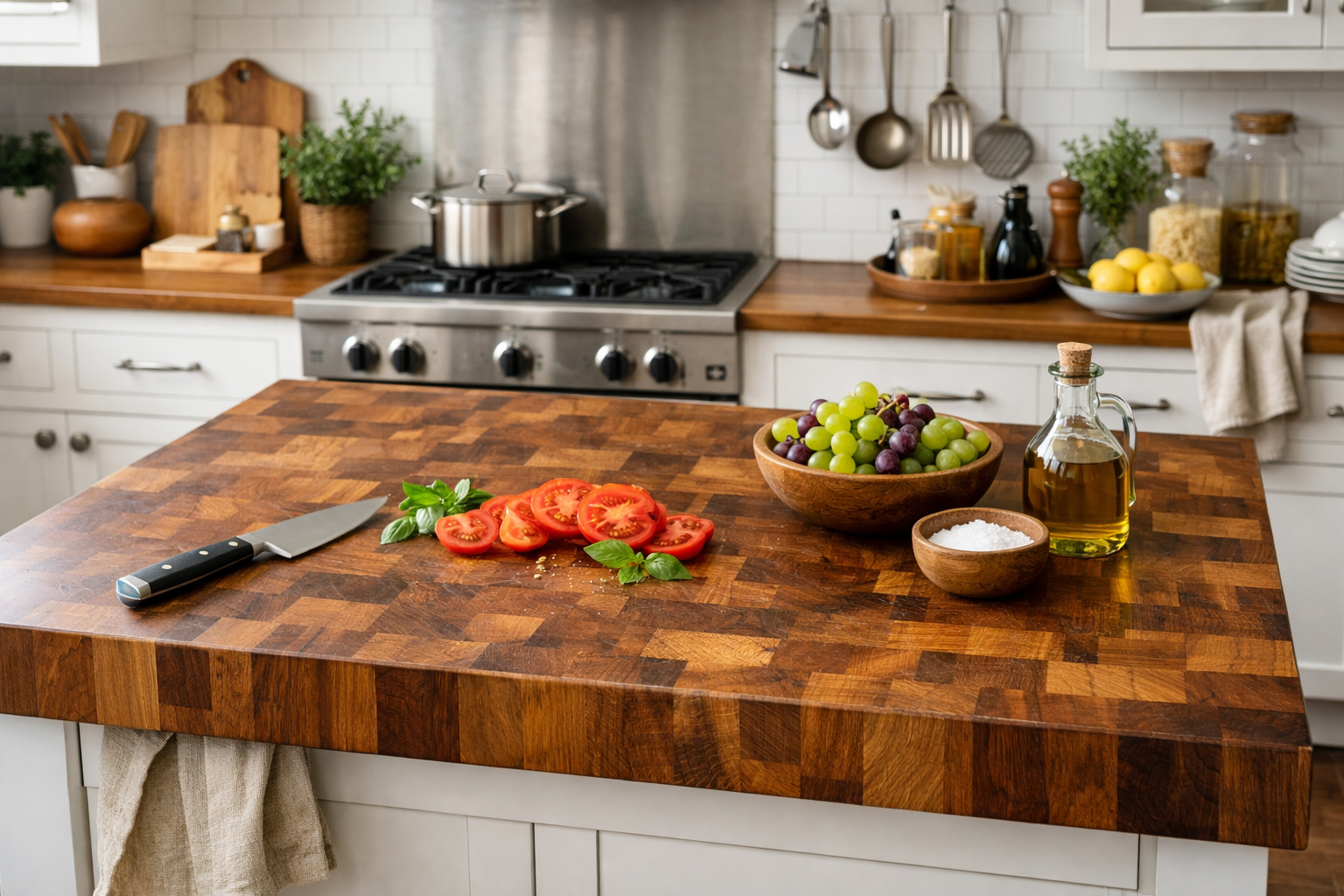
Close-up of a rich end-grain butcher block countertop used for food prep, featuring sliced tomatoes, fresh herbs, olive oil, and kitchen essentials in a bright, modern kitchen.
Wood Species and What They Actually Look Like Over Time
Maple is the workhorse — hard, tight-grained, light in color. It accepts stains and oils beautifully and holds up to heavy use better than most species. If you want a bright, clean-looking wood counter, maple is the most practical choice.
Walnut is the showstopper. Deep, rich brown with grain patterns that are genuinely beautiful. It's softer than maple (so it will show use a bit more) but it develops a patina that many homeowners consider an upgrade, not a problem. Walnut butcher block on a dark-base island in a lighter kitchen is one of the more striking design moves available at this price point.
Oak is traditional, warm, and very durable. The grain is more pronounced than maple, which reads as more character-driven. It pairs naturally with other warm wood tones and traditional kitchen styles.
Cherry starts light reddish-pink and darkens dramatically over years of use and light exposure. If you want a counter that looks completely different — and significantly more beautiful — in five years than the day it was installed, cherry is the one.
Acacia is an affordable option with striking grain movement and natural color variation. It's softer and more prone to scratching than the others, but the visual character is high and the price is lower.
The Real Maintenance Conversation
Here's where I'm going to be direct, because butcher block is often oversold on the "easy maintenance" angle and it's not fully honest.
If you choose an oiled finish — which is the food-safe option and the one most people choose for surfaces near food prep — you need to re-oil it. How often depends on use, but monthly-ish at first, tapering off as the wood stabilizes. You'll know it's time when the surface starts looking dry or chalky. It takes ten minutes and a rag. But it is a real, recurring commitment in a way that quartz or porcelain maintenance isn't.
If you choose a sealed finish — a hard wax or polyurethane coating — the maintenance frequency drops significantly, but the surface isn't food-safe for cutting, and the seal will eventually wear in high-traffic areas. When it does, you'll need to sand back to bare wood and refinish.
Neither option is high-maintenance by any reasonable standard. But butcher block asks more of you than a quartz countertop, which asks essentially nothing. Know that going in.
Where Not to Put Butcher Block
The area directly around a main sink is the most common installation mistake we see with butcher block. Standing water — from hand washing, dish rinse-off, splashing — is wood's enemy. It leads to dark staining, swelling, and eventually mold if it's not caught and addressed. If you want butcher block in a kitchen with a main sink, either position it away from the sink run, or choose a waterproof finish and stay extremely disciplined about wiping moisture.
The area near a cooktop or directly behind a gas range is also worth thinking through carefully. Butcher block isn't heat-proof. A pan set directly on it will leave a mark. Trivets are non-negotiable in these areas.
Outdoor use is simply off the table. Rain plus UV plus temperature swings equals warped, split, ruined wood. Porcelain or granite if you need an outdoor surface — see our porcelain post for more on that.
Butcher Block in Rossmoor
We see butcher block used most often in Rossmoor as accent counters rather than full kitchen installations — a dedicated baking station, a coffee bar area, or an island in a kitchen that has quartz or granite perimeter counters. It brings warmth into smaller kitchens that might otherwise feel a bit clinical. The maintenance is manageable for most homeowners, and the repairability is a genuine asset. Keep in mind that Rossmoor Mutual boards may have guidelines around kitchen renovations — we handle the approval process as part of every project we take on in the community.
Pricing
Material-only butcher block typically runs $30–$80 per square foot depending on species, grain orientation, and thickness. Installed, expect $60–$140+ per square foot. Walnut and end grain push the number up; maple edge grain is the most accessible option. This makes butcher block one of the more budget-accessible ways to add natural material to a kitchen without a full stone installation.
For more on budgeting kitchen remodels, see our guide on kitchen remodeling services.
Butcher Block vs. Other Natural Materials
| Feature | Butcher Block | Soapstone | Quartz | Granite |
|---|---|---|---|---|
| Heat Resistance | Poor — use trivets | Excellent | Fair | Excellent |
| Water Resistance | Moderate — wipe immediately | Excellent | Excellent | Good (when sealed) |
| Scratch Resistance | Low — but fully repairable | Low — but fully repairable | Good | Very good |
| Repairability | Excellent — DIY sanding | Excellent — DIY sanding | Difficult | Moderate |
| Maintenance | Moderate — regular oiling | Low | Very low | Low (seal every 10–15 yrs) |
| Outdoor Use | No | Some varieties | No | Yes |
| Typical Installed Cost | $60–$140+/sq ft | $110–$190+/sq ft | $95–$165+/sq ft | $75–$140+/sq ft |
Candi's Take
Butcher block is for homeowners who understand that a kitchen isn't a showroom. It scratches, it needs attention, and it's completely, honestly itself — which is exactly what makes it beautiful. The people who love it tend to really love it, because it's a surface that actually gets better as the kitchen gets used. For an island, a prep station, a coffee nook, or a mixed-surface kitchen that needs warmth — it's one of my favorite recommendations. Just put it in the right place.
Thinking About Wood in Your Kitchen?
We can help you figure out where butcher block makes sense in your layout and what it'll look like alongside your other materials. Call us or come by — honest advice, no pressure.
Get a Free Consultation — 925-937-4200
Toupin Construction
Ready to start your remodel?
Whether you're dreaming of a new kitchen, a spa-worthy bathroom, or a whole-home transformation — we’d love to hear about your project. Reach out and let's talk.
‹ Back
Comments