


By using our website, you agree to the use of cookies as described in our Cookie Policy
Blog
Yes, You Need a Bathroom Fan. Here's How to Pick a Good One.

Bathroom Remodeling · Code & Permits
Yes, You Need a Bathroom Fan. Here's How to Pick a Good One.
The short answer is in the headline. The interesting part is everything that comes after it.
 This bathroom includes a ceiling-mounted exhaust fan positioned to help remove excess moisture and improve air circulation. Proper ventilation helps prevent mold growth, protects materials like cabinetry and tile, and maintains better indoor air quality. Combined with natural light from the window, this setup supports a healthier and more durable bathroom environment.
We hear some version of this question on nearly every bathroom remodel we do: "Do I actually need an exhaust fan, or is it just a nice-to-have?" The answer is almost always "yes, and California code says so" — but the more useful conversation is about why it matters, and how to choose one that doesn't sound like a leaf blower in a library.
The exhaust fan is the most unsexy component of a bathroom remodel, and it's routinely underspecced as a result. People spend $800 on a light fixture and $40 on the fan. Then they wonder why their mirror fogs up for an hour after every shower and their grout is discoloring six months later.
First, the Code Question
What California Actually Requires
The California Residential Code is fairly direct: if a bathroom doesn't have an operable window — meaning a window that opens and provides direct outside air — it must have a mechanical exhaust fan. Full stop.
Even when a window exists, most building inspectors in Walnut Creek and throughout Contra Costa County still expect mechanical ventilation in a bathroom remodel. The operable-window exception is increasingly narrow in practice, and getting your final inspection signed off without a fan is harder than it used to be.
"Skipping the exhaust fan to save $150 is the kind of decision that costs you $1,500 at inspection when the inspector won't sign off — and you're now retrofitting a fan into finished walls and ceiling."
The practical consequence of skipping it isn't just a failed inspection. Unpermitted work that doesn't meet code can complicate a home sale, cause issues with homeowner's insurance, and — most immediately — damage your new bathroom faster than almost anything else.
The Real Reason It Matters
What Happens Without Proper Ventilation
A bathroom produces more sustained humidity than any other room in the house. Every shower is essentially a steam event. That moisture has to go somewhere — and if it can't exit through the fan duct, it goes into your walls, your ceiling, your grout joints, and your cabinet substrate.
- Grout and tile damage: Persistent moisture accelerates efflorescence — the white salt deposits that appear in grout — and causes grout to crack and loosen faster than normal wear would explain
- Cabinet and vanity damage: Particleboard vanity bases absorb moisture and swell; wood frames warp; finishes peel at corners and edges
- Paint failure: Bathroom ceilings and upper walls are the first to show bubbling, peeling, and staining when ventilation is inadequate
- Mold: The corners where walls meet ceilings, and the back of the vanity cabinet, are the first places mold establishes in a poorly ventilated bathroom — often before it's visible
None of this is dramatic or fast. It's slow, invisible damage that reveals itself six to eighteen months after a remodel — precisely when you'd rather not be tearing things apart again.
Choosing the Right Fan
CFM, Sones, and What They Mean
Trade Term: CFM (Cubic Feet per Minute)
CFM measures how much air a fan moves per minute. The basic rule: you need at least 1 CFM per square foot of bathroom floor area. A 60 sq ft bathroom needs at minimum a 60 CFM fan. Round up if the bathroom has a separate shower enclosure, a soaking tub, or a long duct run — all of which reduce effective airflow.
| Bathroom Size / Type | Minimum CFM | Notes |
|---|---|---|
| Powder room / half bath | 50–70 CFM | No shower; still needed for code compliance |
| Standard full bathroom (up to 100 sq ft) | 100 CFM | Standard recommendation with room to spare |
| Primary bath / large bath (100–150 sq ft) | 150 CFM | Two fixtures or a soaking tub? Go higher |
| Bathroom with long duct run (20'+ to exterior) | Add 25–50 CFM | Duct resistance reduces real-world airflow |
Trade Term: Sones
Sones measure perceived noise — how loud the fan sounds in use. The scale is not linear: 2 sones is roughly twice as loud as 1 sone. A quiet fan is 1.0 sones or below. A standard builder-grade fan runs around 2.0–4.0 sones, which sounds fine in a showroom and infuriating in a bathroom at 6am. The fans we specify are almost always 1.0 sones or below. Quieter fans actually get used — and a fan that gets used is a fan that does its job.
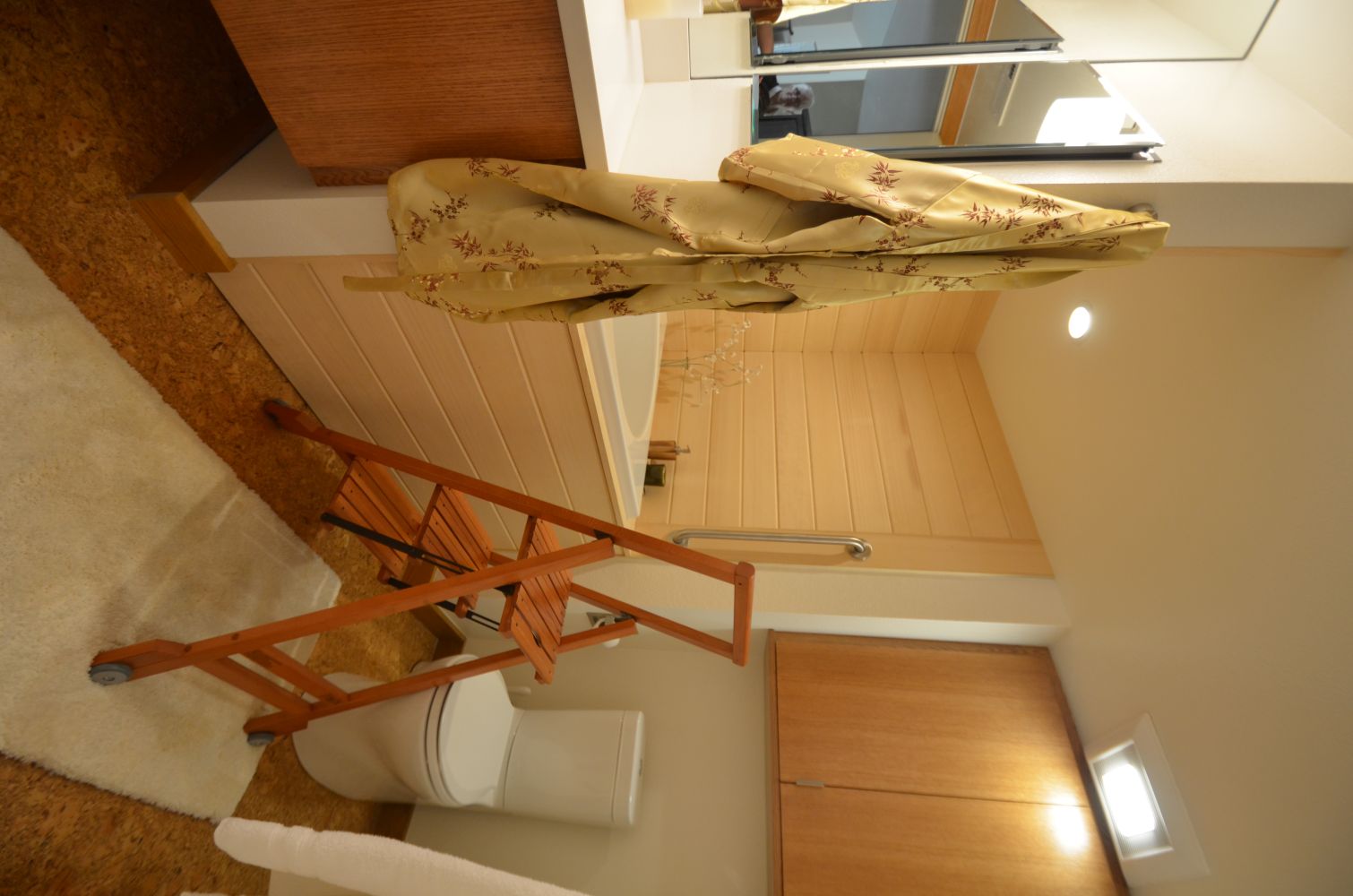 This bathroom does include a ceiling exhaust vent, visible in the top right corner. However, its placement may limit its effectiveness, as it is positioned away from the main moisture source (the bathtub/shower area). For optimal performance, exhaust fans should be located closer to where steam is generated to efficiently remove humidity. While the presence of a vent is beneficial, improper placement can still lead to moisture buildup, increasing the risk of mold and material damage over time.
Features Worth Paying For
- Humidity sensor: Turns on automatically when steam levels rise, turns off when humidity returns to normal — you never have to remember to run it
- Timer function: Runs for a set period after the light is switched off; code-compliant and practical for households where people forget
- ENERGY STAR rating: Runs on less electricity, qualifies for utility rebates in many Contra Costa County programs, and typically signals a better-built unit overall
- Combination units (fan + light): Practical in smaller Rossmoor bathrooms where ceiling space is limited; one box does double duty
Brands we regularly specify and trust: Panasonic WhisperCeiling series (exceptionally quiet, excellent CFM-to-sone ratio), Broan, and Delta Breez. All three make ENERGY STAR units with humidity sensors at reasonable price points.
Installation Notes
The Part That Actually Has to Be Done Right
The fan itself is only part of the equation. The duct that carries moist air out of the bathroom to the exterior is equally important — and more often done wrong.
- Exterior termination is required: The duct must exit to the outdoors, not into the attic, not into a crawlspace. Attic venting deposits moisture directly into your insulation and framing — this was standard practice decades ago and is the source of a lot of mold problems we see in older East Bay homes
- Backdraft damper: The exterior vent cap must have a damper that closes when the fan isn't running, preventing outside air (and pests) from entering through the duct
- Rigid or semi-rigid duct preferred: Flexible accordion duct is common but prone to kinking and sagging, both of which reduce airflow. Where we can, we run rigid metal duct for better performance
- Dedicated switch or timer: The fan should have its own switch, not be hardwired to the light so it only runs when the light is on
My bathroom has a window. Do I still need a fan?
Technically, the CRC allows a window exception — but in practice, most Walnut Creek inspectors expect mechanical ventilation during a permitted remodel. A window that's painted shut, rarely opened, or located where steam doesn't reach it doesn't provide meaningful ventilation. We recommend the fan regardless.
How do I know if my existing fan is adequate?
Hold a tissue near the fan grille while it's running. If the tissue barely moves, the fan isn't pulling adequate air. Many older fans have accumulated enough lint and debris in the housing to reduce their effectiveness significantly. Even a fan that was spec'd correctly at installation may be underperforming now. A bathroom remodel is the right time to upgrade — it's dramatically easier to install before walls are closed than after.
Can I install a bathroom fan myself?
If you're replacing an existing fan in the same housing location, with the same duct connection, it's a manageable DIY project for someone comfortable with basic electrical work. New installation — new duct run, new electrical circuit, new exterior penetration — is contractor work, and in Walnut Creek requires a permit.
Planning a bathroom remodel?
Ventilation is one of those details that's easy to get right when you plan for it and expensive to fix when you don't. We handle permits, duct routing, and fan selection as part of every bathroom project.
Get a Free Quote Call 925-937-4200
Toupin Construction
Ready to start your remodel?
Whether you're dreaming of a new kitchen, a spa-worthy bathroom, or a whole-home transformation — we’d love to hear about your project. Reach out and let's talk.
‹ Back
Comments