

By using our website, you agree to the use of cookies as described in our Cookie Policy
Blog
Statement Lighting: When to Go Bold (And When to Step Back)
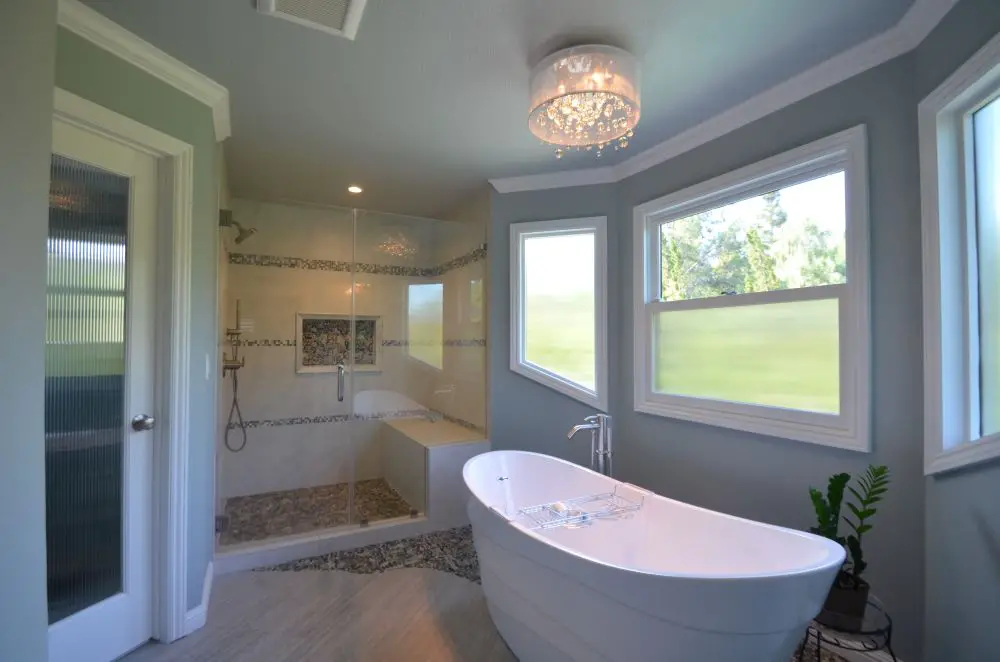 A decorative ceiling-mounted chandelier adds an unexpected statement to a serene bathroom, positioned above a freestanding soaking tub. The soft sparkle elevates the space, blending spa-like calm with a touch of luxury.
A decorative ceiling-mounted chandelier adds an unexpected statement to a serene bathroom, positioned above a freestanding soaking tub. The soft sparkle elevates the space, blending spa-like calm with a touch of luxury.We were wrapping up a kitchen remodel in Rossmoor a while back — new cabinets, fresh countertops, the whole thing — and the client stood in her doorway staring at the space with this look on her face. Not unhappy, just… something was off. We figured it out in about thirty seconds: the new pendants she'd ordered were tiny. Like, laughably small for the island. She'd picked them from a photo online without realizing the island in that photo was half the size of hers.
We've seen the reverse too — a fixture so enormous it swallowed an entire dining room. Lighting is one of those design choices that looks obvious in hindsight and completely opaque before you know what you're doing. So let's fix that.
Trade Term — Know This OneColor temperature is measured in Kelvins (K) and describes how warm or cool a light appears. Lower numbers (2700K–3000K) produce warm, amber-toned light — think candlelight or a cozy restaurant. Higher numbers (4000K–5000K) go cool and bright, like a doctor's office. Most homes do best in the 2700K–3000K range. Bathrooms and kitchens can sometimes go up to 3500K for task lighting clarity.
Why Lighting Is the Last Thing People Think About (And Shouldn't Be)
Here's a truth we've learned after 40-plus years of remodeling: clients spend months agonizing over tile, countertops, and paint colors — and then pick a light fixture in about twelve minutes from a big-box website. And then wonder why the room doesn't feel right after everything is installed.
Lighting isn't decoration. It's how your brain reads the room. The same space under warm, layered lighting feels completely different than under a harsh overhead fixture at full blast. Great tile looks flat under bad light. Mediocre tile can look beautiful under good light. We've seen it both ways.
The biggest decision in lighting design — at least for most rooms — is whether to choose a statement fixture that becomes the room's focal point, or a quiet, recessed approach that lets everything else shine. Neither is automatically right. It depends entirely on what the room needs.
"Does this room need a star — or does it already have one?"
That single question will answer the lighting decision for almost every room in your house. Let's walk through both sides of it.
When to Go Bold: The Case for Statement Lighting
A statement fixture is one that you notice — intentionally. It's designed to be the visual anchor of the room, the thing people comment on when they walk in. Done right, it can transform a flat, forgettable space into something that feels designed.
The Room Doesn't Have a Focal Point
Every room needs something for the eye to land on first. If you walk into a space and it just feels… directionless, a bold overhead fixture can do that job instantly. This is especially common in East Bay homes with open floor plans, Rossmoor co-ops with clean, simple layouts, and transitional spaces like dining areas that sit between rooms.
Dining rooms, entryways, and spaces over a kitchen island are the classic homes for statement lighting. These are spots where there's a natural center of gravity — a table, a threshold, a work surface — and the fixture reinforces it.
Your Decor Is Clean and Minimal
Think of a statement fixture like jewelry. Simple outfit, one great piece — that's the whole look. If your room has neutral walls, natural materials, and not a lot of visual complexity, a bold light adds dimension without adding clutter.
Minimalist kitchens pair beautifully with sculptural pendants. Scandinavian-leaning bedrooms can handle a dramatic woven chandelier because there's breathing room around it. When the room is quiet, the fixture earns its voice.
The Architecture Is Simple
Rossmoor Context
Most Rossmoor units were built between 1964 and the early 1980s. The architecture is clean and functional — which is a polite way of saying there aren't a lot of built-in design details to work with. No crown molding, no coffered ceilings, no dramatic millwork. That's not a problem — it's actually an opportunity. A single great fixture becomes the architectural detail the room was missing. We've seen a well-chosen chandelier do more for a Rossmoor dining room than $20,000 in other upgrades.
You Want Impact Without a Full Remodel
If you're not ready to commit to paint, new floors, or a layout change, updating a light fixture is one of the highest-impact, lowest-disruption moves you can make. An oversized rattan pendant, a linear chandelier, a globe cluster — these things change how a room feels without requiring you to live through a construction timeline.
That said, if the wiring isn't where you need it, or you want to add a fixture where there isn't a junction box, that's where we come in. More on that below.
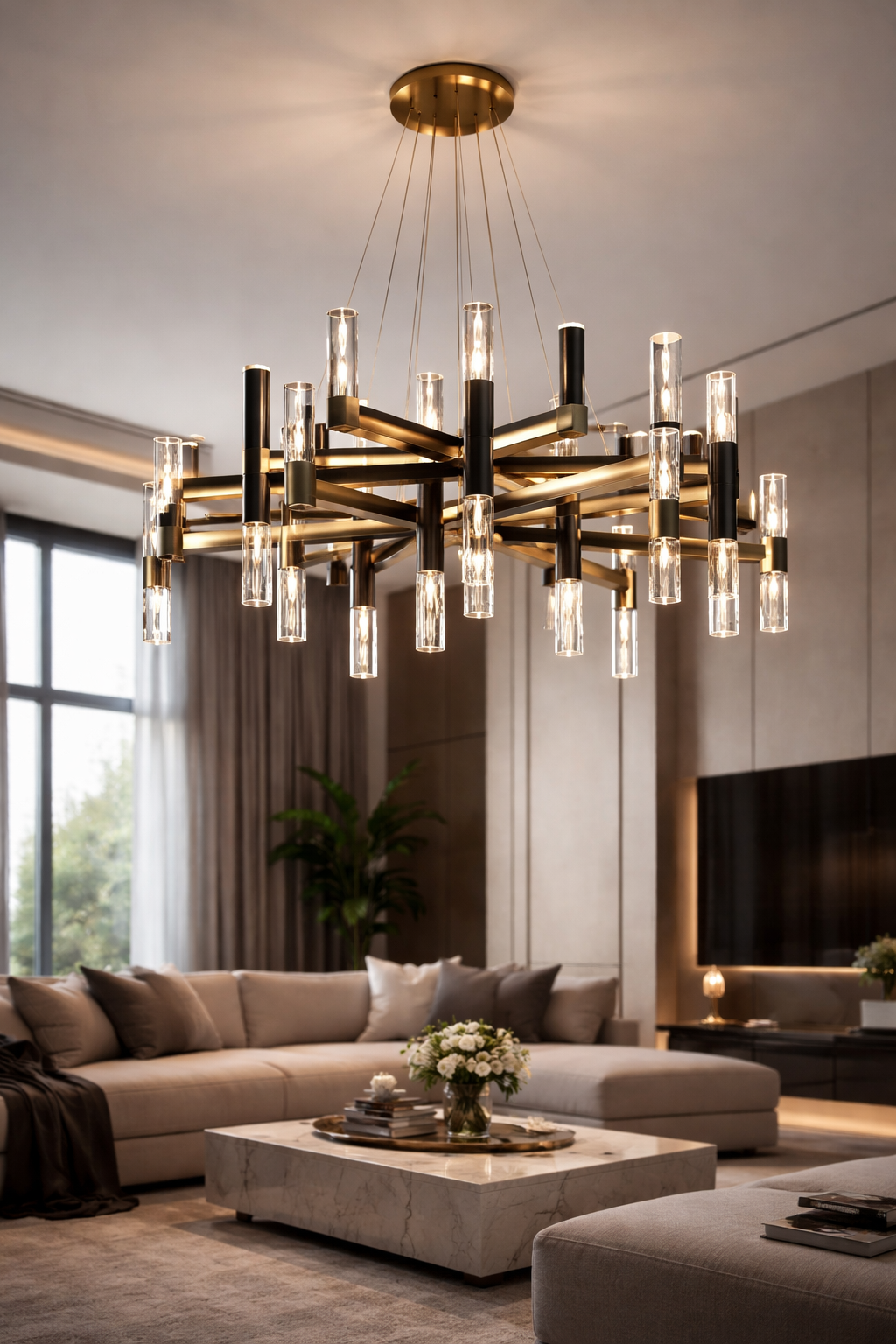 A bold, modern brass chandelier with multiple linear arms and glass tube bulbs creates a dramatic statement in a contemporary living room. The layered design adds depth and visual interest while providing warm ambient lighting.
When to Step Back: The Case for Quiet Lighting
Bold lighting is fun to talk about. But some rooms genuinely call for restraint — and knowing when to hold back is just as much of a design skill as knowing when to go big.
The Room Already Has a Star
Statement lighting plus dramatic backsplash plus bold wallpaper is not layered design — it's chaos. If your room already has a strong focal point (an accent wall, a showpiece fireplace, a patterned tile floor, unique millwork), the lighting should support it, not compete with it. Quiet fixtures — flush mounts, simple pendants, drum shades — let the real star of the room stay center stage.
The Ceilings Are Low
This one matters a lot in older East Bay homes. Many condos and ranches from the 1960s and '70s have 8-foot ceilings. An oversized chandelier in a room with 8-foot ceilings doesn't feel dramatic — it feels like the ceiling is sitting on your head.
For lower ceilings, look for flush mounts, slim semi-flush fixtures, or low-profile drum shades. You can still get beautiful, considered lighting — just keep the profile tight. The room will feel more open, not less.
The Architecture Already Speaks
Homes in Lafayette, Orinda, and Moraga often feature exposed beams, vaulted ceilings, or dramatic rooflines. These elements are already doing the heavy lifting visually. A bold fixture in a room like that competes with the architecture instead of complementing it. Simple, warm lighting that emphasizes the beams or ceiling lines is almost always the right call.
You Want the Room to Feel Calm
There's a reason spas and hotels don't usually hang dramatic chandeliers in their guest rooms. They want you to relax, not be visually stimulated. Bedrooms, reading nooks, and bathroom retreats almost always benefit from soft, diffused, layered lighting over anything that makes a statement. The goal is to feel cocooned, not spotlighted.
How to Choose the Right Statement Fixture
Once you've decided to go bold, you still have to avoid the mistake that Rossmoor client made — picking something that looks right in a photo but lands wrong in your actual space.
Scale Is the Whole Ballgame
A fixture that's too small looks accidental. Too large, and it feels oppressive. Here are the rules we use on our jobs:
- Dining table: The fixture should be roughly half to two-thirds the width of the table.
- Kitchen island: Two or three pendants, spaced evenly. Each pendant should be sized so they don't compete with each other.
- Vaulted ceilings: Go bigger than your instinct. High ceilings can handle — and actually need — more visual weight overhead.
- Entryways: Measure the height carefully. You want impact, but not something people duck under.
From Candi
The most common mistake I see is people ordering fixtures without accounting for how high they'll hang. A pendant that looks normal-sized at 6 feet above an island can look like a toy if your ceilings are 11 feet. Always factor in the drop length — that's the cord or rod that hangs between the canopy (the ceiling piece) and the actual fixture. Most pendants have adjustable drops, but it's worth confirming before you order.
Mind Your Metals
Mixing metals in a room is fine — clashing metals is not. A room with brushed nickel cabinet pulls, chrome faucets, and a warm brass pendant will feel disjointed. Some combinations work well: matte black with brass, for example, is a classic pairing right now. When in doubt, pull from one or two metal finishes and stick with them across the room.
Layer It — Don't Make It the Only Light
A statement fixture should be the star of the lighting plan, not the entire plan. Layer it with recessed cans, under-cabinet lighting in kitchens, wall sconces, or lamps. This keeps the room functional at full light and beautiful at lower settings. A bold chandelier on a dimmer, with soft recessed fill light, is infinitely more livable than one overhead fixture doing all the work.
Quiet Lighting Done Right (It's Not "Builder Basic")
Choosing not to make a statement doesn't mean defaulting to a boring drum shade from the big-box store. Quiet lighting can still feel intentional, warm, and beautiful.
Some options that work well in East Bay homes:
- Woven flush mounts in natural materials (rattan, linen)
- Champagne or soft white globe fixtures
- Slim, low-profile semi-flush fixtures with frosted glass
- Fabric diffuser shades that scatter light softly
- Simple linear pendants in matte black or brushed brass
Timeless, unfussy, and easy to live with for years. Sometimes the quieter choice is actually the more confident one.
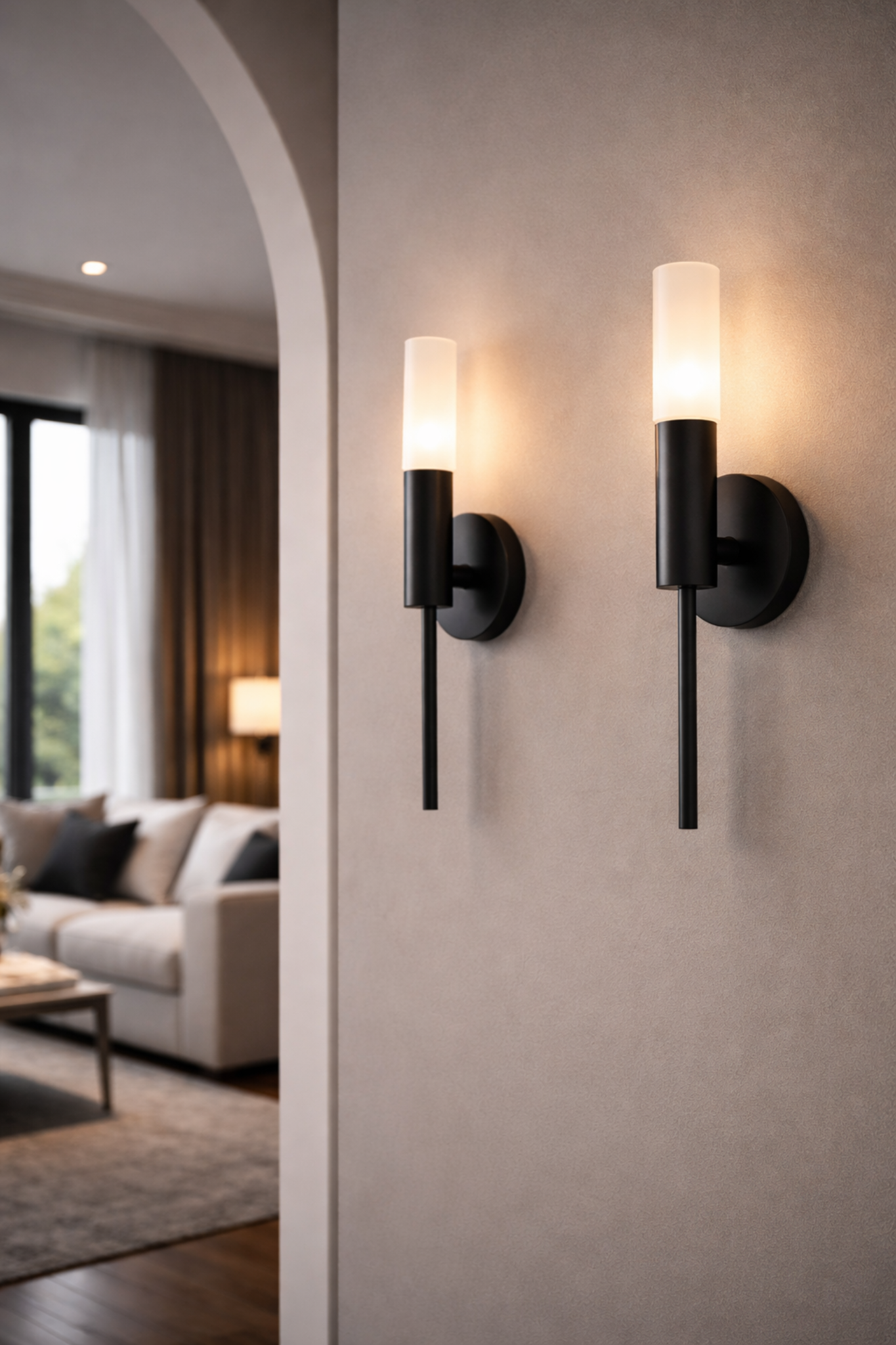 Sleek black wall sconces with frosted cylindrical shades bring a minimalist yet impactful lighting moment to a hallway. Their clean lines and soft glow enhance architectural features without overwhelming the space.
What About Electrical — DIY or Call Us?
Swapping a fixture for one of equal weight on an existing junction box? Most handy homeowners can handle that. But lighting work gets complicated fast, especially in older East Bay homes.
Rossmoor Wiring Note
Original Rossmoor units were wired in the 1960s and early '70s. The panels in many units were sized for the electrical loads of that era — not for today's smart home systems, LED controls, or additional circuits. If you want to add recessed cans where there are none, move a junction box, or install a smart dimmer system, it's worth having our electrician Ismael assess the panel capacity before anything else. We've caught situations where the upgrade someone wanted would have required a panel upgrade first — better to know that upfront than mid-project.
Safe to DIY
- Swapping a fixture of the same weight on an existing junction box
- Changing shades or globes on existing fixtures
- Updating bulb types (LED swaps)
- Adding plug-in pendant lights or lamps
- Switching to a dimmer (if you're comfortable with basic wiring)
Call Toupin Construction (925-937-4200)
- Adding new recessed cans where none exist
- Moving or adding junction boxes
- Installing fixtures on vaulted or cathedral ceilings
- Smart lighting systems and whole-home dimmer plans
- Code compliance in kitchens and bathrooms
- Any work that requires opening the ceiling or running new wire
- Assessing panel capacity before major lighting additions
For kitchens specifically, there are California code requirements around placement, circuit separation, and fixture types that catch a lot of homeowners off guard. We covered this in detail in our post on kitchen electrical codes every homeowner should know — worth a read before you start planning.
Putting It Together: A Room-by-Room Take
Every room has its own logic. Here's how we think about it across the spaces we remodel most often.
- Kitchen: Statement pendants over the island; recessed cans for general light; under-cabinet lighting for task. Three-layer approach.
- Dining room: Statement chandelier, full stop. Size it to the table. Put it on a dimmer.
- Primary bathroom: Sconces at face height flanking the mirror; recessed cans for general light; a quiet semi-flush or small pendant if there's a separate soaking tub area.
- Bedroom: Quiet overhead fixture; bedside lamps for reading; dimmers on everything.
- Entryway: One of the best places for a statement fixture. It sets the tone for the whole house.
- Laundry room and hallways: Functional and clean. This isn't the place to spend your fixture budget.
If you're thinking about lighting as part of a larger kitchen remodel or bathroom renovation, we'd love to help you plan the full lighting scheme from the start — it's much easier (and cheaper) to do it right during the remodel than to come back and add it later.
Not Sure What Your Room Needs?
We're happy to take a look and talk it through — no obligation, just an honest conversation. Call us at 925-937-4200 or reach out online.
Get in Touch
Toupin Construction
Ready to start your remodel?
Whether you're dreaming of a new kitchen, a spa-worthy bathroom, or a whole-home transformation — we’d love to hear about your project. Reach out and let's talk.
‹ Back
Comments