


By using our website, you agree to the use of cookies as described in our Cookie Policy
Blog
Marble Countertops: The Honest Contractor's Take on the Stone Everyone Wants and Half of Them Shouldn't Have
Marble Countertops: The Honest Contractor's Take on the Stone Everyone Wants and Half of Them Shouldn't Have
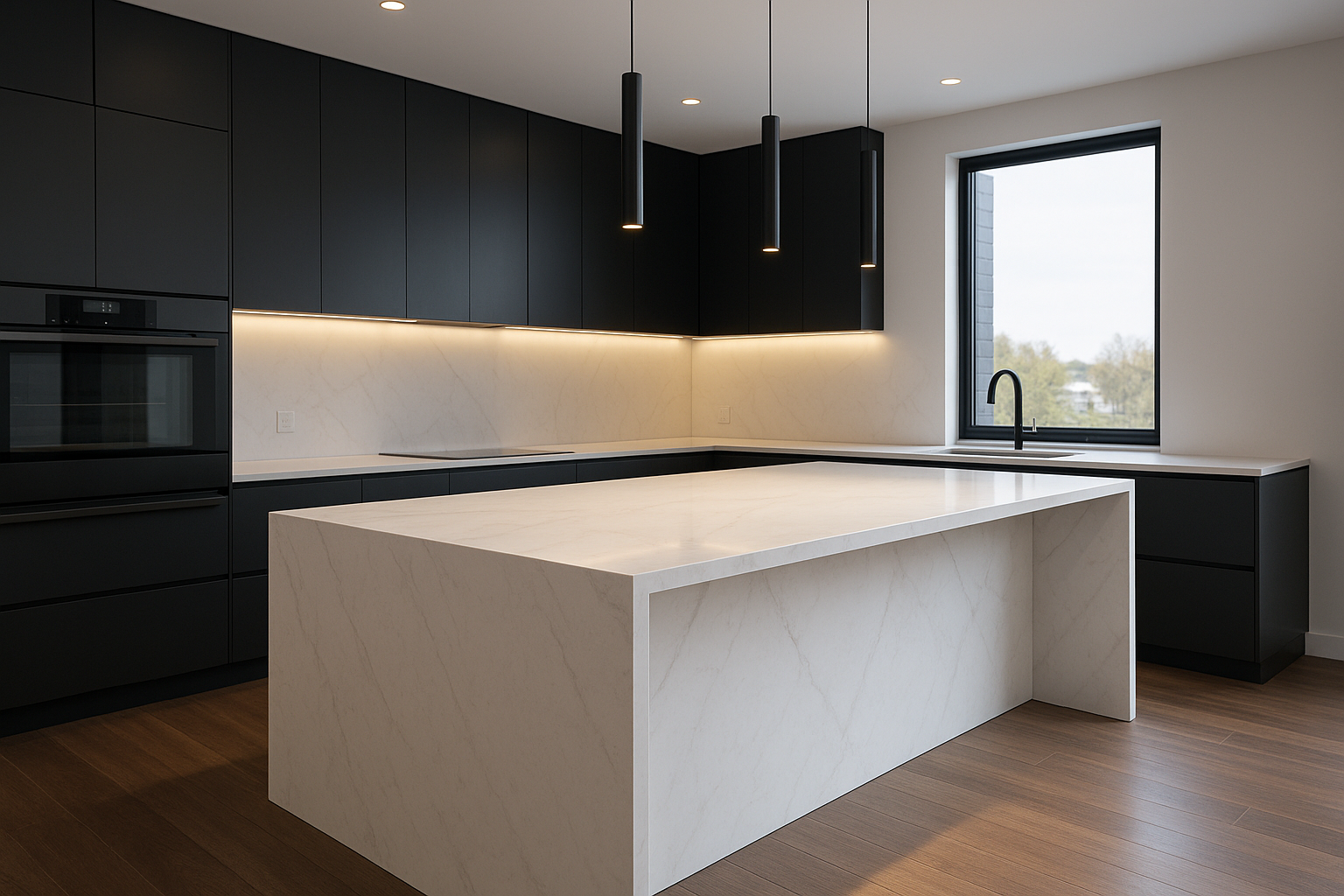
Modern kitchen featuring dark flat-panel cabinets, under-cabinet lighting, and a dramatic marble waterfall island. The contrast emphasizes the elegance of marble while showcasing a sleek, contemporary layout.
Marble is the stone that gets people in trouble. Not because it's bad — it's not. It's genuinely one of the most beautiful natural materials you can put in a home. But it's the material people most often fall in love with for the wrong reasons, and then spend years frustrated with the reality.
We've had this conversation a hundred times at the jobsite. Someone comes in having already decided they want marble. We slow down, ask some questions about how they actually use their kitchen, and about half the time we end up talking them into quartzite or a marble-look quartz instead. The other half, we install the marble and they're thrilled with it for decades. The difference isn't the stone — it's whether the homeowner's lifestyle actually matches what marble asks of them.
So let's be honest about both sides. This is part of our Countertop Materials Series, covering quartz, granite, quartzite, soapstone, porcelain, and butcher block. Every material has a right home. Marble has one too — it's just narrower than people think.
What Marble Is and Why It Looks the Way It Does
Trade Term Explained: EtchingMarble is calcium carbonate — the same compound that makes up limestone and chalk. When any acidic substance (lemon juice, vinegar, wine, most cleaning sprays, even sparkling water left sitting long enough) contacts marble, it reacts chemically with the calcium carbonate and dissolves a tiny layer of the surface. The result is a dull, matte spot that doesn't wash off because it's not a stain — the stone itself changed. This is called etching, and it's the source of most marble unhappiness. Polish can be restored by a stone professional, but it's time and money. Honed marble hides etching much better because the surface is already matte, and the mark blends in rather than standing out.
Marble starts as limestone. Over millions of years, extreme heat and pressure deep in the earth's crust transform the limestone crystals into a new, denser, more crystalline structure. The veining comes from mineral impurities — clay, iron oxides, mica — that were present in the original limestone and get folded and stretched by the same tectonic forces that cook the stone. Every slab captures a moment in geologic time. That's not poetry. That's geology.
The translucent depth you see in a high-quality marble slab — the way light seems to travel into the stone rather than just reflect off it — comes from that crystalline structure. Quartz and porcelain can mimic marble's pattern. They can't replicate that depth. If you've stood next to a real Calacatta slab and then looked at a porcelain version, you know exactly what I'm talking about.
The Genuine Case For Marble
I want to make this case sincerely, not as a warm-up to the warnings. Marble has been used in kitchens and baths for centuries — not because ancient Romans didn't have other options, but because the material is genuinely excellent for a specific lifestyle.
Nothing else looks like it. Not quartzite. Not high-end porcelain. Not the best quartz slabs on the market. Marble has a visual character that is simply not reproducible. The depth, the variation, the way the veining moves differently in morning light than afternoon light — this is real and it matters if beauty in the home matters to you. Some things are worth choosing for their beauty alone.
It's a baking surface like no other. Marble stays cool. Professional pastry chefs have used it for centuries specifically because a cool, smooth surface is ideal for working with butter-based doughs. A dedicated marble baking station, even in an otherwise practical kitchen, is one of those functional luxuries that people who actually bake will tell you changes their relationship with it.
It's genuinely heat-resistant. Unlike quartz, marble has no resin content. A hot pan won't scorch it. This makes it more practical near gas ranges and oven areas than quartz in some respects — it's the acid sensitivity, not heat, that's marble's vulnerability.
For bathrooms, it's nearly ideal. Here's what most marble conversations miss: a bathroom is not a kitchen. Bathrooms don't see acid cooking. Shampoo, soap, toothpaste, face wash — none of these are the problem that wine and tomato sauce are. In bathroom vanities, shower surrounds, and fireplace hearths, marble's sensitivities barely apply. The beauty is full, the maintenance burden is dramatically lower, and you get everything you love about the material without most of what's hard about it.
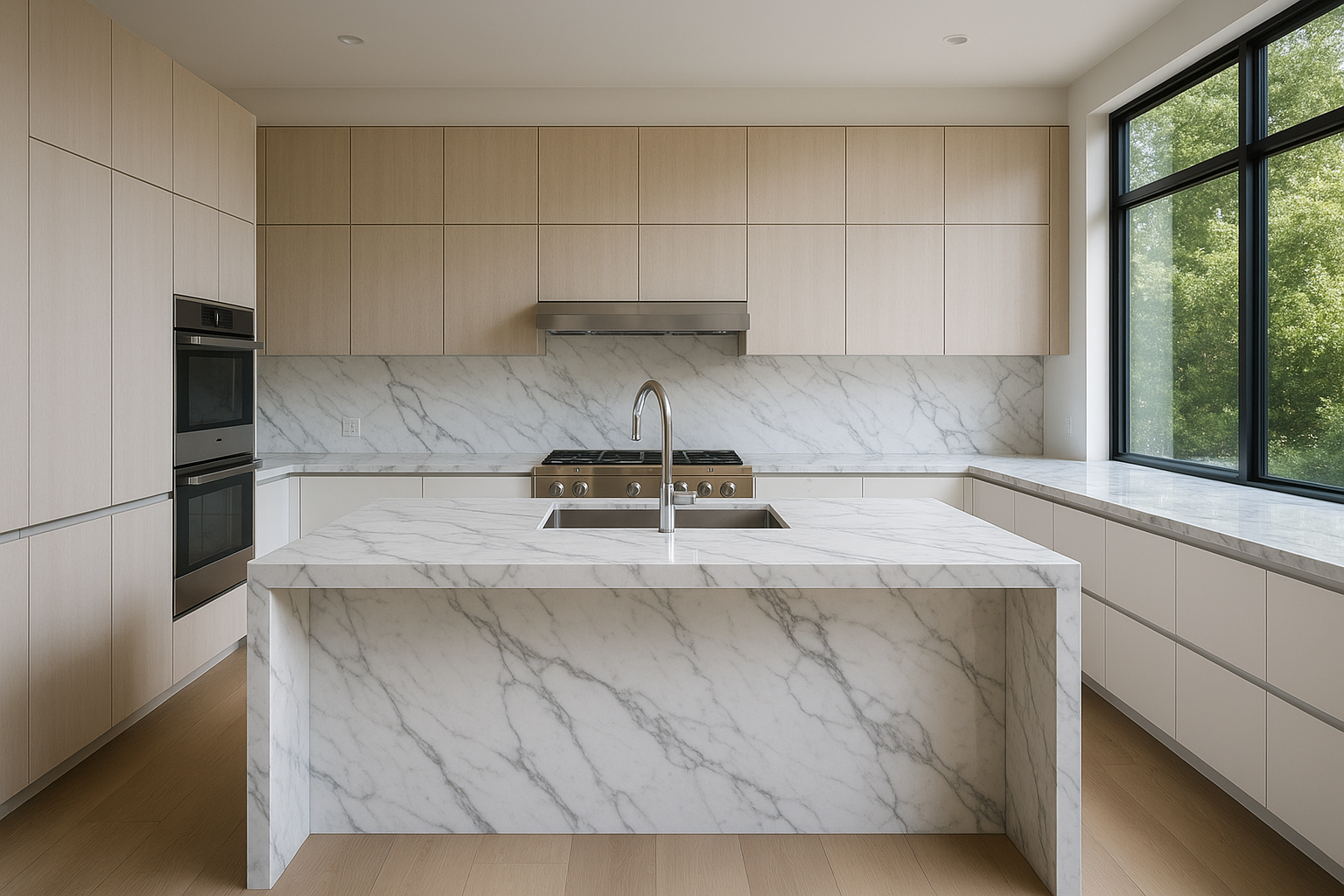
Minimalist kitchen with flat-panel light wood cabinetry and a full marble slab backsplash paired with a waterfall marble island. The clean lines highlight marble’s natural veining and its high-end, seamless look.
The Etching Conversation: What You Actually Need to Know
Etching is the thing that gets marble in trouble, and I want to explain it as specifically as I can so you can make a real decision rather than a fearful one.
Acid contact dulls the marble surface. How quickly depends on the concentration of acid and how long it sits. A drop of lemon juice that sits on polished Calacatta for thirty seconds and then gets wiped away will leave a small dull spot. Wine left sitting in a ring for a few hours on an untreated marble slab will leave a more significant mark. These marks are not stains — they're chemical changes to the surface.
The good news: honed marble hides etching dramatically better than polished marble. A honed surface is already matte, so an etch mark blends into the finish rather than standing out as a shiny-versus-dull contrast. Most of our clients who choose marble for kitchens go honed for this reason. It looks softer and more contemporary anyway.
The other piece of good news: marble can be professionally refinished. If the surface is heavily etched over years of use, a stone restoration professional can hone or re-polish the surface and restore it. This is not a cheap process, but it is a possible one. Marble isn't damaged beyond repair — it just requires occasional professional attention.
French and Italian kitchens have used marble for centuries and the stones are still there. The patina of use is part of the point, not a problem to be solved.
The Marble Personality Test
I've developed an informal way of thinking about whether someone is right for marble, based on years of these conversations. The question isn't "how careful are you?" It's more fundamental than that.
Do you look at an old farmhouse table with worn paint and think "that has character" or "that needs to be refinished"? Do you use your best dishes on regular Tuesdays, or save them for company? When something in your home shows age, does it bother you or do you find it beautiful?
If your instinct is toward the patina end of those questions — if you believe things should be used and that use makes them better — marble will make you very happy. If you're someone who wants surfaces to look like they did on the day of install, forever, marble is not your material, and no amount of falling in love with a slab at the stone yard will change that.
Where Marble Actually Belongs
The best marble applications in East Bay homes, based on our actual installation experience:
Bathroom vanities — This is marble's ideal environment. Lower acid exposure, lower impact, and full access to the material's beauty. Marble in a Walnut Creek master bath with unlacquered brass fixtures is one of the more elegant things we do.
Baking stations — A dedicated section of marble countertop for pastry and bread work is a genuine functional upgrade for serious home bakers. The rest of the kitchen can be quartz or granite.
Fireplace surrounds — Zero acid exposure, mostly decorative, and the classical beauty of marble reads exactly right in this application. This is historically one of marble's primary residential uses for good reason.
Low-traffic accent islands — A kitchen island used primarily for serving, not prep cooking, can be a great marble application. The entertaining surface of a larger kitchen, paired with more practical perimeter counters, gives you the look without the daily risk.
See our bathroom remodeling and kitchen remodeling pages for examples of how we use marble in East Bay homes.
Marble in Rossmoor: Where It Works Best
In Rossmoor, we see marble used most successfully in bathrooms and powder rooms — spaces where the maintenance demands are genuinely low and the elegance is appropriate for the aesthetic. Kitchen marble in Rossmoor is less common, partly because the kitchen scales are compact enough that people tend to want maximum durability, and partly because the Rossmoor demographic tends to favor lower-maintenance choices overall. That said, a marble baking station or powder room vanity in a Rossmoor remodel is something we do frequently and well. Coordinate with us on Mutual approvals before selecting materials — some choices require board sign-off.
Popular Marble Varieties for East Bay Homes
Carrara is the classic — soft gray-white background with gentle gray veining. It's the most widely available and typically the most accessible price point. Subtle, elegant, timeless.
Calacatta Gold has a brighter white background with bolder, more dramatic veining in gray and warm gold tones. The combination reads warmer and more glamorous than Carrara. Higher price point, higher drama.
Statuario offers bright white with bold, distinct gray veining. More contrast and definition than Carrara. Very striking in large applications.
Fantasy Brown is technically a dolomite, not true marble, which makes it more durable and less prone to etching. It looks very much like marble with warm beige and brown movement. Worth knowing about if you love marble's look but want somewhat better durability.
Pricing
Material-only marble typically runs $55–$120 per square foot. Italian marbles (Calacatta, Statuario) sit at the higher end. Installed, expect $110–$200+ per square foot, depending on slab rarity, edge profile complexity, waterfall applications, and finishing. Honed finishes sometimes add a modest premium. See the comparison below.
| Feature | Marble | Quartzite | Quartz | Porcelain (marble look) |
|---|---|---|---|---|
| Etch Resistance | Poor | Excellent | Excellent | Excellent |
| Scratch Resistance | Low | Very high | Good | Very high |
| Heat Resistance | Good | Excellent | Fair | Excellent |
| Natural Look Authenticity | Unmatched | Excellent | Mimics only | Mimics only |
| Sealing Required | Yes — annually | Yes — annually | Never | Never |
| Best For | Baths, baking, fireplace | Full kitchen use | Full kitchen use | Outdoor, sun kitchens |
| Typical Installed Cost | $110–$200+/sq ft | $130–$220+/sq ft | $95–$165+/sq ft | $110–$185+/sq ft |
Candi's Take
Marble is for a specific kind of person, and that person exists — they're often some of our best clients. They chose the material eyes wide open, they understand what it will and won't do, and they've watched it age in their kitchen for fifteen years and genuinely love it more now than when we installed it. That's a real outcome, not a fantasy. But so is the person who chose marble because they loved a Pinterest photo and has been stressed out about coasters ever since. My job is to help you figure out which one you are before the slab is cut.
Still Thinking About Marble?
Come talk to us. We'll ask you the honest questions, show you real slabs, and help you figure out whether marble — or something that'll make you just as happy without the anxiety — is the right call for your home.
Get a Free Consultation — 925-937-4200
Toupin Construction
Ready to start your remodel?
Whether you're dreaming of a new kitchen, a spa-worthy bathroom, or a whole-home transformation — we’d love to hear about your project. Reach out and let's talk.
‹ Back
Comments