


By using our website, you agree to the use of cookies as described in our Cookie Policy
Blog
Granite Countertops: The Material Everyone Wrote Off and Then Quietly Started Installing Again
Granite Countertops: The Material Everyone Wrote Off and Then Quietly Started Installing Again
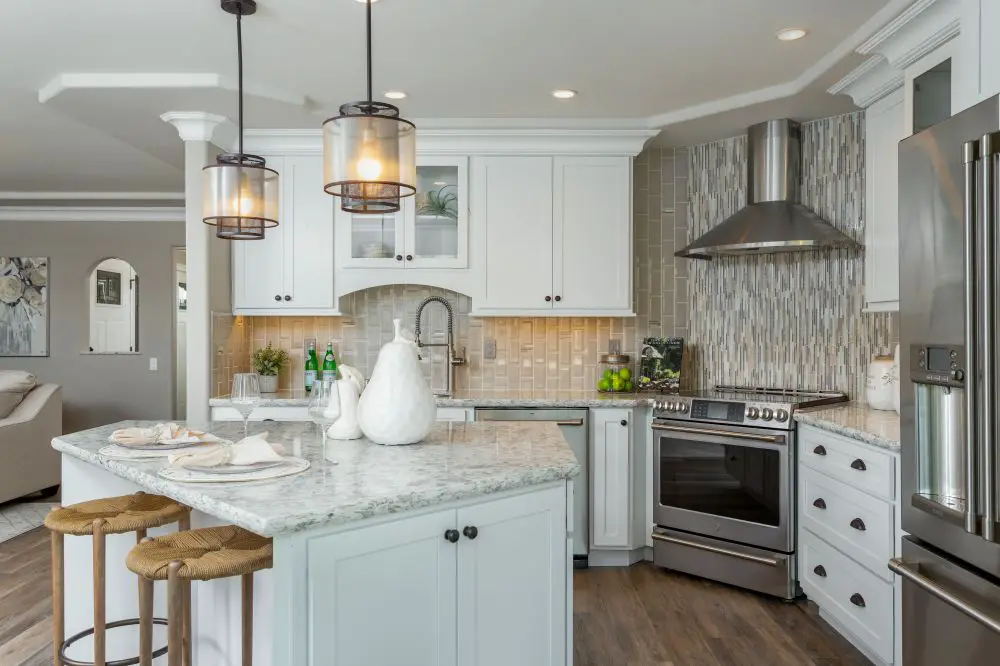
Bright white kitchen with quartz countertops, featuring a large island with seating, glass pendant lighting, and a textured tile backsplash. The quartz surface offers a clean, durable workspace that complements the soft, transitional design.
Granite had a moment when it was everywhere, then a moment when everyone was bored with it, and now we're watching it come back — not because trends are circular (though they are), but because granite's actual performance profile has always been hard to argue with. It's heat-proof. It's naturally unique. It works outdoors. It gets harder to damage the older it gets. The sealing requirement that scared people off for a decade? Modern sealers last ten to fifteen years. That's one application per presidential term.
We've been installing granite for over forty years at Toupin Construction. It's not the trendiest call in 2026, but it's a genuinely excellent one — and I want to give it an honest look alongside everything else in this series.
We cover every major countertop material here: quartz, marble, quartzite, soapstone, porcelain, and butcher block.
What Granite Actually Is (And Why It Looks the Way It Does)
Trade Term Explained: Igneous Rock, Mohs Hardness, and Natural PittingGranite is an igneous rock — formed from magma that cooled slowly deep within the earth's crust. That slow cooling process allows mineral crystals to grow large enough to be visible to the naked eye, which is why granite has that characteristic speckled or crystalline appearance. The dominant minerals are quartz (which gives it hardness), feldspar (which determines the base color), and mica (which provides the shimmer and flecks of light). The Mohs hardness scale runs from 1 to 10 — granite typically sits around 6–7, which is why it resists scratching from knives and most kitchen tools. "Natural pitting" refers to tiny voids in the surface that are part of granite's natural character — they're not damage, but they're worth knowing about so you're not surprised when you see them.
No additives. No resins. No manufacturing process beyond mining, cutting, and polishing. What you're getting when you choose granite is a piece of the earth's crust that formed over millions of years, and that geological history shows in every slab. The mineral composition varies dramatically by quarry location, which is why granite comes in everything from near-white to deep black, warm tan to vivid green and blue. Each slab is genuinely one of a kind.
The Three Things Granite Does Better Than Quartz
Granite dominated the East Bay kitchen market for decades for a reason, and that reason isn't nostalgia. It outperforms quartz in three meaningful categories that matter for real kitchen use.
Heat. Granite has no resin content. It formed under conditions of extreme heat and pressure. A cast iron pan from a 500°F oven is not a threat. A gas cooktop at full blast is not a concern. Granite handles heat the way granite has always handled heat — by not caring. This is a genuine advantage for households with real cooking activity, particularly around gas ranges and cooktop areas.
Granite has been in kitchens for decades. The ones we installed in the early 1990s are still in excellent shape. That's a performance record that speaks for itself.
Outdoor use. This is granite's clearest advantage over quartz. UV exposure doesn't fade granite. Rain doesn't damage it. Temperature cycling — the hot Danville afternoons and cool evenings that stress engineered materials — doesn't affect natural stone the way it does resin-bound surfaces. For outdoor kitchens, BBQ islands, and covered patio bar areas, granite is one of the two materials (alongside porcelain) that genuinely holds up. Quartz is explicitly not recommended for outdoor use.
Authentic natural character. This one is harder to quantify, but it's real. Granite is the earth. No pattern repeats. The variation in color, mineral movement, and surface character from one slab to the next is complete. For homeowners who want something that genuinely couldn't have been manufactured — something that is what it is because of how the planet works — granite delivers that in a way quartz never will.
The Sealing Question: Settled Once and for All
Granite's reputation for demanding maintenance is outdated by about fifteen years. Modern penetrating sealers — the kind we use on every granite installation — last ten to fifteen years and take roughly twenty minutes to apply. You're not sealing granite annually. You're sealing it once and then checking whether it needs resealing by doing a simple water test: if water still beads, you're fine. If it starts absorbing, apply sealer. Most homeowners forget about this completely and the counter remains fine for over a decade.
The sealers we work with now are genuinely different from what was available when granite "got a reputation" for being high-maintenance. They penetrate the stone's pores deeply, bond with the minerals, and create a barrier that liquids cannot easily breach. Is it the zero-maintenance of quartz? No. Is it the minimal-maintenance it's been described as? Yes, fairly.
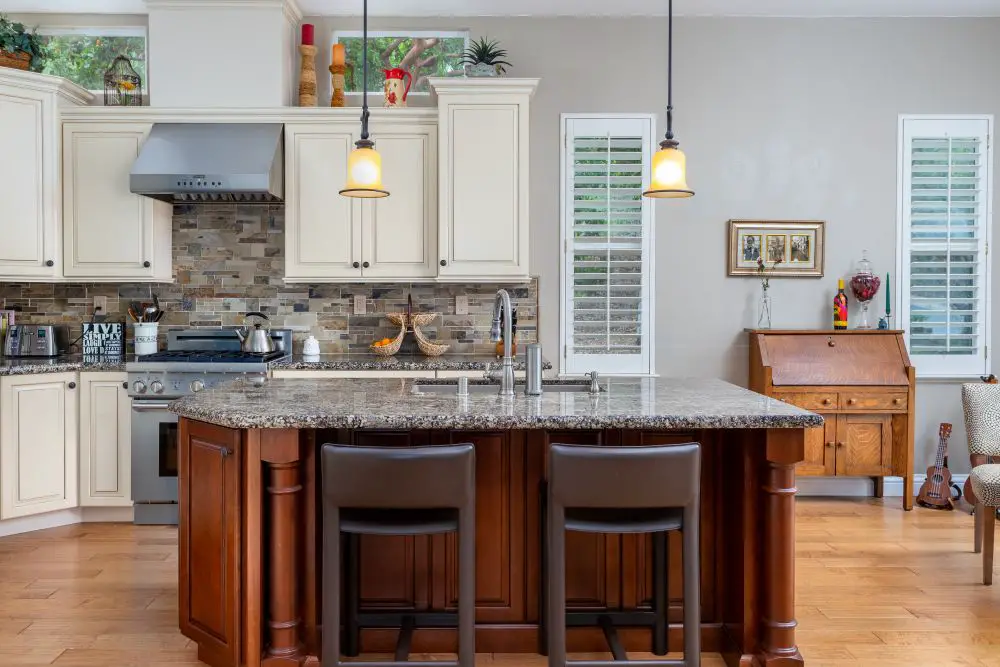
Open-concept kitchen featuring a granite countertop island with seating, cream cabinetry, and pendant lighting. The natural stone surface adds durability and visual texture, paired with warm wood flooring and a functional family-friendly layout.
Natural Variation: Feature or Bug?
This is the honest trade-off conversation. Granite's character comes from its variability, and that variability is also what makes it impractical for certain applications.
If you want a countertop that looks identical from every angle, matches from the perimeter runs to the island, and looks exactly like the sample at the showroom, quartz will serve you better. Granite slabs are each pulled from different sections of a quarry and will vary in color, pattern intensity, and mineral movement even when they're the same name and source. You choose granite slabs in person, at the slab yard, not from a sample card.
That said: we take clients to view actual slabs before every granite installation, and the experience of choosing a specific piece of the earth for your kitchen is one that most people find genuinely exciting. You're not choosing a product. You're choosing a slab. There's a difference.
The other variability factor: granite isn't always suited to the dramatic marble-style veining that's popular right now. Most granite reads as speckled, organic, and mineral-rich — beautiful, but in a different register than flowing marble or quartzite veining. If bold, dramatic movement is the primary goal, quartzite may be the better choice.
Leathered Granite: The Finish Worth Knowing About
Most people think of granite in its polished form — high-gloss, reflective, the classic kitchen look. But leathered granite has been gaining significant traction in East Bay remodels over the last several years, and for good reason.
Trade Term Explained: Leathered FinishA leathered finish is created by running diamond-tipped brushes across the polished granite surface. The process closes the pores slightly (which is good — it improves stain resistance somewhat) while creating a soft, slightly undulating texture that catches light differently across the surface. The result is matte, tactile, and genuinely stunning in person. It hides fingerprints and water spots better than polished granite. It shows the stone's mineral color more naturally, without the artifice of a high-gloss polish. And it reads as more contemporary than traditional polished granite, making it an excellent choice for homeowners who want natural stone without the "builder-grade kitchen from 1998" association.
If you've been avoiding granite because it feels dated, look at leathered granite in a dark color (Ubatuba, Black Galaxy, Absolute Black) before you make a final decision. It's a completely different material in terms of visual character.
Who Granite Is Actually Right For
Granite is the strongest recommendation we make for outdoor kitchens, for households with gas ranges where pots go directly from flame to surface, and for homeowners who want natural stone at a price point below quartzite and comparable to mid-range quartz. It's also an excellent choice for anyone who specifically wants something one-of-a-kind and doesn't mind the brief, infrequent sealing process.
It's less suited to homeowners who want maximum pattern control, who prefer the marketing-forward story of engineered stone, or who specifically want the flowing marble-like veining that quartzite or high-end quartz provides more reliably. See our kitchen remodeling page and portfolio for examples of how we've used granite across different East Bay kitchen styles.
Granite in Rossmoor: The Practical Case
Granite has been a fixture in Rossmoor kitchens since the community was built, and for many remodels it remains an excellent choice. It's available at price points that work well for condo-scale countertops (smaller square footage means granite's higher-end varieties are more accessible). It doesn't require the installation complexity of porcelain slab, and it offers the authenticity of natural stone that many Rossmoor homeowners prefer. We know the approval process for Rossmoor kitchen remodels thoroughly — reach out before you start to make sure the material and scope you're considering is set up for smooth Mutual coordination.
Granite Pricing in the East Bay
Granite has one of the widest pricing ranges of any countertop material, which makes it accessible at multiple budget levels. Standard granite (common patterns, standard thickness, eased edge) typically runs $75–$100 per square foot installed. Mid-range granite with more interesting movement and larger slab formats lands $100–$130. Premium and exotic varieties — rare colors, dramatic patterns, jumbo slabs — can reach $130–$140+ per square foot installed.
| Feature | Granite | Quartz | Quartzite | Marble |
|---|---|---|---|---|
| Heat Resistance | Excellent — no limits | Fair — resin scorches | Excellent | Good |
| Outdoor Use | Good — UV-stable | No — fades | Good | Not recommended |
| Etch Resistance | Good | Excellent | Excellent | Poor |
| Sealing Required | Yes — every 10–15 years | Never | Annually | Annually |
| Pattern Variety | Natural — wide range | Engineered — very wide | Natural — dramatic | Natural — classic |
| One-of-a-Kind | Yes | No — consistent | Yes | Yes |
| Typical Installed Cost | $75–$140+/sq ft | $95–$165+/sq ft | $130–$220+/sq ft | $110–$200+/sq ft |
Candi's Take
Granite isn't the headline material of the moment, but the homes we installed it in twenty and thirty years ago are still standing with beautiful countertops. That's not an accident. It's a material that does what it does reliably, improves with modern sealing technology, and has an outdoor application that nothing in the engineered stone world can match. For the right kitchen — and there are a lot of right kitchens for granite — it's an outstanding choice that'll outlast the trends that replaced it.
Want to See What Granite Looks Like in 2026?
Come look at slabs with us. We can show you leathered finishes, exotic varieties, and designs that might change your mind about what you think granite is. We install throughout Walnut Creek, Rossmoor, Danville, Alamo, and the East Bay.
Get a Free Consultation — 925-937-4200
Toupin Construction
Ready to start your remodel?
Whether you're dreaming of a new kitchen, a spa-worthy bathroom, or a whole-home transformation — we’d love to hear about your project. Reach out and let's talk.
‹ Back
Comments