

By using our website, you agree to the use of cookies as described in our Cookie Policy
Blog
Quartz Countertops: Why It's the Most-Installed Surface in the East Bay (And When to Choose Something Else)
By Candi Toupin Category: Kitchen Remodeling Countertop Materials Series
Quartz Countertops: Why It's the Most-Installed Surface in the East Bay (And When to Choose Something Else)
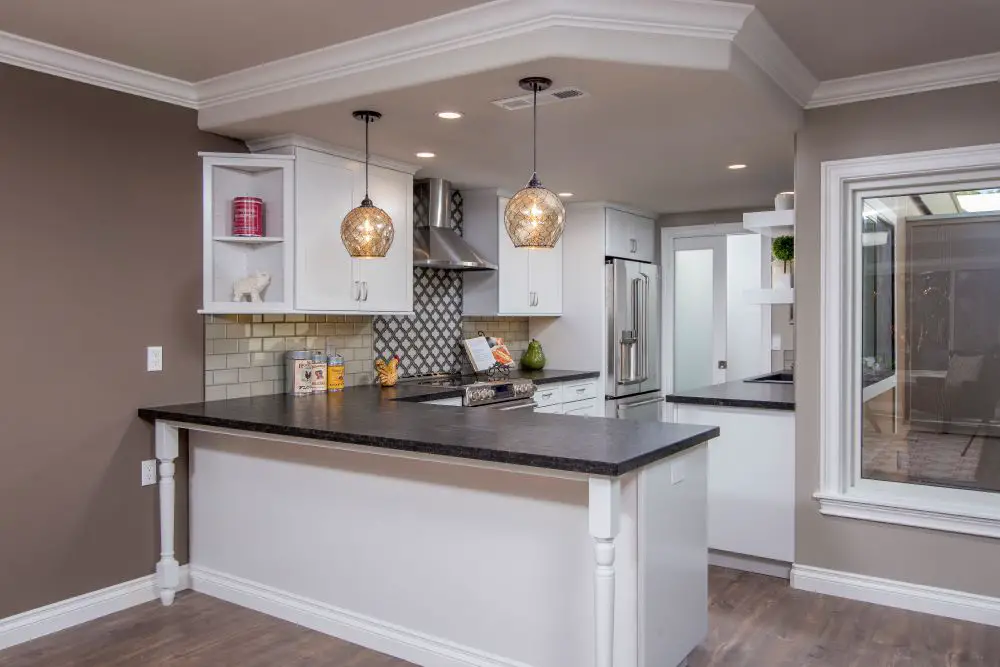
Bright open-concept kitchen with white cabinetry and a dark quartz peninsula, creating contrast while maintaining a clean, durable, and family-friendly workspace.
Quartz is the countertop we install more than any other material at Toupin Construction. By a significant margin. That's not because it's the flashiest option on the market — it isn't — or because we're pushing it for any particular reason. It's because for the way most East Bay families actually live in their kitchens, quartz delivers on every front that matters: stain resistance, scratch resistance, zero sealing, consistent appearance, and a design range that works with essentially any kitchen style.
But "most popular" doesn't mean "right for everyone," and I want to be honest about that too. Quartz has real limitations that are worth understanding before you commit — especially if you're considering it against granite or one of the natural stones. This series exists precisely so you can make an informed choice rather than a default one.
We cover every major countertop material in detail: granite, marble, quartzite, soapstone, porcelain, and butcher block.
What Quartz Actually Is
Trade Term Explained: Engineered StoneQuartz countertops are engineered stone — which means they're manufactured, not quarried. The process: ground quartz crystals (typically 90–95% of the slab by weight) are combined with polymer resins and pigments, then compacted under high pressure into slab form. The resins bind everything together and make the surface non-porous. The pigments control the color and pattern. The result is a consistent, dense, durable slab that can mimic natural stone patterns or go in completely different directions (solid colors, concrete looks, ultra-bright whites that don't exist in nature). The key tradeoff of using resins: heat and UV radiation can damage them in ways they wouldn't damage natural stone.
Understanding that quartz contains resin is the key to understanding both its strengths and its limitations. The resin is what makes it non-porous (granite and marble have pores — quartz doesn't). It's also what makes it vulnerable to extreme heat and prolonged UV exposure. Once you understand the material, its behavior makes total sense.
Why Quartz Works So Well for East Bay Kitchens
The East Bay has a specific kind of homeowner. Busy. Often dual-income. Kids or grandkids who visit and use the kitchen like it's an obstacle course. A love of good design. And zero interest in a sealing schedule or a maintenance manual for their countertops.
Quartz was engineered for exactly this person. The combination of properties it delivers — stain resistance, scratch resistance, no sealing, consistent color, wide design range — is uniquely suited to daily kitchen life in a way no single natural stone can match. Natural stones beat quartz on specific metrics (granite on heat, soapstone on acid immunity, quartzite on UV stability), but none of them beats quartz across all the daily-use metrics simultaneously.
Quartz is the countertop that asks nothing of you. Soap and water, a soft cloth, and that's genuinely it. For a lot of families, that's worth more than we give it credit for.
The non-porous surface means oil doesn't absorb, wine doesn't stain, bacteria don't have places to hide. The scratch resistance means heavy cookware and regular knife-adjacent activity don't leave visible marks over time. The no-sealing requirement means there's no annual task to remember, no window of vulnerability if it slips your mind.
The Design Range: More Than You Might Think
One of the persistent myths about quartz is that it all looks the same — that choosing quartz means accepting a generic white or gray surface. That was truer ten years ago than it is now. The current generation of quartz manufacturing produces patterns that include some genuinely dramatic marble-look veining, concrete-look surfaces, deep charcoals, warm taupes, and designs with flowing movement that would have been impossible to achieve even recently.
What quartz delivers that natural stone doesn't is consistency. When you choose a quartz slab at the showroom, the material coming to your kitchen will match what you chose. Slab to slab, the pattern repeats predictably. For large kitchens with extended countertop runs, or for homeowners who want tight control over the final look, this matters enormously. Natural stone is one-of-a-kind by definition — which is a feature or a bug depending on your perspective.
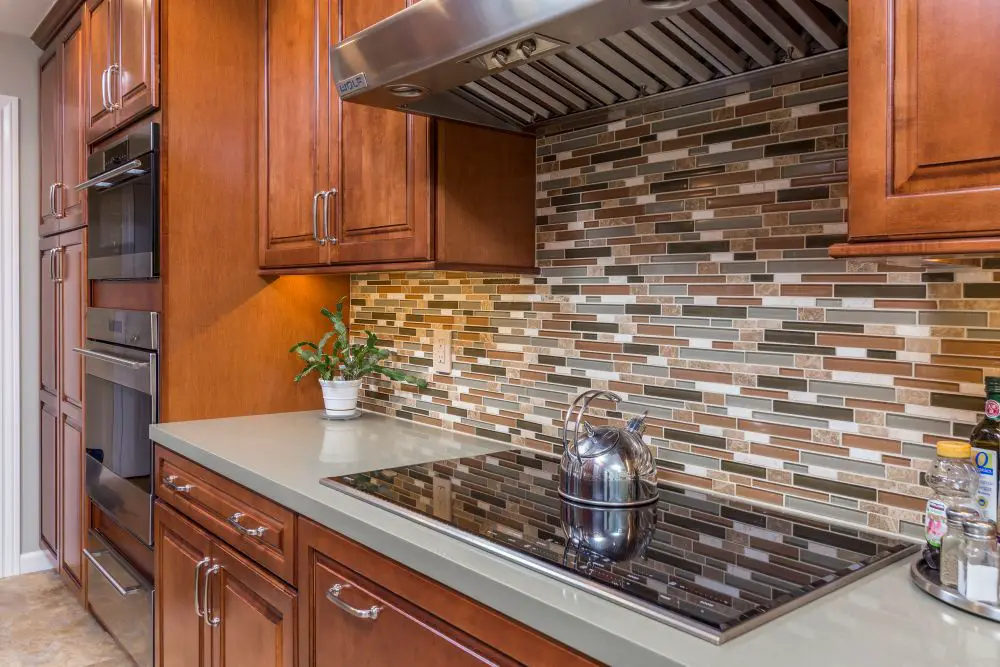
Kitchen featuring warm wood cabinetry paired with smooth quartz countertops and a multi-tone tile backsplash. The quartz surface offers a clean, low-maintenance contrast to the rich cabinet finish.
The Limitations Worth Knowing
Quartz is not heat-proof. This is the most practically significant limitation for kitchen use. The polymer resins that bind the quartz particles can discolor, crack, or warp under extreme heat. A cast iron pan directly from a 500°F oven, set on quartz — that's a risk. The damage often doesn't show up immediately, but thermal shock is a real phenomenon and quartz is more vulnerable to it than granite, quartzite, or porcelain. Trivets are not optional with quartz. They're a maintenance requirement.
Quartz fades outdoors. UV radiation degrades the resin over time, causing quartz to yellow or fade when exposed to prolonged direct sunlight. This means quartz is not a viable outdoor countertop material, and it's also something to consider for indoor kitchens with very significant direct sun exposure. Near a south-facing window that gets six or eight hours of direct sun per day, quartz can show fading over years. Porcelain or quartzite are the better calls in those situations.
Discontinued patterns are a real issue. Unlike natural stone (which can always be matched approximately from the same quarry), quartz patterns are manufactured and can be discontinued. If you need to replace a section years later — due to damage or a remodel extension — matching the original pattern exactly may not be possible. This is a minor concern for most homeowners but worth noting for large, high-end installations.
How to Choose the Right Quartz
Start with the room. The countertop should respond to the light quality, the cabinet color, the floor tone, and the backsplash. Bring samples home if you can — quartz reads very differently under warm LED lighting than it does under showroom fluorescents, and differently again in afternoon natural light. What looks perfect at the showroom can feel off in your actual kitchen.
Think about your backsplash relationship early. A quartz with strong veining movement can compete with a patterned tile backsplash. If you want a statement backsplash, consider a quieter quartz. If the quartz is your statement, let the backsplash support it. This coordination is something we think through with every kitchen client before a single material is ordered — see our kitchen remodeling services page for more on how we approach the design process.
For edge profile selection, the choice matters more than most homeowners realize before they see the options. A waterfall edge, a mitered edge, an eased edge — each changes the character of the kitchen significantly. We can walk you through the options in a consultation.
Quartz in Rossmoor: The Go-To for Good Reason
Quartz is probably the most frequently specified countertop in Rossmoor remodels, and it's earned that position. For many Rossmoor homeowners, the zero-maintenance profile is the primary draw — no sealing to remember, no anxiety about what the grandkids spill, nothing to keep track of. The consistent appearance also works well for smaller kitchens where predictability in the surface helps the overall space feel organized and calm. We handle all Mutual board coordination for Rossmoor kitchen remodels, which includes material approval for certain renovation types — reach out before you start so we can map out the process.
Quartz Pricing in the East Bay
Entry-level quartz (simpler patterns, standard colors, MSI Q Series and comparable lines) typically runs $95–$120 per square foot installed. Mid-range quartz with more veining complexity and premium brands like Caesarstone or Vadara generally lands $120–$150 installed. Premium and signature designs from brands like Cambria, with dramatic movement and jumbo-slab formats, can reach $150–$165+ per square foot installed. Waterfall islands, full-height backsplashes, and mitered edge details add to the cost regardless of brand tier.
Quartz Compared
| Feature | Quartz | Granite | Quartzite | Porcelain |
|---|---|---|---|---|
| Heat Resistance | Fair — resin can scorch | Excellent | Excellent | Excellent |
| UV/Outdoor Use | Poor — fades/yellows | Good | Excellent | Excellent |
| Sealing | Never | Every 10–15 years | Annually | Never |
| Stain Resistance | Excellent | Good (when sealed) | Good | Excellent |
| Pattern Consistency | Controlled/predictable | Natural variation | Natural variation | Printed/controlled |
| Natural Stone | No — engineered | Yes | Yes | No — engineered |
| Typical Installed Cost | $95–$165+/sq ft | $75–$140+/sq ft | $130–$220+/sq ft | $110–$185+/sq ft |
Candi's Take
I recommend quartz constantly, and I stand behind those recommendations. But I only recommend it because it's the right fit, not because it's the default. When someone comes in and tells me they cook over high heat every day, they want outdoor-adjacent counter space, or they really want something that carries the authenticity of natural stone — I point them elsewhere. Quartz is genuinely excellent at what it does. Know what it does, know what it doesn't, and you'll be happy with it for decades. We've got the installs to prove it.
Thinking About Quartz for Your Kitchen Remodel?
We'll bring samples, talk through your specific layout and light situation, and help you find the slab that actually works for your home. No pressure — just the honest guidance we'd want if we were the ones remodeling.
Get a Free Consultation — 925-937-4200
Toupin Construction
Ready to start your remodel?
Whether you're dreaming of a new kitchen, a spa-worthy bathroom, or a whole-home transformation — we’d love to hear about your project. Reach out and let's talk.
‹ Back
Comments