



There's a particular moment on condo jobs that I've watched play out more times than I can count. We're a week into a kitchen remodel, the demo is done, and the homeowner's neighbor — who is home during the day, because in Rossmoor a lot of people are — knocks on the door. Sometimes they're just checking in. Sometimes they're not happy.
Nine times out of ten, when a neighbor is unhappy, it's not because the noise was too loud or the dust spread. It's because nobody told them anything was coming. That's a fixable problem. And after more than 40 years remodeling homes across the East Bay, fixing it before it starts is just part of how we work.
Why Rossmoor Is Different
Neighbor communication matters on any remodel. But in Rossmoor, it matters more — and the reasons are pretty specific.
First: the walls are shared. Rossmoor is a condo and co-op community, which means your kitchen demo is your neighbor's Tuesday morning soundtrack. Sound travels differently in attached construction than in a freestanding house. There's no buffer of a side yard or a detached garage between you and the family next door. A saw cutting tile at 8 AM hits differently when it's on the other side of your bedroom wall.
Second: most Rossmoor residents are home during the day. This is an active adult community — people are retired, working from home, or have schedules that keep them at the residence. A construction crew showing up at 8 AM isn't background noise for someone who left for the office. It's the foreground of their whole morning.
Third: this community cares about community. That sounds obvious but it's real. People in Rossmoor have neighbors they've known for a decade. They look out for each other. When something happens on the block without warning — even something as benign as a remodel — it registers. A heads-up isn't just courtesy here; it's part of living in the culture of the place.
"We've never had a project go sideways because we over-communicated with the neighbors. We've had a few get complicated because we didn't."
What We Actually Do
Our neighbor communication process has three phases: before we start, during the work, and at the end. None of it is complicated. All of it is intentional.
What Goes Into the Notice
The written notice doesn't need to be long. It needs to be complete. Here's what ours always includes:
- ✓
Start date and estimated project lengthGive a real range, not just a start date. "4–6 weeks" is more useful than "starting November 3rd."
- ✓
Work hoursOurs are 8:00 AM – 4:30 PM, Monday through Friday. No weekends, no holidays. We put this in writing so neighbors can hold us to it.
- ✓
Type of workKitchen remodel, bathroom update, flooring installation — be specific. "Construction" could mean anything. "Kitchen cabinet and countertop replacement" tells people what to expect in terms of noise and duration.
- ✓
How debris gets removedWe use our own Toupin dump truck to remove debris directly from the site — no dumpster sitting in the parking lot for three weeks. This matters in Rossmoor where parking and shared access are real constraints.
- ✓
A direct contact for the project leadNot the main office line. The actual name and number of the person running the job. If something comes up, neighbors shouldn't have to track anyone down.
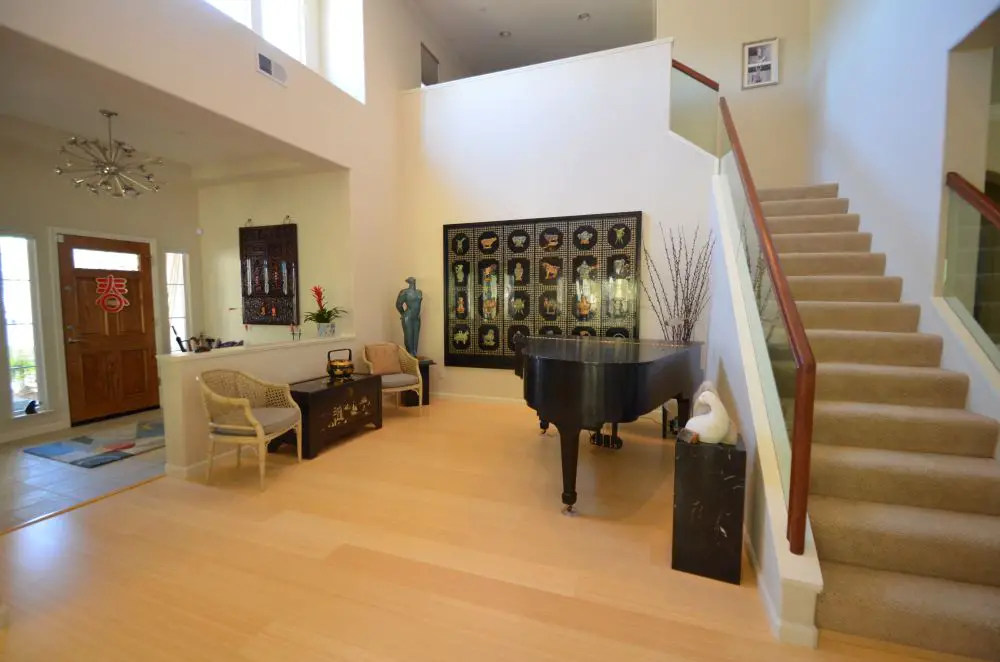
Bright open-concept entry with high ceilings, staircase, and hardwood flooring, featuring a piano and sitting area.
On-Site Behavior Is Part of the Communication
How a crew conducts themselves on a job says something that no written notice can. We're pretty specific about this at Toupin.
Our crews sweep the driveway, curb, and walkway at the end of every day. Materials are staged inside the unit or in a contained area — nothing left in the parking lot, nothing blocking a shared path. Noise-heavy work like demo and tile cutting is scheduled for mid-morning, not 8 AM sharp and not late afternoon when people are winding down. These are small things. They add up to a job that the neighbors barely notice — which is exactly the goal.
In a condo community, a dumpster parked in the lot for weeks isn't just unsightly — it can block parking, limit fire lane access, and require Mutual approval of its own. We use our own dump truck to haul debris off-site directly, which means no container sitting around, no parking complaints, and no secondary approval headache. It also means the site stays cleaner throughout the job, which is better for everyone.
When a Neighbor Has a Concern
Even when you've done everything right, someone will occasionally have a concern. That's fine. The way you handle it is what matters.
Our rule is simple: acknowledge it fast, fix it if we can, and follow up. Not a defensive explanation. Not a delay. Just: "Thanks for letting us know — let me check on that right now." Then we check on it, and if there's something to fix, we fix it. A short follow-up the next day — even just to say everything's been addressed — closes the loop and usually turns a frustrated neighbor into a friendly one.
In 40+ years, some of the best referrals we've gotten came from the neighbors of clients we remodeled for. Think about that. People who never hired us, who just watched how we ran a job next door, decided that's the contractor they wanted. That's not an accident. That's reputation, built one job at a time.
A Note on the Mutual Approval Process
In Rossmoor specifically, neighbor communication is sometimes baked into the Mutual approval process itself — some Mutuals require written notification to adjacent units as part of getting a remodel approved. We handle this documentation as part of our standard Rossmoor prep, so our clients aren't navigating it from scratch.
If you're planning a remodel in Rossmoor and haven't started the approval process yet, our Rossmoor remodeling page walks through what that process typically looks like. And our overall remodeling process shows how we structure a project from first conversation to final walkthrough — neighbor communication included.
For condo and co-op remodeling across the East Bay — not just Rossmoor — our condominium remodeling service page covers the specifics of how we approach attached construction.


Comments