

By using our website, you agree to the use of cookies as described in our Cookie Policy
Blog
Porcelain Countertops: What Happens When Tile Gets Serious
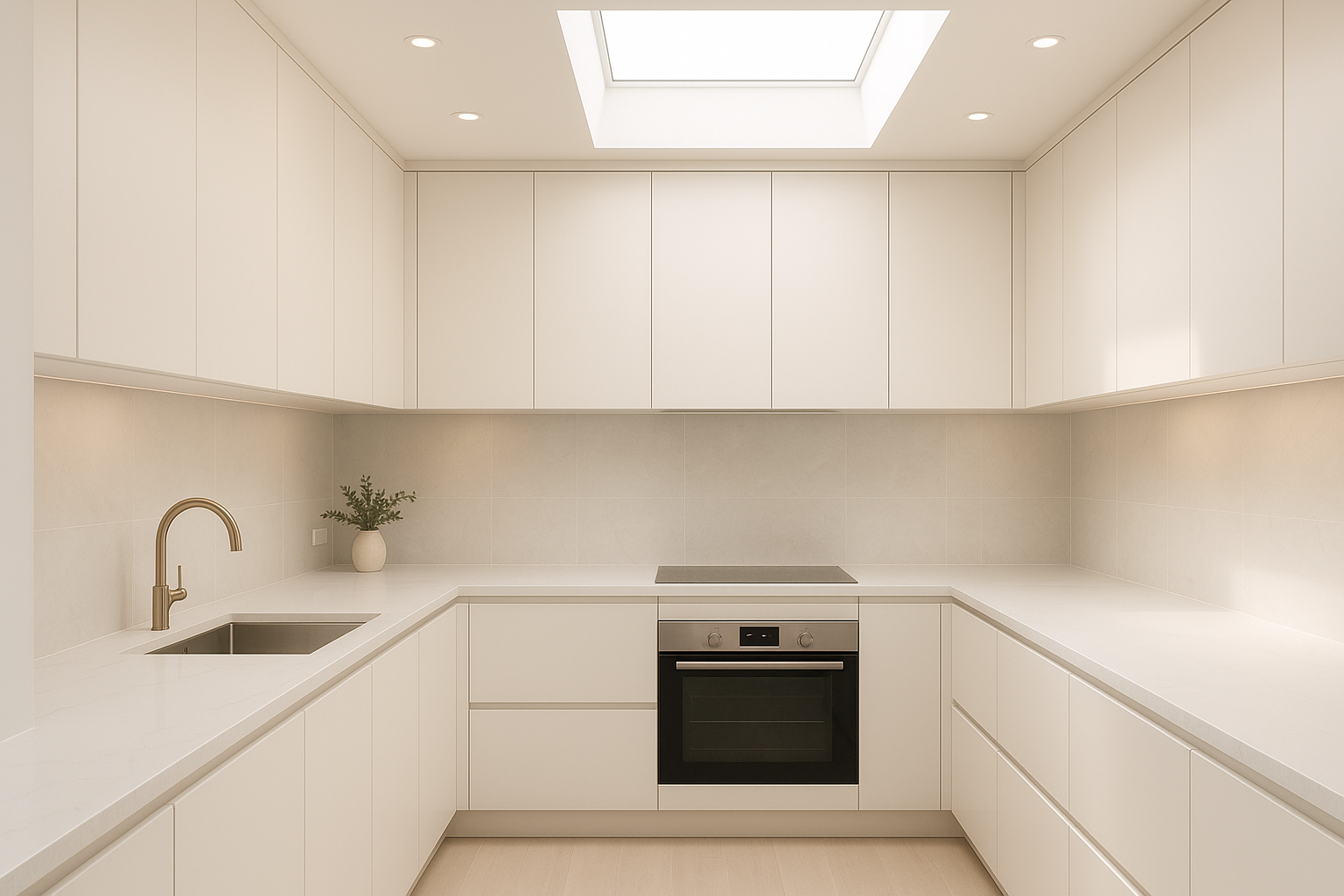 Minimal U-shaped kitchen featuring seamless porcelain countertops, flat-panel cabinetry, and a skylight that fills the space with soft natural light. The porcelain surface offers a clean, durable, and low-maintenance finish ideal for modern living.
People see "porcelain" and immediately think bathroom floor tile. Which is understandable — that's where most of us first encountered it. But the porcelain countertop market has almost nothing in common with the 12x12 floor tile world. We're talking about slabs as large as 10 feet long, as thin as a quarter inch, with veining that rivals the best Italian marble — fired at temperatures that would make granite envious.
Porcelain slabs are one of the fastest-growing countertop materials in the East Bay right now, and they're earning it. In outdoor kitchens from Danville to Pleasant Hill, in modern Walnut Creek kitchens with south-facing windows, in Rossmoor remodels where homeowners want the marble look with zero maintenance — porcelain keeps showing up. There's a reason.
This post is part of our Countertop Materials Series. If you're still deciding which material is right for your project, we also cover quartz, granite, marble, quartzite, soapstone, and butcher block.
What Porcelain Slab Actually Is
Trade Term Explained: Porcelain Slab vs. Sintered StonePorcelain slab countertops are made from refined natural materials — clay, kaolin, feldspar, and mineral oxides — that are pressed under enormous hydraulic pressure and then fired at extremely high temperatures (over 2,200°F). The result is a surface that is non-porous, UV-resistant, and harder than granite. "Sintered stone" is a term you'll see with brands like Dekton — it refers to a similar high-pressure, high-heat manufacturing process. For practical purposes, Dekton, Neolith, and large-format porcelain slabs from brands like Daltile Panoramic all belong to the same family: kiln-fired, ultra-dense, and genuinely engineered for punishment.
The firing process is what makes porcelain different from engineered quartz. Quartz uses resin binders to hold the stone particles together — and those resins have limits, particularly around heat and UV exposure. Porcelain has no resin. The materials are fused at the molecular level under heat. The result is a surface with no weak points from a chemical or thermal standpoint.
The Two Things Porcelain Does Better Than Any Other Countertop
There are a lot of good countertop materials. But only one of them is completely UV-stable and heat-proof in the same package. That's porcelain, and those two properties together are the reason it dominates certain categories of project.
Quartz fades in direct sunlight. Porcelain doesn't. For south-facing kitchens and outdoor applications, that's not a minor detail — it's the whole ballgame.
Heat resistance means you can put a hot pan directly on the surface without scorching, discoloring, or cracking. Quartz countertops — despite the "stone" framing — contain resin, and extreme heat can discolor or warp that resin. Porcelain has no such vulnerability. A cast iron pan straight from a 500°F oven is not a problem. We still recommend trivets as a general habit (thermal shock is real, and no surface is completely immune), but porcelain is genuinely forgiving in a way that quartz simply isn't.
UV stability is the less-discussed advantage that matters enormously in certain East Bay kitchens. Quartz near a window that gets hours of direct sunlight per day can yellow or fade over years. Porcelain doesn't change color in sunlight. Period. For kitchens with big south or west-facing windows, skylights, or open-plan layouts that get real sun exposure, this is a critical distinction. And for outdoor kitchens — which are becoming increasingly popular in our service area, especially in Danville and Alamo where homeowners have the outdoor space for it — porcelain is essentially the only engineered surface that makes sense.
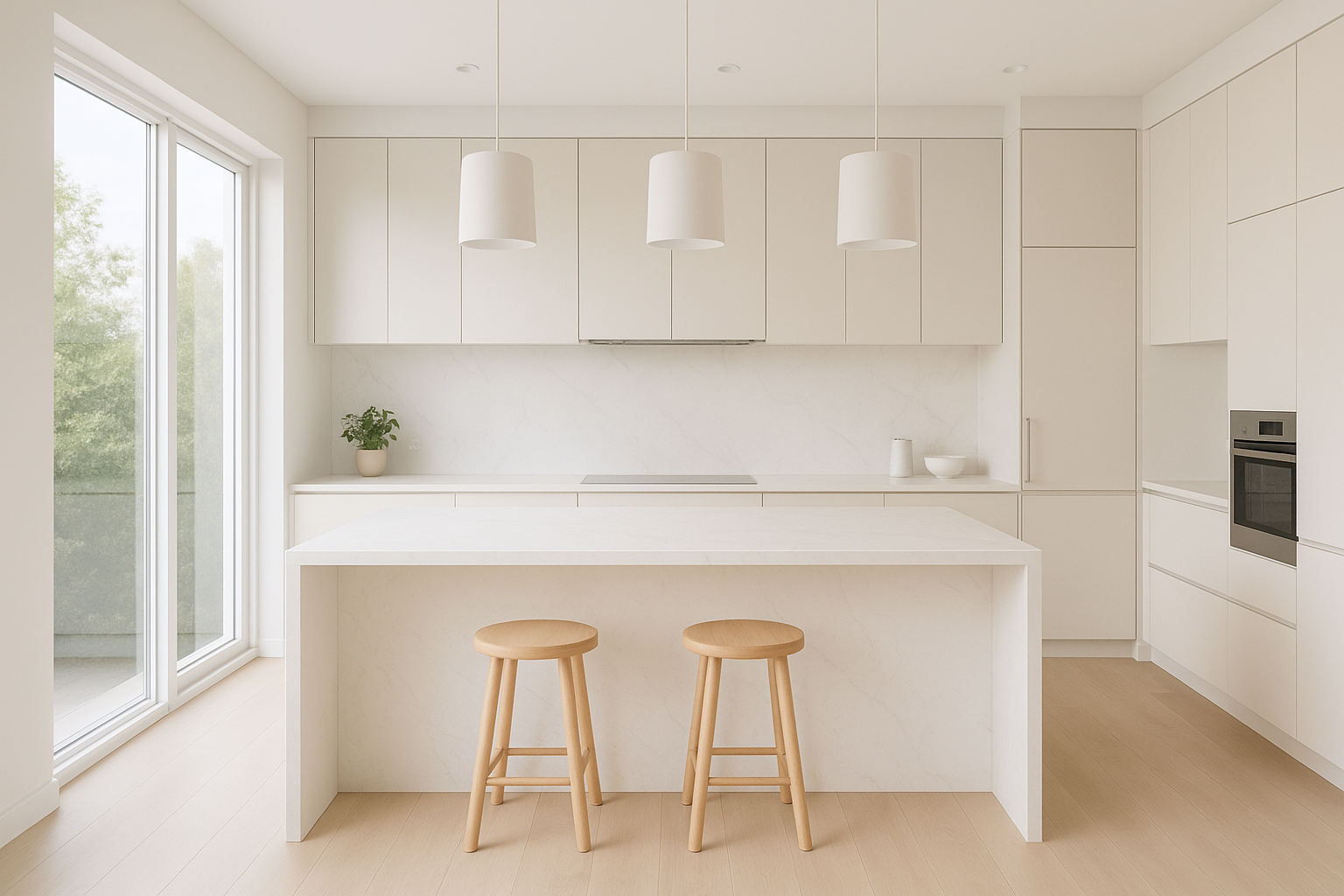 Modern kitchen with a large porcelain waterfall island, integrated cabinetry, and warm wood accents. The ultra-thin slab creates a sleek, high-performance surface that is resistant to heat, stains, and scratches.
The Design Possibilities: Not What You Expect
The design flexibility of porcelain has genuinely expanded in the last decade. The printing technology used to create patterns has reached a point where the best marble-look porcelain is nearly indistinguishable from the real thing in photographs. In person, they feel different — porcelain doesn't have the translucent depth of natural stone — but from a pattern and veining standpoint, manufacturers can now mimic Calacatta, Statuario, Carrara, soapstone, and slate with remarkable precision.
For homeowners who want the marble look without the etching, sealing, and maintenance — and don't require the tactile authenticity of real stone — porcelain marble-look slabs are a genuinely good answer. They won't etch. They won't stain. They won't care what your cooking habits are.
Porcelain also comes in formats that don't exist in natural stone. Slabs as thin as 6mm (about a quarter inch) are available for wall cladding and backsplash applications. The same slab material that covers your countertop can run continuously up the wall behind it — no grout lines, no visual interruption. Full-height backsplashes bookmatched to the countertop are one of the most striking design moves available in kitchen remodeling right now, and porcelain makes them possible in a way that natural stone slabs can't match for scale and consistency.
Porcelain in Rossmoor Remodels
Porcelain has become one of our go-to recommendations for Rossmoor kitchen remodels. The thin-profile slabs work especially well in compact kitchen layouts — they add counter presence without visual bulk. The maintenance-free surface is a natural fit for homeowners in the 55+ community who want a beautiful kitchen without the annual sealing routine. And the marble-look options deliver the elegance many Rossmoor homeowners are after without the vulnerability of real marble. We handle all aspects of permitting and Mutual coordination for Rossmoor remodels — reach out before you start planning so we can walk you through the approval process.
Where Porcelain Is the Right Call (And Where It Isn't)
Porcelain is genuinely excellent for outdoor kitchens — it's one of our top recommendations when someone comes in asking what to use on an outdoor island. Sun, heat, rain, temperature swings: porcelain handles all of it without fading or deteriorating. This puts it in a category largely by itself; quartz is specifically not recommended for outdoor use, and even natural stone requires more care outdoors.
Indoor kitchens with significant sun exposure, shower walls, fireplace surrounds, and laundry room counters are all excellent applications. In showers, large-format porcelain slabs are increasingly used to eliminate grout lines entirely — a single slab wall is easier to clean, harder to damage, and genuinely more striking than tile.
Where porcelain is less ideal: heavily traditional design schemes with thick, ornate edge profiles. Porcelain works best with clean, modern edge treatments — mitered, eased, or square. An ogee or bullnose edge that reads beautifully on a 3cm granite slab looks awkward on thin-profile porcelain. If the aesthetic direction of your kitchen leans toward traditional, heavy woodwork, and decorative hardware, granite or quartz will serve you better.
The Trade-Offs to Know Before You Commit
Edge chipping is porcelain's Achilles' heel. The surface of a porcelain slab is extraordinarily hard — harder than granite. The edges, particularly at sink cutouts and corners, are more vulnerable to chipping from impact than other materials. Dropped pots, dishwasher door catches, cabinet hardware impacts near the sink: these are the scenarios that can chip a porcelain edge. A skilled fabricator minimizes this risk with proper edge reinforcement and careful installation, but it's worth understanding going in.
Pattern matching requires expertise. Because porcelain patterns are printed, veins don't flow continuously from slab to slab the way they would in natural stone. Bookmatching (flipping two slabs so the veining mirrors) is one technique to address this, but it requires precise planning. Seams in prominent locations can be more visible on some porcelain patterns than on granite or soapstone.
Fabrication demands specialist tooling. Porcelain cannot be cut with standard stone equipment without chipping. It requires diamond blades, specialized saws, and fabricators with specific experience. The upside is that any competent stone fabricator in the East Bay who works with porcelain regularly will have the right tools. The downside is that not every shop does — ask before you commit to a fabricator.
Porcelain vs. The Field
| Feature | Porcelain | Quartz | Granite | Quartzite |
|---|---|---|---|---|
| Heat Resistance | Excellent | Fair — can scorch | Excellent | Excellent |
| UV Resistance | Excellent | Poor — can fade/yellow | Good | Excellent |
| Outdoor Use | Excellent | Not recommended | Good | Some varieties |
| Etch Resistance | Excellent | Excellent | Good | Excellent |
| Needs Sealing | Never | Never | Yes (every 10–15 yrs) | Yes (annually) |
| Edge Chipping Risk | Moderate — needs expert fab | Low | Low | Low |
| Design Range | Wide — including marble looks | Very wide | Natural variation only | Natural variation only |
| Typical Installed Cost | $110–$185+/sq ft | $95–$165+/sq ft | $75–$140+/sq ft | $130–$220+/sq ft |
Pricing in the East Bay
Material-only pricing for porcelain slabs runs roughly $55–$120 per square foot, depending significantly on the brand (Dekton and Neolith sit at the premium end), the pattern complexity, and the finish. Installed, expect $110–$185+ per square foot. Mitered edges, bookmatching, waterfall configurations, and vent hood cladding all move the number upward. See our kitchen remodeling page for how we approach project scoping.
Candi's Take
Porcelain is the material that surprises people most in our consultations. They come in thinking it's a budget tile product and leave understanding it's a genuinely sophisticated engineering feat. For outdoor kitchens, for sunlit spaces, for homeowners who want the marble look without any of the marble vulnerability — porcelain consistently delivers. The fabrication demands more expertise than other materials, but when it's done right, the result is genuinely stunning. We've been doing it long enough to know how to do it right.
Interested in Porcelain for Your Kitchen or Outdoor Space?
We install porcelain slab countertops throughout Walnut Creek, Rossmoor, Danville, Alamo, Lafayette, and the East Bay. Let's talk through your project — no pressure, just honest guidance on what'll work best.
Get a Free Consultation — 925-937-4200
Toupin Construction
Ready to start your remodel?
Whether you're dreaming of a new kitchen, a spa-worthy bathroom, or a whole-home transformation — we’d love to hear about your project. Reach out and let's talk.
‹ Back
Comments