


By using our website, you agree to the use of cookies as described in our Cookie Policy
Blog
Countertop Edge Profiles: What They Are, What They Cost, and How to Choose
Countertop Edge Profiles: What They Are, What They Cost, and How to Choose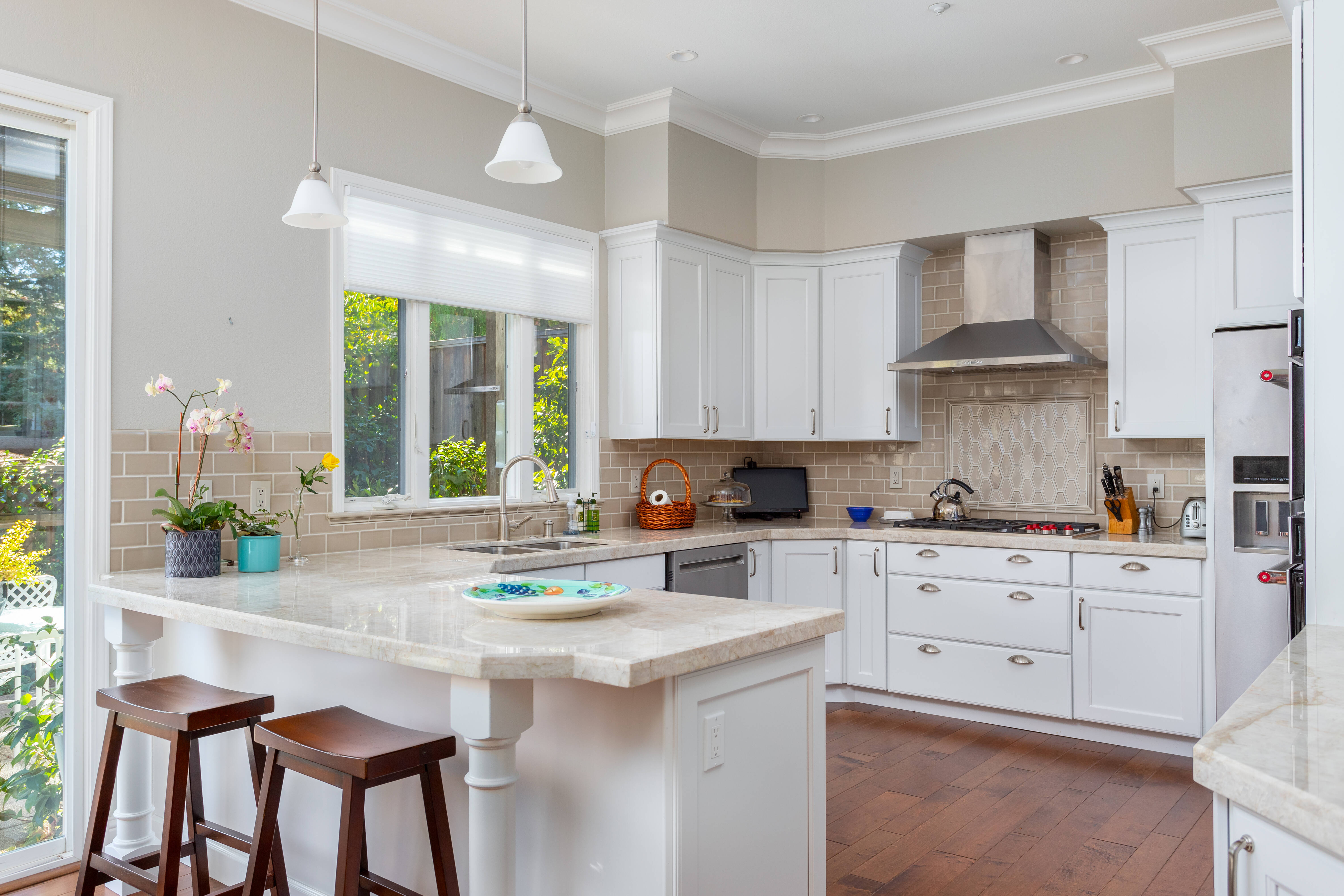
Walnut Creek kitchen with quartz countertops featuring a soft eased edge profile and extended island overhang for seating, combining safety, durability, and everyday functionality.
There's a moment in almost every kitchen design meeting where the homeowner picks their countertop material, picks their color, picks their thickness — and then the fabricator asks what edge profile they want. And they go quiet.
Nobody warned them about the edge. They spent six weeks agonizing over quartz vs. granite and thirty seconds on the thing that's going to be at hip height every time they walk through the kitchen for the next twenty years.
Edge profiles are a real decision. They affect cost, they affect how the countertop reads in the space, they affect how easy the surface is to clean, and in kitchens with kids or older adults, they affect safety. This guide covers every common profile we install — what each one looks like, what it costs relative to the others, and who it actually makes sense for.
A Quick Note on How Edge Profiles Work
Your countertop slab arrives at the fabrication shop as a flat rectangle. The fabricator cuts it to your exact dimensions, makes the sink cutout, and then runs the front edge through a CNC router or polishing wheel to create the profile. That edge shaping is a separate cost from the material itself — and the more complex the profile, the more machine time and hand finishing it takes, and the more it adds to your fabrication bill.
The good news: edge profile upcharges are usually measured in dollars per linear foot, not hundreds or thousands. On most kitchen projects the difference between a simple eased edge and an ogee is a few hundred dollars total — real money, but not the place to make your budget decisions. Pick the one that's right for the design, not the cheapest one available.
Profile / Edge Profile
The cross-sectional shape of the front and side edges of your countertop slab — what you see when you look at the edge straight-on. There are dozens of named profiles, but about eight to ten show up on the vast majority of residential kitchen jobs. Everything else is a variation or a custom one-off.
Linear Foot
Edge profile pricing is quoted per linear foot — meaning the total length of exposed edge that gets shaped. A standard kitchen with 25 linear feet of exposed counter edge at a $10/LF upcharge for an ogee adds $250 to fabrication. Edges on island ends, peninsula returns, and bar overhangs all count toward that total.
Polished vs. Honed Edge
The edge finish can be polished (glossy, reflective) or honed (matte, slightly soft). This is usually matched to the surface finish of the slab — a polished quartz countertop gets a polished edge, a honed marble gets a honed edge. Mismatching them draws the eye and rarely looks intentional.
Thickness
Standard residential countertop slabs are 3/4" (2 cm) or 1-1/4" (3 cm) thick. Some edge profiles — like the waterfall or mitered — require 3 cm minimum to look right. Thinner slabs can be built up at the edge with a laminated strip to create the appearance of a thicker slab, which affects which profiles are available to you.
The Profiles — Every Common One, Explained
Eased Edge
The eased edge is a square corner with one subtle modification: the top arris — the very edge where the surface meets the front face — is lightly broken so it's not a knife-sharp 90°. It's flat on the front, flat on top, with just enough softening at the corner to keep it from being uncomfortable against your hip and reduce the chance of chipping.
This is the default profile on most fabrication quotes for a reason. It costs nothing extra, works with every material and every kitchen style, and reads as clean and contemporary without being trendy. If you're not sure what you want and nobody has made a strong case for something else, the eased edge is almost certainly your answer.
Cost
Standard
Upcharge
None
Maintenance
Easy
Best for: Modern and transitional kitchens, any material, anyone who values a clean line and an easy clean. This is what we spec most often when clients haven't made a strong preference known — and it holds up beautifully.
Beveled Edge
The beveled edge adds a flat angled cut — usually at 45° — at the top corner of the slab. It catches light differently than a square edge and gives the countertop a slightly more finished, intentional look without adding the visual complexity of a curved profile. It reads as a step up from the eased edge without being decorative.
The bevel width varies — a 1/8" bevel is subtle; a 1/2" bevel is more prominent and makes more of a design statement. Wider bevels are more common on thicker slabs (3 cm) where there's enough material to work with. On 2 cm slabs, a wide bevel can make the edge look thin and insubstantial.
Cost
$ Low
Upcharge
$3–8/LF
Maintenance
Easy
Best for: Contemporary and transitional kitchens that want a bit more polish than a straight eased edge without committing to a curved profile. Works especially well with quartz and granite on 3 cm slabs.
Bullnose Edge
The bullnose is a fully rounded edge — the top corner curves continuously from the flat surface all the way around to the flat front face, creating a smooth half-circle profile. There are no corners. Nothing to catch a hip on, nothing to chip a toddler's head against. It's the softest, safest edge profile available on a standard slab.
Bullnose was the dominant edge on East Bay kitchen remodels through the 1990s and 2000s — it reads as warm and traditional. It's had a reputation for being dated in the past decade as square edges took over in contemporary design, but that reputation is softening. A bullnose in a warm-toned material on a craftsman or farmhouse kitchen is exactly right and not something to apologize for.
Cost
$ Low
Upcharge
$5–10/LF
Maintenance
Easy
Best for: Families with young kids or older adults where sharp corners are a genuine concern. Craftsman, farmhouse, and traditional kitchens. Rossmoor remodels where Mutual board aesthetic standards lean toward traditional profiles. The safest edge option, period.
Half Bullnose (Demi Bullnose)
The half bullnose — sometimes called a demi bullnose — rounds only the top corner of the edge, leaving the front face flat. The result is softer than a square edge, safer than a full 90°, but more contemporary-looking than a full bullnose. The front face stays vertical, which gives the countertop a slightly more substantial appearance than the continuous curve of a full bullnose.
This is an underused profile that deserves more consideration. It's a genuinely useful middle ground for transitional kitchens where a full bullnose feels too traditional and a hard square edge feels too cold.
Cost
$ Low
Upcharge
$5–10/LF
Maintenance
Easy
Best for: Transitional kitchens that want the safety of a rounded corner without the full traditional look of a bullnose. A good call anywhere kids or seniors are in the kitchen regularly.
Ogee Edge
The ogee is an S-curve — a convex curve on top that transitions to a concave curve below, creating a profile with visual depth and shadow lines. It's the most architecturally classical of the common edge profiles, borrowed directly from millwork and furniture traditions that go back centuries. In the right kitchen — traditional cabinetry, ornate hardware, warm stone — an ogee edge looks genuinely beautiful and completely at home.
The honest caveat: the ogee is a profile that requires commitment to a style. It doesn't coexist well with contemporary or minimalist design — in those contexts it reads as incongruous, not elegant. It's also the most demanding of the standard profiles to keep clean, because the concave portion of the S-curve traps crumbs, grease, and cleaning product residue. Not unmanageable, but worth knowing before you choose it.
Cost
$$ Mid
Upcharge
$10–20/LF
Maintenance
Medium
Best for: Traditional and formal kitchens with ornate cabinetry, marble or granite surfaces, and homeowners who are committed to the aesthetic and comfortable with a soft brush as part of their cleaning routine. Not the right call on a contemporary quartz kitchen — the contrast in design language is jarring.
Mitered Edge
The mitered edge isn't a shaped profile in the traditional sense — it's a fabrication technique. Two slabs are cut at 45° and joined together at the edge, creating the appearance of a slab that's twice as thick as it actually is. The result is a countertop with a heavy, substantial-looking edge that reads as architectural rather than decorative. Think 4–6 cm of visible edge face on what is actually a standard 3 cm slab with a drop piece attached underneath.
Mitered edges are the statement choice on contemporary and high-design kitchen islands right now. The look is dramatic, intentional, and unmistakably modern. The fabrication challenge is that the 45° joint has to be near-perfect — a gap or misalignment at that seam is visible and impossible to hide. You want an experienced fabricator on this one, not the cheapest quote you can find.
Cost
$$$ High
Upcharge
$25–60/LF
Maintenance
Easy
Best for: Contemporary kitchens where the island or countertop is meant to be a design statement. Quartz is the most common material for mitered edges because of its consistent coloring — a dramatic book-matched stone slab at a mitered edge is stunning, but the fabrication is significantly more complex and costly.
Waterfall Edge
The waterfall is not technically an edge profile in the same sense as the others — it's a design element where the countertop material continues vertically down one or both sides of the island or cabinet run, all the way to the floor. The stone or quartz "flows" uninterrupted from horizontal surface to vertical panel. Done with a book-matched stone slab — two slabs cut from the same block, mirrored so the veining continues across the joint — a waterfall island is genuinely one of the most dramatic design statements you can make in a kitchen.
The cost is significant. You're buying additional slab material for the vertical panels, paying for the mitered joints where the horizontal and vertical pieces meet, and if you're doing a book-matched stone waterfall, you're coordinating the slab selection and orientation with the fabricator and paying a premium for the matching. The plumbing and electrical rough-in under the island also has to account for the waterfall panels — this needs to be in the plan from the beginning, not retrofitted.
Cost
$$$$ Premium
Upcharge
Varies widely
Maintenance
Easy
Best for: Whole-home or high-budget kitchen remodels where the island is meant to be the visual centerpiece of the space. Plan this from day one — it affects the island structure, the rough-in, and the material order. It's not something to add mid-project.
Live Edge
Live edge is in a different category from everything else on this list — it's not a machined profile, it's a preserved natural edge. A live edge slab is cut from a log in a way that retains the original outer shape of the tree: the organic curves, voids, bark inclusions, and irregular contour that the tree grew into over decades. No two live edge pieces are the same. You're not choosing a profile from a chart — you're choosing a specific slab that you've seen and approved.
Live edge countertops are almost exclusively wood, most commonly walnut, maple, cherry, or black acacia. They're most common on kitchen islands, where the organic shape becomes the centerpiece rather than competing with adjacent cabinetry. They require the same maintenance as any wood countertop — regular oiling, protection from standing water, refinishing when scratched — with the added consideration that voids and bark inclusions can trap debris and need to be sealed carefully at fabrication.
Cost
$$$$ Custom
Upcharge
N/A — slab price
Maintenance
Medium–High
Best for: Homeowners who want something genuinely one-of-a-kind and are committed to the wood maintenance routine. Most successful as an island surface in a kitchen where the rest of the counters are quartz or stone — the contrast in materials is part of the design intent.
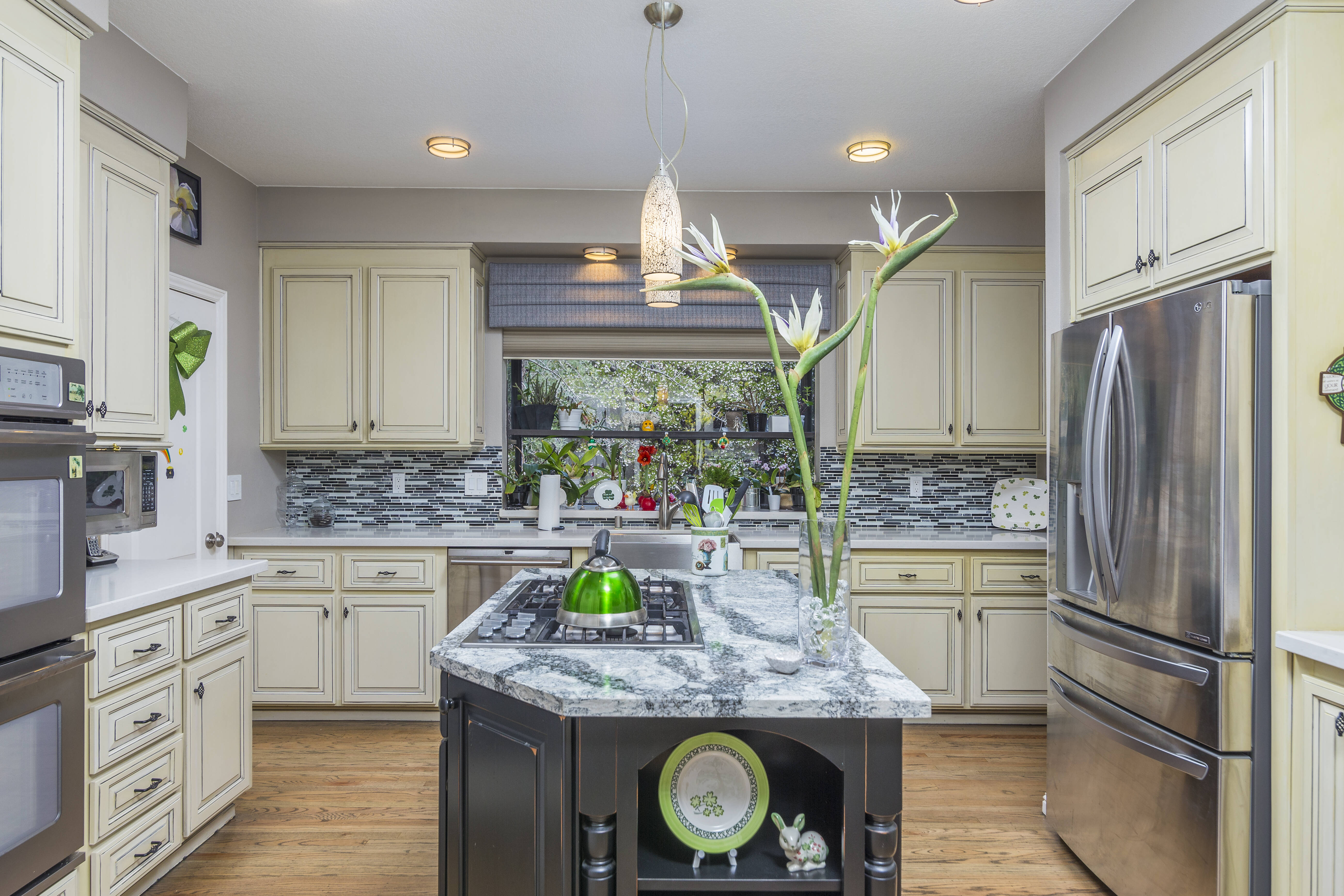
East Bay kitchen showcasing a granite countertop with a decorative edge profile on the island, adding dimension and a more traditional, detailed finish to the space.
All Profiles Side by Side
| Profile | Typical Upcharge | Safety | Cleaning | Design Style | Material Fit |
|---|---|---|---|---|---|
| Eased | None (standard) | Good | Very easy | Modern, transitional | All materials |
| Beveled | $3–8 / LF | Good | Very easy | Contemporary, transitional | All materials |
| Bullnose | $5–10 / LF | Best | Very easy | Traditional, farmhouse | All materials |
| Half Bullnose | $5–10 / LF | Very good | Very easy | Transitional | All materials |
| Ogee | $10–20 / LF | Good | Medium (grooves) | Traditional, formal | Stone; not quartz |
| Mitered | $25–60 / LF | Good | Easy | Modern, architectural | Quartz, thick stone |
| Waterfall | Project-dependent | Good | Easy | Contemporary, statement | Quartz, stone slab |
| Live Edge | Slab-priced | Good (soft wood) | Medium (voids) | Organic, eclectic | Wood only |
"The edge decision should come after the material decision, not before it. Once you know what you're working with — a 3 cm quartz, a 2 cm marble, a walnut butcher block — the list of profiles that actually work for that material narrows itself down fast."
— Tim Toupin, Toupin ConstructionHow to Actually Choose
Most edge decisions boil down to four practical questions. Answer these before you even look at a profile chart:
Question 1
What's the design style of the kitchen?
Contemporary and modern kitchens want square profiles — eased, beveled, or mitered. Traditional and farmhouse kitchens want curved profiles — bullnose, half bullnose, or ogee. Mixing design languages (ogee on a contemporary quartz kitchen) rarely lands well.
Question 2
Who's using this kitchen?
Young kids or older adults in the space? Round it — bullnose or half bullnose. Sharp corners at counter height are a real hazard in those situations, and no edge profile is worth an ER visit or a daily bruise.
Question 3
What's the slab thickness?
2 cm slabs limit your options — wide bevels and mitered edges don't have enough material to work with and can look thin. 3 cm slabs open up the full range. Know what you're buying before you fall in love with a profile that doesn't work on your material spec.
Question 4
Are you okay with more cleaning?
Ogee and other decorative profiles have grooves that trap crumbs and grease. If you're a wipe-and-go cleaner, stick to flat or rounded profiles that a sponge can cover in one pass. If you're meticulous about cleaning and love the look — go for it.
Common Questions
Does the edge profile affect how durable the countertop is?
Yes, at the corners. Sharp square edges — especially on natural stone — are more prone to chipping at the corner arris than rounded profiles. The eased edge reduces that risk slightly. Bullnose and half bullnose have no exposed corner at all, so they're the most chip-resistant. Quartz is more forgiving than granite or marble on this front because of its resin content, but no stone countertop edge is indestructible.
Can I get a different edge on the island vs. the perimeter counters?
Yes, and it's done intentionally sometimes — a mitered island with eased perimeter counters is a common choice where the island is meant to stand out. That said, be thoughtful about it. Mixing profiles works when there's a clear design rationale. It looks accidental when it's just indecision. Run it by your designer or contractor before committing.
How much does a nicer edge profile actually add to the total project cost?
Less than most people expect. On a typical kitchen with 25–30 linear feet of exposed edge, upgrading from a standard eased edge to a beveled or bullnose adds $100–$300 total. An ogee might add $300–$600. Mitered edges are the real cost jump — $25–$60 per linear foot adds up to $750–$1,800 on that same kitchen. Waterfall and live edge pricing depends entirely on material and scope. As a proportion of total kitchen project cost, the edge is rarely where you should be making your budget calls.
Can I change my edge profile after the countertop is installed?
Not practically, no. The edge is shaped at the fabrication shop before installation. Once the slab is in, reworking the edge would require removing the countertop, returning it to a fabricator, and reinstalling — which costs more than choosing the right profile the first time. This is a decision to make at the template stage, before fabrication begins.
Which edge profile is most popular in East Bay kitchens right now?
Eased and beveled edges dominate in new and remodeled kitchens across Walnut Creek, Alamo, Danville, and Lafayette — contemporary design is the default in our market right now. Mitered edges are increasingly common on statement islands in higher-budget whole-home remodels. Bullnose still holds strong in Rossmoor and craftsman-style homes where traditional aesthetics are intentional.
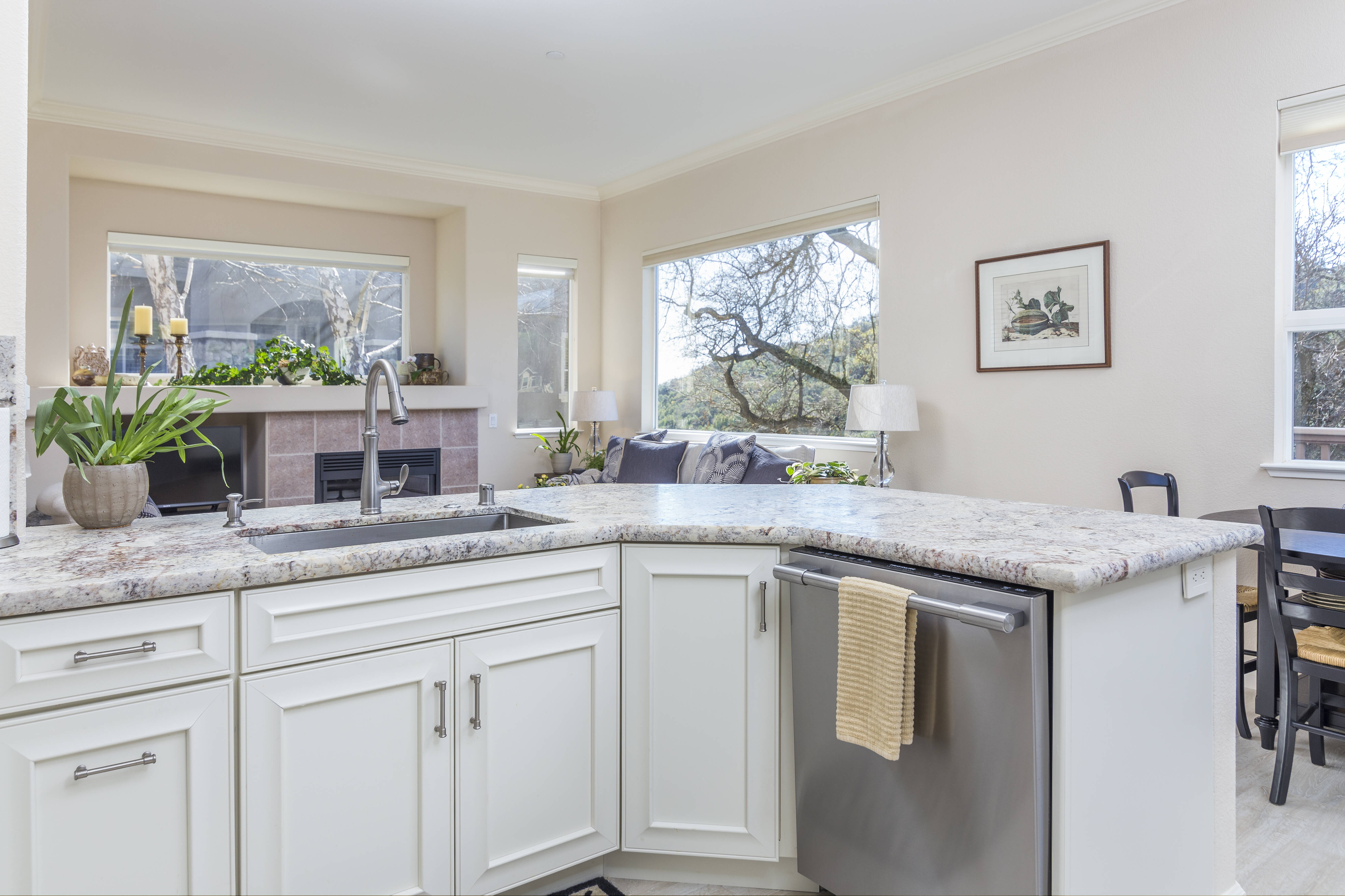
Rossmoor kitchen with quartz countertops featuring a clean square edge profile, emphasizing modern lines and a streamlined transition between kitchen and living space.
The Edge Is the Detail That Ties It Together
It's a small decision in the scheme of a kitchen remodel. But it's one of the few decisions that you literally touch every single day — every time you set something down on the counter, lean against the island, or wipe down after cooking. Getting it right matters.
The answer is almost never the most expensive profile available. It's the one that fits the material, the design, the people using the kitchen, and the way you want the space to feel. That's usually a pretty quick conversation once you're looking at actual samples in your actual kitchen.
We're happy to have that conversation. If you're planning a kitchen remodel in Walnut Creek, Rossmoor, Alamo, Danville, or anywhere in the East Bay, give us a call or come see us. First consult is always free.
Ready to Plan Your Kitchen Remodel?
We'll walk through material, edge, and layout decisions together — with forty-plus years of knowing what holds up in East Bay kitchens and what just looks good on a showroom floor.
Schedule a Free Consultation See Our PortfolioOr call us directly: 925-937-4200
Toupin Construction
Ready to start your remodel?
Whether you're dreaming of a new kitchen, a spa-worthy bathroom, or a whole-home transformation — we’d love to hear about your project. Reach out and let's talk.
‹ Back
Comments