


By using our website, you agree to the use of cookies as described in our Cookie Policy
Blog
Soapstone Countertops: The Stone That Never Needs Sealing (and Actually Gets Better with Age)
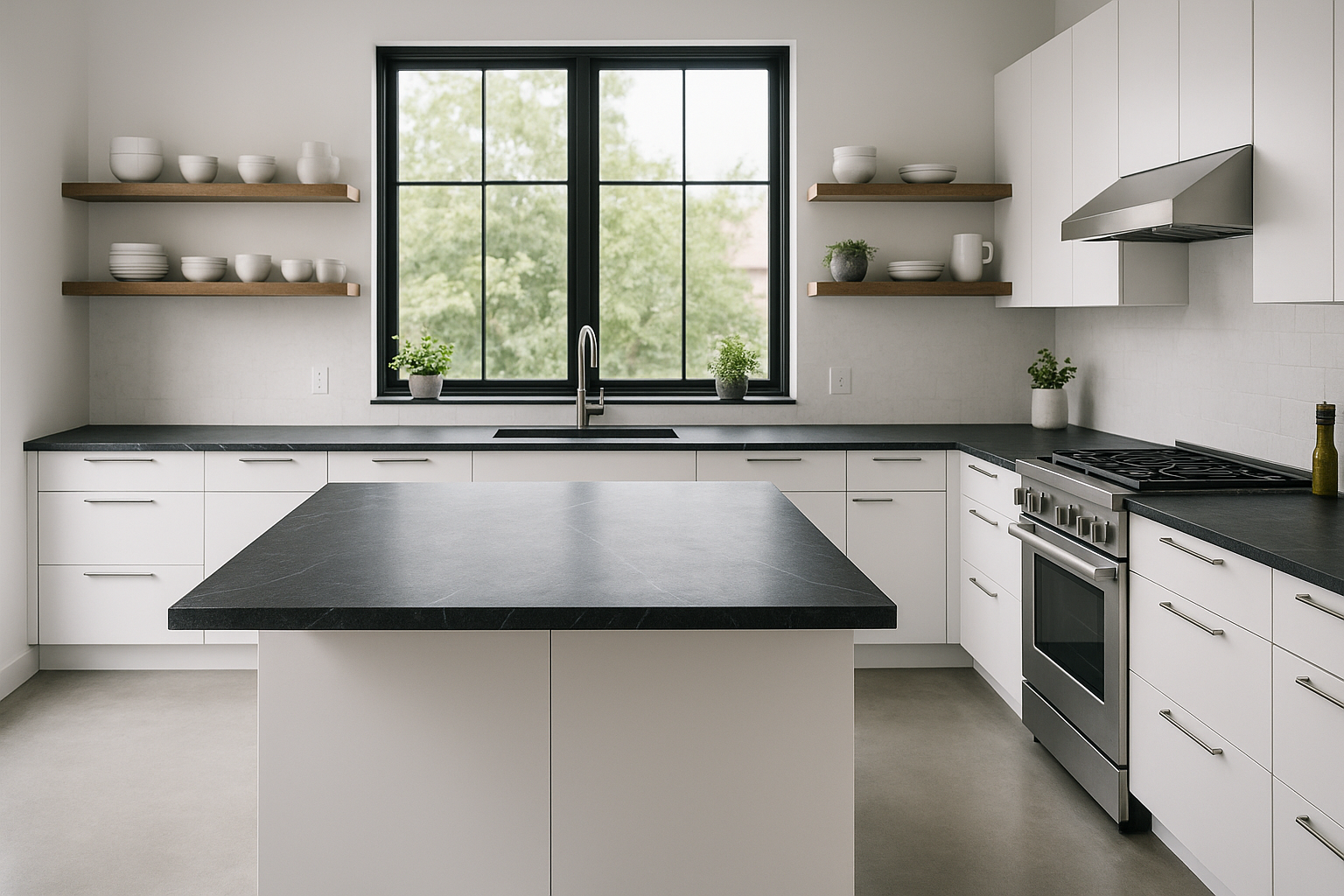 Bright, modern kitchen featuring white cabinetry, open shelving, and a bold black soapstone island. The matte finish and subtle veining of the soapstone create a soft contrast against the light space.
Last year we installed soapstone in a kitchen in Pleasant Hill for a homeowner who'd been burned by marble. She'd spent two years babying a beautiful Carrara marble island — coasters for everything, a mild panic every time someone brought a wine glass near it — and she'd finally had enough. She wanted natural stone. She wanted the look of something real and earthy. But she was done with maintenance anxiety.
We pointed her toward soapstone. She was skeptical. By the end of the install she was running her hand back and forth across the surface like she couldn't quite believe it was real. That velvety, silky feel — there's nothing else like it in the countertop world.
Countertop Materials Series. We cover every major material we install in East Bay homes — including granite, quartz, marble, quartzite, porcelain, and butcher block — with complete honesty about what works and what doesn't.
What Soapstone Actually Is
Trade Term Explained: Soapstone (Steatite)Soapstone — technically called steatite — is a metamorphic rock formed deep in the earth's crust. Its primary component is talc, which is the softest mineral on the Mohs scale, and that's exactly where its characteristic silky, almost waxy feel comes from. Also present: magnesite, chlorite, and trace minerals that vary by quarry. What makes soapstone unlike any other natural stone is its chemical inertness — it simply doesn't react to acids, oils, or most cleaning products, which is why it's been used in chemistry labs, wood stoves, sinks, and farmhouse kitchens for centuries.
That history is actually worth knowing. Soapstone was the material of choice for laboratory benchtops at universities and research facilities for over a hundred years — places where chemical spills were routine and the surface had to survive them. If something can handle sulfuric acid, it can handle taco night with flying colors.
Colonial farmhouses across the East Coast have soapstone sinks that are still in use. These aren't refinished pieces — they're original, two hundred years old, and still functional. That's not marketing copy. That's just what the material does over time.
The Thing That Makes Soapstone Genuinely Unique
Every natural stone we work with has something that sets it apart. Granite gives you one-of-a-kind mineral patterns. Marble gives you drama and depth. Quartzite gives you both of those things with better durability. But soapstone has something none of the others offer: it is the only natural stone that is completely non-porous without any treatment.
Soapstone is the only natural stone that never needs sealing — not once, not ever. Liquids don't absorb into it. They sit on top.
That's not a minor detail. It means oil doesn't stain it. Wine doesn't soak in. Coffee, lemon juice, vinegar — none of it leaves a mark. The acids that would etch marble or dull an unsealed granite surface do nothing to soapstone because there's nothing for them to react with. The stone is chemically inert all the way through, not just on the surface.
For homeowners who love the idea of natural stone but don't want the sealing calendar, soapstone is the only honest answer.
The Look and Feel: What You're Actually Getting
Soapstone is dark. That's the starting point for any honest description. It runs from soft gray to charcoal to a deep, almost black tone — and it will darken over time, either gradually through natural use or immediately if you oil it. If you're looking for a bright white kitchen, soapstone is not it.
Within that range, there's real variation. Some slabs have subtle white veining that softens the depth. Others are nearly uniform charcoal. Some have green or blue undertones that only reveal themselves under certain light. The color palette is narrow compared to marble or quartzite, but within that range, the material has genuine character.
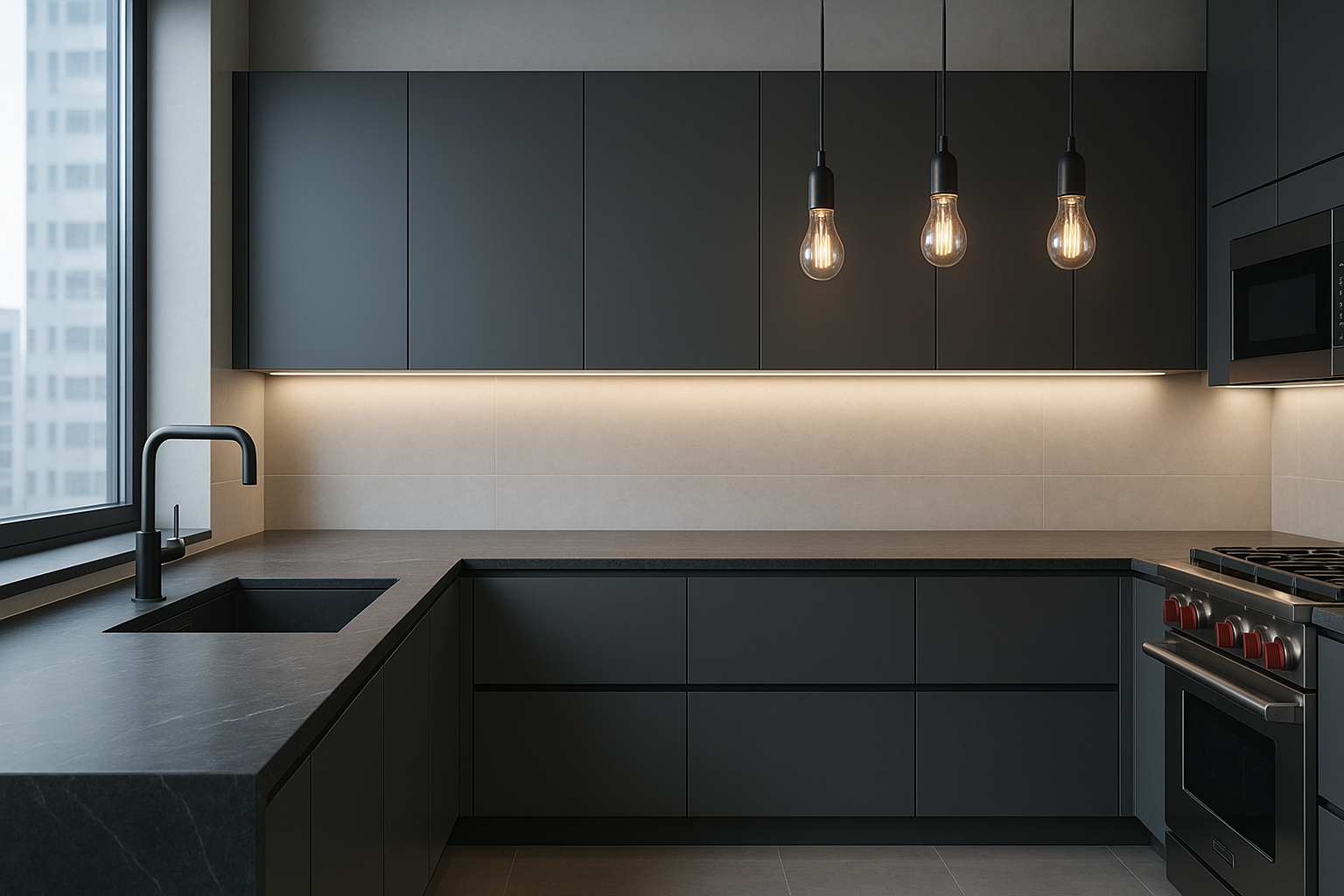 Moody, modern kitchen with matte black cabinetry and soapstone countertops, highlighted by warm under-cabinet lighting and minimalist pendant fixtures. The natural stone adds depth and a smooth, honed texture.
The texture is what people are never prepared for. Polished granite and quartz have a smooth, glassy feel. Soapstone is smooth in a completely different way — velvety, soft, almost warm to the touch despite being stone. You'll want to touch it. Everyone does.
In terms of design pairings, soapstone is exceptionally versatile despite its narrow color range. It works with white shaker cabinets, dark navy or forest green cabinets, warm wood tones, and modern flat-panel designs. The charcoal-to-black range plays beautifully against contrast — it's the stone that makes other elements in the kitchen pop.
The Honest Trade-Offs
Soapstone is low-maintenance but not zero-maintenance, and it's important you understand what "it scratches" actually means before you choose it.
It is softer than granite or quartz. Soapstone ranks low on the Mohs hardness scale — we're talking about a stone that contains talc, the softest mineral that exists. You can scratch it with a knife. You can dent it if you drop something heavy at the right angle. This is simply true.
Here's the other truth: scratches in soapstone are the easiest repair in the countertop world. Minor scratches — the kind from daily kitchen life — sand out with a bit of fine sandpaper and a few minutes of work. Deeper marks can be refinished entirely. No epoxy, no special kit, no contractor needed. The homeowner can do it themselves. That's a meaningful distinction from a chip in quartz or a crack in porcelain, both of which are much more involved repairs.
It will darken. This happens whether you want it to or not. Oiling speeds the process and gives you control over how even the darkening looks. Leaving it natural means it will darken unevenly over time as different areas get more use and contact. Some homeowners love this — it reads like leather, developing a patina that tells the story of the kitchen. Others find it unsettling. Know which camp you're in before you commit.
Slab sizes can be limiting. Soapstone comes in smaller slabs than granite or quartz, which means large, open kitchen layouts may require more seams. In Walnut Creek and Danville homes with big islands, that's a planning conversation worth having upfront with your fabricator.
A Note for Rossmoor Homeowners
Soapstone is an excellent material for Rossmoor kitchens and bathrooms. The compact scale of many Rossmoor units actually works in soapstone's favor — smaller countertop runs mean fewer seams and more design flexibility. The deep, dark tones add richness and sophistication to spaces that might otherwise feel neutral. We've also found that Rossmoor homeowners who are done with the sealing-and-maintenance routine of other natural stones take to soapstone immediately once they understand what "non-porous" really means in daily practice.
Oiling vs. Letting It Age Naturally: Your Two Paths
This is a choice unique to soapstone that you won't face with most other countertop materials. When soapstone arrives, it's typically a lighter gray. From there, you have options.
If you oil it with mineral oil, it darkens immediately and dramatically — right to that deep charcoal or near-black tone. You'll need to re-oil periodically (maybe monthly at first, then less often as the stone stabilizes), and the surface stays even and rich-looking. Most homeowners who want the classic soapstone look choose this path.
If you leave it natural, it darkens gradually and unevenly over time. Areas that get more contact — where hands rest, where food prep happens — will darken faster. The result is a patina that's genuinely beautiful in an organic way, like the worn arm of a favorite leather chair. This is the path for homeowners who want their kitchen to tell a story, not look like a showroom.
Either choice is valid. Neither is wrong. But decide before installation which direction you're going, because once you start oiling, you're committed to that path.
Where Soapstone Works Best in East Bay Homes
Kitchen countertops and islands are the obvious applications, but soapstone's heat resistance and chemical inertness make it a natural fit in several other spots. Baking stations are a classic choice — the cool, smooth surface is genuinely useful for pastry work, and the heat resistance means no worries about a hot pan from the oven. Laundry room countertops, utility sinks, mudrooms, and home bars are all excellent applications where soapstone's durability and easy-clean surface really earn their keep.
Bathroom vanities are another strong use. Soapstone is chemically inert, so toothpaste, face wash, cleaning products — none of it matters. In bathrooms, it tends to look elegant and collected, especially against warm wood tones or unlacquered brass fixtures.
Fireplace surrounds and hearths are historically one of soapstone's primary uses. It's been doing this job for centuries. If you have a fireplace and want a surround material that's genuinely heat-proof, naturally beautiful, and requires no maintenance, soapstone is the obvious choice. See our kitchen and bathroom remodeling pages for more on how we approach material selection for specific spaces.
Soapstone Pricing in the East Bay
Material-only pricing for soapstone typically runs $70–$130 per square foot, depending on quarry, veining intensity, slab size, and origin. Alberene and Brazilian soapstones have different price points — your fabricator can walk you through what's available locally.
Installed, expect $110–$190+ per square foot. Variables that move the number include sink cutouts, edge profiles, any sanding and finishing work, and whether seams are required based on your layout. It's comparable to marble and sits below quartzite at the upper end of natural stone pricing.
Soapstone vs. the Alternatives
| Feature | Soapstone | Marble | Quartz | Granite |
|---|---|---|---|---|
| Needs Sealing | Never | Yes — annually | Never | Yes — every 10–15 yrs |
| Etch Resistance | Excellent | Poor | Excellent | Good |
| Heat Resistance | Excellent | Good | Fair | Excellent |
| Scratch Resistance | Low (easy to repair) | Low (harder to repair) | Good | Very good |
| Color Range | Grays to black | Wide | Very wide | Wide |
| Repairability | Excellent — DIY-friendly | Moderate | Difficult | Moderate |
| Typical Installed Cost | $110–$190+/sq ft | $110–$200+/sq ft | $95–$165+/sq ft | $75–$140+/sq ft |
Candi's Take
Soapstone is the stone for people who don't want to think about their countertops. Not in a dismissive way — in the best possible way. It handles everything you throw at it, it repairs itself with a little sandpaper and five minutes, and it ages in a way that genuinely improves over time. The homeowners who choose it tend to become its most passionate advocates. It's one of those materials where you have to touch it to understand it — photographs just don't capture what it feels like to run your hand across it.
Done Babying Your Countertops?
If you want natural stone that actually works with your life instead of against it, come talk to us about soapstone. We install throughout Walnut Creek, Rossmoor, Pleasant Hill, Danville, and the rest of the East Bay.
Call 925-937-4200 or Get a Free Consultation
Toupin Construction
Ready to start your remodel?
Whether you're dreaming of a new kitchen, a spa-worthy bathroom, or a whole-home transformation — we’d love to hear about your project. Reach out and let's talk.
‹ Back
Comments