


By using our website, you agree to the use of cookies as described in our Cookie Policy
Blog
Your Bathroom Fan Is Working Harder Than You Know

Bathroom Remodeling · Ventilation
Your Bathroom Fan Is Working Harder Than You Know
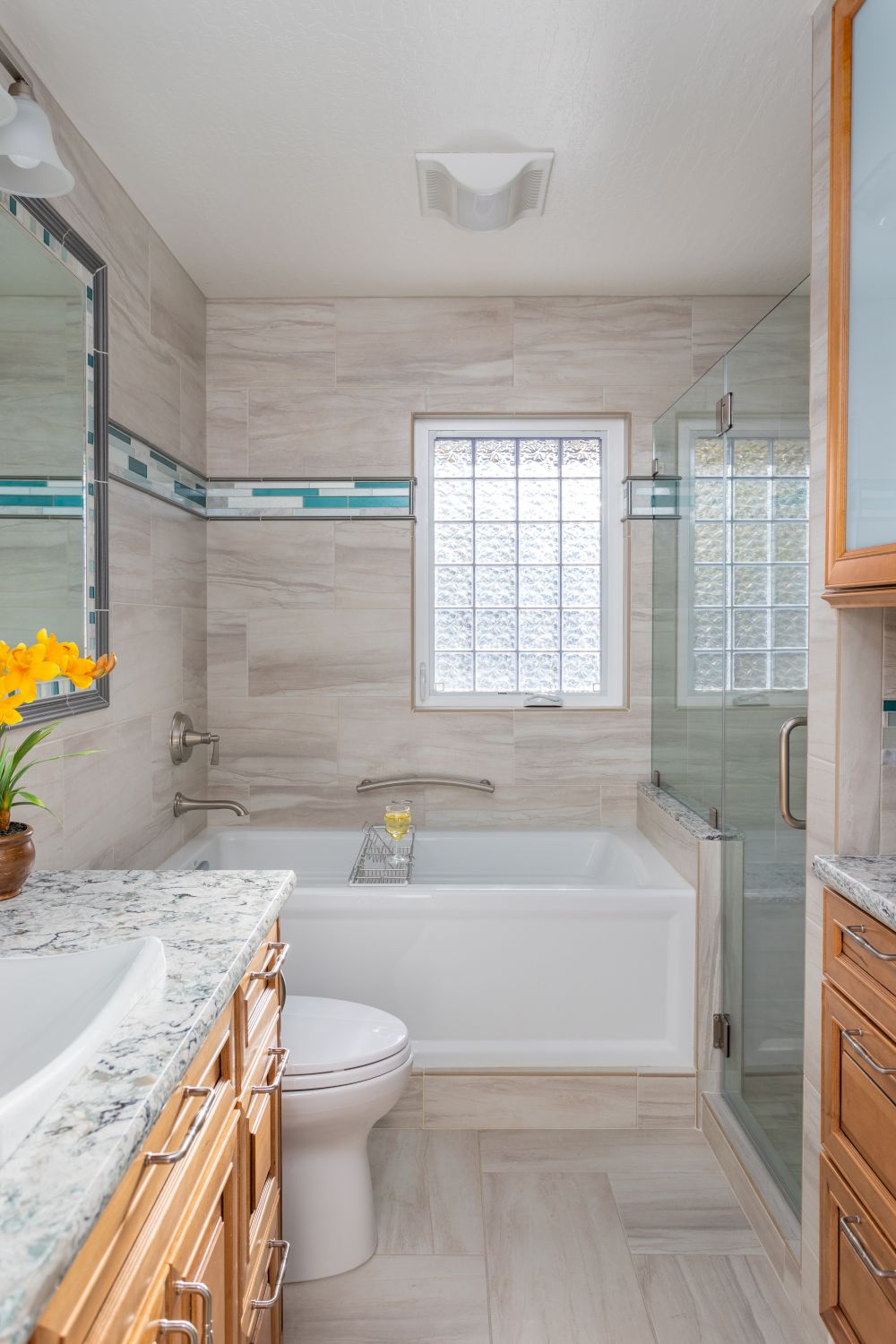
Walnut Creek bathroom featuring a ceiling-mounted exhaust fan for proper ventilation above a tub and shower combo, helping control moisture, prevent mold, and meet bathroom code requirements.
We were wrapping up a full bathroom remodel in Danville a couple of years ago — new tile, new vanity, a gorgeous walk-in shower. The homeowner loved everything. Then she pointed at the ceiling and said, "Can we just keep the old fan? It still works."
My dad Tim took one look at it — a builder-grade unit probably installed in the early 90s, humming like a small aircraft — and said, "Ma'am, that fan is working so hard it's basically screaming for retirement."
We swapped it out. Two weeks later she texted us: "I had no idea how much moisture was just… sitting in my bathroom. The mirror doesn't fog anymore. The paint looks better. Why didn't I do this years ago?"
That's the exhaust fan story in a nutshell. Unglamorous, underestimated, and quietly one of the most important things in your bathroom.
"A bad exhaust fan doesn't just fail at its job — it lets moisture silently wreck everything else you just paid to install."
Why It Actually Matters
Here's what an exhaust fan is doing — or failing to do — in your bathroom every single day.
Reason 01
Moisture Control
Every shower releases a serious amount of water vapor. Without ventilation, that moisture lands on your walls, ceiling, mirrors, and inside your cabinetry — where it quietly causes paint to peel, wood to warp, and mold to take hold. A properly sized fan pulls that air out before it settles.
Reason 02
Mold Prevention
Mold doesn't need much — just a consistently damp surface. Bathrooms without adequate ventilation are one of the most common places we find mold behind walls and under flooring during demo. Remediation is expensive. A fan is cheap insurance.
Reason 03
Air Quality
Cleaning products, air fresheners, and hair products all release VOCs — volatile organic compounds that build up in enclosed spaces. A running exhaust fan replaces stale, chemical-laden air with fresh air. If anyone in your home has asthma or respiratory sensitivities, this matters more than you might think.
Reason 04
Protecting Your Remodel
You just spent real money on tile, paint, vanity, and cabinetry. Chronic moisture is the fastest way to shorten the life of all of it. A good fan is the cheapest line item in a bathroom remodel — and the one that protects everything else.
Trade Term: CFM
CFM stands for Cubic Feet per Minute — it's the measurement of how much air a fan can move. The higher the CFM, the more air the fan moves per minute, and the faster it clears humidity out of the room. The standard rule of thumb: 1 CFM per square foot of bathroom floor space. So an 8×10 bathroom (80 sq. ft.) needs at least an 80 CFM fan. Go higher if you have a large shower, high ceilings, or a windowless space.
Trade Term: Sone Rating
Sones measure sound output — specifically, how loud a fan is during operation. The lower the sone rating, the quieter the fan. A rating of 1.0 sone is library-quiet. 3.0 sones sounds like a typical window air conditioner. Builder-grade fans from the 80s and 90s are often 4.0+ sones — which is why that old fan in the Danville bathroom sounded like a prop plane. For a bathroom you actually want to spend time in, look for 1.5 sones or under.
How to Choose the Right Fan
Fans have gotten genuinely good in the last decade. You no longer have to choose between effective and bearable — there are units now that move serious air, make almost no noise, and look great on the ceiling. Here's how to evaluate your options.
| Feature | What to Look For | Why It Matters | Pro Note |
|---|---|---|---|
| CFM Rating | 1 CFM per sq. ft. minimum | Determines actual moisture-clearing power | Size up if you have a large shower or no window |
| Sone Rating | 1.5 sones or under | Quieter fan = fan you'll actually run | 0.3–0.5 sones exist — whisper-silent |
| Energy Star Rating | Look for the Energy Star label | Lower operating cost, greener | Matters especially in whole-home remodels |
| Integrated Lighting | LED preferred | Eliminates need for a second ceiling fixture | Great in small bathrooms with limited ceiling space |
| Humidity Sensor | Optional but useful | Fan turns on automatically during a shower | Removes the "did I leave the fan on?" problem entirely |
| Smart / Bluetooth Features | Nice-to-have | Speakers, RGB lighting, app control | Worth it if you spend real time in the bathroom |
| Duct Diameter | Match to your existing ductwork | Bigger duct = less restriction = better airflow | Your installer will confirm; don't assume it matches |
Candi's Pick
When I remodeled my own bathroom, I went with the Orein OL005 — and I'm obsessed. It connects to my phone via Bluetooth, has RGB mood lighting (pink for bubble baths, obviously), and runs at a sone rating so low I sometimes forget it's on. It's proof that "exhaust fan" and "spa experience" are not mutually exclusive.
That said — the right fan for your bathroom depends on your square footage, existing ductwork, and ceiling situation. Smart features are great, but only after you've confirmed the basics are handled correctly.
Installation: The Part That Actually Matters
Here's where a lot of DIY fan swaps go wrong: the unit gets upgraded, but the duct situation stays exactly as problematic as it was before.
The Cardinal Rule: Vent to the Exterior
An exhaust fan must vent to the outside of your home — through the roof or an exterior wall. Venting into an attic (which happens more often than you'd think, especially in older East Bay homes) doesn't remove moisture from your house. It just relocates it somewhere you can't see, where it will cause mold and structural damage over time.
Trade Term: Backdraft Damper
A backdraft damper is a one-way flap installed in the duct that allows air to flow out — but prevents cold outside air (or critters) from coming back in when the fan isn't running. Most quality fans include one built-in, but if yours doesn't, your installer should add one at the exterior termination point. Without it, you'll feel cold drafts in winter, and on windy days the fan flap can rattle loudly.
Fan Installation Checklist — What Your Contractor Should Verify
- CFM is sized correctly for your bathroom's square footage — not just whatever fits the existing hole in the ceiling
- Duct terminates to the exterior — roof cap or exterior wall vent, never the attic or crawlspace
- Duct diameter is correct for the fan — a 4" fan on a 3" duct starves the airflow and creates back-pressure that wears out the motor faster
- Duct is rigid or semi-rigid metal — flexible plastic accordion duct is cheaper but collapses over time and traps moisture
- Backdraft damper is present at the exterior termination point
- Electrical is up to code — bathroom fans require a GFCI-protected circuit; never share a circuit with a light without verifying it's properly wired
- Fan is centered over the shower or tub where humidity is highest — not just wherever the old one was
Rossmoor Homeowners
Exhaust fan replacement in Rossmoor condominiums often requires Mutual board approval before work begins — especially if new ductwork penetrates a shared wall or the roof structure. Some Mutuals also have specific requirements about how exterior vents are terminated. We've navigated these approvals many times across Rossmoor's communities. Call us before you buy a unit: (925) 937-4200.
Maintenance: Keep It Working
A fan that's caked in dust moves less air than its rating says — sometimes significantly less. This is the easiest maintenance task in your entire bathroom, and it takes about five minutes.
Simple Fan Maintenance Routine
- Every 3 months: Remove the grille cover and wash it with warm soapy water. Lint and dust accumulate fast in bathrooms.
- Every 6 months: Vacuum dust from the motor housing while the grille is off. A clogged motor runs hot and fails early.
- Once a year: Check the exterior duct termination for blockages — bird nests are surprisingly common in roof caps.
- Any time: If your fan starts sounding louder than usual, that's a motor bearing on its way out. Don't wait — a struggling fan uses more electricity and moves less air.
- After remodel: If you've had drywall work or painting done recently, check that the grille isn't painted shut or partially blocked.
Common Questions
How do I know if my current fan is big enough?
Multiply your bathroom's length × width to get square footage, then match that number in CFM. If your bathroom is 80 sq. ft., you need at least 80 CFM. If you have a large enclosed shower, high ceilings, or no window, add 20–30 CFM on top of that baseline.
My bathroom has a window — do I still need a fan?
Yes. Windows help, but California building code requires mechanical ventilation in bathrooms regardless of whether a window is present. And honestly — you're not going to open a window in January just because you took a shower. A fan handles it automatically.
Can I install a bathroom fan myself?
A straight swap of an existing fan — same location, same duct size, existing wiring — is manageable for a confident DIYer. But if new ductwork is needed, the electrical situation is unclear, or you're in a Rossmoor condo, call a professional. Bathroom electrical requires GFCI protection, and duct runs done wrong will cause moisture problems you won't discover until they're expensive.
How long should I run the fan after a shower?
At least 15–20 minutes after you're done. The shower itself is only part of the moisture load — steam keeps rising off wet surfaces after the water stops. A timer switch or humidity-sensing fan solves this automatically so you don't have to think about it.
What does a bathroom exhaust fan installation cost?
A basic swap of an existing unit runs roughly $150–$350 for labor, plus the cost of the fan itself ($50–$400 depending on features). If new ductwork or electrical work is required, budget more. We can give you an accurate estimate during a bathroom consultation — no guessing.
Keep Reading
Remodeling your bathroom? Let's get the details right.
From fan sizing to tile selection to permit navigation in Rossmoor — we've been doing this for over 40 years across Walnut Creek, Alamo, Danville, and Lafayette. The details are where good remodels become great ones.
Schedule a Consultation See Our Bathroom Work
Toupin Construction
Ready to start your remodel?
Whether you're dreaming of a new kitchen, a spa-worthy bathroom, or a whole-home transformation — we’d love to hear about your project. Reach out and let's talk.
‹ Back
Comments