


By using our website, you agree to the use of cookies as described in our Cookie Policy
Blog
Common Rossmoor Laundry Reconfiguration Strategies: What Actually Works

By Candi Toupin · Community & Rossmoor Focused · Remodeling Tips
We've been working in Rossmoor units for more than 40 years. We've been inside hundreds of them. And while every floor plan is different — Mutual 1 versus Mutual 7, Patio Home versus two-story, the four-plex models versus the singles — the laundry problem is almost always the same.
The machine is shoved somewhere it was never meant to go. The door barely opens. Nothing is stored where it's actually used. And every single time you do laundry, you're reminded that someone improvised this in 1994 and nobody has thought about it since.
This post is about the strategies that actually work — not in theory, but in real Rossmoor units with real constraints. We'll cover the four most common reconfiguration approaches, the electrical and plumbing realities you can't ignore, and the HOA approval process so nothing catches you off guard mid-project.
Rossmoor Context
Rossmoor is a 55+ active adult co-op community in Walnut Creek with approximately 6,700 units built from 1964 through the mid-1980s. Units are governed by individual Mutual boards, and any remodeling work — including laundry modifications — requires both Mutual approval and a City of Walnut Creek permit. Toupin Construction has been working within this approval process for decades and handles the coordination on every project.
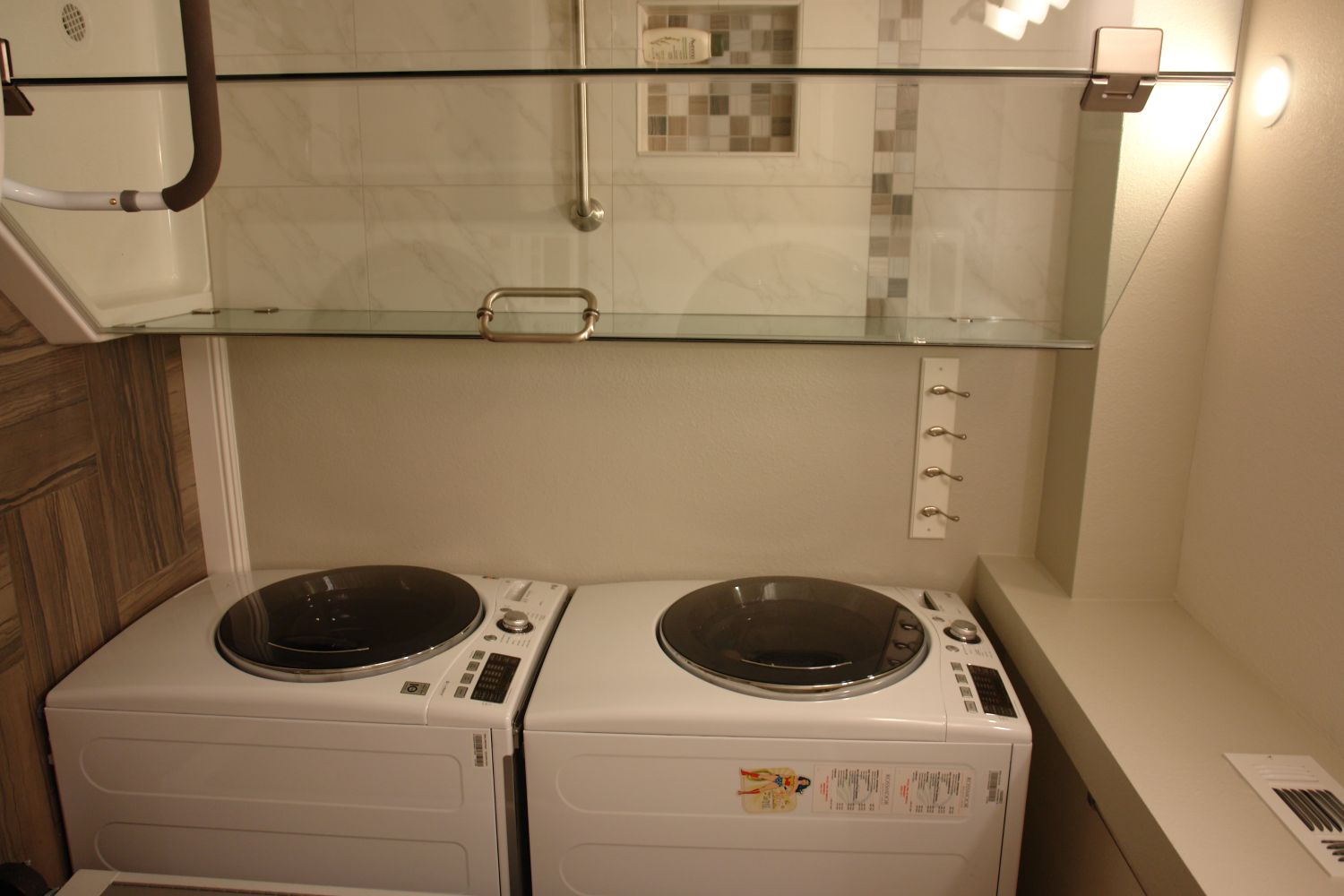 In-unit laundry stacked next to the shower in a Terra Granada unit — proof that bathrooms are one of the best laundry locations in Rossmoor when the plumbing is already there.
 Strategy 1: Closet Expansion — Small Adjustments, Real Results
01
Borrow Inches From Adjacent Space
Sometimes the fix isn't a full remodel — it's a few intentional inches borrowed from what's next door.
In many Rossmoor entry closets, the machines technically fit but the access is terrible. There's not enough clearance to fully open the dryer door. The depth isn't quite there for the machines to sit flush. The utility box sticks out too far. These are problems that a modest expansion can resolve without changing the home's footprint in any meaningful way.
We typically borrow from adjacent bedroom closets, hallway dead space behind a knee wall, or unused corners on the other side of a shared wall. In many cases, we're talking about 4 to 8 inches — barely noticeable anywhere else, but transformative for the laundry space.
Even a few inches of gained clearance can allow proper door swing, correct appliance service access, and room for a folding shelf above the machines. That's the difference between a space that works and one you avoid.
Strategy 2: Door Reconfiguration — The Simplest Fix with the Biggest Daily Payoff
02
Replace the Bifolds. Seriously.
If there's one single change that transforms how a Rossmoor laundry feels, it's replacing the door.
Most original Rossmoor laundry closets still have bifold doors — the accordion-style doors that split in the middle and fold back when you open them. They were standard in the 1970s and 1980s and they are, with genuine affection in my heart for their era, terrible for laundry.
They fall off the track. They block half the opening when folded. They don't give you full visual access to the space. And aging in place — which is a very real consideration for a lot of Rossmoor residents — requires clear, unobstructed access that bifolds simply don't provide.
Door Options for Laundry Closets — A Quick Guide
Bifold doors: The original option in most Rossmoor units. They fold accordion-style. They block half the opening when open and frequently come off the track over time. Pocket doors: Slide entirely into the wall, leaving the opening completely clear. Requires wall depth to accommodate the pocket — not always possible. Full swing doors: Open 180° when there's clearance. Best when the hallway gives enough swing room. Cabinet-panel doors: Give laundry the look of built-in cabinetry. Ideal for kitchen integrations or living spaces where you want the laundry to disappear entirely.
Strategy 3: Vertical Storage — Designing Up, Not Out
03
Build Up. The Space Above the Machines Is Yours.
Once units are stacked, the wall above them is free real estate. Use it.
This is the most consistently underused opportunity in Rossmoor laundry spaces. Once you stack the washer and dryer, you often have 24 to 30 inches of vertical space between the top of the dryer and the ceiling. That's room for upper cabinets, floating shelves, a pull-out hamper, a hanging rod — any combination of storage that turns laundry from cluttered to calm.
We see a version of this thinking in every culture that has solved small-space laundry effectively. The Japanese build ceiling-mounted drying racks into their bathroom laundry zones. The French use pull-out racks and wall-mounted systems in kitchen-integrated laundry corners. It's the same principle: when floor space is limited, go vertical. We dig into these global approaches in our laundry around the world post.
Strategy 4: Relocating the Laundry Entirely
04
Sometimes a Fresh Start Is the Right Answer
If the current location is fundamentally wrong, fix the location — not just the symptom.
Most Rossmoor laundry reconfigurations happen in place — we improve what's already there. But in some units, the original laundry location was never going to work well no matter how much you optimize it. A closet that's too shallow to ever accommodate modern machines. A location on the wrong side of the unit from the bathroom plumbing. A placement that creates noise problems in an adjacent bedroom wall.
In these cases, relocation is the honest answer. The most common alternative locations we evaluate: hallway closets that sit closer to bathroom plumbing, kitchen pantry zones during a full kitchen remodel, and second-bathroom closets or corners that already have the water lines we need.
Relocation requires careful planning around plumbing routing, electrical panel capacity, and Mutual board approval — but it's absolutely doable. For a full breakdown of what each Rossmoor location involves, see our deeper guide on closet and laundry reconfigurations in Rossmoor.
The Electrical and Plumbing Reality
This is where condo remodels differ significantly from single-family homes, and where we see a lot of well-intentioned DIY plans run into problems.
Modern washers and dryers — especially heat pump models — often require dedicated 240-volt circuits. Many older Rossmoor units were designed at a time when in-unit laundry wasn't anticipated, so the electrical panel may not have the capacity for new laundry circuits without an upgrade. We evaluate panel capacity on every project before committing to a location.
Plumbing considerations include the drain slope (water needs to flow downhill at the right pitch to drain properly — a minimum of 1/4 inch drop per foot of horizontal run), water supply valve access, and whether the drain line needs to be extended to reach the laundry location. In most Rossmoor units, these are very manageable if we're working near existing bathroom or kitchen plumbing. The further we get from existing lines, the more complex the routing becomes.
Dedicated Circuit — Why Laundry Needs Its Own
A dedicated circuit is an electrical circuit that serves only one appliance. Most building codes require dedicated circuits for washers, dryers, refrigerators, and dishwashers — because these appliances draw consistent, significant power. Sharing a circuit with other outlets or lights creates tripped breakers, potential fire hazards, and appliance damage over time. When we add laundry to a Rossmoor unit, we always verify the panel has capacity for the required dedicated circuits before starting.
HOA Approval: What to Expect
Rossmoor's Mutual approval process exists to protect shared building systems — plumbing, electrical, structural — and to ensure changes in one unit don't create problems for neighbors. We respect it and work within it every day.
For a laundry reconfiguration, expect to submit plans showing the proposed machine location, plumbing changes, and electrical modifications. The Mutual board will review and typically approve or request modifications within a few weeks. The City of Walnut Creek permit follows.
We handle the documentation and coordination on every project. Our plans are drawn to the specifications Rossmoor's Mutuals expect, which means fewer revision cycles and faster approvals.
"Rossmoor's approval process isn't the obstacle — working with someone who doesn't know the process is. We've done this hundreds of times. It goes smoothly."
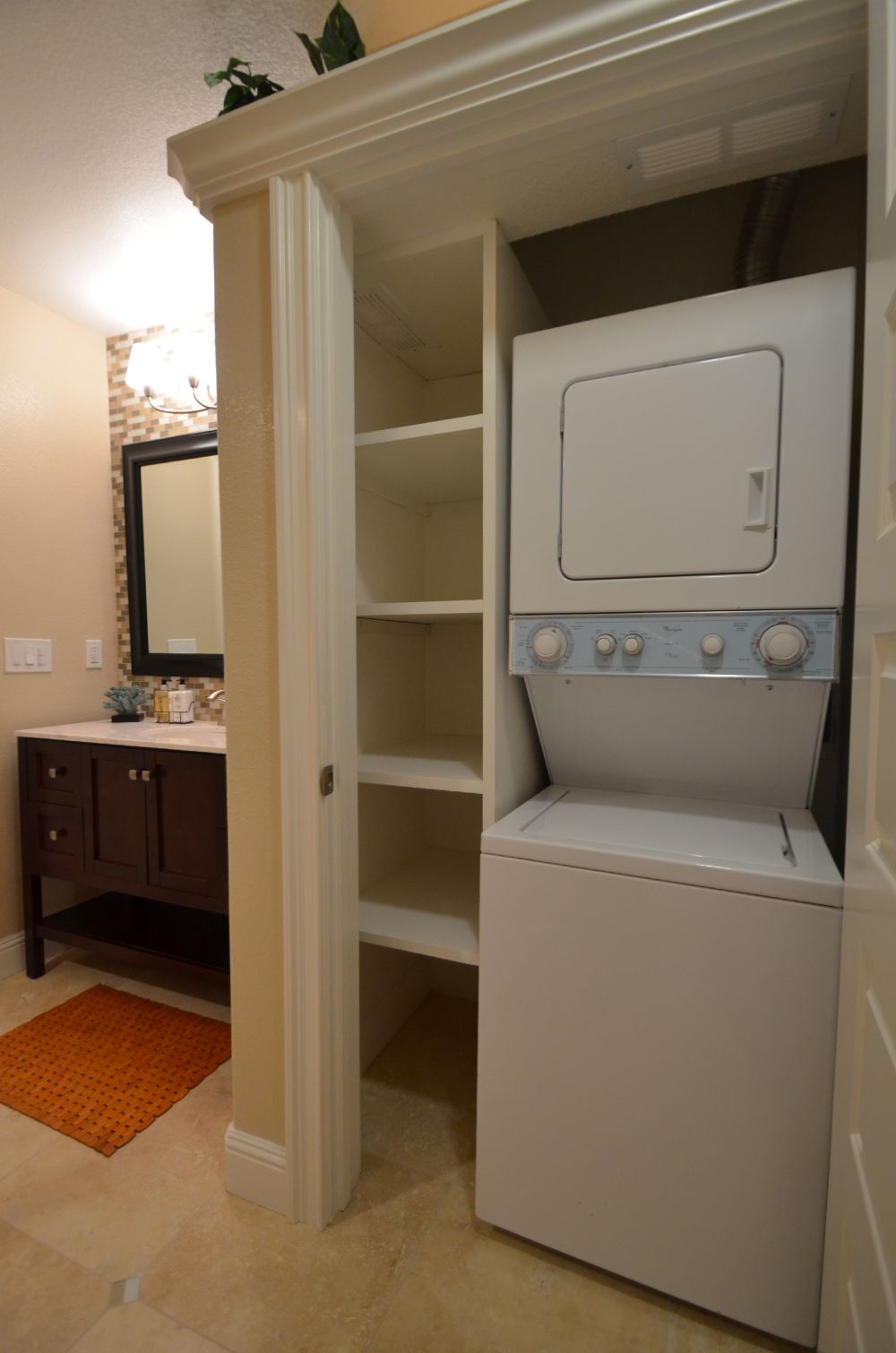 A stacked laundry unit paired with open shelving in a Pine Knoll Rossmoor unit — the pocket door slides away completely so the space stays open and easy to access.
 Aging in Place: Design Laundry for the Future
Many of our Rossmoor clients are thinking about how their home will work for them not just today but 10 or 15 years from now. That's smart, and laundry is worth designing with that lens.
Front-load machines on raised platforms eliminate bending. Wider closet openings and pocket or full-swing doors eliminate the obstacle course. Good lighting — motion-activated LED in a laundry closet is genuinely helpful — eliminates squinting. Hampers at hip level eliminate awkward lifting. None of these changes are expensive. All of them compound into real long-term comfort.
We cover the full scope of aging-in-place design thinking in our post on ADA accessibility remodeling.
We Know These Units. Let's Talk About Yours.
We've worked in hundreds of Rossmoor homes across every Mutual. If your laundry doesn't work, we can fix it — and we know how to get Mutual approval done right.
Schedule a Free Consultation
Toupin Construction
Ready to start your remodel?
Whether you're dreaming of a new kitchen, a spa-worthy bathroom, or a whole-home transformation — we’d love to hear about your project. Reach out and let's talk.
‹ Back
Comments