


By using our website, you agree to the use of cookies as described in our Cookie Policy
Blog
Small Laundry, Big Impact: How to Build a Laundry Nook in Any Home — From Entry Closets to Hallway Alcoves

We opened a hall closet in a Rossmoor unit on Golden Rain Road last year and found three things inside: a water heater, a box of holiday decorations, and a very sad extension cord with nowhere to go. The homeowner's washer and dryer were still down in the shared building laundry room. She'd been walking down there for 14 years.
Three weeks after that visit, she had stacked laundry in that closet. No major plumbing move. No electrical panel upgrade. Just the right machines, a reconfigured door, a tankless water heater swap, and a shelf above. That's it.
Most people assume they need a dedicated laundry room to have laundry that actually works. They don't. You just need the right approach to whatever space you have.
Why Laundry Nooks Outperform Big Laundry Rooms (Seriously)
A well-designed laundry nook is often better than a large laundry room — not in spite of being small, but because of it. When the machines are close to where you sleep, get dressed, and shower, you actually use them. Laundry becomes part of your daily flow instead of a dedicated expedition to another part of the house.
The reason most laundry frustration exists isn't the size of the space. It's the design. A cramped, poorly lit corner with no storage and a door that won't open all the way teaches your brain to avoid the task. A clean, functional nook — even a tiny one — removes that resistance entirely.
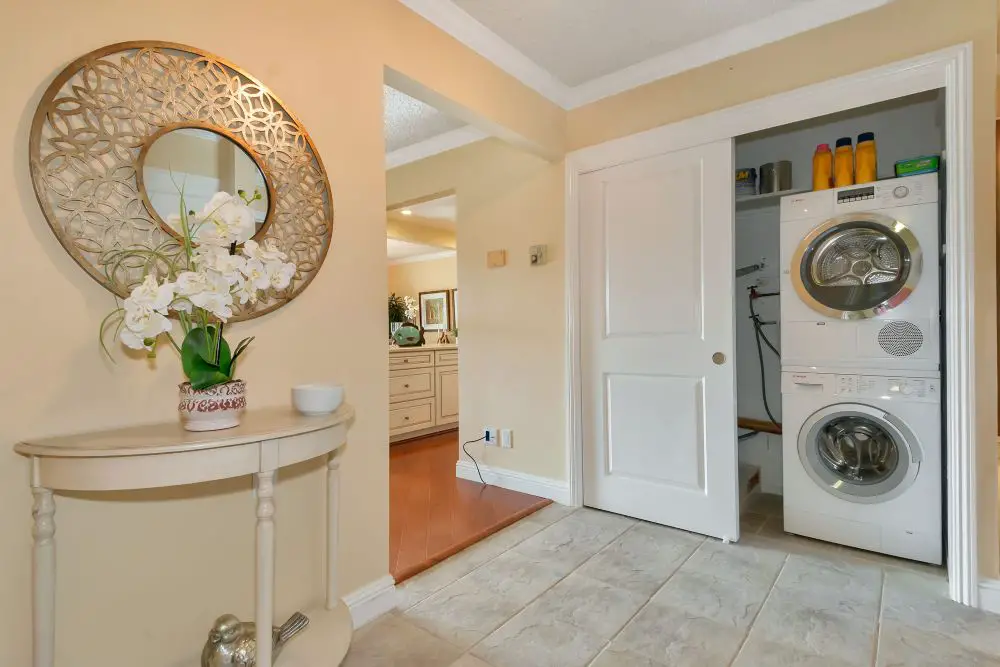 A stacked washer and dryer tucked behind closet doors in a Walnut Creek home, designed to keep laundry out of sight and maintain a clean, open living space. While compact, this type of setup highlights the importance of smart layout and accessibility in everyday laundry use.
We've built laundry into 2-foot-deep closets. We've put stacked machines in bathroom corners behind louvered doors. We've tucked a compact unit under the kitchen counter between the dishwasher and the base cabinet. Every single one of those homeowners tells us the same thing afterward: I had no idea it could actually feel like this. The size isn't the barrier. The design is.
Where Laundry Nooks Actually Work
1. Entry Closets
This is the most common laundry retrofit in Rossmoor, and for good reason. Entry closets often sit right where the original shared laundry plumbing runs through the building. That proximity makes new hookups far more practical than routing pipes across an entire unit.
The typical challenge is depth — entry closets in 1960s Rossmoor models are usually 18 to 22 inches deep, and standard stackable units need at least 27 to 30 inches plus rear clearance. That's where tankless water heater swaps become critical. A traditional 40-gallon tank heater sitting in the back of the closet eats all the usable depth. A tankless unit mounted on the wall gives you that space back.
Tankless Water Heater — What It Is and Why It Matters Here
A tankless water heater heats water on demand instead of storing a tank of preheated water. It's mounted on the wall and takes up a fraction of the space of a traditional tank heater. In Rossmoor entry closets, swapping to tankless is often what makes laundry physically possible in the space — it can free up 12 to 18 inches of depth instantly.
2. Hallway Alcoves and Linen Closets
Odd recessed spaces in hallways are some of the most underutilized real estate in older Bay Area homes. We've converted linen closets, hallway bumps, and narrow storage niches into laundry nooks that feel completely intentional — especially when the door treatment is right. A bifold that's off the track tells your brain "afterthought." A pocket door or a clean cabinet-panel door tells your brain "on purpose."
3. Bathroom Closets and Bathroom Corners
Bathrooms already have the two things laundry needs most: water supply lines and drain access. A compact stacked unit tucked into a linen closet adjacent to the vanity — or behind louvered doors in the corner of a second bathroom — can disappear entirely when not in use. These setups work especially well in Rossmoor units where the bathroom is centrally located and the plumbing is accessible.
One thing to plan for: moisture. When laundry and bathing share a space, ventilation becomes critical. See our post on exhaust fan requirements in bathrooms for specifics on what airflow is needed when machines are in the mix.
4. Kitchen Cabinets and Pantry Zones
This is extremely common in older European homes and increasingly popular in Rossmoor kitchens during full remodels. A compact washer fits neatly under the counter. A ventless dryer slides into a tall cabinet. Cabinet-panel doors make the whole thing invisible. The kitchen already has the electrical access and plumbing proximity to make hookups relatively straightforward — especially when a full kitchen remodel is underway anyway.
Choosing Machines for a Small Space
| Machine Type | Best For | Key Consideration |
|---|---|---|
| Compact 24" stackable set | Entry closets, bathroom corners, kitchen cabinets | Fits the widest range of Rossmoor spaces; less capacity per load |
| Full-size 27" stackable set | Hallway closets, larger bathroom closets | Requires more depth; wider door opening needed |
| Ventless / heat pump dryer | Any interior location — no exterior wall needed | Higher upfront cost; saves energy long-term; no lint duct fire risk |
| All-in-one combo unit | Ultra-compact spaces; 1–2 person households | One machine does both; longer cycle times; smaller capacity |
For a deep dive on heat pump dryer technology and why more Rossmoor homeowners are switching away from traditional vented dryers, see our post on the future of laundry appliances.
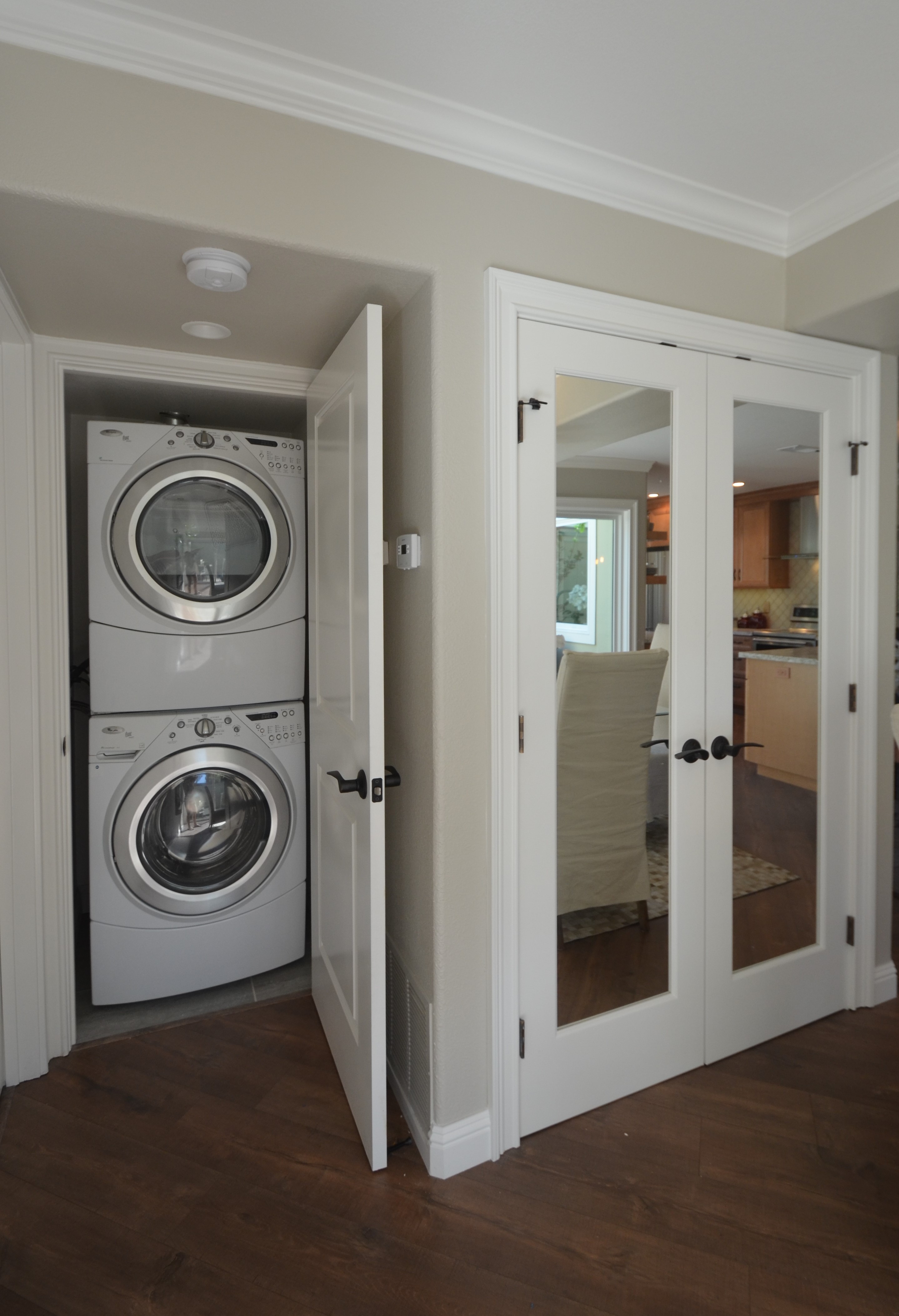 A stacked washer and dryer tucked into a narrow closet just off the main living space in a Walnut Creek home. This hidden laundry setup keeps appliances out of sight, but the tight layout highlights how important thoughtful design and accessibility are for everyday use.
Layout Tweaks That Make the Biggest Difference
Before spending anything on new machines or storage, assess the fundamentals. These targeted fixes often transform a frustrating space without touching the machines themselves.
Reframe or widen the door opening. The most common complaint we hear is "the door doesn't open all the way." Usually the door frame is the problem, not the machines. A few inches of reframing changes the whole experience.
Rotate the machines. If the dryer door swings into a wall, try rotating the entire unit 90 degrees. It sounds too simple, but it's one of the most common fixes we make — and it costs almost nothing.
Recess the utility box. If the washer sticks out 3 or 4 inches too far, the utility box probably isn't recessed properly into the wall. Moving it back lets the machine sit flush, which can be the difference between the closet door closing and not closing.
Replace the bifold doors. Old bifold doors are the bane of small laundry spaces. They track poorly, they block access, and they look like an apology. Pocket doors, full-swing doors, or cabinet-panel doors are all better options depending on the space.
Storage That Makes a Small Space Work
The most underused resource in a laundry nook is the wall space above the machines. Upper cabinets for detergents, a pull-out hamper to keep the floor clear, a short hanging rod for delicates, floating shelves for baskets — all of these can live in 18 inches of width and still transform how the space functions.
Vertical is everything in a Rossmoor laundry nook. Build up, not out.
"A 2-foot-deep closet with a stacked compact unit, a tankless swap, and three shelves above will outperform a big, messy laundry room every time — if it's designed with intention."
Moisture and Ventilation — Don't Skip This Part
Small laundry spaces generate heat and humidity. In older East Bay homes, we often find long dryer vent runs with flex duct that's been kinked, torn, or loaded with lint for years. That's a fire hazard and a moisture problem.
When traditional venting isn't safe or practical, ventless dryers solve the problem completely. When venting is viable, we shorten the run, replace flex duct with rigid metal duct, and add a proper exterior vent hood — not the plastic flap that came with the house 40 years ago. Bathroom-adjacent laundry always needs a properly sized exhaust fan too.
Let's Find Your Laundry Nook
We've built laundry into entry closets, bathrooms, hallways, and kitchens all over Rossmoor and the East Bay. We'd love to find yours.
Schedule a Free Walk-Through
Toupin Construction
Ready to start your remodel?
Whether you're dreaming of a new kitchen, a spa-worthy bathroom, or a whole-home transformation — we’d love to hear about your project. Reach out and let's talk.
‹ Back
Comments