


By using our website, you agree to the use of cookies as described in our Cookie Policy
Blog
Why Laundry Sucks — And How Better Design Fixes It

By Candi Toupin · Whole Home · Rossmoor · Remodeling Tips
A few weeks ago I was standing in a client's laundry closet in Rossmoor, and I couldn't open the dryer door all the way without hitting the wall. The water heater was right there, blocking the whole right side. The bifold doors had come off the track — again. And this woman, who is completely lovely and organized in every other room of her home, had three laundry baskets on the floor because there was nowhere else to put them.
Laundry didn't fail her. The design failed her. And we see this every single week.
If your laundry setup makes you want to procrastinate indefinitely, that's not a character flaw. It's usually a design problem — and most of them are very fixable.
The Rossmoor Reality: Laundry Was Never Part of the Plan
When Rossmoor was built in the 1960s and 1970s, individual units weren't designed for private washers and dryers. Laundry lived in shared breezeway rooms near each building's entrance. That was the system.
Over the following decades, residents understandably wanted in-unit laundry. So the machines went in — squeezed into entry closets, tucked behind kitchen bifold doors, shoehorned next to bathroom vanities, wedged beside water heaters. It worked. But rarely gracefully.
Rossmoor Context
Rossmoor is a 55+ active adult community in Walnut Creek with roughly 6,700 units, most built between 1964 and the mid-1980s. Because shared laundry was standard when these homes were constructed, private laundry was added unit by unit over the years — which is why no two setups look quite the same. Every remodel requires a fresh assessment of what that specific closet, bathroom, or kitchen can actually support.
Today, most Rossmoor laundry problems trace back to that original improvisation. The home wasn't engineered for private laundry, and nobody went back later to design it properly. Understanding that context matters — because it means most of the frustration is fixable.
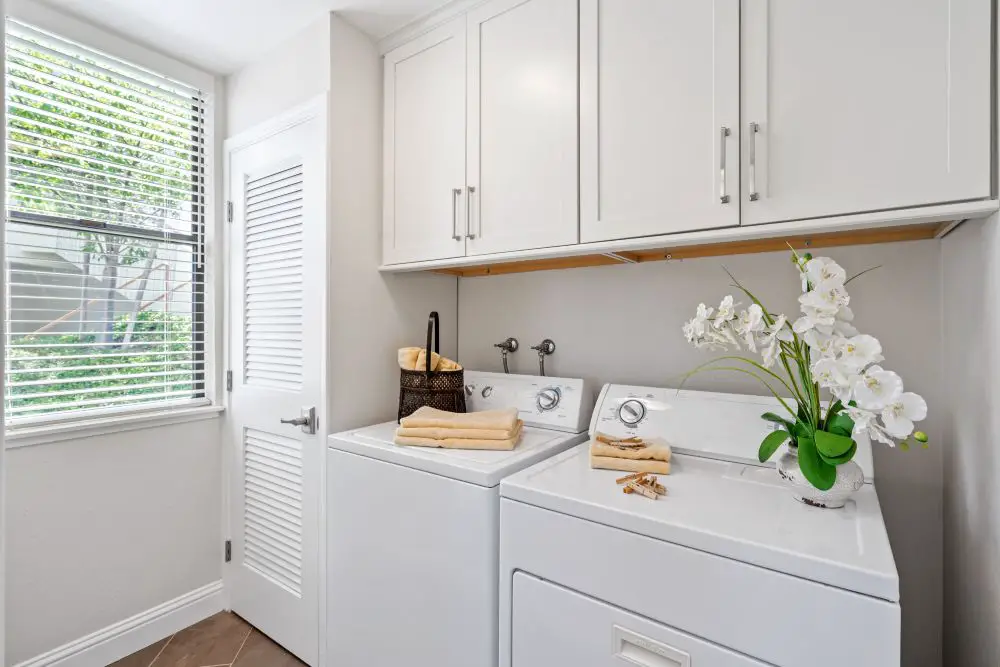 A bright, functional laundry room in Pleasant Hill featuring side-by-side washer and dryer with overhead storage cabinets. Natural light, clean finishes, and smart storage make everyday laundry feel more manageable.
 Why the Space Itself Is the Problem
Here's the short list of what we encounter on almost every laundry call in the East Bay.
Machines That Don't Fit the Room
Full-size dryers crammed into shallow closets. Machines that block door swings. Washers sticking out into walkways because the utility box — that's the recessed panel in the wall where the water supply and drain hookups live — was never set back far enough. When machines are too big for the space, every load feels like a wrestling match.
What's a Utility Box?
The utility box (or washer box) is the recessed panel built into the wall behind your washing machine. It holds the hot and cold water supply valves and the drain connection. When a utility box sits too far forward — or isn't recessed at all — the machine can't push back flush against the wall, which eats precious inches of clearance in a small space.
A Layout That Adds Steps Instead of Removing Them
Dryer door hitting the frame. Clothes falling into the gap between machines. Hampers on the floor because there's no shelf. Having to contort sideways to reach the controls. These aren't minor inconveniences — they add friction to a task you already have to do multiple times a week, and over time that friction adds up.
Storage That Was an Afterthought
Laundry needs a place for detergent, dryer sheets, a stain pen, folded clean clothes waiting to go back to bedrooms, and at least one basket for things that need to air dry. Most East Bay laundry closets offer one wire shelf. That's it. Everything else ends up on the floor or on top of the machines.
Venting That's Outdated or Unsafe
Traditional vented dryers push hot, humid air outside through a duct. In older Rossmoor units, those duct runs are often too long, improperly sized, or clogged with decades of lint. Lint buildup is the leading cause of appliance fires in the U.S. — and in a multi-unit building, that's not just your problem. HOAs are increasingly restricting vent modifications for exactly this reason.
The Fixes — None of Them Require a Full Remodel
Right-Size the Machines First
In Rossmoor and most older Bay Area condos, compact 24-inch washers and ventless dryers are almost always the better fit. Ventless dryers — especially heat pump dryers — don't need a duct run to the exterior at all. They pull moisture out of the clothes using condensation technology and collect it in a reservoir or route it to your drain. That means laundry can live in an interior closet, a bathroom, or a kitchen cabinet without any wall penetration.
We cover heat pump dryer technology in much more depth in our guide to the future of laundry — but the short version is: they use about half the energy of a traditional dryer, they're gentler on fabrics, and they solve the venting problem almost entirely.
Rethink the Layout Before Adding Anything
Before buying new machines or adding shelves, we look at the fundamentals: Is the door opening wide enough? Could stacking the units free up floor space? Would rotating the machines 90 degrees improve access? Is the water heater taking up space that could go toward laundry? A few targeted layout changes often make more difference than a full gut renovation.
For a full breakdown of what those changes look like in Rossmoor-specific floor plans, see our post on closet and laundry reconfigurations in Rossmoor.
Build Up, Not Out
Vertical space is almost always underused in small laundry setups. Upper cabinets for detergents and cleaning supplies. Floating shelves for baskets. A pull-out hamper so laundry stays off the floor. A small hanging rod for delicates. These additions don't require moving walls — they just require treating the space like it deserves to function well.
Deal With the Venting Situation
If you have a traditional vented dryer, have the duct professionally cleaned and inspected — especially in Rossmoor units where those ducts may be original to the building. If venting isn't viable at your location, a ventless heat pump dryer is almost certainly the better long-term solution. We explore that transition in depth in our small laundry, big impact guide.
"Most laundry frustration is a design problem, not a personal failing. When we fix the layout, people stop dreading the chore."
Small Design Touches That Actually Matter
This part gets dismissed, but it shouldn't. A laundry space you like spending 60 seconds in is one you'll actually use without procrastinating. Fresh paint, LED lighting, matching baskets, a small tile backsplash, a butcher-block counter above the machines — none of these are expensive. All of them change how the space feels.
If you want ideas from cultures that have been solving small-space laundry for centuries, our laundry around the world post is surprisingly practical. The French, in particular, have figured out how to make a tiny laundry corner feel intentional rather than apologetic — something we covered in our French laundry post.
I grew up in a house where laundry had its own room — and I took that completely for granted until I started working on Rossmoor units. These are beautiful homes. They're well-kept, thoughtfully furnished, and lived in by people who clearly care about their spaces. But that one closet, the one with the machines, is almost always the dark corner nobody wants to think about. That's the part I love fixing. It's usually not that hard once you know what you're actually dealing with.
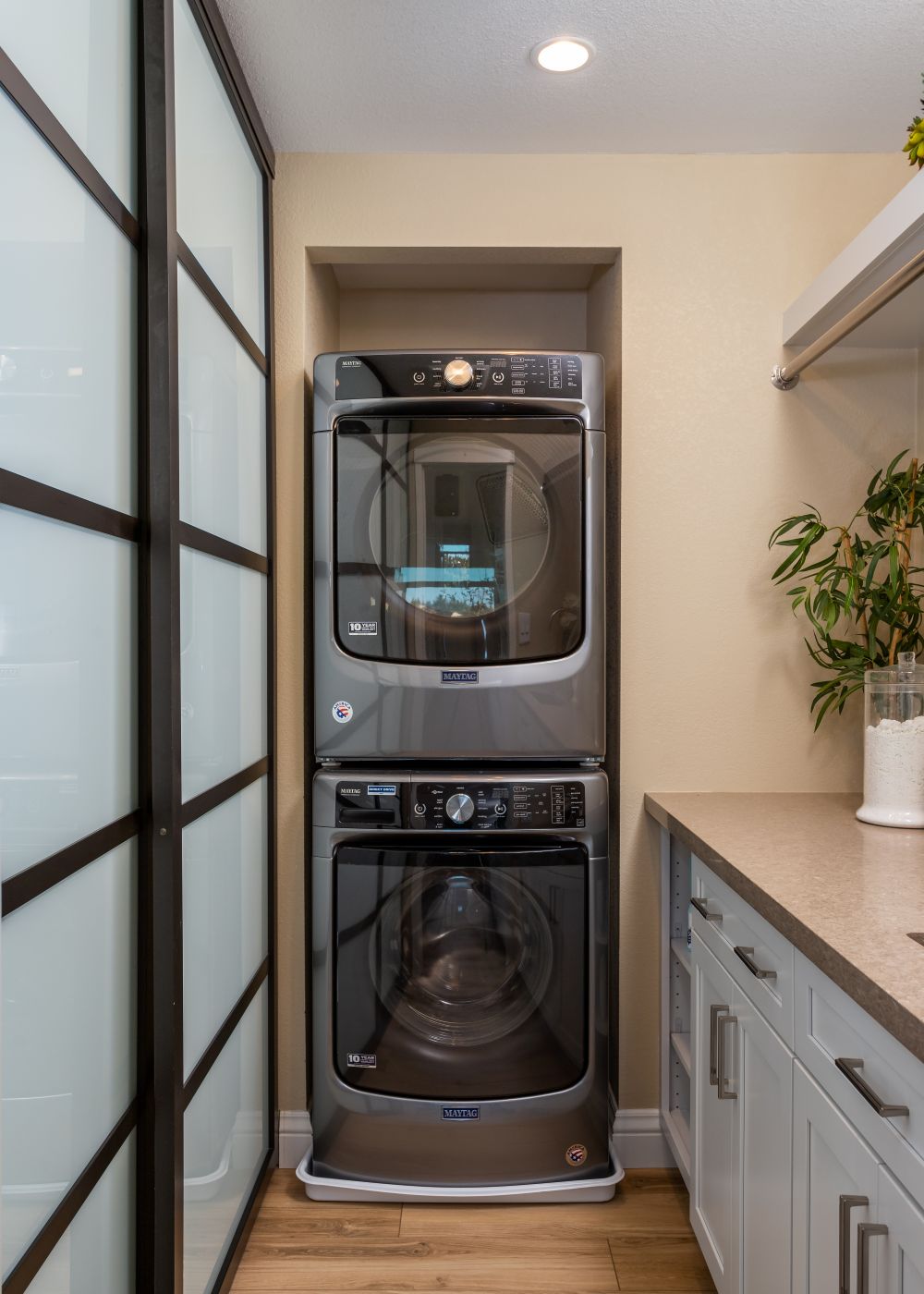 A compact stacked washer and dryer tucked into a recessed laundry closet in Moraga, designed to maximize space without sacrificing function. The vertical layout keeps the footprint small while still allowing for nearby cabinetry and countertop workspace.
Frequently Asked Questions
Do I need a permit to move my washer or dryer?
It depends on what's being moved. Appliance relocation that involves new plumbing, electrical work, or structural changes typically does require permits in Walnut Creek — and in Rossmoor, you'll need HOA approval as well. We handle that coordination on every project. For a breakdown of what Rossmoor specifically looks for, see our common Rossmoor reconfiguration strategies post.
What's a heat pump dryer and is it worth the higher price?
A heat pump dryer is a ventless dryer that uses a refrigerant loop — similar to how an air conditioner works — to pull moisture out of your clothes at low heat. No exterior duct needed. They typically cost more upfront than a standard vented dryer, but they use about 40–50% less electricity per load, they're gentler on fabrics, and they eliminate the fire risk that comes with lint-filled ductwork. In Rossmoor, where venting is often impractical, they're usually the right call.
Ready to Fix Your Laundry Once and For All?
We design and build laundry reconfigurations throughout Rossmoor and the East Bay — closets, bathrooms, kitchens, hallways. No more door gymnastics.
Get a Free Consultation
Toupin Construction
Ready to start your remodel?
Whether you're dreaming of a new kitchen, a spa-worthy bathroom, or a whole-home transformation — we’d love to hear about your project. Reach out and let's talk.
‹ Back
Comments