


By using our website, you agree to the use of cookies as described in our Cookie Policy
Blog
Upgrade Your Bathroom With The Charm of Pedestal Sinks
Bathroom Remodeling · Fixtures & Design
Upgrade Your Bathroom With The Charm of Pedestal Sinks
Why a pedestal sink might be exactly what your small bathroom needs — and exactly what it doesn't need.
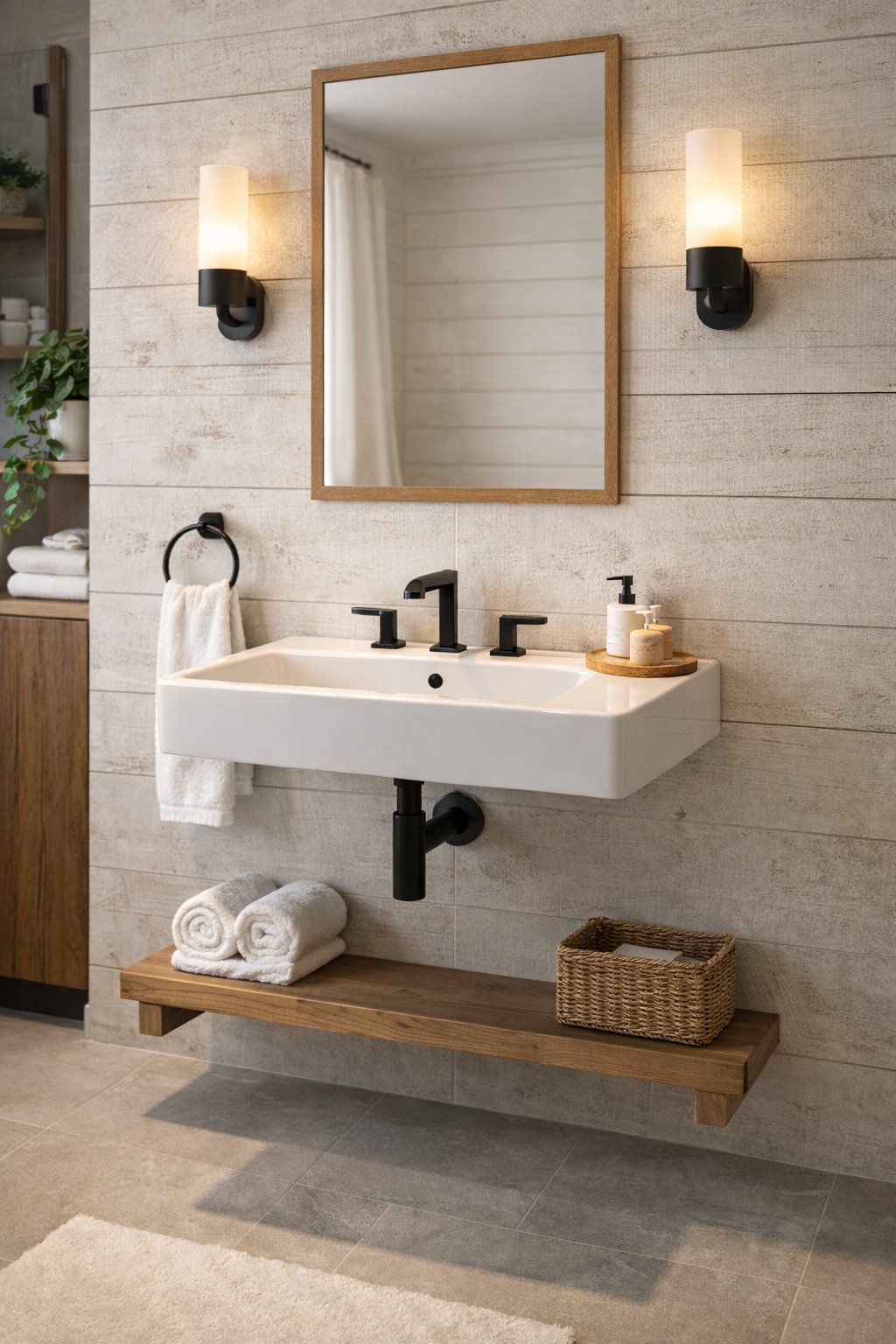
A modern pedestal-style sink with matte black fixtures set against a light textured wall. The design features a warm wood floating shelf below for storage, creating a clean yet inviting farmhouse-inspired bathroom look.
We were doing a powder room in Lafayette — tiny room, maybe 18 square feet including the door swing, original 1970s vanity that was roughly the size of a small aircraft carrier relative to the space. The homeowner was convinced she needed a new vanity. Same footprint, just updated.
My dad Tim looked at the layout for about thirty seconds and said, "What if we just take the vanity out?"
She looked at him like he'd suggested removing the floor. But we talked through it — where she'd store what, what a pedestal sink would do to the sightlines, how we'd handle the exposed plumbing — and she agreed to try it. When we finished, she texted us a photo of the room and said it looked like it had doubled in size. It hadn't. The vanity had just been eating 40% of the visual space the whole time.
Pedestal sinks are not for every bathroom. But when the fit is right, they do something no vanity can: they get out of the way and let the room breathe. Here's how to know if that's the right call for your space.
"The vanity wasn't making the bathroom functional. It was making it feel like a closet with plumbing."
What a Pedestal Sink Actually Does
Before we get into styles and specs, it's worth being clear about the trade. A pedestal sink trades storage for space — visual space, floor space, and the feeling of openness. That trade is genuinely worth it in some bathrooms and genuinely not worth it in others.
Where It Wins
- Opens the floor plan dramatically — small rooms feel larger
- Light travels farther and reaches more corners
- Easier to clean — mop straight under it, no vanity base to trap dust
- Shows off your tile, flooring, and mirror design instead of hiding them
- Better traffic flow — no vanity corners to bump hips on in tight quarters
- Timeless silhouette that doesn't date the way vanity styles do
- Typically less expensive than a full vanity installation
✗ Where It Falls Short
- Zero built-in storage — everything that was under the sink needs a new home
- Plumbing is visible — pipes run exposed down the pedestal column
- No countertop — nowhere to set toiletries while you wash your face
- Plumber must rough in precisely — the column has no wiggle room to hide misaligned pipes
- Not ideal as a primary bathroom sink if storage is a daily necessity
- Some styles don't meet ADA knee clearance requirements without careful selection
The Honest Fit Test
A pedestal sink works best in: powder rooms, half baths, guest baths, and small bathrooms where storage is handled elsewhere (medicine cabinet, linen closet, floating shelves).
Think twice if: it's the only bathroom in the house, you keep daily medications and skincare at the sink, or the space is already plumbed for a large vanity and the rough-in would need significant rerouting.
Styles: Classic to Sculptural
Pedestal sinks have evolved a lot beyond the plain white column you're probably picturing. Here's the current landscape of styles, and which rooms they suit best.
Style 01
Classic Column Pedestal
The original. A round or oval basin on a full-length column pedestal that conceals all the plumbing. Clean, proportional, works in virtually any bathroom style from Victorian to transitional.
TimelessPlumbing HiddenAny Style
Style 02
Leg-Style Pedestal
The basin sits on two or four decorative legs instead of a solid column. More exposed floor — and more exposed plumbing — but the open base makes very small rooms feel even more spacious and architectural.
Airy LookModern & TraditionalPipes Visible
Style 03
Sculptural / Contemporary
Geometric bases, asymmetric profiles, matte-finish columns in colors like deep navy, graphite, or warm clay. These make the sink the design focal point rather than a background element. Best in a room that can carry the statement.
Design Focal PointBold ColorsModern Spaces
Style 04
Wall-Mount (Honorable Mention)
Not technically a pedestal, but worth considering in the same conversation. The basin mounts directly to the wall with no column at all — maximum floor exposure, minimum material. Requires blocking in the wall during rough-in.
Maximum OpennessRequires Wall BlockingModern
Trade Term: Rough-In
Rough-in refers to the initial plumbing work done before walls are closed — the supply lines (hot and cold water), the drain, and the P-trap location. With a pedestal sink, the rough-in placement is critical because the column conceals the pipes. If the pipes come out of the wall in the wrong location relative to where the pedestal sits, there's no vanity cabinet to hide the problem. Your installer needs to know the exact model of sink before the rough-in is finalized — not after.
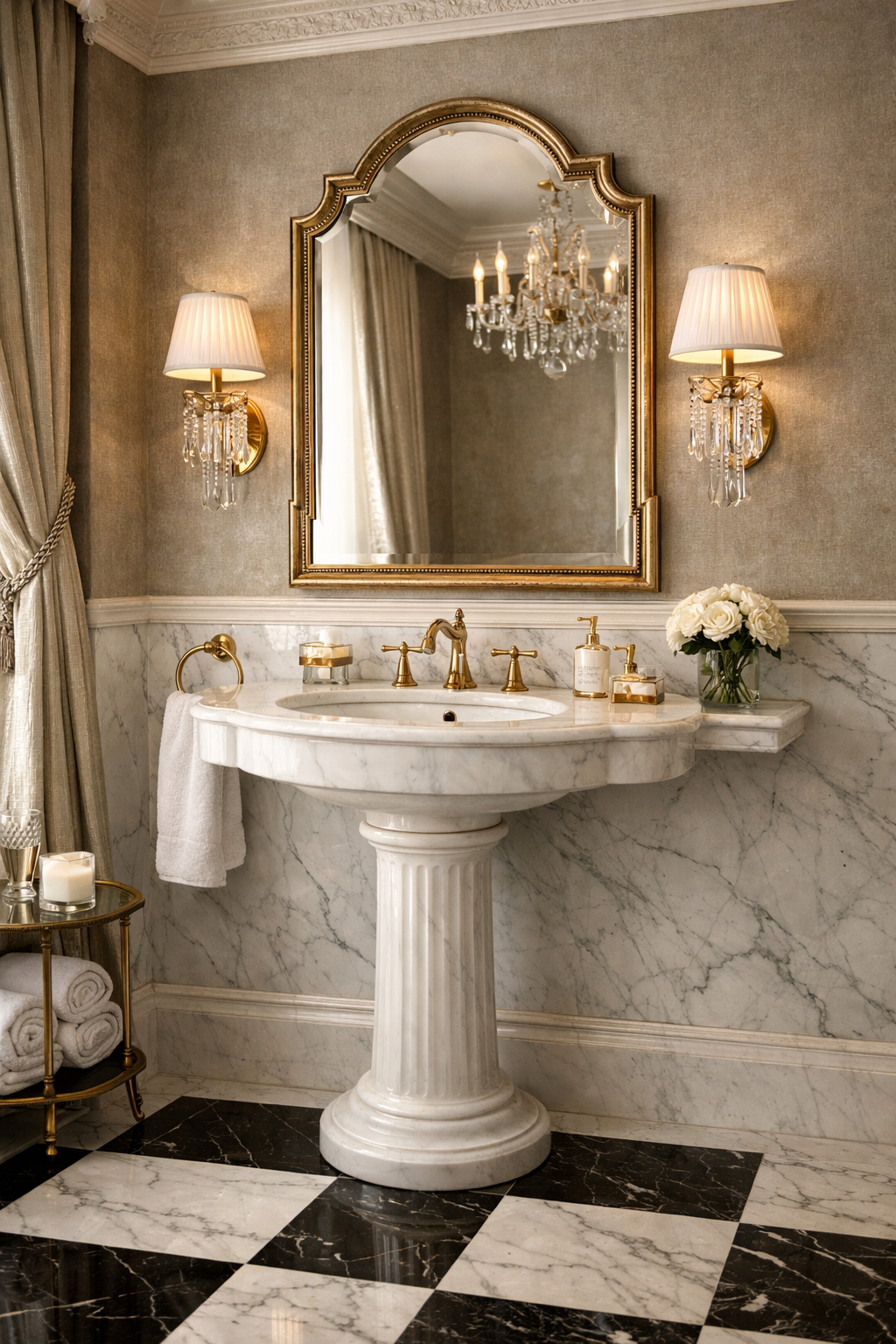
A high-end marble pedestal sink with ornate detailing, paired with gold fixtures and crystal sconces. This elegant bathroom design highlights timeless luxury with rich textures and classic finishes.
Sizing and Clearances: Measure Before You Buy
This is where a lot of pedestal sink projects go sideways. The sink looks great in the showroom. It arrives at the house. And then you realize the door won't open all the way, or the toilet is now uncomfortably close, or the drain is three inches left of where the column wants it.
Measure your space with the existing rough-in location in mind, then check the spec sheet of any sink you're considering against these clearances before you order anything.
Bathroom Clearance Checklist — Pedestal Sink Edition
- 21 inches minimum clear floor space in front of the sink — this is the minimum code requires; 30 inches is comfortable for daily use
- 15 inches from sink centerline to any side wall or obstruction — minimum per code; 18 inches is more livable
- Door swing clears the sink — tape the sink's footprint on the floor and swing the door before ordering anything
- Confirm rough-in location against the sink's spec sheet before rough-in work is done — drain location is the most critical measurement
- Rim height 34–36 inches for adult comfort; confirm against your chosen model's listed height before purchase
- Faucet drilling matches your faucet style — single-hole, 4-inch centerset, and 8-inch widespread are not interchangeable on most pedestal sinks
- Wall blocking is installed if your pedestal attaches to the wall for stability — this should happen during rough-in, not as an afterthought
Faucet Matching: Don't Get Caught With the Wrong Drilling
This is a detail that catches people off guard — pedestal sink basins come pre-drilled for a specific faucet configuration, and you can't change it after the fact. The three configurations are completely different physically, so pick your faucet style before you buy the sink, not after.
| Faucet Type | Holes Required | Best For | Notes |
|---|---|---|---|
| Single-hole | 1 centered hole | Modern and minimal styles; tight basins | Cleanest look; most finish options |
| 4-inch centerset | 3 holes, 4" spread | Traditional and transitional styles; most common | Widespread handle options; classic look |
| 8-inch widespread | 3 holes, 8" spread | Larger basins; high-end traditional or vintage | Requires wider deck — confirm basin width first |
Coordinate your faucet finish with your other bathroom hardware — towel rings, toilet paper holder, light fixture — before finalizing. Mixing brushed nickel and chrome in the same room is one of those small choices that reads as unfinished even when everything else is beautiful.
Solving the Storage Problem
The number one hesitation we hear about pedestal sinks: "But where does everything go?" It's a fair question, and it has real answers. You're not choosing between a pedestal sink and storage — you're choosing between storage under the sink and storage somewhere smarter.
Storage Options That Work With a Pedestal
Option A
Recessed Medicine Cabinet
Built into the wall between studs, a recessed medicine cabinet adds serious storage without projecting into the room. Looks flush and intentional. Works especially well in older East Bay homes where stud spacing accommodates a standard unit.
Most StorageFlush with Wall
Option B
Floating Shelves
Open shelves on the wall keep the visual lightness of a pedestal while adding practical surface area. Works best with matching baskets or vessels so it reads as curated rather than cluttered.
AiryEasy to Install
Option C
Tall Linen Cabinet
A narrow freestanding cabinet in an unused corner provides enclosed storage for everything that was under the old vanity. Available in widths as narrow as 12 inches, so tight rooms can often accommodate one.
EnclosedFreestanding
Option D
Slim Open Shelf Behind Toilet
The space above and behind the toilet is chronically underused in small bathrooms. A slim ladder shelf or over-toilet unit can hold towels, toiletries, and decorative items without touching the floor space the pedestal is trying to open up.
Dead Space ActivatedNo Floor Footprint
Trade Term: P-Trap
The P-trap is the curved section of drain pipe beneath a sink — shaped like the letter P on its side. It holds a small amount of water at all times, which creates a seal that prevents sewer gases from coming up through the drain into your bathroom. With a pedestal sink, the P-trap is partially visible behind the column. Choosing a chrome P-trap that matches your faucet finish turns a functional necessity into a design detail rather than something to apologize for.
Rossmoor Homeowners
Pedestal sink swaps in Rossmoor co-ops frequently require Mutual board approval before work begins — especially if the project involves moving or rerouting plumbing supply or drain lines, or if work touches shared walls. Some Mutuals also require specific licensed plumbers for wet area work.
The good news: a straightforward pedestal swap (same rough-in location, no rerouting) is typically among the simpler approval processes. We know what each Mutual generally requires and can help you prepare your submittal before any work starts. Call us before you order the sink: (925) 937-4200.
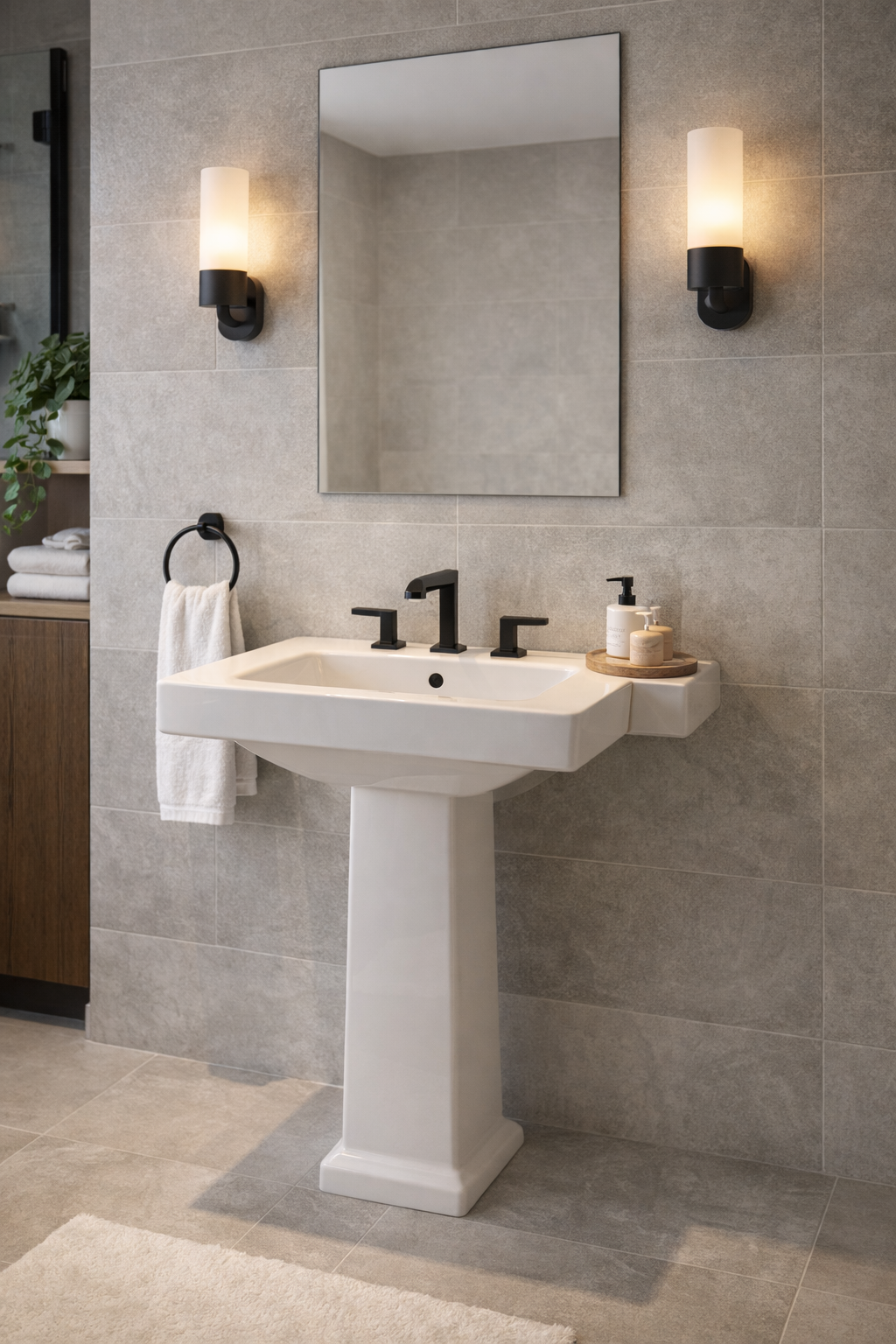
A sleek pedestal sink with clean lines and matte black fixtures set against soft gray tile walls. The minimalist design emphasizes simplicity and functionality, perfect for a modern bathroom remodel.
Installation: What the Field Actually Looks Like
Pedestal sinks have a reputation for being simple installations. They can be — but only when the rough-in is right and the wall prep is done properly. Here's what a clean installation requires.
Installation Notes From Our Crew
- Wall blocking is non-negotiable. Most pedestal sinks have a wall-mount bracket or lag bolts that anchor the basin to the wall for stability. Blocking (solid wood installed between studs) must be in place before drywall closes. If you're remodeling, add blocking even if the current sink doesn't need it — future owners will thank you.
- Silicone seal at all wall contacts. Where the basin or column meets the wall, a clean bead of color-matched silicone keeps moisture from wicking behind the drywall. This edge is visible, so a steady hand matters.
- Level before anchoring. A pedestal that's even slightly out of plumb looks off — the eye catches it immediately against tile grout lines and mirror frames.
- P-trap placement is a finish detail. Chrome P-traps and supply lines behind a column pedestal are partially visible. Use matching finish hardware; it's a small cost that makes a visible difference.
- Torque the basin bolts carefully. Vitreous china and porcelain crack under uneven pressure. Snug is correct. Tight is a broken sink.
Common Questions
Is a pedestal sink harder to keep clean than a vanity?
Actually, no — it's easier in most ways. The basin itself is identical to any sink, and the open floor space under the pedestal means you can mop or sweep straight under it without moving anything. The one extra step: the exposed column can collect dust, especially at the top where it meets the basin. A quick wipe-down once a week handles it.
Can I put a pedestal sink in a bathroom that used to have a vanity?
Often yes, but it depends on where the drain and supply lines are roughed in relative to the pedestal's spec sheet. Vanities have a lot of flexibility in hiding rough-in locations; pedestals do not. Your plumber may need to adjust the rough-in before the pedestal goes in — which is why we always say: confirm your sink model before the plumbing work starts, not after.
Do pedestal sinks meet ADA accessibility requirements?
Some do, some don't — it depends on the specific model and mounting height. ADA requires knee clearance under the basin for wheelchair access, a maximum rim height of 34 inches, and insulated pipes below to prevent contact burns. If accessibility is a consideration now or for future resale, look specifically for ADA-compliant pedestal models and confirm the installation meets clearance specs. This is something we factor in on all our aging-in-place projects.
How much does a pedestal sink installation cost compared to a vanity?
The sink itself typically runs $200–$800 for a quality unit (sculptural or designer models run higher). Installation labor — assuming the rough-in doesn't need major rerouting — is generally less than a vanity installation because there's no cabinet to set or countertop to fit. If rough-in work is needed, add plumbing costs. Overall, a pedestal sink swap is usually one of the more budget-friendly bathroom updates with significant visual impact.
What finishes are pedestal sinks available in beyond white?
Quite a few now — deep navy, forest green, matte black, graphite, warm beige, and soft clay are all available from major manufacturers. Matte finishes hide water spots and minor scratches better than glossy, which can be useful in a high-use bathroom. Just confirm your chosen finish is available in the size and drilling configuration you need before committing — color options sometimes narrow the selection.
Keep Reading
Not sure if a pedestal sink fits your bathroom? Let's look together.
We've redesigned powder rooms, half baths, and tight primary baths all across Walnut Creek, Rossmoor, Alamo, Danville, and Lafayette. Sometimes a pedestal is the move. Sometimes it isn't. We'll tell you the truth either way.
Schedule a Consultation See Our Bathroom Work
Toupin Construction
Ready to start your remodel?
Whether you're dreaming of a new kitchen, a spa-worthy bathroom, or a whole-home transformation — we’d love to hear about your project. Reach out and let's talk.
‹ Back
Comments