


By using our website, you agree to the use of cookies as described in our Cookie Policy
Blog
Heat Pump Dryers & Smart Washers: The Future of Laundry Is Already Here

We had a homeowner in a Rockledge Drive unit last year who'd been pushing hot, humid air through a 16-foot dryer duct for 22 years. The duct ran through two walls, made a 90-degree turn, and exited through the exterior stucco. The last time it was cleaned was — by her best estimate — never. When Ismael, our electrician, pulled the machine to look, the flex duct behind it had partially collapsed and the lint accumulation back there was genuinely alarming.
She replaced the whole setup with a Bosch heat pump dryer. No duct. No exterior penetration. No lint hazard. Uses about half the electricity per load. And now the machine lives comfortably in the interior bathroom closet where it always should have been.
This is exactly why heat pump dryer adoption is accelerating — not because of trends, but because they solve real problems that traditional dryers create in older buildings like Rossmoor.
Why Traditional Vented Dryers Are Fading Out
The traditional vented dryer has been the American standard for decades. It works by heating air, blowing it through your clothes, and pushing the hot moist air outside through a duct. Simple. Effective. Also: energy-intensive, fire-prone (lint in the ductwork is the leading cause of appliance fires), and dependent on exterior wall access that many condos and older buildings simply don't have.
In Rossmoor specifically, traditional vented dryers create compounding problems. The original duct runs — if they exist at all — were often designed for smaller machines. They travel through shared walls and building cavities that are difficult or impossible to clean properly. HOAs are tightening restrictions on exterior penetrations. And PG&E rates make running a high-heat appliance for 45 minutes per load increasingly expensive.
A Note on HOA Vent Restrictions
Rossmoor's Mutual boards have become increasingly cautious about approving new exterior vent penetrations — and for good reason. Cutting through stucco and the exterior skin of an older building requires careful waterproofing, affects neighboring units, and creates long-term maintenance obligations for the building. When we're planning a new laundry installation in Rossmoor, ventless is almost always the first option we present to the Mutual board — and it's almost always the option that gets approved fastest.
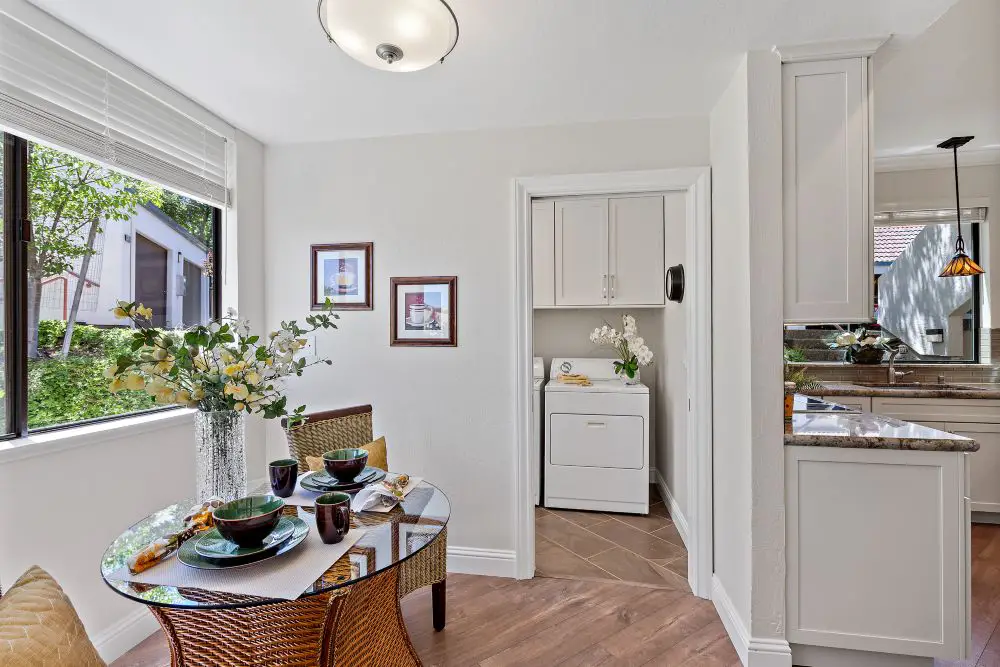 A small laundry area located just off the kitchen and dining space, offering convenient access but blending laundry into everyday living zones. Without dedicated storage or separation, this type of layout can quickly feel cluttered and disruptive.
How Heat Pump Dryers Actually Work
A heat pump dryer uses a closed-loop refrigerant system — the same basic technology as an air conditioner or a heat pump for your home — to extract moisture from your clothes. Warm air circulates through the drum, picks up moisture from the fabric, and then passes over a cold evaporator coil where the moisture condenses out. The now-dry air gets reheated and cycled back through. The collected water goes either into a reservoir you empty or directly into your drain.
Refrigerant Loop — The Key to Why Heat Pump Dryers Work
A refrigerant is a substance that absorbs heat when it evaporates and releases heat when it condenses — that's the same chemistry inside your refrigerator and air conditioner. In a heat pump dryer, the refrigerant loop uses this heat exchange cycle to extract moisture from clothes at low temperatures, instead of blasting them with high heat the way a traditional dryer does. The result: clothes come out drier, the process uses significantly less energy, and no hot humid air needs to go anywhere outside the machine.
The practical benefits: no exterior vent needed. Lower operating temperature means clothes last longer (high heat is what breaks down fabric fibers over time). 40–50% less electricity per cycle compared to a standard vented dryer. And because the machine doesn't push heated air into the living space, it doesn't affect your home's climate control the way a traditional dryer does in the summer.
The One Honest Tradeoff
Heat pump dryers run longer than traditional dryers — typically 20 to 40 minutes more per load. That's the honest downside. For most homeowners, especially in Rossmoor where load sizes tend to be smaller and laundry is done more frequently rather than in giant weekly batches, this isn't a meaningful problem. But it's worth knowing going in.
Heat Pump Dryer Pros
- No exterior vent required
- 40–50% less energy per load
- Gentler on fabrics
- Safer — no lint duct fire risk
- Works in interior locations
- HOA-friendly
- Quiet operation
Heat Pump Dryer Cons
- Longer dry cycle (45–90 min vs 45–60)
- Higher upfront cost
- Drain connection or reservoir needed
- Occasional filter cleaning required
Smart Washers: What Actually Makes Them "Smart"
The word "smart" gets slapped on a lot of appliances that are really just "has an app." Smart washers are different — the technology inside them genuinely changes how laundry works.
A good smart washer has a load-sensing system that detects how much laundry is in the drum and adjusts the water level automatically. It has an auto-dose function that meters detergent from a reservoir rather than relying on you to measure correctly every load. It has vibration sensors that reduce spin speed when it detects an imbalanced load — which matters enormously in condos and older buildings where excessive machine vibration transmits through shared floors and walls.
Auto-Dose — What It Is and Why It Saves Money
Auto-dose is a feature on smart washers where the machine pumps a precise amount of liquid detergent from a built-in reservoir based on load size and soil level. Most people use 2–3 times more detergent than they need, which doesn't clean better — it just leaves residue in clothes and in the machine. Auto-dose fixes this completely. You fill the reservoir once a month, the machine does the rest, and you use about 30–40% less detergent overall.
For Rossmoor specifically, the noise and vibration reduction is significant. Machines with advanced vibration dampening systems are much quieter during spin cycles — relevant in a co-op building where your laundry closet may share a wall with your neighbor's bedroom.
Combo Washer-Dryer Units: The Ultra-Small Space Solution
All-in-one combo units — one machine that washes and then dries — have been standard in Japan and much of Europe for decades. They're gaining significant traction in Bay Area condos and Rossmoor units as ventless technology has improved.
A combo unit is a single machine, usually 24 inches wide, that runs a full wash cycle and then transitions to a ventless dry cycle without you moving anything. One machine. One set of hookups. One space requirement. For units where even a compact stacked set is a squeeze — a bathroom corner, a kitchen cabinet slot, a very tight entry closet — a combo unit is often the answer.
The honest limitation: smaller drum capacity, and the combined cycle takes significantly longer than separate machines. For a two-person household doing regular-size loads, this is a non-issue. For a family of four doing a load of towels, it's a real consideration.
What This Means for Your Rossmoor or East Bay Home
The combination of heat pump dryers and compact smart washers has genuinely expanded where laundry can live. Spaces that were off-limits for traditional dryers — interior closets, bathroom corners, kitchen cabinets — are now completely viable. And because these machines are quieter, more efficient, and gentler on fabrics, the in-unit laundry experience is better than it was with the machines they replace.
For homeowners planning a remodel that includes laundry, we almost always spec a heat pump dryer as the default recommendation — and go from there based on what the specific space can support. If you're still running a traditional vented dryer through aging ductwork, the upgrade conversation is worth having sooner rather than later.
For more on what a complete laundry reconfiguration looks like in Rossmoor — including electrical, plumbing, and Mutual board approval — see our detailed Rossmoor laundry guide. And for the full picture of how to build a functional laundry nook in any East Bay home, see Small Laundry, Big Impact.
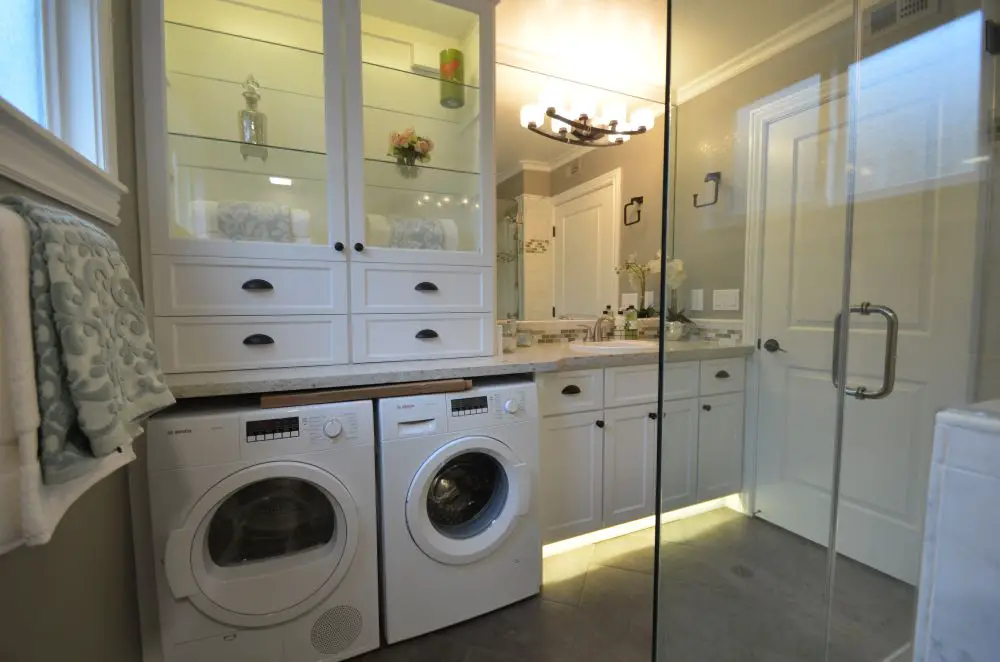 A thoughtfully designed Rossmoor bathroom incorporating a side-by-side washer and dryer beneath custom cabinetry. With built-in storage, countertop space, and layered lighting, this layout turns laundry into a functional and integrated part of the home.
Continue Reading — The Laundry Series
Thinking About Upgrading Your Laundry Appliances?
We design laundry spaces around the right machines for the space — not the other way around. Let's figure out what works for your home.
Get a Free Quote
Toupin Construction
Ready to start your remodel?
Whether you're dreaming of a new kitchen, a spa-worthy bathroom, or a whole-home transformation — we’d love to hear about your project. Reach out and let's talk.
‹ Back
Comments