


By using our website, you agree to the use of cookies as described in our Cookie Policy
Blog
The Vanity Decision You Won't Regret
Bathroom Remodeling · Design
The Vanity Decision You Won't Regret
How to measure, choose, and spec a bathroom vanity that actually works — not just looks good in the showroom
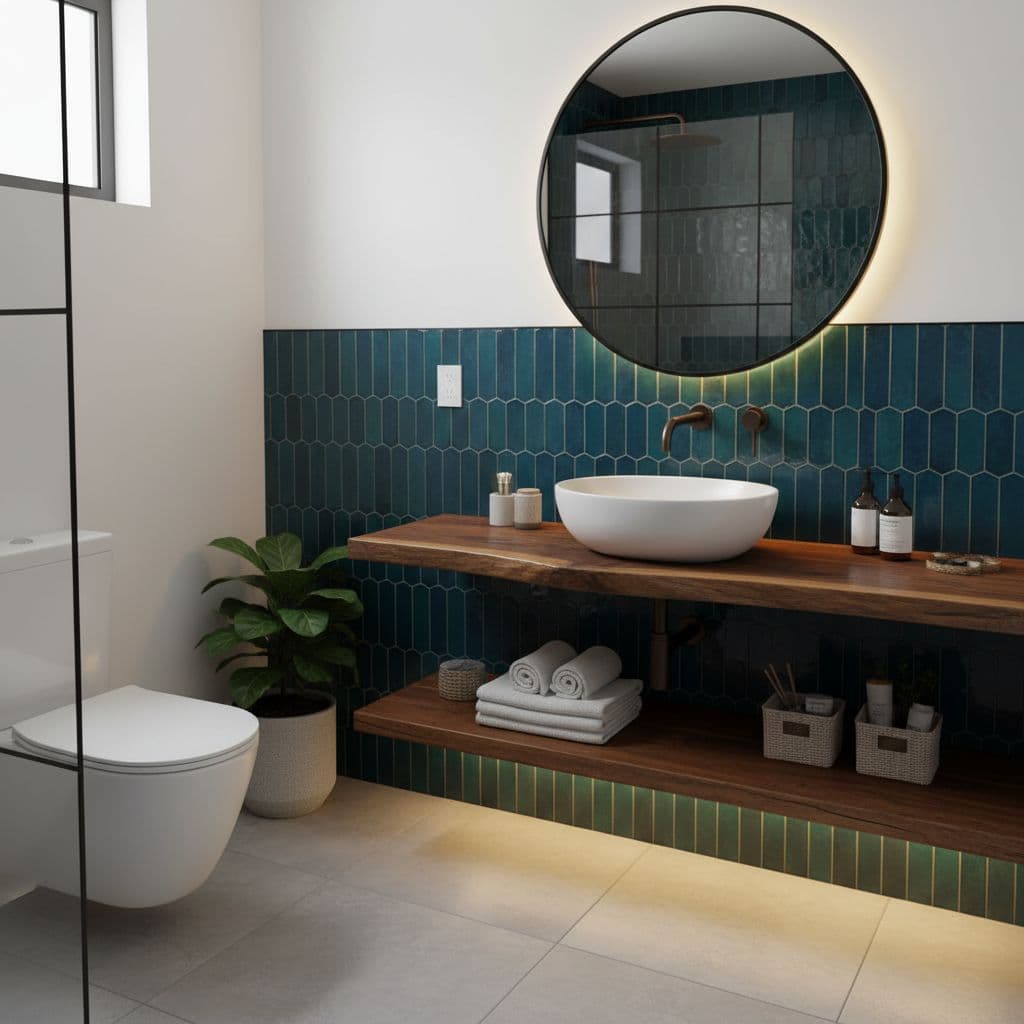 Designed for smaller spaces, this compact vanity maximizes function without sacrificing style. The floating wood shelf and open storage keep the area feeling light and uncluttered, while the vessel sink and bold tiled backsplash add personality. Ideal for powder rooms or minimalist bathrooms, this setup proves small can still be stunning.
We have three bathrooms at home — our primary, the kids' bathroom, and what my husband has officially named the "poop deck" (it's a powder room; I did not name it). Each one has completely different vanity requirements, and if I'd just walked into a showroom and picked whatever looked pretty, at least one of them would be a daily frustration by now.
The vanity is the hardest-working piece of furniture in your bathroom. It handles moisture, weight, constant use, and whatever your household throws at it — and it needs to do all of that while also looking like you made intentional design choices. Here's how to actually make good ones.
Before You Shop Anything
Measure More Than the Wall
This is where most vanity regrets begin: someone measures the wall width, finds a vanity that fits, buys it, and then discovers that the drawer hits the toilet when it opens. Or the door swings into the vanity. Or the new vanity is deeper than the old one and the bathroom door now brushes the corner.
Measure all of these before you look at a single product:
- Wall width — obviously, but also note where the plumbing is and whether relocating it is on the table
- Available depth — standard vanities are 21–22 inches deep; a shallow bathroom may require an 18-inch depth version
- Door swing — measure from the hinge side to the vanity wall; you need clearance for the door to open fully without hitting the vanity corner
- Toilet clearance — 15 inches minimum from toilet centerline to the nearest obstruction; drawers that conflict with this are a daily annoyance
- Traffic clearance — 30 inches in front of the vanity to walk comfortably; this is code minimum and also just practical
- Existing plumbing location — the drain and supply lines are where they are; a vanity that requires relocating them costs more to install
| Bathroom Type | Recommended Width | Notes |
|---|---|---|
| Powder room / half bath | 18–30 inches | No storage needed for daily routine; prioritize design |
| Guest or secondary bath | 30–42 inches | Single sink, moderate storage |
| Primary bath, one person | 42–60 inches | Single sink with generous storage on both sides |
| Primary bath, shared | 60–72 inches | Double sink; the upgrade that makes mornings survivable |
The Style Decision
Four Types — and Which One Is Actually Right for Your Home
Traditional / Shaker
Raised-panel or Shaker-style doors, warm wood tones, visible legs or furniture feet. Works best in homes with traditional architecture — and looks dated fast in a space that's otherwise contemporary. This is the safe choice that's also often the right one.
Modern / Flat-Panel
No visible frame, flat slab doors, handleless or minimal hardware. Clean and striking in the right setting; cold and sterile if the rest of the bathroom doesn't support it. The tile and mirror need to match the commitment.
Transitional
Clean lines with subtle detailing — often a simple Shaker door in a painted finish. Works in the widest range of homes because it reads as neither aggressively modern nor traditionally heavy. This is what we specify most often.
Floating / Wall-Mounted
Mounted to the wall with no legs, no contact with the floor. Creates the impression of more floor space — visually significant in smaller bathrooms. Requires proper blocking in the wall to support the weight. Popular in Rossmoor remodels where floor space is at a premium.
Trade Term: Wall Blocking for Floating Vanities
A floating vanity mounts directly to the wall — which means the wall framing has to be able to support the weight of the vanity, the countertop, the sinks, and whatever's stored inside. "Blocking" is solid lumber added between the wall studs specifically to provide a secure anchor point. A floating vanity mounted only to drywall will eventually pull away from the wall. When we install a floating vanity, we open the wall, add blocking, and close it back up before mounting. This is why floating vanity installation is not a weekend project.
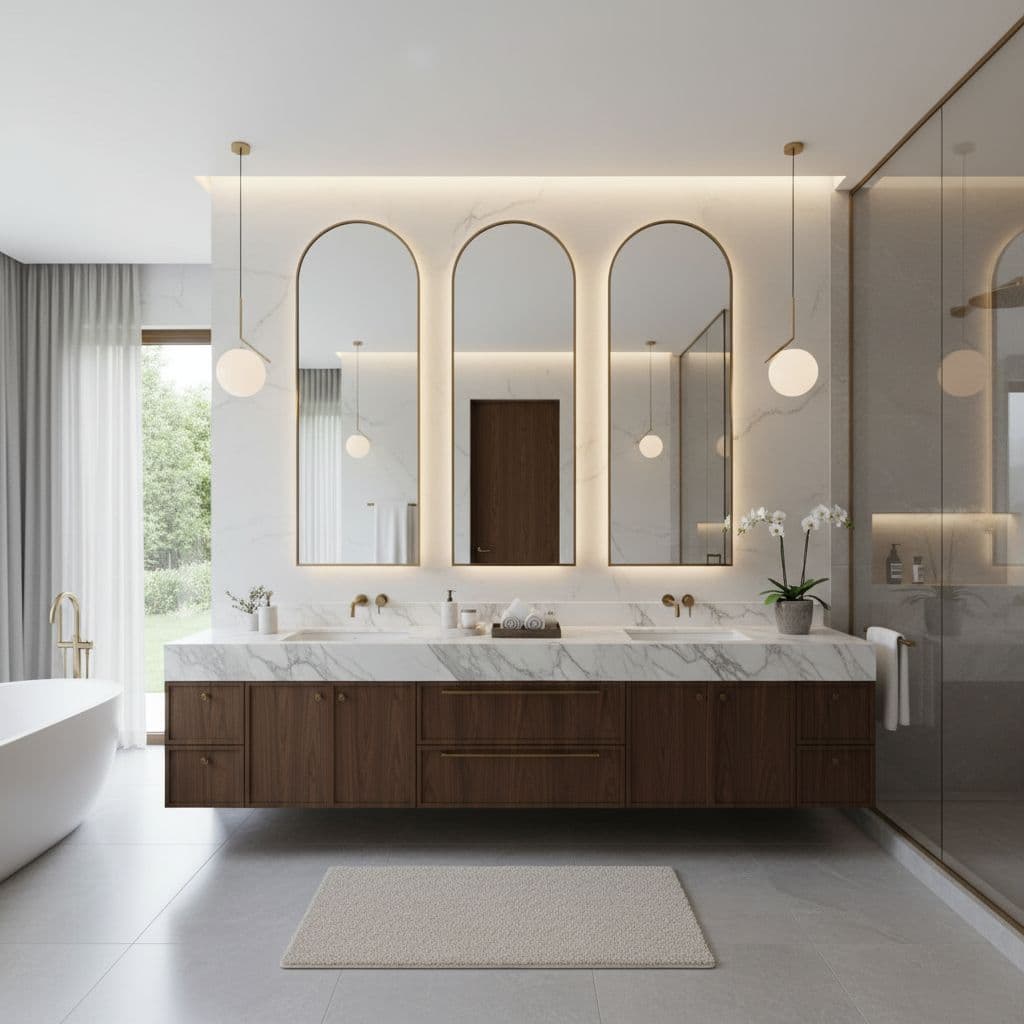 This large bathroom vanity features a sleek floating wood base paired with a luxurious marble countertop and integrated double sinks. The standout arched mirrors with soft backlighting add elegance and depth, while the wall-mounted design enhances the sense of space. High-end materials and clean lines make this ideal for a master bathroom focused on both style and functionality.
Storage That Actually Works
Drawers Beat Doors. Every Time.
This is not an aesthetic opinion — it's a usability one. Cabinet doors require you to reach into a dark space and search. Drawers slide out and show you everything at once. For daily-use items — toothbrushes, makeup, medication, hair tools — a drawer is unambiguously more functional than a cabinet door with shelves behind it.
The ideal primary bathroom vanity has:
- Three to five drawers on the dominant user's side — sized from small (top: toiletries, jewelry) to deep (bottom: hair dryer, styling tools)
- Cabinet door storage under each sink for the plumbing chase space — this is where the cleaning supplies and spare rolls live
- Soft-close drawer slides on everything — not optional in a quality vanity
- Full-extension slides so the drawer opens completely and you can see and reach the back
Materials
What the Box Is Made of Matters More Than the Door
The door is what you see. The box — the structural shell — is what determines how long the vanity lasts. And bathroom vanities are exposed to more sustained moisture than almost any other piece of furniture in the home.
| Material | Moisture Resistance | Durability | Notes |
|---|---|---|---|
| Plywood box | High | High | The right answer for bathroom vanities. Holds screws, resists swelling, lasts decades |
| Solid wood | Moderate (with sealing) | High | Beautiful but needs proper finishing; susceptible to humidity changes over time |
| MDF doors | Moderate | Medium | Paints beautifully, holds a crisp edge; fine for doors, not ideal for the box |
| Particleboard box | Low | Low | Absorbs moisture and swells; common in budget vanities; avoid near any sink |
| PVC / waterproof | Very high | High | Excellent for wet rooms or any vanity that might see repeated flooding; increasingly common |
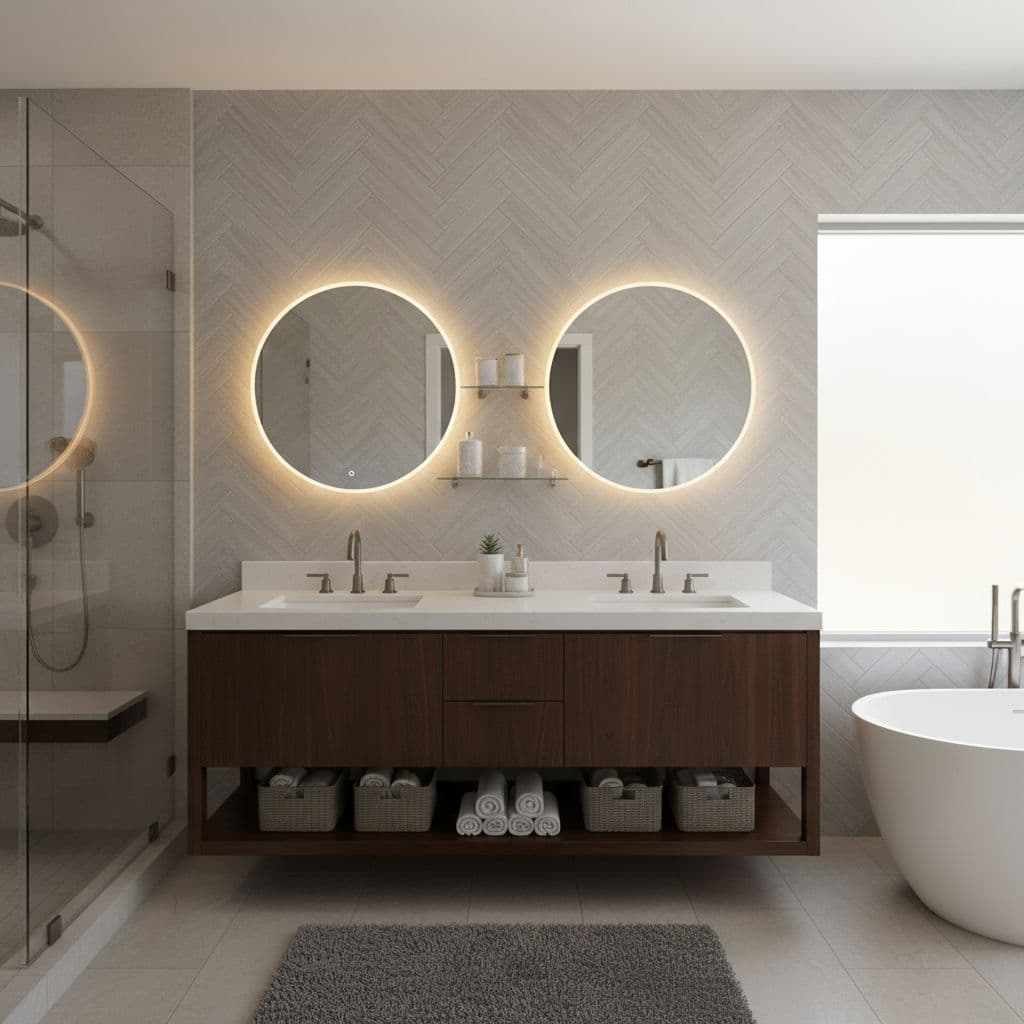 This medium-sized vanity balances practicality and modern aesthetics. Featuring a warm wood cabinet, dual sinks, and symmetrical round LED mirrors, it offers both storage and visual appeal. The open lower shelf adds accessible storage, while the neutral palette keeps the design versatile for various interior styles.
The Sink Decision
Undermount, Vessel, or Integrated — Which Is Right
The sink type affects how the vanity is used, cleaned, and how long the countertop-to-sink joint holds up.
Undermount Sink
Mounted below the countertop surface — no rim, seamless edge. The easiest to keep clean because water and debris wipe directly off the counter into the basin. Works with quartz, granite, or solid surface. Our most common recommendation.
Vessel Sink
A basin that sits on top of the countertop surface — often stone, ceramic, or glass. Striking in a powder room or guest bath. Requires a taller faucet with a higher spout. Less practical for daily heavy use — the rim collects water and soap.
Integrated Sink/Counter
Sink and countertop are one continuous piece — often solid surface or cast concrete. No joint to seal, no caulk to degrade, no seam to clean around. Requires precise installation. Great for Rossmoor bathrooms where moisture management matters.
Drop-In / Top-Mount
Rim sits on top of the counter. Easiest to install; hardest to clean. The caulk bead around the rim is a permanent maintenance task. We rarely recommend this for a full remodel — it's mostly an original-era holdover.
From My Own BathroomsOur primary bath has a 60-inch double vanity with undermount sinks, deep drawers on both sides, and a quartz countertop. My husband and I do not argue about counter space anymore, which I consider a significant quality-of-life improvement from our previous house.
The kids' bathroom has a single 36-inch vanity with a solid surface integrated sink — I chose it specifically because there's no caulk joint for children to somehow destroy. It has held up flawlessly.
The powder room has a vessel sink on a narrow floating base because it's for guests and I wanted it to look a little bit like a piece of furniture, not a plumbing fixture. It does. Would not put it in a bathroom anyone uses seriously.
How do I know if a vanity is worth the price?
Ask what the box is made of. Plywood = quality. Particleboard = budget grade. Ask about drawer slides — full-extension, soft-close metal slides are standard in quality vanities. Ask about the finish — a moisture-resistant paint or lacquer on all interior surfaces matters for longevity. A good vanity rep or contractor can answer all three questions without hesitation.
Can I install a vanity myself?
Swapping an existing vanity for one of the same width in the same plumbing location: yes, a capable DIYer can handle it. Installing a floating vanity, changing vanity width, or moving plumbing: those are contractor jobs. The floating vanity specifically — the blocking, the level mount, the plumbing connections — has enough ways to go wrong that we'd rather you called us.
Does vanity choice affect resale value?
A dated or deteriorating vanity is one of the first things a buyer notices in a bathroom and one of the most common negotiating points in East Bay home sales. A well-chosen, quality vanity in a transitional or timeless style is essentially neutral in a sale — it doesn't hurt you and it doesn't dramatically help you. Where it does matter: a double vanity in a primary bathroom is increasingly expected at certain price points in Walnut Creek and will be conspicuously absent to buyers who are used to seeing them.
Remodeling your bathroom? Let's talk vanities.
We're happy to walk through your space, take measurements, and recommend specific products that will work for your plumbing layout and your life. No showroom pressure, just honest guidance.
Get a Free Quote Call 925-937-4200
Toupin Construction
Ready to start your remodel?
Whether you're dreaming of a new kitchen, a spa-worthy bathroom, or a whole-home transformation — we’d love to hear about your project. Reach out and let's talk.
‹ Back
Comments