


By using our website, you agree to the use of cookies as described in our Cookie Policy
Blog
Why Niches Are the Smartest Little Upgrade You Can Make
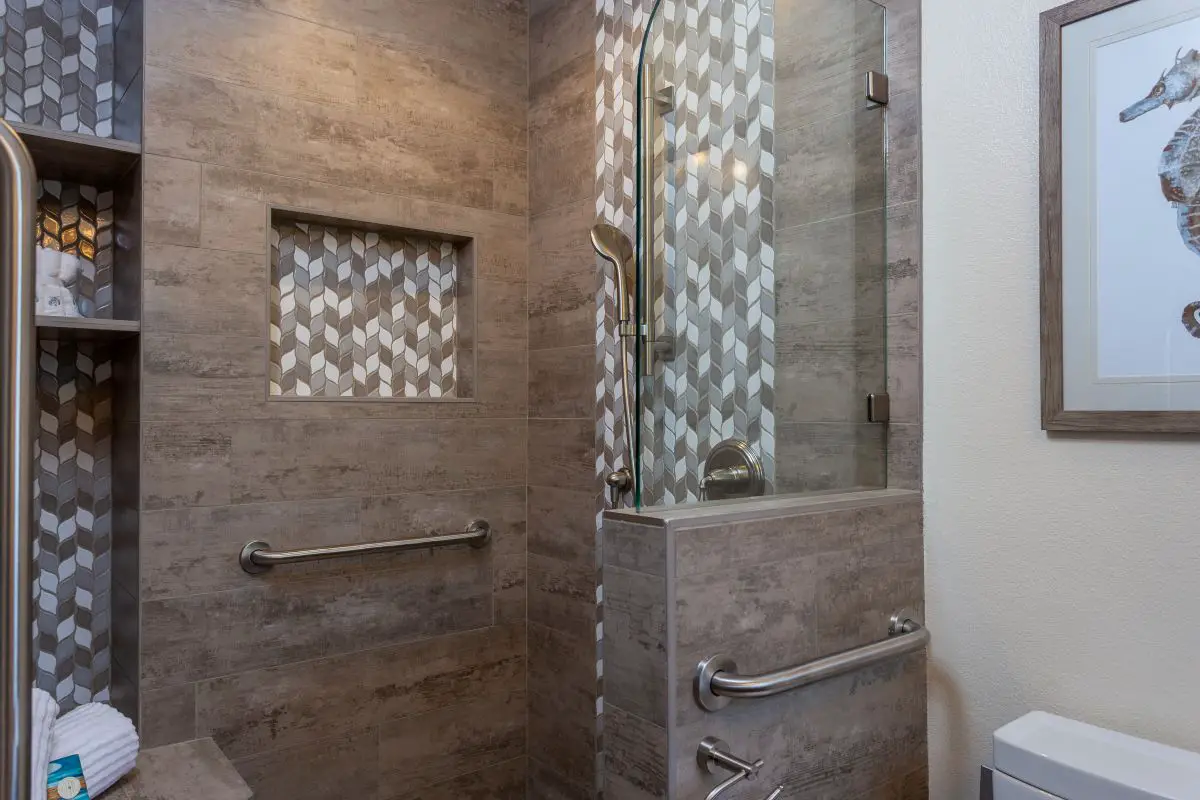
Custom shower niche with bold geometric tile backing, paired with large-format textured wall tile and integrated grab bars for a modern, functional design.
A client called me after her bathroom remodel was finished and said, "I want to tell you the thing I love most, and it's going to sound ridiculous." She paused. "It's the shelf in the shower. I didn't realize how much I hated that wire caddy until it was gone."
I get a version of that call more than you'd think. Not about the tile, not about the new vanity — about the niche. The recessed shelf built right into the wall that holds the shampoo and the conditioner and the bar soap without taking up an inch of floor space or dangling off the showerhead like a stainless-steel afterthought.
It costs almost nothing to add during a remodel. And it's the thing people keep bringing up years later. That's the thing about small details — they're what you actually live with every day.
What a Niche Actually Is
A niche is a recessed opening built into a wall — framed between studs during construction, waterproofed if it's in a wet area, tiled or finished to match the surrounding surface. It sits flush with the wall plane, so it adds storage without adding depth. No shelf bracket. No separate furniture piece. No hardware to corrode.
Done well, a niche looks like it was always part of the design. Because it is — when it's planned correctly, which is the whole point.
Trade Jargon: "Framing the Cavity"
A niche is built by cutting an opening between two wall studs and adding horizontal blocking at the top and bottom to define the shelf space. Standard stud spacing is 16 inches on center, which gives you about 12–14 inches of usable width — plenty for shower products or a display shelf. The cavity depth is determined by the wall construction: a standard 2×4 framed wall gives you roughly 3.5 inches of depth, which is enough for shampoo bottles but not deep enough for a chunky decorative object. We size the niche to what you're actually putting in it.
Where Niches Make Sense
Most people think shower first — which is right, because that's where the payoff is most immediate. But the logic applies anywhere you have a wall and a storage problem.
Shower Walls
The original use case and still the best one. Holds shampoo, conditioner, body wash, and a bar of soap without any hanging hardware. Plan for one shelf minimum; two if there are multiple users with different routines.
Tub Surrounds
Same principle as the shower, applied to the tub deck area. Keeps bath salts and bubble bath within reach without crowding the ledge. Works especially well on the wall above the faucet end.
Kitchen Backsplash
Above the stove or along the cooking wall, a niche holds oils, spices, or the salt cellar you reach for every day. Lined in matching backsplash tile, it reads as intentional design rather than afterthought storage.
Mudrooms & Entries
Keys, sunglasses, mail, a charging cable. A niche at entry level — around 48–54 inches high — creates a landing zone that doesn't require a table or shelf bracket eating into the walkway.
Hallways & Living Rooms
Display niches for art, books, or objects. Add a small recessed LED and the niche becomes a built-in light fixture as much as a shelf. Works especially well in longer hallways that need a visual break.
Bathroom Walls
Beyond the shower, a niche in the main bathroom wall can hold rolled towels, a candle, or a small plant. In Rossmoor units where floor space is genuinely tight, this is often the move that eliminates the need for a freestanding storage piece entirely.
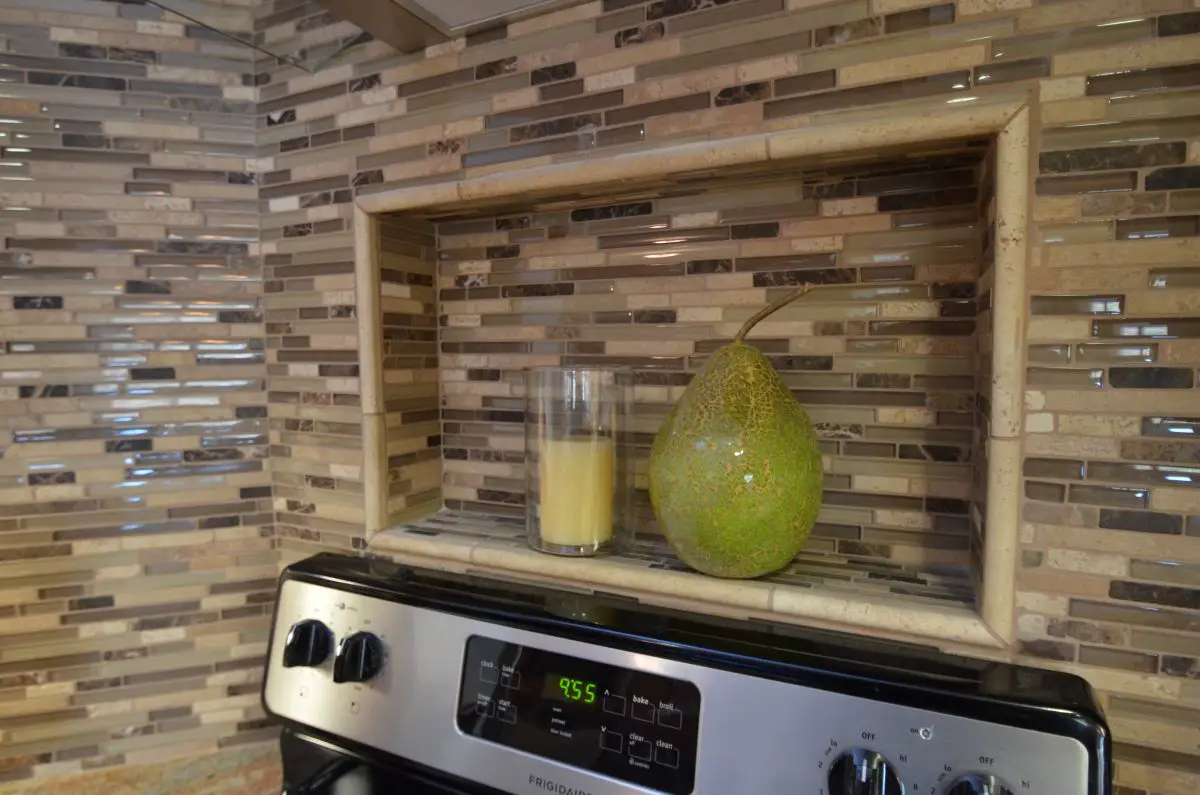
Built-in kitchen backsplash niche above the range, finished with matching linear mosaic tile for easy-access storage of oils, spices, or décor.
From Our Jobsites
The real-world examples tell the story better than the theory does.
The Full-Width Shower Niche — Orinda
We had a client who wanted her shower to feel like a spa but didn't want to fuss with it. No products on the floor, no caddy, nothing that needed cleaning around. We built a full-width niche that ran the entire length of one shower wall — about 42 inches across — with a single marble shelf. She chose a mosaic tile accent inside that reads as a design feature, not storage. The shower looks like a hotel room. Her only regret is not doing it the first time they remodeled.
The Kitchen Spice Niche — Walnut Creek
Above the range on a job off Cypress Drive, we recessed a small niche into the backsplash wall — about 12 inches wide, 18 inches tall, lined in the same field tile as the rest of the backsplash so it blends completely. We added a small under-cabinet light above it. Salt, olive oil, the pepper grinder. They live there now, within reach of the stove, taking up zero counter space. Every person who walks into that kitchen eventually notices it and asks the homeowner where she got the idea. The answer is always: it was part of the remodel plan from week one.
The Hallway Display Niche — Lafayette
A long, blank hallway in a Lafayette home — the kind of corridor you walk through to get somewhere else and never actually look at. We built three shallow display niches into one wall at staggered heights, with small recessed LEDs in each one. The homeowners rotate what's in them: a ceramic piece, a framed photo, a small plant. The hallway is now something they actually notice when they walk through it. Three niches, minimal framing cost, and a completely transformed experience of a space they'd ignored for twelve years.
A note for Rossmoor residents
Rossmoor bathrooms are compact — most are in the 45 to 65 square foot range, and every inch of wall space is doing double duty. That's exactly why niches make so much sense here. A wire shower caddy in a small shower takes up actual shower space and blocks the tile you paid for. A built-in niche sits inside the wall and gives you back that room.
The other thing worth knowing: in Rossmoor's concrete-frame construction, the "walls" between the framing are often not standard 2×4 stud walls — they can be concrete block or poured concrete, especially on shared walls. Those can't be niched without significant work. We assess the wall construction before we design anything, so we're recommending niches where they'll actually work, not just where they'd look good on paper.
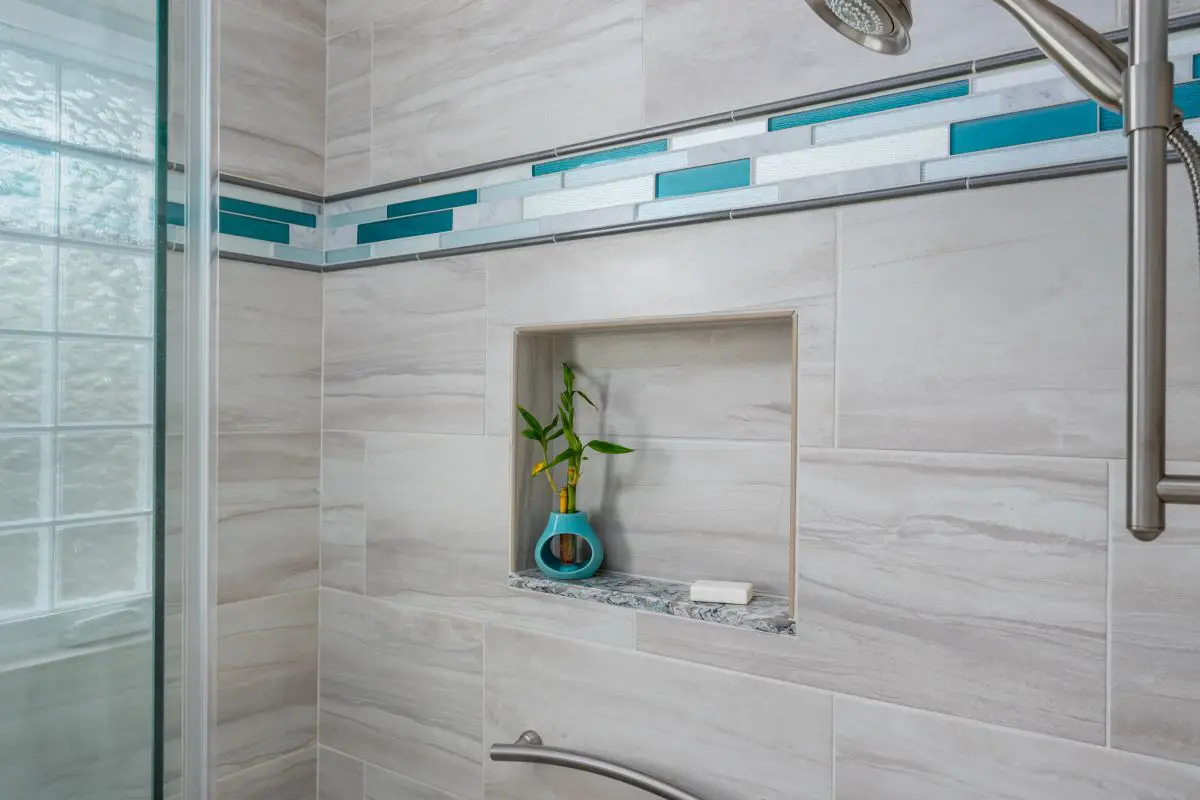
Wide horizontal shower niche integrated with a decorative accent tile band, creating a seamless and modern storage feature within a light neutral tile shower.
How to Get a Niche Right
The niche itself is simple. The decisions around it are where things go either well or sideways.
1
Plan it before the walls close — not after
A niche has to be framed into the wall during rough-in, before drywall or backer board goes up. If you ask for one after tile is set, you're looking at a demo and redo. This is the single most common niche mistake we see when clients come to us after a bad experience with another contractor: they asked for a niche as an afterthought and were quoted an absurd price to rework finished walls. The cost of adding a niche during an open-wall remodel is negligible. The cost of adding it afterward is not.
2
Set the height based on use, not aesthetics
Shower niches work best at chest to shoulder height — roughly 42 to 54 inches from the floor, depending on the users. That puts your shampoo at reach without bending or stretching. Display niches should align with eye level (around 60–66 inches) or key furniture heights. The mistake is centering a niche on the wall because it looks balanced, without thinking about whether anyone can comfortably use it. We always align niche edges with existing grout lines so the tile layout reads cleanly — a niche that cuts through a grout line looks like a mistake even when it isn't.
3
Use the niche to introduce contrast
A niche interior finished in the same tile as the surrounding wall disappears — which is fine if that's the intention. But a niche is a natural opportunity to introduce an accent tile that would be overwhelming as a full wall but is exactly right in a contained space. The aqua glass strip in the Eastwood Drive shower (see the photo above) is a great example: two inches of color against a neutral stone wall. It punches well above its weight. Mosaic tile, a bold grout color, a contrasting stone — any of these work inside a niche without committing your whole bathroom to a dramatic choice.
4
Slope the shelf — just slightly
A shower niche shelf should pitch toward the shower at a very slight angle — about 1 to 2 percent, which is barely perceptible. This prevents water from sitting on the shelf and pooling against the back wall. It's a small detail that matters a lot over time. We build this into the framing, not as an afterthought in the tile setting. If you've ever seen a niche with a perpetual ring of soap scum sitting in standing water, this is why — the shelf was set flat.
5
Add recessed LED lighting for display niches
A small recessed downlight or LED strip inside a display niche transforms it from a shelf into a focal point. The light draws the eye, gives the objects inside dimension, and adds ambient warmth to the room. This is worth roughing in during the electrical phase even if you're not sure you want it — capping off a junction box costs almost nothing; running wire after drywall is a full repair job.
The Part Nobody Talks About: Waterproofing
I want to spend a minute on this because it's where corners get cut and where the consequences show up two or three years later.
Any niche in a wet area — shower, tub surround, anywhere water hits regularly — needs to be fully waterproofed behind and around the tile. Not just the face of the niche. The back wall. The sides. The shelf. The corners where the niche meets the shower wall, which are the highest-risk points for any waterproofing system.
What goes wrong when waterproofing is skipped or rushed
Water gets into the wall cavity through a niche faster than almost anywhere else in a shower — because the back and sides of the niche are exposed to direct spray, and because the corners are complex geometry that's easy to bridge poorly. Once water is inside the cavity, it saturates the framing, grows mold, and eventually compromises the wall structure behind the tile. By the time you see it — usually as efflorescence on the grout, soft spots in the tile, or a musty smell — the damage is significant. The fix is a full demo and redo, not a patch.
We use a waterproofing membrane system throughout the shower and extend it continuously into and around every niche — no gaps, no seams at the corners that aren't properly treated. The niche gets the same level of care as the shower pan. This isn't optional and it's not a place to save money.
Trade Jargon: "Schluter Strip" (Niche Edging)
Where a niche opening meets the surrounding tile, we often use a Schluter strip — a thin metal channel in aluminum, brushed nickel, or matte black — to create a clean, finished edge between the niche tile and the wall tile. It prevents chipping at the edge, gives the niche a defined frame, and looks intentional. You've probably seen these in high-end hotel showers and thought the detail just looked tight. That's usually why.
"The niche is one of about five details in a remodel that you interact with every single day. It costs almost nothing to do right and nothing to regret for years if you skip it."
What It Actually Costs
This is the part that surprises most people — in a good way.
A standard shower niche framed and tiled during an open-wall remodel typically adds $300 to $800 to a project, depending on the tile choice for the interior and whether a Schluter strip or special edging is used. A larger full-width niche, or one with a contrasting mosaic tile interior, runs a bit more — $600 to $1,200 is realistic. A lighted display niche with electrical rough-in adds another $200 to $400 for the fixture and wiring, assuming the walls are already open.
None of those numbers are meaningful in isolation. In the context of a $30,000 bathroom remodel, adding a niche is a rounding error. But leaving it out is a decision you'll notice every morning for the next decade.
What costs significantly more — easily five to ten times the open-wall price — is cutting a niche into a finished wall after the fact. Demo the tile. Check for studs, plumbing, electrical in the cavity. Cut the opening. Frame the blocking. Waterproof. Retile the niche and potentially patch the surrounding area. It's a full project, not a quick add-on. Plan it while the walls are open. That's the whole point.
Related: Our Bathroom Remodeling Services
Frequently Asked Questions
Can you add a niche to an existing wall without a full remodel?
Sometimes — but it's not the easy add it sounds like. We scan the wall first to confirm there's no plumbing, electrical, or blocking in the stud cavity. If it's clear, we can cut the opening, frame the blocking, waterproof, and tile. In a shower, that means demoing the surrounding tile and re-waterproofing properly, which makes it a meaningful project. In a dry wall (hallway, living room), it's more straightforward. We always assess before we commit to a price.
How many niches should a shower have?
At minimum, one — sized for your actual product collection, not for what fits between two studs. If multiple people use the shower with different routines, two niches on different walls means nobody's reaching over anyone else. We've built showers with three or four niches for large households, though at that point we're also talking about layout so they don't all end up on the same wall.
What's the ideal niche depth?
A standard 2×4 framed wall gives you about 3.5 inches of depth — enough for standard shampoo and conditioner bottles. If you want room for larger containers or decorative objects, we can frame out a 2×6 wall in that section, which gives you 5.5 inches. In concrete or CMU walls (common in Rossmoor), creating depth requires furring out the wall, which adds cost and reduces room size slightly. We flag this upfront.
Do niches affect resale value?
Not in any measurable line-item way — but they're consistently part of what makes a bathroom feel custom versus builder-grade. Buyers notice the difference between a bathroom that looks designed and one that looks assembled. Niches contribute to that feeling without being a specific feature anyone can point to. It's the absence of a wire caddy that you notice, even if you can't name what you're reacting to.
What tile works best inside a niche?
Anything that contrasts slightly with the surrounding wall tends to read better than a perfect match — a mosaic insert, a subway tile running in a different direction, a bold grout color, or a natural stone slab if the budget allows. Full matches work for a seamless look but can make the niche disappear when you actually want it to be a feature. We'll show you samples of both approaches so you can make the call with real context.
Planning a Bathroom or Kitchen Remodel?
Add niches to the conversation early — while the walls are still open, the cost is minimal and the payoff lasts for years. We'll assess what's possible in your space and make sure the details are done right. Give us a call.
925-937-4200Toupin Construction · CA Lic #626819 · Walnut Creek, CA

Toupin Construction
Ready to start your remodel?
Whether you're dreaming of a new kitchen, a spa-worthy bathroom, or a whole-home transformation — we’d love to hear about your project. Reach out and let's talk.
‹ Back
Comments