

By using our website, you agree to the use of cookies as described in our Cookie Policy
Blog
Smart Bathroom Tech: What's Worth It
Bathroom Remodeling · Tech & Smart Homes
Smart Bathroom Tech: What's Worth It
A contractor's honest take on which upgrades earn their place — and which ones you'll stop using by March.
A client in Alamo came to us mid-remodel — she'd been doing research and arrived at our meeting with a printed spreadsheet of smart bathroom features she wanted. Smart toilet. Digital shower. Chromotherapy lighting. Heated floors. Smart mirror with built-in Alexa. Motion-sensing night lights. An app-controlled exhaust fan. Bluetooth speakers in the ceiling.
Every item on that list is a real product that exists and works. The total for the technology layer alone was going to be north of $18,000 before a single tile went in, so it was clear we need to sit down and talk through what was important and what was a wish list item.
In the end, she installed heated floors, a thermostatic shower valve with digital presets, a smart mirror, and Bluetooth ceiling speakers. She uses all four of them daily. The rest — the app-controlled fan, the chromotherapy lighting, the motion sensors — got cut without regret. Six months later she told me she makes her coffee in the morning and her floor is already warm and her shower is already at 104°. That's not technology for technology's sake. That's a bathroom that takes care of you.
That's the frame I want to bring to this topic. Smart bathroom features are genuinely good now. But "genuinely good" and "right for your specific bathroom and how you actually live" are different questions.
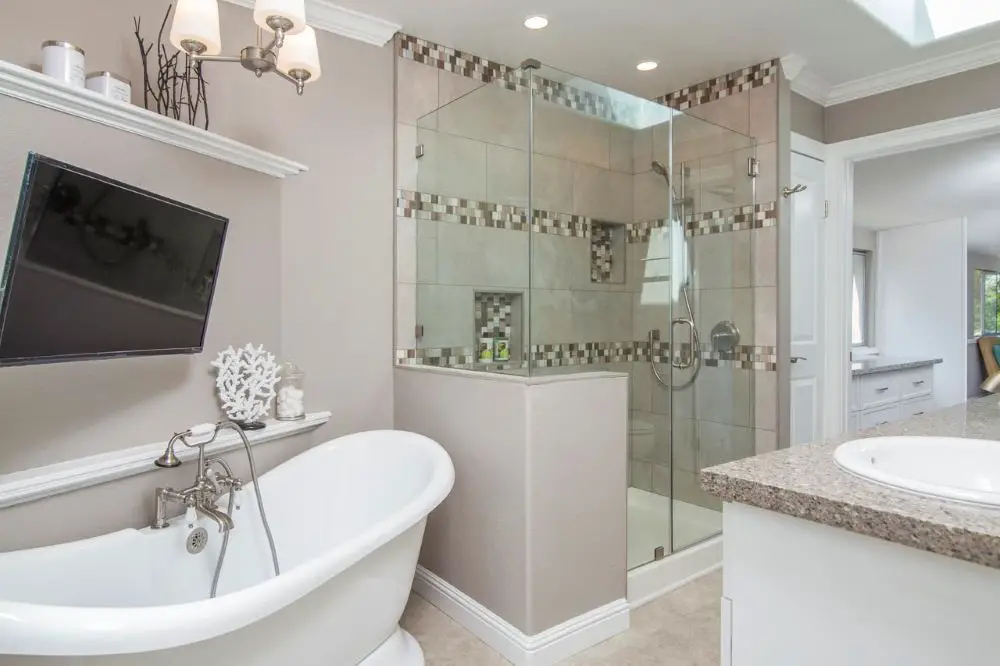
A thoughtfully designed bathroom featuring smart tech integration, including a wall-mounted TV for in-bath relaxation, alongside a glass-enclosed shower and freestanding tub. Blending comfort, convenience, and modern functionality, this space elevates everyday routines with a spa-like experience.
"The best smart bathroom upgrade is the one you interact with every single day without thinking about it. The worst is the one that needs a firmware update to work and you've forgotten the app password."
Tier One: Plan These In During Your Remodel
Some smart features are dramatically easier — and cheaper — to install during a remodel than to retrofit later. If you're already opening walls and floors, the incremental cost of adding these is small relative to the value. Miss the window and you're looking at reopening finished work.
Tier One · Highest Daily Value
Radiant Floor Heating
Electric radiant heat mats go under tile during installation — once the floor is down, there's no adding them without tearing it up. The heat is controlled by a programmable thermostat (increasingly app-enabled) and can be set to warm up before your alarm goes off.
In East Bay homes, radiant floors are especially effective in bathrooms because concrete slab construction — common in Rossmoor-era builds — absorbs and radiates heat exceptionally well. Tile is naturally cold underfoot; radiant floors fix that permanently.
This is the smart feature we recommend to virtually every client doing a full bathroom tile remodel. The usage rate is 100%. Nobody regrets it.
Best Window to Install
During tile installation only — cannot retrofit without removing tile
Typical Added Cost
$8–$15/sq ft installed (electric mat + thermostat)
Electrical Required
Dedicated 15–20 amp circuit; GFCI protected
Tier One · Highest Daily Value
Thermostatic (Digital) Shower Valve
A thermostatic shower valve maintains a precise water temperature regardless of pressure fluctuations elsewhere in the house — no more scalding when someone flushes the toilet. Digital versions add user presets, so each person's preferred temperature is saved and activated with one press.
Higher-end systems like the Kohler DTV+ or Moen Smart Shower let you start the shower remotely from your phone so it's at temperature when you step in. More practically useful: they separate volume control from temperature control, so you can pause the shower without losing your temperature setting.
This is a rough-in decision — the valve body goes in the wall during plumbing, before tile. You can upgrade the trim and controller later, but the valve type is set during construction.
Best Window to Install
Plumbing rough-in stage — valve body is in-wall
Typical Added Cost vs. Standard
$300–$800 upgrade for thermostatic valve; $1,500–$4,000 for full digital systems
East Bay Note
Anti-scald protection built in — important for households with children or seniors
Tier One · Install During Rough-In
In-Ceiling Bluetooth / Wi-Fi Speakers
Flush-mount ceiling speakers in a bathroom deliver dramatically better sound than a portable Bluetooth speaker on the vanity — better coverage, water-resistant rated for wet areas, and completely out of the way. The wiring runs during rough-in; the speakers drop in after drywall like recessed lights.
Sonos, Polk Audio, and Klipsch all make bathroom-rated in-ceiling options. Once they're in, they're just there — part of the room, not a gadget you're moving around.
Best Window to Install
Wire during rough-in; speaker install after drywall
Typical Cost
$200–$600 per pair installed; higher for premium brands
Wet Area Requirement
Must be rated for wet/damp locations; verify spec sheet before ordering.
Tier Two: Retrofit-Friendly Upgrades Worth Doing Anytime
These don't require opening walls or rerouting plumbing. They can be added during a remodel or dropped into an existing bathroom with minimal disruption — which also means you can try one before committing to a whole ecosystem.
Tier Two · High Value · Retrofit OK
Smart Mirror / LED Mirror
Smart mirrors range from simple backlit LED mirrors (just a hardwired light switch) to full touchscreen displays with weather, calendar, and Alexa integration. The practical sweet spot for most bathrooms is an LED mirror with built-in dimming and a defogger element — the defogging feature alone earns its place in any bathroom where the mirror fogs during a shower.
More sophisticated smart mirrors with integrated displays are impressive in showrooms. In practice, most people use the display for about a week before reverting to their phone. Unless you specifically want the mirror to be an information hub, a high-quality LED mirror with dimming and defog is the better investment.
Retrofit Complexity
Needs a hardwired outlet or junction box at mirror location — low complexity during remodel, moderate as retrofit
Typical Cost
$150–$600 for quality LED + defog; $800–$2,500 for full smart displays
Tier Two · High Value · Retrofit OK
Smart Bidet Seat or Integrated Smart Toilet
Bidet toilet seats — like those from Toto, Kohler, or Bio Bidet — retrofit onto most standard toilets in under an hour and require only a nearby GFCI outlet. Features typically include heated seat, warm water wash, air dry, and adjustable pressure. They consistently get the highest satisfaction ratings of any bathroom tech upgrade among clients who've tried them.
Integrated smart toilets (where everything is one unit) are a bigger investment and require removing and replacing the toilet — more involved, but the best option if you want the complete experience without the "seat on a different toilet" look.
Retrofit Complexity
Bidet seat: very easy — outlet near toilet required; full smart toilet: moderate
Typical Cost
Bidet seat: $300–$900; Integrated smart toilet: $1,200–$5,000+
Water Efficiency
Many meet WaterSense criteria; look for dual-flush or efficiency-rated models
Tier Two · Practical · Retrofit OK
Humidity-Sensing Exhaust Fan
A humidity-sensing fan monitors the bathroom's moisture level and runs automatically when it detects steam — then shuts off when the air is dry. No timer switches, no forgetting to turn it on, no "did I leave the fan running?" at work. It just handles itself.
This is the unglamorous smart feature that might be the most practically useful upgrade in a bathroom. Moisture damage is the quiet destroyer of tile grout, paint, and wood trim. A fan that reliably runs when it needs to — without any user input — prevents that damage consistently and invisibly. Panasonic's WhisperSense line is the one we install most often.
Retrofit Complexity
Straightforward swap if existing fan wiring is in place
Typical Cost
$80–$250 for unit; $100–$250 labor for swap
Related
Tier Two · Accessibility · Easy Retrofit
Motion-Sensor Night Lighting
Low-level LED night lighting triggered by motion — activated when someone enters the bathroom at night, off otherwise. These range from plug-in under-vanity strips to hardwired toe-kick lighting built into the vanity base. For households with children, seniors, or anyone navigating a dark bathroom at 3am, this is a simple feature that genuinely improves daily safety.
Particularly relevant for Rossmoor homeowners planning aging-in-place upgrades — motion night lights are one of the most cost-effective safety improvements in a bathroom and require no structural changes.
Retrofit Complexity
Plug-in strips: none; hardwired toe-kick: requires electrician
Typical Cost
$20–$80 plug-in; $150–$400 hardwired toe-kick
Trade Term: WaterSense
WaterSense is an EPA certification program — the water efficiency equivalent of Energy Star. A WaterSense-labeled fixture uses at least 20% less water than standard while meeting performance requirements. In California, where water conservation is both a cost and a civic concern, WaterSense fixtures are worth prioritizing. They also count toward certain rebate programs through East Bay Municipal Utility District (EBMUD). When comparing smart toilets, faucets, or showerheads, look for the WaterSense label on the spec sheet.
The Honest Worth-It Assessment
Not every smart bathroom feature earns its cost and complexity. Here's the unfiltered version of what we see actually get used versus what gets abandoned.
| Feature | Daily Use Rate | Real Value | Our Take |
|---|---|---|---|
| Radiant floor heating | ✔ Every day | ✔ High | Install during every tile remodel. No exceptions. |
| Thermostatic shower valve | ✔ Every shower | ✔ High | Genuine quality-of-life upgrade. Worth the rough-in planning. |
| Humidity-sensing exhaust fan | ✔ Automatic | ✔ High | Protects the investment. Every bathroom should have one. |
| Smart bidet seat | ✔ Every use | ✔ High | Highest satisfaction of any single upgrade. Try before doubting. |
| LED mirror with defog | ✔ Every day | ✔ High | Defog feature alone justifies it. Great lighting bonus. |
| In-ceiling speakers | ◐ Most days | ◐ Medium | Worth it if you spend real time in the bathroom. Install during rough-in. |
| Motion night lights | ◐ As needed | ✔ High for families/seniors | Low cost, genuine safety value. Easy yes. |
| Smart mirror with display/Alexa | ✗ Usually not | ◐ Low-medium | People use it for a week, then ignore it. Pay for light quality, not the screen. |
| Chromotherapy lighting | ✗ Rarely | ✗ Low | Fun in theory. Ignored in practice. Save the budget. |
| App-controlled faucets | ✗ Rarely | ✗ Low | Motion-sensor is more practical and doesn't need a phone to work. |
| Full digital shower ecosystem | ◐ Varies | ◐ Medium | Impressive if you'll use it. Expensive if you just want consistent temp — thermostatic valve does that for less. |
???? My Personal Smart Bathroom Setup
Radiant floors. Thermostatic shower valve. LED mirror with defog. Bluetooth ceiling speakers. Humidity-sensing fan.
That's it. That's the full list. My bathroom doesn't have a touchscreen or an app dashboard or chromotherapy. What it has is a floor that's warm when I step out of the shower at 6am, a mirror that never fogs, music that sounds like it's coming from everywhere, and a fan that handles itself.
Every single one of those things makes my morning better every single day. That's the standard I apply when clients ask what to add.
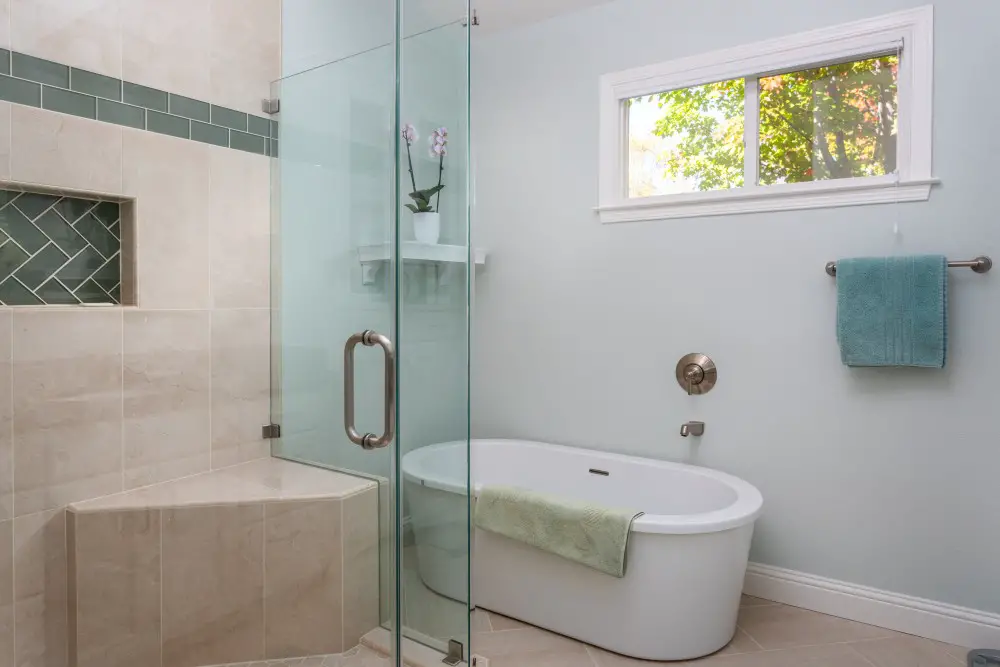
A bright, spa-like bathroom designed for comfort, featuring radiant heated flooring that keeps the space warm underfoot. Paired with a freestanding soaking tub and glass-enclosed shower, this design blends everyday luxury with practical, energy-efficient warmth.
What Smart Features Require From Your Remodel
Smart bathroom features aren't plug-and-play in new construction — most have specific electrical and plumbing requirements that need to be planned before walls close. Here's what to flag with your contractor early.
Pre-Remodel Smart Feature Planning Checklist
- Radiant floor heating needs a dedicated 15–20 amp GFCI circuit run before tile installation. Confirm the panel has capacity — and that the electrician knows the mat wattage to size the circuit correctly.
- Thermostatic shower valve requires specifying the valve model before plumbing rough-in. The valve body is in-wall; the trim and digital controller are surface-mounted and can be upgraded later, but the valve type is permanent once tiled in.
- In-ceiling speakers need low-voltage wiring run to the ceiling location before drywall. Decide speaker placement before drywall goes up — moving them after means patching and repainting.
- Smart mirror / LED mirror needs a hardwired junction box or outlet at the mirror location. If your current mirror just hangs on drywall with no electrical, this requires an electrician to add a box during rough-in.
- Smart bidet seat needs a GFCI outlet within 4 feet of the toilet. Many older bathrooms don't have one near the toilet — add it during the remodel rather than running an extension cord.
- Humidity-sensing exhaust fan is a straightforward swap if existing fan wiring is in place. Confirm the existing circuit can handle the new fan's wattage before ordering.
- Any smart feature requiring Wi-Fi — test your bathroom's Wi-Fi signal strength before finalizing fixture selection. Dead zones in bathrooms (especially those surrounded by tile and concrete) will make app-connected devices unreliable regardless of how expensive they are.
Rossmoor Homeowners — Smart Tech Considerations
Adding smart features during a Rossmoor bathroom remodel often expands the permit scope — particularly when new electrical circuits are involved (radiant floors, smart mirrors, bidet outlets). Mutual board approval should be in place before any electrical or plumbing work begins.
The good news: Rossmoor's original concrete subfloor construction is excellent for radiant floor heating — concrete holds and radiates heat better than wood subfloor. It's one of the few cases where the original construction is actually an advantage for a smart upgrade. We know what each Mutual typically requires for tech-related electrical work. Call us before you start planning: (925) 937-4200.
Common Questions
Can I add smart features to my existing bathroom without remodeling?
Several of them, yes. A bidet seat replaces your existing toilet seat and plugs into a nearby outlet — no plumbing required. A humidity-sensing exhaust fan swaps in like a standard fan. Smart mirrors need a junction box at the mirror location, which may require an electrician but doesn't involve tile or plumbing. The features that genuinely require a remodel — radiant floors and in-wall shower valves — can't be done without opening the floor or wall.
Do smart bathroom features add to resale value?
The ones buyers can see and feel during a showing — heated floors, a good LED mirror, a smart bidet — yes. App dashboards and proprietary smart ecosystems that require explaining during a showing are harder to translate to value and sometimes create concern about maintenance complexity. Install things that feel intuitive to a stranger using the bathroom for the first time, not things that require a tutorial.
What's the most cost-effective smart bathroom upgrade?
A humidity-sensing exhaust fan. Under $300 installed, runs automatically, protects your entire bathroom from the moisture damage that shortens the life of grout, paint, and cabinetry. It's not glamorous but it might have the best cost-to-benefit ratio of anything on this list. Runner-up: a good LED mirror with defog — it eliminates the single most annoying part of a post-shower routine.
Do I need a smart home hub for smart bathroom features?
Most current smart bathroom products are standalone — they connect directly to your phone via Wi-Fi or Bluetooth without requiring a hub like SmartThings or Apple HomeKit. If you want voice control through Alexa or Google Home, check compatibility before purchasing. And test your bathroom's Wi-Fi signal before committing to any app-dependent device. A smart shower that can't maintain a Wi-Fi connection is just an expensive dumb shower.
Are smart bathroom features worth it for a primary bathroom vs. a secondary bath?
Radiant floors and thermostatic shower valves are worth it in any bathroom you use daily — primary or otherwise. Features like smart toilets and premium ceiling speakers are better suited to a primary bath where you spend real time. For a secondary bath used by guests or occasionally, a good humidity-sensing fan and a decent LED mirror are the highest-value additions without over-investing in a room that sees less traffic.
Keep Reading
Adding smart features to a bathroom remodel? Let's plan it right.
The electrical and plumbing decisions that make smart features possible happen early in a remodel — before tile, before drywall. We'll help you figure out what's worth building in and what can wait, so you're not cutting into finished work later.
Schedule a Consultation See Our Process
Toupin Construction
Ready to start your remodel?
Whether you're dreaming of a new kitchen, a spa-worthy bathroom, or a whole-home transformation — we’d love to hear about your project. Reach out and let's talk.
‹ Back
Comments