


By using our website, you agree to the use of cookies as described in our Cookie Policy
Blog
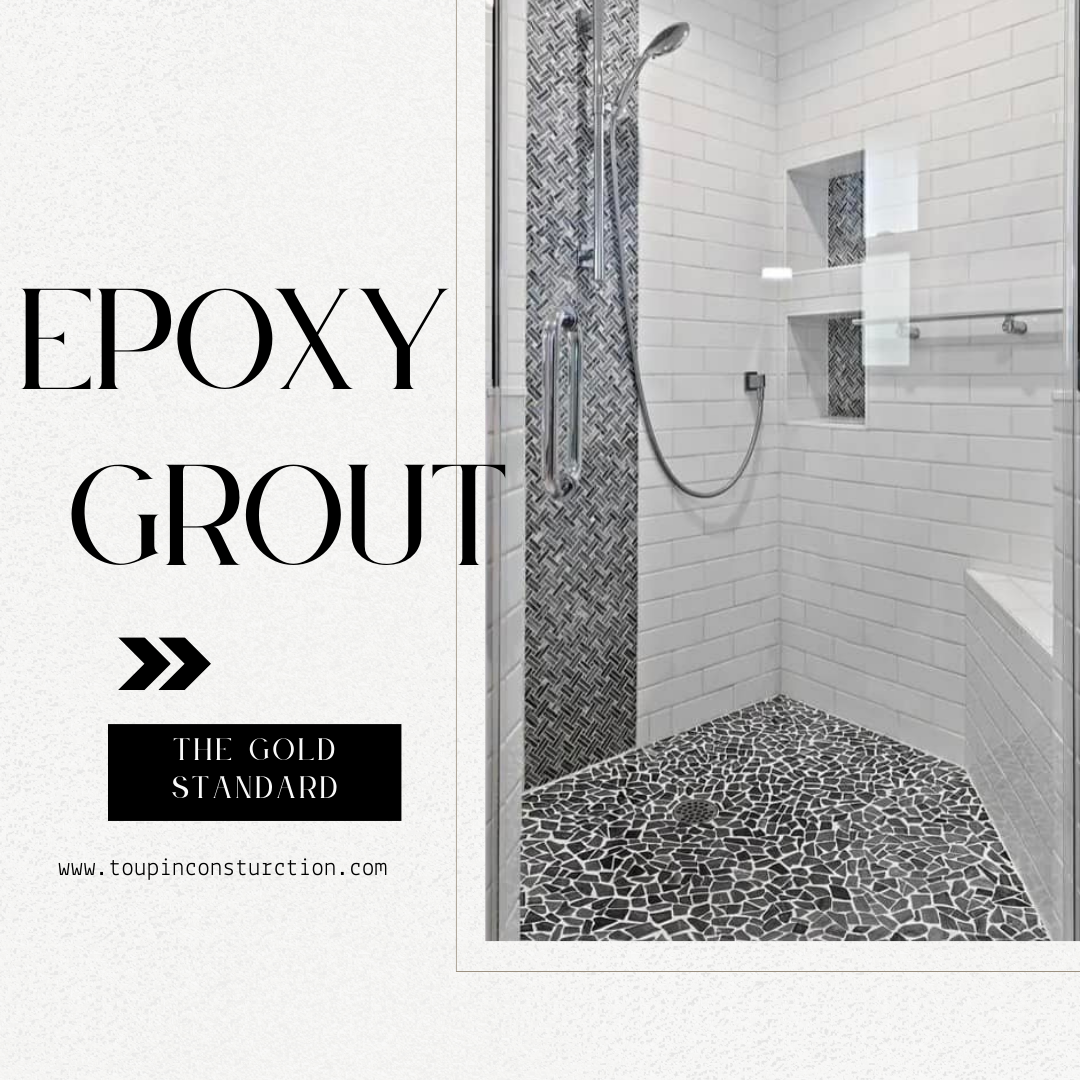
Why Epoxy Grout is the Gold Standard in Construction: A Personal Story from Toupin Construction
Tile & Grout · Craft & Materials
The Grout Conversation Nobody Is Having
Why we use epoxy grout on every Toupin tile job — and why most contractors don't bother.
My first real lesson in epoxy grout cost us an entire day.
I was apprenticing under Adan — our lead tile setter, who has been with Toupin Construction since 2000 and is one of the most meticulous craftsmen I've ever watched work. We had just finished grouting a tiled floor with epoxy, and Adan walked me through the three-wash method: first pass to loosen the haze, second to polish, third to perfect. Straightforward enough.
I was feeling confident. Maybe too confident. After the first wash, I walked across the freshly grouted floor to grab a tool — and left a trail of hazy footprints embedded into the surface behind me.
Epoxy doesn't forgive. It sets fast, it bonds hard, and those footprints were not coming off with a second or third wash. We spent the rest of that day carefully reworking the affected tiles, and I absorbed a lesson I have never forgotten: epoxy grout is unforgiving to install precisely because it is unforgiving to everything else. That's the whole point of it.
That day is also why I can write this post with actual authority. I didn't research epoxy grout. I learned it the way tile setters learn things — with my hands, under someone who knew better than me, and by making a mistake I still remember clearly twenty years later.

A clean, modern kitchen featuring a light mosaic tile backsplash paired with epoxy grout, designed for durability, stain resistance, and long-term performance in high-use areas.
"Grout is the material that touches every tile in the room. It's also the material most homeowners never think about until it's gray and stained and impossible to clean. That's the wrong time to think about it."
Three Types of Grout — Honestly Explained
Most homeowners walk into a tile selection appointment thinking there are two grout choices: the color and the width. The type of grout — the actual chemistry — rarely comes up. It should, because the three types perform very differently and are suited to different applications.
Type 01 · Most Common · Industry Default
Cement-Based Grout
Portland cement mixed with sand (for joints wider than 1/8") or without sand (for narrow joints). It's been the industry standard for decades because it's inexpensive, easy to work with, available in hundreds of colors, and most tile setters can install it competently.
The problem is what happens after installation. Cement grout is porous — it absorbs water, oils, cleaning products, and whatever else gets on your tile. Unsealed, white cement grout in a kitchen will be gray within a year. Sealed, it's better — but the sealer needs to be reapplied every 1–2 years and still doesn't make it non-porous, it just slows the absorption. In a shower with East Bay hard water, mineral deposits accumulate in the pores and create a haze that's genuinely difficult to remove without acids or abrasive cleaners.
Cement grout also shrinks slightly as it cures, which over time — and especially with any subfloor movement or thermal cycling — leads to hairline cracks. Hairline cracks in shower grout are water intrusion paths, and water intrusion behind tile is how you get mold in the wall framing.
Type 02 · What We Use · Premium Performance
Epoxy Grout
Two-part system: epoxy resin plus a hardener, mixed immediately before use. When it cures, it forms a dense, glass-like bond — non-porous, chemical-resistant, and essentially impervious to the things that destroy cement grout over time.
It doesn't absorb water. It doesn't stain. It doesn't need sealing ever. The color is locked into the chemistry of the material, not sitting on a porous surface, so it doesn't fade or discolor. East Bay hard water — which calcifies cement grout and turns white joints gray — wipes right off epoxy. A damp cloth handles what would require an acidic cleaner and a brush on cement grout.
The catch is installation. Epoxy grout is significantly harder to work with than cement grout. It's stickier, sets faster, and has a narrower working window — especially in warmer temperatures. The three-wash cleanup process requires discipline and timing; skip a step or let it sit too long between passes and you're dealing with a haze that bonds to the tile surface like a coat of matte varnish. This is why most contractors don't use it. It requires a skilled, experienced installer who has worked with it enough to know its behavior across different conditions. Adan has been setting tile with epoxy for over two decades. We trust it completely — in his hands.
Type 03 · Single-Component · The Middle Ground
Urethane (Pre-Mixed) Grout
Single-component pre-mixed grout that handles roughly like cement grout but is more stain-resistant and doesn't require sealing. Brands like Mapei's Flexcolor CQ and Custom Building Products' Prism have become popular among contractors who want better performance than cement without the installation demands of epoxy.
Urethane grout is a legitimate option and performs meaningfully better than cement in wet areas. It's easier to install than epoxy, which is why many contractors prefer it. Our honest take: it's a solid middle ground that performs well for most residential applications, especially for clients who want improved durability without the full epoxy premium.
Where epoxy is still the stronger choice: heavily used shower floors, commercial applications, anywhere with extreme temperature swings, and anywhere the client specifically wants the best available performance. Urethane is good. Epoxy is the ceiling.
The Full Comparison
Side by side across every factor that actually matters in a remodel decision.
| Factor | Cement Grout | Epoxy Grout | Urethane Grout |
|---|---|---|---|
| Durability | ◐ Moderate — cracks over time | ✔ Exceptional — bonds hard | ✔ Good — flexible, won't crack |
| Porosity | ✗ Highly porous — absorbs everything | ✔ Non-porous — nothing penetrates | ✔ Low porosity — stain inhibitors built in |
| Sealing Required | ✗ Yes — every 1–2 years | ✔ Never | ✔ Never |
| Stain Resistance | ✗ Poor unsealed; moderate sealed | ✔ Excellent | ✔ Good |
| Color Retention | ◐ Fades and discolors over years | ✔ Permanent — color is in the chemistry | ✔ Very good |
| Mold / Mildew Resistance | ✗ Susceptible in wet areas | ✔ Excellent — nothing to grow in | ✔ Good |
| Hard Water Performance | ✗ Minerals accumulate in pores | ✔ Wipes clean — nothing bonds | ◐ Better than cement; not as clean as epoxy |
| Installation Difficulty | ✔ Easy — most installers competent | ✗ Demanding — requires experienced setter | ◐ Similar to cement |
| Material Cost | ✔ Lowest | ✗ Highest | ◐ Mid-range |
| Long-Term Cost of Ownership | ✗ Higher — sealing, cleaning, repair | ✔ Lowest — virtually maintenance-free | ◐ Low — no sealing required |
| Best For | Low-traffic dry areas with annual maintenance | Showers, floors, kitchens, commercial | Walls, moderate-traffic residential |
???? Trade Term: Working Time / Pot Life
Working time (also called pot life) is how long a mixed grout or adhesive remains usable before it begins to set. Cement grout typically has a working time of 30–60 minutes at room temperature. Epoxy grout's working time is significantly shorter — often 20–30 minutes, and faster in warm conditions. This is why epoxy demands an experienced setter who works efficiently and in small batches. An installer who mixes too much epoxy grout at once, or pauses too long between mixing and application, ends up with material that's started to set before it's fully in the joint — and those joints will have performance problems from day one.
Why East Bay Hard Water Makes This Decision Easy
Walnut Creek, Rossmoor, Danville, Alamo, and most of the East Bay pull their water supply from sources with naturally higher mineral content — particularly calcium and magnesium. That's what "hard water" means: dissolved minerals that are completely harmless to drink but relentless on surfaces.
In a shower with cement grout, here's what happens: water hits the grout, the minerals in it stay behind as the water evaporates, and they slowly accumulate in the porous surface. Calcium deposits build up, the grout looks increasingly hazy, and the solution — acidic cleaners or hard scrubbing — gradually damages the grout surface further, making it even more porous and vulnerable. It's a losing cycle.
With epoxy grout, the mineral deposits sit on top of a non-porous surface. They don't penetrate. A damp cloth removes what would take a CLR soak and a brush on cement grout. For East Bay homeowners specifically, this is one of the most practically significant arguments for epoxy — not a theoretical durability advantage, but a real weekly difference in how your shower looks and how long it takes to clean.
???? Rossmoor Showers — Where Grout Choice Really Matters
Rossmoor's co-op and condo bathrooms present a specific challenge: moisture that gets behind tile in a shared-wall unit doesn't stay in your unit. Water intrusion through cracked or porous grout in a Rossmoor shower can mean moisture in a shared wall cavity, which means mold, which means a conversation with your Mutual that is significantly more expensive and complicated than the cost of doing the tile job right the first time.
This is one reason we specifically recommend epoxy grout on all Rossmoor shower installations. The non-porous, crack-resistant surface that epoxy provides is genuine water protection in an environment where the consequences of grout failure extend beyond the bathroom. We've seen what happens when it fails. It's avoidable.
The Three-Wash Method — What It Actually Involves
The cleanup process for epoxy grout is where most installation errors happen, and it's worth explaining in detail so you understand what your installer is doing — and why it matters if they skip steps or rush it.
Adan's Three-Wash Method
- First wash — the loosening pass. Using a damp grout sponge or specialized epoxy cleanup pad, the installer works in a circular motion to loosen the epoxy haze from the tile surface. This pass is about lifting, not polishing. The sponge must be wrung out thoroughly — too much water dilutes the epoxy in the joints before it fully cures. Timing matters: start too early and you smear uncured grout; wait too long and the haze begins to bond.
- Second wash — the polish pass. A clean sponge or pad, working in a figure-eight pattern to avoid redepositing haze. This pass removes the bulk of the residue. Any footprints, tool marks, or contamination from the first pass get addressed here. This is where mistakes like my floor incident become apparent — and where they become expensive to fix if the epoxy has started to set.
- Third wash — the perfecting pass. Final light buffing with a clean, dry microfiber cloth or cheesecloth to pull the last traces of haze and bring the tile surface to its final appearance. This pass cannot be skipped — epoxy haze left on tile from rushed cleanup bonds to the surface and requires chemical removal after the fact. Done correctly, the third wash leaves tile looking like it was just polished.
- Temperature management throughout. Epoxy sets faster in warm conditions. On hot days, or in rooms with direct sun exposure, experienced installers work in smaller batches and may apply the tile in sections to maintain timing control. Adan adjusts his batch size and pace based on ambient conditions — something that only comes from years of reading how a specific product behaves in specific environments.
???? What I Learned That Day on the Floor
When I walked across that freshly washed floor and left footprints in the epoxy haze, Adan didn't yell. He looked at what I'd done, assessed how much time we had before it set permanently, and said, very calmly: "Get fresh water and a new pad."
We spent the next several hours fixing it. He could have been angry. Instead, he walked me through exactly what had gone wrong, why it happened, and what to do differently. That patience — the willingness to teach through a mistake rather than around it — is exactly what makes him the craftsman he is.
I've never walked across a freshly washed epoxy floor again. And I've never seen anyone on our crew do it either, because everyone who works with Adan hears that story before they ever pick up a grout float.
When Epoxy Grout Is the Wrong Choice
We believe in being straight with clients. Epoxy grout is not always the right answer, and there are situations where we'd recommend cement or urethane instead.
When We Don't Recommend Epoxy
- Very large grout joints (over 1/2 inch). Epoxy grout is formulated for standard joint widths — typically 1/16" to 1/2". Oversized joints require specialized epoxy formulations or a different product entirely. For rustic stone installations with intentionally wide, irregular joints, a flexible cement or urethane grout may be more appropriate.
- Natural stone with textured or rough surfaces. Epoxy haze cleanup requires a cleanable tile surface. Heavily textured stone, porous travertine, or brushed slate can trap epoxy residue in the surface texture during cleanup — making the three-wash method difficult to execute completely. Unsealed natural stone should be carefully assessed before committing to epoxy grout.
- DIY installations. We mean this with no disrespect to capable homeowners: epoxy grout is not a DIY-friendly material. The working time, cleanup precision, and temperature sensitivity require hands-on experience to execute correctly. A cement or urethane grout will perform acceptably in most residential applications and is a much more forgiving material for self-installation.
- Budget-constrained projects where the tile itself is temporary. If you're grouting a rental property's bathroom tile that's going to be demoed and replaced in five years anyway, the long-term durability premium of epoxy may not pencil out. Urethane grout at lower cost and similar no-seal convenience is the better fit here.
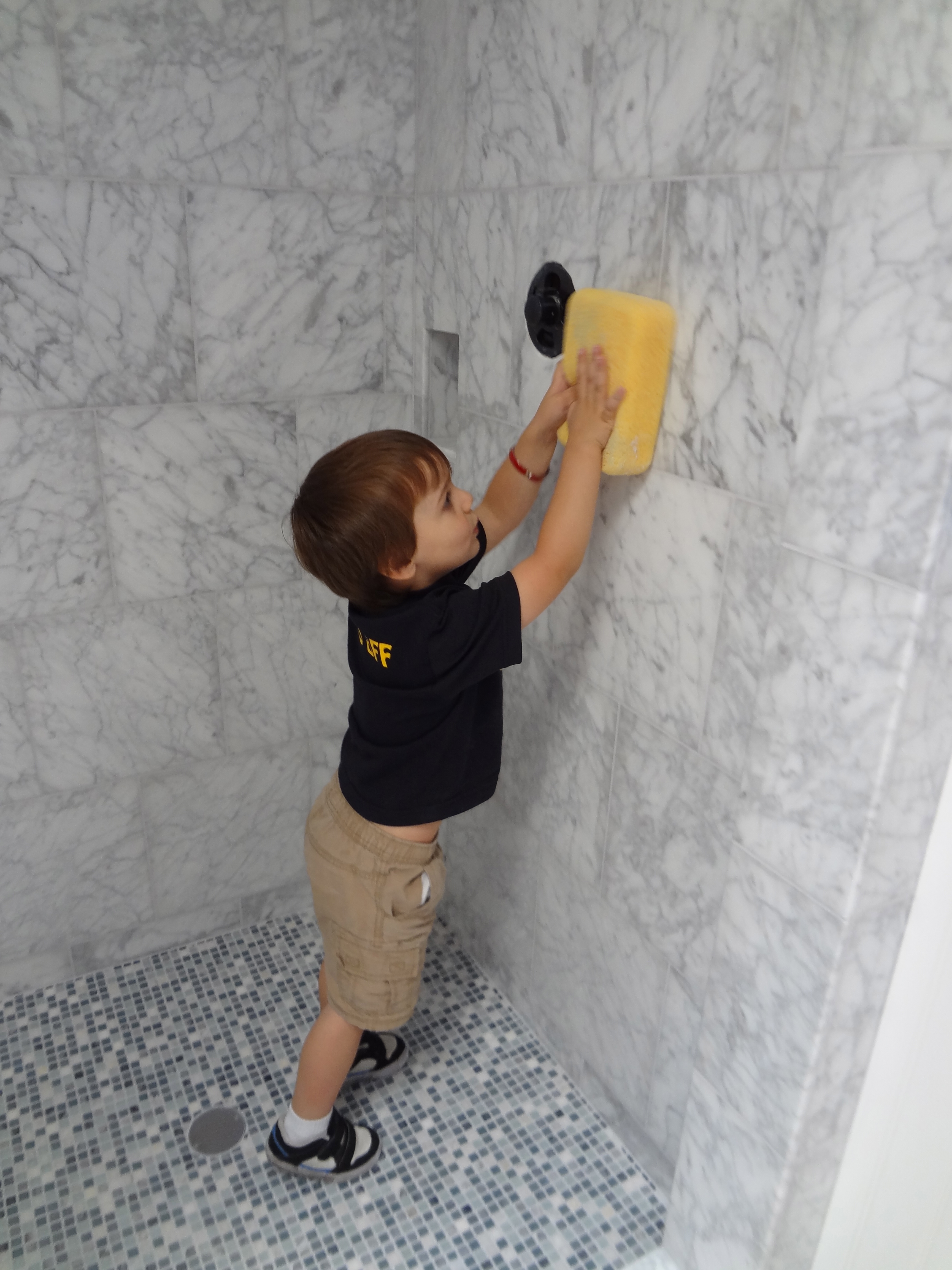
Marley (age 3) helping apply grout in a marble-tiled shower, showing how even the smallest hands can be part of the process—while highlighting epoxy grout’s durability and easy cleanup.
Common Questions
Can I use epoxy grout over existing cement grout during a regrout?
No. Epoxy grout requires a clean, prepared joint to bond correctly — it can't be applied over existing grout. Regrouting with epoxy means grinding or routing out the existing grout to the appropriate depth first, then applying epoxy to the cleaned joint. This is more labor-intensive than a standard regrout, but the result is a joint that will likely never need to be done again.
What colors does epoxy grout come in?
Broad selection — most major manufacturers offer 30–50 standard colors, including whites, grays, beiges, and darker tones. Our default on many Toupin projects is Laticrete 23 Antique White — a warm off-white that reads as clean without the stark brightness of a true white that shows every shadow. Color accuracy in epoxy tends to be very consistent batch-to-batch because the pigment is chemically bound rather than surface-applied.
How much more does epoxy grout cost than cement grout?
Material cost is roughly 3–5x higher per pound than cement grout. Labor cost is also higher — epoxy installation takes more time and requires a more experienced setter. On a typical East Bay bathroom shower, the upgrade from cement to epoxy grout adds approximately $300–$600 to the total project cost. Against the alternative — resealing cement grout every year or two, or dealing with a grout failure that allows water behind the tile — that premium pays for itself within a few years for most homeowners.
Can epoxy grout crack?
Rarely, and almost never from the grout itself. Epoxy doesn't shrink during cure the way cement does, and it bonds so strongly to the tile and substrate that it moves with the installation rather than separating from it. If cracking occurs in epoxy-grouted tile, the cause is almost always in the substrate — subfloor deflection, improper tile adhesive coverage, or a movement joint that should have been installed and wasn't. Fix the substrate problem, not the grout.
Why don't more contractors use epoxy grout if it's so much better?
Honest answer: because it's harder to install and most contractors prefer to work with materials they know well. Cement and urethane grout are more forgiving, have a longer working time, and are easier to clean up. A skilled epoxy installation requires experience that most tile setters develop only through dedicated practice and — usually — some version of the footprint incident I described above. We use it because Adan has mastered it and we've built our installation process around it. Not every contractor has made that investment.
Keep Reading
Tile work that's built to outlast the grout conversation.
Adan has been setting tile with epoxy grout at Toupin Construction since 2000. If you're remodeling a kitchen, bathroom, or shower across Walnut Creek, Rossmoor, Alamo, Danville, or Lafayette — this is the standard we bring to every job.
Schedule a Consultation See Our Tile Work
Toupin Construction
Ready to start your remodel?
Whether you're dreaming of a new kitchen, a spa-worthy bathroom, or a whole-home transformation — we’d love to hear about your project. Reach out and let's talk.
‹ Back
Comments