


By using our website, you agree to the use of cookies as described in our Cookie Policy
Blog
Open Concept in a Condo: What Actually Works (and What the HOA Will Never Let You Do)
Shared walls change everything. Here's what 40 years of condo remodeling has taught us about getting the open feel without the headaches.
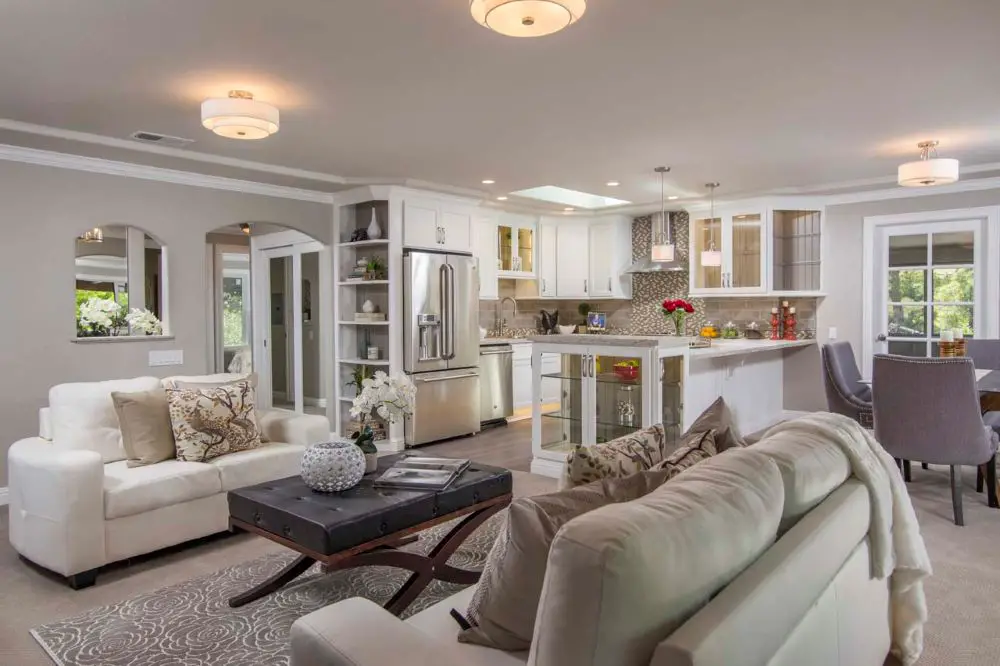
Open-concept living room and kitchen remodel in Walnut Creek Rossmoor with white cabinetry, recessed lighting, neutral furnishings, and seamless indoor flow.
We had a client call us not long ago — lovely couple in a Rossmoor condo — who had already drawn up their own floor plan. They'd pulled out a load-bearing wall in their sketch, relocated the kitchen plumbing, and knocked through what was very much a fire-rated shared wall. On paper it looked beautiful. In reality, three of those four moves were not happening.
That call is pretty representative of what we see all the time: people who want open concept (totally reasonable — it's genuinely great) but who don't yet know that condos play by a completely different set of rules than single-family homes. The walls in your condo aren't just yours. And the HOA isn't just being difficult.
Here's what actually works — and how we've helped condo owners in Walnut Creek, Rossmoor, and across the East Bay get the open, airy feel they're after without the fines, the failed inspections, or the neighbor complaints.
Why Condos Are a Different Animal
In a single-family home, most interior walls exist purely to divide space. You can remove a lot of them — with permits and engineering review — without impacting anyone but yourself. In a condo, those same walls might be doing four other jobs at once:
- Supporting the floor or ceiling of the unit above you
- Acting as a fire barrier between your unit and your neighbor's
- Housing shared plumbing, electrical, or HVAC systems
- Providing the sound insulation that keeps your neighbor from hearing your 6am coffee grinder
Changes in one unit ripple through the whole building. That's why HOAs have rules, that's why permits matter, and that's why a contractor who does condos well is worth their weight in gold.
Trade Term: Party Wall
A "party wall" is the wall you share with a neighboring unit — not a fun party, unfortunately. It's called that because both parties (you and your neighbor) have legal stake in it. These walls are almost always structural and fire-rated, which means they're essentially off limits for removal or significant alteration.
Know Your Walls Before You Dream About Removing One
Step one in any condo remodel conversation is understanding what kind of walls you're working with. We walk every client through this before we talk design. Here's the breakdown:
⛔ Almost Never Removable
Shared (Party) Walls
Separates your unit from your neighbor's. Nearly always structural, fire-rated, and contains shared utilities. HOAs universally restrict these.
⛔ Rarely Approved
Exterior Walls
Technically yours, but structurally part of the building. Insulated, weather-rated, and regulated. Changes like new window openings almost always require HOA approval plus permits.
✓ Best Candidates
Interior Non-Load-Bearing Walls
These separate rooms within your own unit and don't support the structure above. These are your best shot — but still require confirmation from a structural engineer before anything gets touched.
That last point is worth underlining: a wall looking non-structural is not the same as it being non-structural. We've opened walls that looked completely innocent and found beam pockets, electrical panels, and plumbing runs inside. Engineering review isn't optional — it's how we protect you.
Trade Term: Load-Bearing Wall
A load-bearing wall carries the weight of the structure above it — think floors, ceilings, sometimes the roof — down to the foundation. Remove one without proper support, and that weight has to go somewhere. Usually, that somewhere is bad. A structural engineer can tell you definitively which walls are load-bearing and what it would take (beams, posts, permits) to remove them safely.
The HOA Approval Process: What to Expect
HOAs have a reputation for being the enemy of fun. In reality, most HOA restrictions exist to protect the building and everyone in it — including you. The approval process for structural changes typically requires:
Typical HOA Requirements for Wall Changes
- Architectural review application (submitted before any work begins)
- Structural engineer's report confirming wall type and plan
- Detailed drawings of existing and proposed layout
- Licensed and insured contractor — no handymen, no unlicensed crews
- Proof of permits from the city or county
- Noise and work-hour compliance (yes, they care when your guys show up)
Some HOAs also restrict plumbing relocation, hard surface flooring, and even how debris gets removed from the building. In Rossmoor specifically, you're dealing with two layers of approval — both the Mutual board and the city of Walnut Creek — which means timelines are longer and documentation needs to be airtight. We've covered this in more depth in Double the Oversight: Rossmoor vs. Walnut Creek Inspections.
The contractors who struggle with HOA approvals are usually the ones who show up without documentation, use unlicensed subs, or try to get work done before approvals are finalized. We've been navigating these approval processes for decades. It's not as scary as it sounds — it's just process.
"Full open concept is rarely the right move in a condo. But condo-friendly open concept? That's where the magic happens."
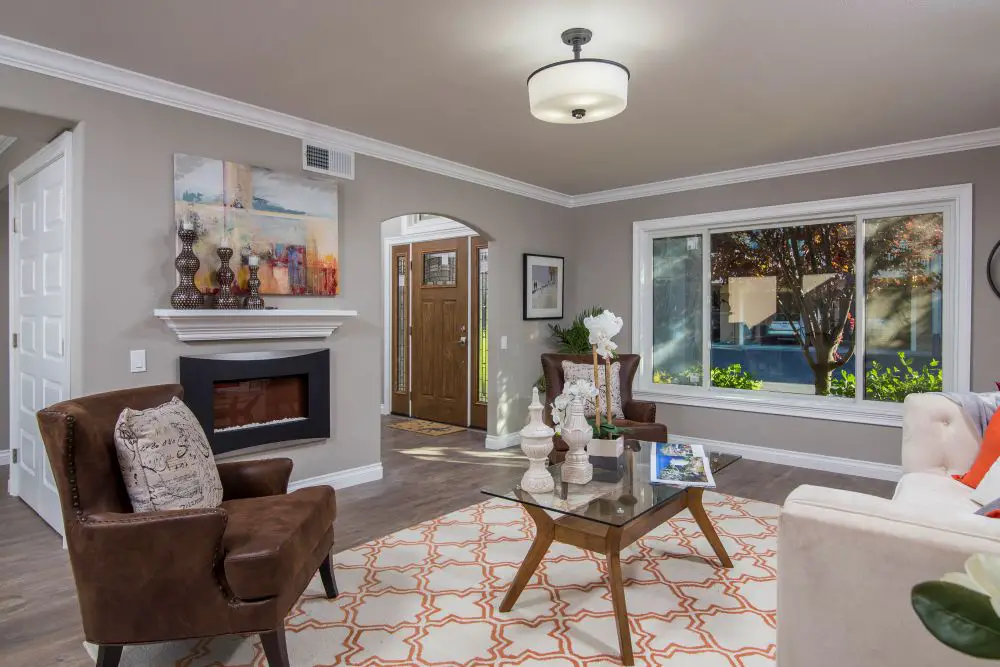 Bright Rossmoor living room in Walnut Creek featuring a modern fireplace, large picture window with natural light, neutral tones, and contemporary staging.
The Real Play: Partial Openness
Here's something we tell almost every condo client: you don't need to remove a wall to get the open concept feeling. You need to change how the spaces relate to each other. There's a meaningful difference.
These are the approaches that consistently deliver — without triggering HOA review boards or structural engineers:
Wide Cased Openings
Widening a doorway from a standard 36 inches to 60 or even 72 inches changes the entire sightline of a room. It's technically a "doorway," but to the eye, it reads as open. This is one of the first things we look at on any condo layout.
Trade Term: Cased Opening
A cased opening is a doorway — or a wider wall opening — finished with trim (called "casing") instead of a door. The trim frames the opening and makes it feel intentional rather than unfinished. You get the flow of an open plan without actually removing the structural capacity of the wall.
Pass-Throughs
Cut an opening in the wall between your kitchen and living room — not to the floor, but from counter height up. You get light, connection, and conversation. The wall stays structurally intact below, which makes this much more HOA-friendly. Think bar ledge, not wall removal.
Half Walls
Sometimes called a "pony wall" — a wall that's reduced to about 42 inches tall instead of full height. You maintain the visual separation (great for sound and cooking smells) while completely opening the sightline above it.
Interior Windows and Glass Panels
This is one of our favorite tricks in condos. Cut a window opening into an interior wall, fill it with fixed glass or even operable windows, and you've let light travel between rooms without removing a thing. Walls stay intact, sound is softened, and the visual effect is genuinely dramatic.
How Layout and Finishes Create Flow (Without Touching Walls)
Open concept is as much about how spaces relate visually as it is about physical openings. A few smart finish choices can make a compartmentalized condo feel dramatically more connected:
| Strategy | What It Does | HOA Approval Needed? |
|---|---|---|
| Continuous flooring (same material, same direction) | Visually connects rooms; the eye reads it as one space | Sometimes (hard surfaces often restricted) |
| Matching cabinet heights across spaces | Creates cohesion and reduces visual clutter | Usually not |
| Unified color palette across walls and trim | Eliminates the "room to room" effect; spaces blur together naturally | Usually not |
| Peninsula instead of wall | Creates separation AND connection; adds storage and seating | Depends on plumbing |
| Removing upper cabinets on one side | Opens sightlines over the counter dramatically | Rarely required |
We talk about kitchen layout strategy in a lot more depth in Understanding Kitchen Zones — it's worth a read if you're rethinking your kitchen layout in a condo context.
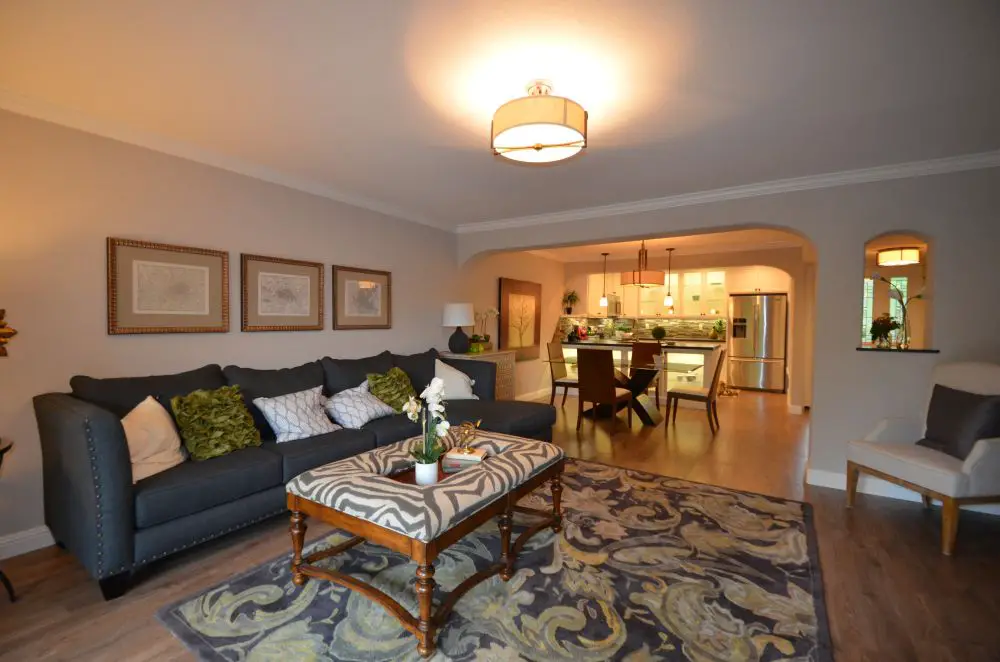 Open-concept Rossmoor living room flowing into kitchen and dining area, featuring warm lighting, neutral walls, and staged seating for a cozy, connected layout.
Sound Control: The Thing Nobody Thinks About Until It's Too Late
Open concept and condos have a tension that doesn't get talked about enough: the more open you make a space, the more sound travels. In a single-family home, that's usually fine. In a condo, you're managing your noise exposure and your neighbors'.
Before you open anything up, have a sound strategy. These are the approaches that work:
Acoustic underlayment under hard flooring
Area rugs and upholstered furniture (they absorb a lot)
Solid-core interior doors (hollow-core is basically cardboard)
Sound-rated drywall where walls remain
Window treatments on exterior walls
Soft furnishings in the living zone
Trade Term: Acoustic Underlayment
Acoustic underlayment is a layer of material — usually foam, cork, or rubber — installed between your subfloor and your finished flooring. It absorbs impact sound (footsteps, dropped items) before it transfers to the unit below. In condos, this is often required by the HOA before any hard surface flooring gets installed. It's one of the first things we spec on condo jobs.
Don't Trade Storage for the Trend
This one surprises people. When you open up a condo, you often lose wall space — and wall space is where storage lives. Before we touch anything structural, we ask our clients: where does everything currently stored in this space actually go?
The honest answer is usually: we hadn't thought about that yet.
Smart storage solutions for condo open concept projects include:
- Built-in cabinetry on the walls you keep
- Taller upper cabinets going to ceiling height
- Peninsula or island with integrated storage on both sides
- Refacing and reconfiguring existing cabinets rather than removing them
Sometimes the right move is to rethink storage rather than walls. We have a whole post on when a kitchen reface makes more sense than a full remodel — condo kitchens come up a lot in that conversation.
Fire Ratings: The Non-Negotiable
Some walls in your condo aren't just structural — they're fire barriers. Their job is to contain a fire in one unit long enough for people to get out of the building. Removing or significantly altering them isn't just an HOA problem; it's a building code problem and a life safety problem.
Even partial changes to fire-rated walls may require fire-rated drywall assemblies, specific fastening schedules, and inspection sign-offs. This is one of those areas where we've seen homeowners get into real trouble by working with contractors who didn't flag it. Shortcuts here have consequences that go well beyond a failed inspection.
We cover why working with properly insured and licensed contractors matters in Why You Should Hire an Insured Remodeling Company. For condo work specifically, it's not optional.
When Open Concept Isn't the Right Answer
We're pro-open-concept when it fits. But we're also honest, and sometimes it just doesn't.
Open concept may not serve you well if:
- You work from home and need acoustic separation
- Cooking smells are a concern (open kitchens let everything travel)
- Storage is already tight and you can't afford to lose wall space
- Your HOA restrictions are strict enough to make it not worth the process
- The condo already flows reasonably well — sometimes lighting, finishes, and layout refinement does more than demolition ever could
A good contractor tells you this. A contractor who only wants to sell you a project won't.
The Mindset Shift That Changes Everything
The best condo projects we've done all started with the same question — and it wasn't "how do we remove this wall?" It was: "how do we make this space feel the way you want it to feel?"
Sometimes that leads to wall removal. Sometimes it leads to a peninsula, a wider doorway, a new flooring run, and paint colors that tie it all together. Either way, when you start from what the space needs rather than what trend you're chasing, the result is almost always better.
We've been doing this in condos across Rossmoor, Walnut Creek, and the East Bay for over 40 years. We know the HOA processes. We know the Mutual boards. We know what gets approved and what doesn't — and we know how to design something that works beautifully within those constraints instead of fighting them.
If you're thinking about opening up your condo, let's talk through it. No obligation — just an honest conversation about what's possible for your specific unit.
Ready to See What Your Condo Could Be?
We've navigated HOA approvals, shared walls, and condo-specific remodels across the East Bay for decades. Let's find out what's actually possible in your space.
925-937-4200Toupin Construction · CA Lic #626819 · Walnut Creek, CA
Toupin Construction
Ready to start your remodel?
Whether you're dreaming of a new kitchen, a spa-worthy bathroom, or a whole-home transformation — we’d love to hear about your project. Reach out and let's talk.
‹ Back
Comments